


I went to Epirus expecting a simple trade: mountains first, beaches later, with Ioannina as an easy base in the middle. What I got instead was a region that kept changing tone on me, sometimes within the same day. One moment I was drinking coffee along Lake Pamvotis with a university-city buzz in the background, the next I was on a switchback road headed into Zagori’s stone villages, and a couple days later I was watching boats idle over turquoise water in Syvota like I had accidentally crossed into an island. Epirus is not one trip. It is several distinct trips stitched together by highways, hairpin passes, and a lot of very good food.
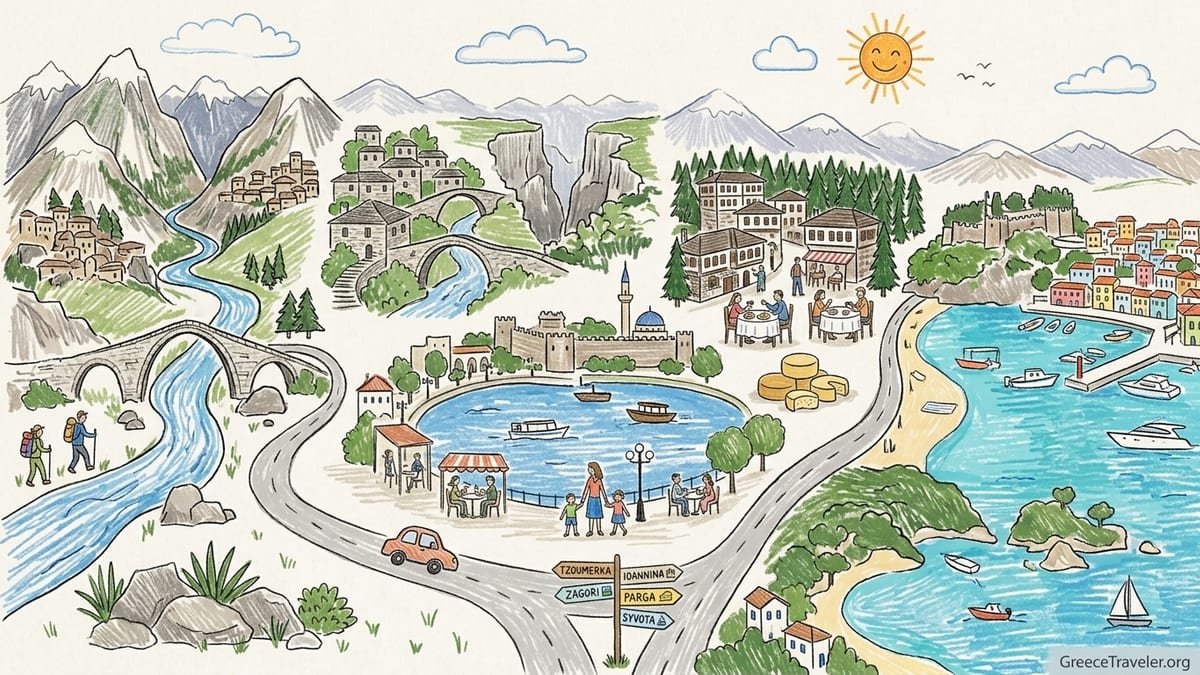
Why Epirus Works Best As Several Mini-Trips, Not One Base
Before I got there, I made the classic mistake: I treated Epirus like one destination where you pick a “best base” and do day trips. Then I looked at how Greece’s official tourism guide splits Epirus into separate experiences: Ioannina, Zagori, Metsovo, Tzoumerka, Parga, Preveza, and Syvota. That separation is not marketing fluff. It reflects how different the landscapes, logistics, and even the pacing feel once you are on the ground.
Ioannina is a proper city break with museums, lakeside walks, and an evening food scene that stays lively outside peak summer. Zagori and Vikos are a hiking and scenery trip that rewards early mornings and slow drives. Metsovo is a mountain stop where you show up hungry and leave with cheese. Tzoumerka is wilder and more remote, the kind of place where you carry snacks and keep your fuel tank above half. Then the coast (Parga and Syvota, plus nearby Preveza) shifts you into beach mode with boat rentals, seaside dinners, and traffic that spikes hard in July and August.
If I were planning it again, I would build Epirus as two or three bases, not one. One base in Ioannina for the lake and museums plus a Zagori push. One base either in Metsovo (if your priority is mountain food and cooler nights) or in the Tzoumerka villages (if your priority is rivers and solitude). And one base on the coast, either Parga for postcard vibes or Syvota if you want to be on a boat every day.
Ioannina: The Lakefront Arrival That Made Me Slow Down
I arrived into Ioannina the way I now recommend for most travelers: treat it like a “real” destination, not just a sleep-and-drive hub. The first thing that surprised me was the atmosphere. Around the lake, it felt local and lived-in, with evening strolls, cafés doing steady business, and just enough visitors to keep it animated without turning it into a theme park.
I stayed within walking distance of the lakefront, choosing a small, modern city hotel because I wanted parking and easy evenings out. That choice paid off. In Ioannina, what makes the city memorable is not one single monument, but the rhythm: coffee by the water, a late afternoon loop along the promenade, then dinner that runs long. I built my days around walking, not driving, and it made the whole region feel less frantic.
For a first-time visit, I would prioritize the castle area and the lake itself. The castle complex gives you that “layers of history” feeling Ioannina does so well, and it is easy to combine it with museums if you care about context. The most memorable micro-moment for me was an unplanned one: sitting by the lake as the light changed, watching families and couples do their evening circuit while the city noise softened behind them. That is when Ioannina stopped being a base and became the emotional anchor of the trip.
Time allocation now: I would give Ioannina two nights minimum, three if you want museums and leisurely meals. It suits food-focused travelers, couples who like city walks, slow travel, and anyone who wants to buffer the more demanding mountain drives with a place that has amenities, pharmacies, supermarkets, and a reliable evening scene.
Zagori And Vikos Gorge: The Day My Itinerary Got Rewritten
Zagori hit me like a plot twist. One drive out of Ioannina and the scenery turns to stone villages, arched bridges, and the kind of mountain light that makes you pull over without thinking. The region is often described as a network of villages, and that is accurate, but what matters in practice is how spread out everything is. Distances on the map look modest. In real time, you are dealing with narrow roads, stops for viewpoints, and slow village approaches that make a “quick” loop feel rushed.
I based myself in the Zagori area for a couple nights, choosing a traditional-style guesthouse in a stone village (the kind of place where breakfast is set out with local pies and you can hear footsteps in the lane outside). The atmosphere at night was exactly what I wanted after Ioannina: darker skies, quieter streets, and that deep mountain calm. Crowds were concentrated in the obvious spots during the day, but evenings were peaceful, especially once day-trippers drove back toward the city.
Vikos Gorge is the name that pulls people in, and it deserves the hype if you match it to your fitness and logistics. What stayed with me was not a single viewpoint photo, but the feeling of scale once you commit to being there in person. Even if you are not doing the full hike, plan at least one proper half day where you are not checking your watch. For hiking-oriented travelers, this is where Epirus becomes a serious outdoors trip, not just “pretty villages.”
Time allocation now: two nights in Zagori if you want a taste, three nights if hiking is a priority. It suits hikers, photographers, and road trippers who like slow scenic driving and don’t mind planning around trailheads and daylight. It is less ideal for travelers who want easy public transport only; you can do some visits without a car, but a car makes the whole region exponentially easier.
Metsovo: The Mountain Stop Where Food Is The Attraction
Metsovo was the stop I almost skipped because, on paper, it looked like a quick detour. In practice, it became one of the most satisfying breaks in the entire route. The arrival is part of the charm: as you climb, the air cools, the architecture changes, and suddenly you are in a town that feels built around mountain tradition rather than coastal seasonality.
I stayed one night in Metsovo in a cozy mountain hotel, the kind that leans into warm interiors and quiet evenings. What I remember most is how easy it was to have a complete “Metsovo day” without needing a checklist. I wandered, ate slowly, and let the town set the pace. If Ioannina is about lakefront strolls and city energy, Metsovo is about sitting down, ordering something hearty, and not rushing off.
Food-wise, Metsovo is where my Epirus trip turned into a deliberate eating trip. This is a place where you can build an itinerary around dinner and not feel guilty about it. I focused on the simplest goal: pick a traditional taverna, order local specialties and grilled meats, and give yourself time. It was also the place where I started buying edible souvenirs seriously: cheese for the cooler bag, local products you can actually use when you get home, not just decorative jars.
Time allocation now: one night if you are on a road trip, two nights if you want to relax and hike lightly nearby. It suits food lovers, couples who want a cozy mountain interlude, and travelers doing a mainland road trip who want a rewarding stop between bigger moves.
Tzoumerka: The Wild Card That Felt Like “Real” Epirus
Tzoumerka was the most demanding part of my Epirus trip and the one that felt the most “earned.” The landscape has a rugged, almost untamed quality, with steep slopes and river valleys that make distances feel longer than they look. If Zagori is dramatic in a polished, iconic way, Tzoumerka feels rawer. It is less about famous viewpoints and more about being inside the mountains.
I stayed in a small guesthouse in a village setting, specifically because I wanted that feeling of being embedded in the landscape. Nights were quiet. Mornings started earlier, partly because there is less to do in the village itself and partly because the best experiences involve driving out to rivers, bridges, and trail starts before the day warms up. This is where having a car is not optional in the practical sense. You can attempt pieces without one, but you will spend too much time negotiating taxis and schedules.
The most memorable part of Tzoumerka for me was the sense of discovery on the road itself. In other parts of Greece, the drive is just transit. Here, the drive was the experience. There were moments when I pulled over just to listen to the river, to take in a ridge line, or to sit with a coffee from a roadside stop. It also tested my expectations: I had assumed I would “do” Tzoumerka quickly. Instead I realized it rewards staying put, because the scenery is not a single stop, it is a whole environment.
Time allocation now: two nights minimum, three if you want a relaxed rhythm. It suits road trippers, hikers who want fewer crowds than Zagori, and travelers who like remote, nature-first destinations. It is less ideal for anyone who wants a nightlife scene or easy, structured sightseeing.
Parga And Syvota: Two Coastal Moods, One Summer Reality Check
When I finally dropped to the Ionian side, Parga felt like I had arrived in a different country’s vacation. The town has that amphitheater layout above the water that makes you keep stopping to look back at it. The atmosphere is unapologetically holiday-focused, especially in peak season, and that can be either exactly what you want or not your style at all. For me, it worked best as a short, high-impact stop: arrive, walk the waterfront, swim, eat well, and accept that it is popular for a reason.
I stayed in Parga close enough to walk into town, but far enough that I could sleep without hearing late-night foot traffic. That trade-off mattered in summer. Crowds concentrate on the waterfront in the evening, and parking can be the trip’s hidden stress. The moment that made Parga click for me was a simple one: an early swim before the day trippers fully arrived, when the bay felt calm and the town looked freshly lit rather than busy.
Syvota, on the other hand, is the stop that changed my coastal plans completely. It is smaller and more “boat-centric,” and the famous experience here is not just a beach day, but a day of hopping between coves and islets. If you are comfortable renting a small boat or joining a short cruise, Syvota can deliver that island-water color without actually taking a ferry to an island. I saw rental operators advertising small boats with rates starting around the €60 range plus fuel, which made a half-day on the water feel achievable if you split it with a partner or friends.
Time allocation now: for Parga, two nights if you want the full evening atmosphere and a beach day. For Syvota, two or three nights if you want at least one boat day plus a slower beach day. These destinations suit beach travelers, couples, and anyone building a summer trip around swimming and sunsets. They are less impressive if you arrive expecting solitude in July or August; the most practical way to “beat” the crowds is to swim early, eat later, and plan boat time outside the midday rush.
Planning Helpers That Actually Matter: Preveza, Acheron, Arta, Dodona
Some Epirus stops are not “must-sees” in a vacuum, but they make the trip work better. Preveza is one of them. It is useful as a logistics node near the coast, especially if you are thinking about airport access and a flatter, easier pacing after mountain roads. I used it as a practical reset: a place to do errands, have a straightforward seaside meal, and position for beach time without threading through mountain roads again.
Acheron is the day I would recommend to anyone who wants a nature experience that is not a full-on mountain hike. It is the kind of place that can be family-friendly in parts, adventurous in others, and it is a smart add-on if you are staying around Parga or Syvota and want a change from saltwater. I treated it like a half-day that turned into a full day because it was simply pleasant to linger, especially if you time it outside the hottest hours.
Arta surprised me as a history-and-city-life add-on that feels authentic rather than curated. It is not the kind of stop where you need a packed itinerary. What it offered was a different texture: a lived-in provincial city with famous landmarks, including the legendary bridge, plus Byzantine-era sights that reward a slower, curious afternoon. It is also a helpful southern anchor if you are road-tripping across the region and want to break up drives.
Dodona was the most purely “history” stop of my trip and the easiest to slot in from Ioannina if you have a car. What mattered most to me was pairing it with the right expectations: go early, bring water, and treat it as a focused visit, not a full-day complex. It is memorable precisely because it sits in a natural setting that makes the site feel less like a museum piece and more like something integrated into the landscape.
The Takeaway
If Epirus changed my trip, it was because it forced me to stop chasing the idea of a single perfect base. Ioannina gave me the pacing I needed and turned out to be a destination in its own right. Zagori and Vikos delivered the iconic mountain drama I came for, but only once I stopped trying to compress it into a rushed day trip. Metsovo added warmth, appetite, and a sense of mountain culture that felt immediate, not staged. Tzoumerka gave me the raw, remote version of Epirus I did not know I needed. And on the coast, Parga and Syvota proved that “beach time” in Epirus comes in two distinct styles: postcard-town evenings or boat-and-cove days.
If you want a simple rule: split Epirus into city, mountains, and coast, and commit at least two nights to each section that matters to you. That is how the stops stop being checkboxes and start becoming the moments you remember on the flight home.
FAQ
Q1. How many days do I need in Epirus for a first trip?
Plan about 7 to 10 days to cover Ioannina, Zagori or Vikos, one mountain stop like Metsovo or Tzoumerka, and at least one coastal base such as Parga or Syvota.
Q2. Is Ioannina worth staying overnight, or should I day-trip it?
It is worth at least two nights for the lakefront atmosphere, castle area, museums, and evening food scene without rushing.
Q3. Can I visit Zagori and Vikos Gorge without a car?
You can visit parts with tours or careful planning, but a car is the most practical way to reach villages, viewpoints, and trailheads efficiently.
Q4. Which is better for hikers: Zagori or Tzoumerka?
Zagori is the classic choice with well-known routes around Vikos, while Tzoumerka feels wilder and more remote, often with fewer crowds and more driving between points.
Q5. Where should I stay if I want beaches but also day trips?
Parga is great if you want a lively town base, while Syvota is better if you want to spend time on boats and explore coves and islets.
Q6. Is Metsovo a good stop year-round?
Yes, it works well beyond summer because it is a mountain town where food, atmosphere, and cooler weather are part of the appeal, though winter conditions can affect high roads.
Q7. What is the most romantic stop in Epirus for couples?
Ioannina for evening lake walks and dining, plus either a stone-village stay in Zagori or a coastal sunset base in Parga depending on whether you prefer mountains or sea.
Q8. What is the easiest Epirus itinerary for slow travel?
Do three bases: Ioannina (city and nearby history), Zagori (villages and hikes), and Syvota or Parga (beach days), spending at least two or three nights in each.
Q9. Are Dodona and Arta worth adding if I am short on time?
Dodona is the easier add from Ioannina for a focused history visit, while Arta is best if your route already takes you south and you want Byzantine sights and a more local city feel.
Q10. What is one practical tip that will improve an Epirus road trip?
Avoid overpacking days: in the mountains, short distances can take longer than expected, so pick fewer stops and leave time for viewpoints, meals, and unplanned pauses.