


I arrived in the village of Toxotes on a cool September morning, backpack over one shoulder and that mix of nerves and excitement that always comes before stepping into a river gorge I have only ever traced with my finger on a map. The Nestos had been a snaking green line on my screen for months, but that morning the famous meanders near Xanthi were very real, hidden somewhere between the wooded hills and limestone cliffs rising beyond the railway tracks.
Meeting Riverland in Toxotes
My Nestos experience began at the Riverland outdoor activities base in Toxotes, a small village on the eastern bank of the river about half an hour’s drive from Xanthi. Riverland is one of the best-known local operators focusing on canoe and kayak trips through the Nestos Gorge, as well as hiking, rafting and other nature activities in the wider region. Their base sits near the railway station, a reminder that the same line which clings dramatically to the cliffs above the gorge also brings weekend visitors from Thessaloniki and Alexandroupoli.
The trip I joined was Riverland’s long canoe kayak route through the famous Straits of Nestos, starting from Stavroupoli and finishing at the river beach of Galani near Toxotes. The route covers about 22 kilometers of river, with around 4 hours of net paddling over a day that lasts 7 to 8 hours including transfers and breaks. At the time of my visit in September 2025, the advertised price was about 75 euros per person, with a minimum age of 6 years, which included the guides, boat, paddles, buoyancy aids, transport to the put-in, picnic-style snacks, and digital photos from the day.
Our group ended up being 10 people plus two guides: a Greek family with older children, a couple from Germany on a road trip, two friends from Athens, and myself. It was a good size: small enough that the guides could keep an eye on everyone, big enough that you never felt alone in the wide river bends. After signing the usual liability waivers and confirming emergency contacts, we were handed lightweight life jackets and dry barrels for phones and small personal items. Riverland provided neoprene tops and river shoes for anyone who did not have their own, which turned out to be important once I felt how cold the Nestos can be outside the peak of summer.
Transfer to Stavroupoli and Safety Briefing
By 9:15 we were all in Riverland’s minibus heading north along the valley road to Stavroupoli, about a 50 minute drive following the general course of the river. The morning light picked out the folds of the Rodopi mountains and the first hints of autumn color in the plane and poplar trees. Occasionally the bus crossed the railway line that would later appear far above us on ledges carved into the limestone cliffs. The guides used the drive to talk about the Nestos: its role as a natural border in history, the protected riparian forest, and the way the river has shaped the deep meanders between Stavroupoli and Toxotes.
At a gravel pull-out close to the riverbank upstream of Stavroupoli, we stepped down into the crisp air. The water was clearer than I expected, olive green in the deeper pools and tea-colored near the shore. While one guide unloaded the open, two-seater kayaks from the trailer, the other delivered the safety briefing. He went through how to adjust our buoyancy aids so they sat firmly on the chest, how to hold the paddle to reduce strain on the wrists and shoulders, and what to do in the unlikely event of capsizing. The Nestos on this route is class I to II, with mostly gentle current and some faster-moving sections around tight bends, but no technical whitewater. Nevertheless, we practiced wet exits on the gravel bar and learned how to float feet-first if we ended up in the current.
The boats were stable sit-on-top kayaks rather than enclosed river kayaks, a deliberate choice for this style of touring trip. They were wide and forgiving, easy for beginners to control after a few minutes of instruction. The life jackets were river-specific buoyancy aids with around 50 newtons of flotation, snug without restricting arm movement. I shared a kayak with one of the Greek participants, trading the front and back positions halfway through the day so both of us could test steering in the rear.
Into the First Meanders of the Nestos Gorge
We slid the kayaks into the river just before 11:00. The current immediately took hold, gentle but insistent, and within the first five minutes the road and village noise had fallen away behind the trees. The first section north of Stavroupoli eased us into the rhythm of paddling. The riverbanks were lush, with dense riparian forest of willows, alders and tall plane trees forming a leafy tunnel. Kingfishers flashed ahead of us in electric blue streaks, while herons lifted lazily from the shallows as our flotilla approached.
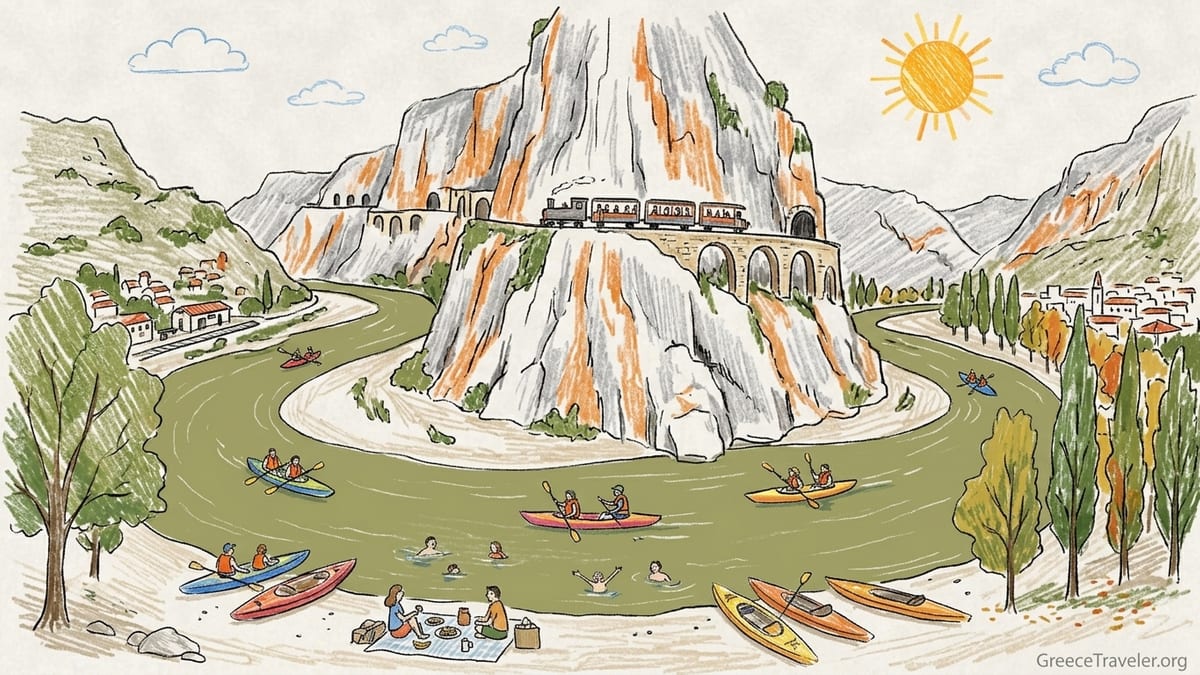
It took about half an hour for the gorge to start revealing itself in full. The hills rose more steeply, giving way to sheer limestone walls streaked with orange and gray, sometimes dropping directly into the water. Here the famous Nestos meanders start to assert their character, swinging in tight, horseshoe-shaped curves that force the river to constantly change direction. From water level you cannot always see the full shape of each bend, but you feel it in the way the current pulls you towards the outside wall and then settles again in a quieter pool on the inside.
Our guide kept reminding us to look up, and suddenly above one of these bends the railway line appeared as a scratch across the cliffs. There were old stone arch bridges and galleries cut into the rock, relics of early 20th century engineering that somehow manage to look as if they have always been there. Several times during the day we heard a train passing high above us and caught glimpses of carriages sliding along the narrow shelf between sky and limestone, passengers likely craning to look down at our bright kayaks below.
Gentle Sections Versus More Demanding Routes
The Stavroupoli to Galani route is rightly promoted as accessible for beginners, yet it would be misleading to describe the entire Nestos as uniformly easy. The section we paddled through the Straits of Nestos is mostly gentle, but it still requires steady work with the paddle, attention to the current, and a basic level of physical fitness. We were on the water for close to four hours of active paddling broken by two longer breaks, and by the third hour I could feel it in my shoulders and lower back.
Our guide explained that north of Stavroupoli, closer to Platanovrisi and the dam lake, there are routes with a significantly higher difficulty level. Those trips, often described in regional tourism documents and operator programs, can reach level 3 in terms of river classification, with stronger currents and, at certain times of year, waves suitable for rafting rather than relaxed canoeing. On those upper sections the river narrows more and the gradient increases, so quick reactions and better boat control are required.
The notable contrast is important for trip planning. Families with younger children, first-time paddlers and anyone who wants a mostly relaxing meander through dramatic scenery will be happier on the Stavroupoli to Toxotes or Stavroupoli to Galani section. Paddlers with previous river experience or a taste for more excitement might choose itineraries that combine segments of the upper Nestos with downstream stretches, or visit in early spring when water levels are higher. The guides were frank about not overselling the challenge of our particular route, describing it accurately as a long scenic float with pockets of faster water rather than a full-on whitewater adventure.
Swimming, Picnics and How the Day Was Spent
Time easily blurs on the water, but one of the things I appreciated most about this trip was the clear breakdown between paddling and pauses. On our 7 to 8 hour excursion, about four hours were spent actually moving on the river. The rest of the time was taken by the morning transfer, equipment fitting, safety briefing, two major stops and a couple of short regrouping pauses in wide pools.
The first major stop came after roughly an hour and a half of paddling. We beached the kayaks on a gravel bar where the river split briefly around a small vegetated island. The morning sun had burned off the last of the mist, and the air had warmed enough that the idea of a swim no longer felt optimistic. Those of us who braved the water discovered that the Nestos keeps a memory of the mountains even in late summer: sharp cold at first, but refreshing after effort. I wore neoprene socks and a thin top provided by the operator, which made a real difference when re-entering the boat after swimming.
Lunch was simple but satisfying: sandwiches, fresh fruit, local cheese and tomatoes, offered picnic-style on blankets spread over the pebbles. The guides used the time to talk about the protected status of the riparian forest and the birds we might see, including cormorants, egrets and, if we were lucky, raptors circling on thermals above the cliffs. That pause lasted close to 45 minutes before we pushed off again into another sequence of bends.
Later in the afternoon, as fatigue began to creep into the group’s strokes, we stopped once more in a wide, calm section where one of the limestone walls receded and the river widened. Here the current was gentler, and some participants simply floated alongside their kayaks in their life jackets, letting the slow movement of the Nestos carry them. That second break was shorter, around 25 minutes, but it reset the group’s energy for the final stretch towards Galani.
Weather, Water Levels and Less-Than-Perfect Moments
No river trip is entirely idyllic, and our day on the Nestos had its own imperfect edges. The forecast that morning had suggested clear skies with light winds, but by early afternoon thin cloud moved in and the air cooled noticeably when the sun disappeared. On one particularly exposed bend, a gust funneled through the gorge and pushed several kayaks toward the outer wall, forcing the rear paddlers to work hard to correct the course. It was never dangerous, but it was a reminder that even calm-class rivers demand attention.
Late summer also means lower water levels compared with spring, and we felt this in a few shallow riffles where the kayaks scraped briefly over submerged stones before sliding back into deeper channels. The guides navigated us into the main current whenever possible, but we still had one minor grounding where half of the group needed to step out into ankle-deep water and tug their boats a few meters. Riverland had clearly calibrated equipment for such conditions, choosing robust plastic kayaks that could handle contact with rocky shallows without issue.
Equipment comfort is one of those things you only really notice when something is wrong. In this case, the life jackets were in good condition and adjustable, but I did misjudge my personal clothing. Expecting warmer conditions throughout the day, I wore only a light synthetic t-shirt under the buoyancy aid. Once the wind picked up, I felt cold whenever we paused paddling. A thin fleece or long-sleeved quick-dry layer would have made a big difference. On a longer break, I borrowed a spare windproof jacket from the guide, which is the kind of small contingency that good operators keep in their dry bags but travelers should not rely on.
As for group size, ten participants worked well. Anything significantly larger on this route might feel slow to move through the inevitable bottlenecks and landings, especially in low water when suitable landing spots are more limited. The guides mentioned that in high season they sometimes split people into two pods on the river to avoid overcrowding, even if they share the same transport. That kind of management is worth asking about when booking, especially if you prefer a quieter nature experience rather than a floating social event.
Comparing Kayak-Only and Kayak Plus Hiking Experiences
In the days before my trip I spent time comparing Riverland’s different offerings and similar packages from other regional platforms that list their activities. Beyond the full-day kayak tour through the Straits, Riverland also promotes a short kayak tour on the Nestos and several combined hiking and kayaking products in the same general area. The short kayak option runs for about 1.5 hours on the water in the Topeiros area near Galani and is priced at around 25 euros per person. It is designed as an introduction to kayaking, with calm conditions near the river mouth and minimal transfer time.
The combined hiking and kayaking product I considered before choosing the full-day paddle was structured as roughly five hours total, focusing on a moderate hike on the Nestos hillside trails followed by a shorter kayak section. The price point was similar to the long kayak day, around 75 euros, targeting visitors who want to experience both perspectives of the gorge in a single outing. In that format, less time is spent sitting in a boat and more time is dedicated to walking panoramic paths above the river before descending for a shorter paddle.
In terms of value, the full-day kayak offers maximum immersion in the water environment. You feel every bend in the river, sense how the current behaves, and accumulate enough time under the cliffs and along the wooded banks to appreciate slow changes in light and color. The combination hike and kayak, on the other hand, gives a stronger sense of the geographic drama of the meanders, where you can look down on loops of the river from above and trace the line you will later paddle. Travelers who are unsure about spending several hours sitting and paddling may find the mixed activity day more satisfying.
Whichever option you choose, it is important to understand the booking and cancellation rules in advance. At the time of my research, full-day Nestos gorge kayak trips required cancellations at least 72 hours before departure for a full refund, with a 50 percent refund window between 24 and 72 hours and no refunds for last-minute cancellations less than 24 hours in advance. Trips canceled by the operator due to weather, insufficient participation or other operational reasons were refunded in full. Policies can change, so always read the latest terms when reserving.
The Nestos Riverside Trail as a Non-Paddling Alternative
Not everyone in my guesthouse in Xanthi was enthusiastic about getting into a kayak, but several people were very interested in seeing the Nestos meanders. For them, and for travelers on a tighter budget, the riverside hiking trail between Toxotes and the entrance to the Straits offers a compelling alternative. Often called the Nestos Riverside Trail, this path starts near the Galani river beach and loosely follows the left bank upstream, sometimes right by the water, sometimes climbing the slope to viewpoints over the gorge.
Local guides and regional tourism materials describe this trail as an easy to moderate hike rather than a mountaineering route. The first section is nearly flat, ideal for a relaxed riverside stroll among cottonwoods and plane trees, with frequent clearings where you can sit by the water. As you go further towards the narrower parts of the gorge, the path becomes more undulating, with some short, steeper climbs to rocky balconies that look directly down on the most photogenic meanders.
Riverland runs dedicated hiking tours on this path, typically around 1.5 hours for the shorter version, with fees in the region of 15 euros per person when booked as a stand-alone activity. Independent hikers can also access large parts of the trail for free, paying only for their own transport to Toxotes or Galani. For non-paddlers traveling with kayakers, walking a portion of the riverside trail while their friends are on the river is a practical way to share the landscape without sharing the boat.
Experiencing both the river surface by kayak and the river trace from above by foot gave me a fuller appreciation of just how intricate the Nestos gorge really is. From the trail you can see several consecutive loops of the river at once, each carving into the soft rock and rotating direction like a chain of question marks. It also reinforced why strict environmental protections are in place here, since any large-scale development would immediately scar what is now a remarkably cohesive river landscape.
Favorite Moments, Lessons Learned and Ideal Duration
When I think back to that day on the Nestos, the single most vivid image is from a quiet mid-river pause. We had just exited one of the tighter bends, cliffs rising in a semi-circle around us, when the guide asked everyone to stop paddling and let the current do the work. For a minute or two there was only the sound of water slipping along the hulls and the distant call of a bird from the trees high above. A train emerged on the cliff edge, its windows catching the light, and for a few seconds boats, river and railway all moved in parallel before the line disappeared again into a tunnel. That simple alignment of nature and human engineering, viewed from the level of the water, felt like the essence of the Nestos gorge.
In terms of preparation, I made two clear mistakes. The first was underestimating how variable the temperature can feel on a long river day outside of midsummer. Even in September, being wet from paddle drips or a quick swim made me chilly whenever the sun hid behind clouds. Next time I would bring a lightweight synthetic base layer and a compact windproof shell, even if the forecast promised warmth. The second mistake was not stretching properly beforehand. Four hours of mostly continuous paddling is more demanding than a casual lake outing, and my shoulders and hip flexors reminded me of that for a couple of days afterward.
If I had to recommend one activity duration as the best balance of scenery, adventure and value for most visitors, it would be the full-day Stavroupoli to Galani kayak trip I experienced. The long route gives you time to settle into the rhythm of the river, pass beneath the most spectacular limestone walls, and enjoy both swimming and picnic breaks without feeling rushed. For those with limited time or concerns about endurance, the combination hike and kayak day would come a close second, because it layers two complementary viewpoints into a still-manageable half-day window.
What I would not advise is compressing the Nestos to a single 60 to 90 minute taster unless your schedule truly demands it. The meanders and cliffs that make this river special reveal themselves gradually. It takes at least a couple of hours of continuous contact with the river, and ideally more, to feel the Nestos shift from a pleasant paddle into a place that stays with you long after you have left its banks and boarded the train or car back to Xanthi.
FAQ
Q1. Is the Stavroupoli to Galani Nestos kayak route suitable for beginners?
The long Stavroupoli to Galani route is generally suitable for reasonably fit beginners, as it follows class I to II water with no major rapids, but it does involve around four hours of paddling, so some basic fitness and willingness to follow guide instructions are important.
Q2. How much does a full-day Nestos gorge kayak trip cost?
During my research and visit, full-day guided kayak trips through the Nestos Straits with established operators such as Riverland were typically priced around 75 euros per person, including guide, equipment, transport between Toxotes and Stavroupoli, light meals and photos, though travelers should always confirm current prices when booking.
Q3. What is the minimum age for participating in Nestos kayak tours?
For the long Stavroupoli to Galani route, the minimum age was set at 6 years old at the time of my trip, provided children shared a boat with an adult and were comfortable in the water, while shorter and calmer introductory tours near Galani may accept younger participants based on operator policy and conditions.
Q4. How should I prepare physically for a Nestos kayaking day?
Regular walking, light cardio and some upper-body exercise in the weeks before your trip will help, but the most useful preparation is understanding that you will be paddling for several hours and pacing yourself accordingly, maintaining steady, relaxed strokes rather than sprinting in the early sections.
Q5. What clothing and personal gear should I bring?
Pack a synthetic or merino base layer, a light fleece or windproof shell, swimwear, a hat, sunglasses with a strap, sunscreen, a towel, and secure footwear that can get wet, while leaving valuables behind or packing them in the dry containers the operator provides.
Q6. Are there non-kayaking ways to see the Nestos meanders?
Yes, the Nestos riverside trail from the Galani area towards the Straits offers riverside walking and viewpoints above the meanders, and guided hiking tours or independent walks on this path provide a low-cost and low-commitment alternative to being on the water.
Q7. What happens if the weather is bad on the day of my trip?
If conditions are unsafe due to strong winds, heavy rain or sudden changes in river level, reputable operators cancel or reschedule the activity and usually offer a full refund or alternative date, so it is important to check their specific weather and cancellation policy at the time of booking.
Q8. Can I bring a camera or phone on the kayak?
You can bring a camera or phone if it is secured with a lanyard and stored in a waterproof pouch or the dry barrels supplied by the operator, but it is wise to accept that anything you bring onto the river is exposed to splashes and the small risk of immersion.
Q9. Is it possible to do the Nestos gorge without a guide?
Experienced paddlers with their own equipment sometimes explore sections of the river independently, but for most visitors the logistics of shuttles, knowledge of safe access points, and understanding of local regulations make guided trips the more practical and safer choice.
Q10. When is the best time of year to kayak the Nestos meanders?
Late spring through early autumn, roughly May to October, offers the most comfortable combination of air temperature and river conditions, with higher, faster water in spring and warmer, gentler flows in high summer and early autumn, each period giving the gorge a slightly different character.