


I’ve done plenty of “full-day” tours that feel like two rushed visits stitched together by motorway miles. Thessaloniki to Pella and Vergina could easily fall into that category: two major Macedonian sites, a museum at each, and just one day to do it. But this excursion surprised me. It was still a long day, still a lot of archaeology, and yes, the schedule had that familiar tour-company tempo. Yet it also delivered the kind of vivid, specific encounters that stick with you: mosaics you can almost feel under your shoes, a guide who made dynasties readable, and that unforgettable descent into Vergina’s underground royal-tombs museum where the lighting, the silence, and the gold make you whisper without meaning to.
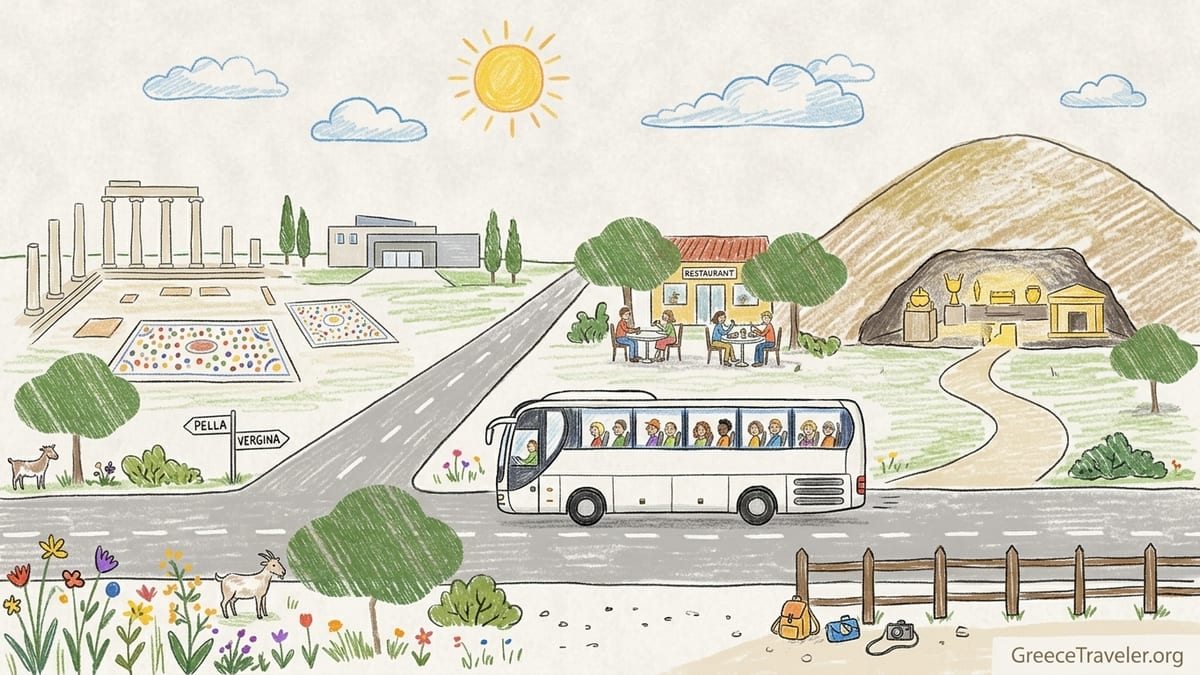
Starting the Day in Thessaloniki: Meeting Point, Group Vibe, and the Bus
My day began in the center of Thessaloniki, not at a hotel lobby. The meeting point was by the Eleftherios Venizelos statue at Aristotelous Square and Egnatia Street, with an 8:00 a.m. departure time. I arrived early enough to grab a takeaway coffee nearby and watch the group assemble: a mix of couples, a few friends traveling together, and solo travelers who, like me, wanted an easy way to see Macedonia’s headline sites without solving rural transport logistics.
The vehicle was a modern, air-conditioned coach rather than a van, the kind tour companies often describe as a “luxury bus.” Seats were comfortable, the ride felt stable, and there was enough overhead storage for day bags. Our guide did the practical briefing right away: restroom expectations, a rough order of stops, and the reminder that entrance fees and lunch were not automatically included on many versions of this tour, depending on who you book with. That matters because site tickets are not token amounts here.
Once we were rolling, the mood shifted quickly from city break to countryside day trip. Thessaloniki thinned into highway and farmland. The guide used the first stretch to set up the historical arc in plain language: Pella as the later capital of the Macedonian kingdom and associated with Alexander the Great’s world, then Aigai in the Vergina area as the earlier royal center where the dynasty buried its dead and staged its power. It was the kind of framing that helped later, when fatigue threatened to turn carved marble into a blur.
The Drive Out: Realistic Timing and What the Morning Feels Like
From Thessaloniki, you are essentially crossing the Macedonian plain. On paper, both Pella and Vergina are “about an hour” away in different directions. In practice, once you factor in urban pickup traffic, tour-coach speed, and the inevitable small pauses, the driving is a meaningful part of the day. I found it helpful to treat the coach time as part of the experience rather than dead time, because it’s when the guide connected the dots and when I could pace myself mentally for two museums.
The guide quality can make or break this itinerary. Ours was strong: clear voice, solid structure, and just enough story to make the names stick. Instead of dumping dates, they worked like a good editor, returning to the same key points until they felt familiar: the Macedonian royal line, why Pella mattered politically, and why Vergina is not “just a tomb” but a carefully presented archaeological and museum experience.
If you are doing this tour between April 1 and October 31, both Pella and Aigai sites operate on extended summer hours, with a later Tuesday opening time. That matters because many tours run on fixed departure days and can land at sites at different times depending on traffic. Knowing that both places can stay open into the evening in summer takes some stress out of the schedule, even though most tours still keep you on a mid-afternoon return trajectory.
Pella: Walking the Ancient Capital, Then Seeing the Mosaics Up Close
Pella was my first major stop. What hit me immediately was how open the landscape feels. You are not entering an “ancient city” in a romantic old-town sense. You are stepping into a broad archaeological area where foundations outline the plan of a wealthy, organized place. For first-timers, that can be disorienting, which is why I’m glad I had a guide narrating what I was looking at: street grids, house footprints, courtyards, and the logic of a capital built for administration as well as status.
The highlight, without question, is the mosaic tradition associated with Pella. In the archaeological area, you can sense how those decorated floors once anchored domestic power. But the real “wow” for me came in the Archaeological Museum of Pella, where the presentation makes it easier to appreciate detail, technique, and iconography without squinting under harsh sun.
In practical terms, the Pella museum’s current posted ticket price is €10, and there is also a unified ticket option listed at €15 that covers the archaeological site, the archaeological museum, and the palace of Pella. Opening hours follow the Ministry of Culture seasonal schedule: in the summer season (April 1 to October 31), it is generally 08:00 to 20:00 with Tuesday opening later (12:00 to 20:00). In winter (November 1 to March 31), it is 08:30 to 15:30 and Tuesday closure applies. The museum also notes last admission roughly 20 minutes before closing and typical holiday closures like January 1, March 25, May 1, Easter Sunday, and December 25 and 26.
Time on the ground is where tours differ, and this is where you should be honest with yourself about pace. Between walking the ruins and doing the museum properly, I felt we had enough time to see Pella, but not enough to linger. I would estimate we had roughly 1.5 to 2.5 hours combined, depending on how long the group needed and whether there was a guided walk plus free time. It was sufficient for a first visit, but if you love ancient urbanism and want to read the site plan slowly, you’ll want more.
Lunch: The Midday Reset That Prevents Archaeology Burnout
Lunch on this route is less about culinary discovery and more about stamina. After Pella, you are ready for a reset: shade, a chair, and something that isn’t museum lighting. On many standard group tours, lunch is not included and is paid separately at a local restaurant stop selected by the operator. That can be a blessing because you can choose how much to spend and how heavy to eat.
I took the conservative approach: something recognizable and not too heavy, the kind of meal that won’t make the second museum feel like a battle. A Greek salad and a grilled main is the classic move for a reason. If you want the experience to feel less rushed, I recommend ordering quickly and saving lingering for Thessaloniki, because the best part of the day still waits at Vergina.
This is also the moment when archaeology fatigue tries to creep in. You’ve already done a site and a museum, you’re hearing a lot of royal names, and you’re about to enter one of Greece’s most emotionally charged museum spaces. Lunch is where you decide how you’ll handle the afternoon: drink water, pace the coffee, and accept that you cannot read every label and still enjoy the day.
Vergina and Aigai: Entering the Underground Royal Tombs Museum
Arriving in the Vergina area feels different from Pella because the story is narrower and more intense. You are here for Aigai, the earlier royal capital, and for the museum built to protect and interpret the royal tombs under the Great Tumulus. The site is UNESCO-listed, and the museum experience leans into that global significance without turning it into a theme park.
Logistically, it helps that the Polycentric Museum of Aigai ticket structure is straightforward at the top line: the standard ticket is listed at €20, and it’s not just for one room. The ticket is stated to include access to the Central Museum Building, the Royal Tombs display, the royal burial cluster, the Ancient Theater of Aigai, and the Palace of Aigai. Summer hours are generally 08:00 to 20:00, with a later Tuesday opening time (12:00 to 20:00). Winter hours shift to roughly 09:00 to 17:00 and Tuesday closure. Like other major Greek museums, last admission is typically about 20 minutes before closing.
Then comes the part everyone talks about: the descent into the underground museum. Even if you’ve seen photos, the physical sensation is different. You move from daylight into a controlled, low-lit space designed to feel like entering the earth. The architecture is part of the storytelling, a protective shell over the archaeological reality. The atmosphere is quiet, and it changes your behavior without anyone telling you to change. Voices drop. Footsteps soften.
I won’t overclaim what any one visitor sees, because exhibit emphasis can shift and people move at different speeds. But the core experience is consistent: you are confronted with the extraordinary material culture of Macedonian royalty and the way it has been presented to keep the tomb context central. For me, the emotional peak was the sense of proximity: not to a vague “ancient world,” but to named power. It is the kind of museum where you stop thinking of Macedonia as a chapter title and start seeing it as a lived place with grief, propaganda, craft, and violence braided together.
How Much Time You Actually Get, and What I’d Do Differently Next Time
On a standard 8.5-hour group day trip from Thessaloniki, time is always the tradeoff. The schedule has to include two major visits and roughly four hours of driving total, plus lunch and group coordination. In real terms, that means you rarely get the “I could sit here all afternoon” freedom at either site.
At Pella, I felt the time pressure in the open-air portion more than in the museum. Walking ruins takes time because you are literally covering ground, and groups stretch. If you’re the kind of traveler who wants to stand still and imagine the city around you, the pace can feel brisk. At Vergina, the pressure is different: you’re not racing across a large open site so much as trying not to rush the museum’s most important displays. I found myself choosing between reading labels carefully and simply absorbing the space.
Archaeology fatigue did become real for me late in the afternoon. Not the “I’m bored” kind, but the sensory overload: stone, gold, dynasties, and a lot of standing. If I were returning independently, I would give more time to Vergina and Aigai. The underground royal-tombs museum and the broader Aigai complex reward slow attention, and it’s the more singular experience between the two. Pella is important and fascinating, but Vergina is the one that felt unrepeatable.
One more honest point: tours sometimes mention multiple components at Aigai, but not every itinerary gives enough time to fully add the palace area and the tombs and the main museum building at a leisurely pace. If you are specifically passionate about architecture, confirm in advance whether your departure includes time at the Palace of Aigai, not just the underground tombs museum, because the ticket can cover multiple elements while the tour clock cannot.
Guided Tour vs Rental Car: After Doing It, Here’s What Makes Sense
After taking the excursion, I understand why most travelers choose a guided day trip. The route is simple on a map, but the friction points are real: coordinating transport between two rural sites, matching opening hours (especially Tuesday variations and winter closures), and making sure you don’t arrive too late to do the underground museum properly. A guided day trip also gives you the narrative thread, which is not a luxury here. Without context, Pella can look like foundations and Vergina can feel like “beautiful objects” rather than a coherent story about a kingdom and its power rituals.
That said, a rental car becomes attractive if you have two priorities: more time at Vergina and control over pacing. Driving from Thessaloniki allows you to start early, skip a fixed lunch stop, and build the day around your attention span. It also helps if you travel with family or anyone who needs frequent breaks. Just remember that the museum hours are seasonal and Tuesday schedules can be different. You also need to be comfortable with Greek driving norms outside the city and factor in that you’ll be doing a full day behind the wheel.
Ticket arrangements are another consideration. Official pricing and availability should be checked close to travel time, and you should be cautious about third-party “ticketing” claims. Greece’s state cultural ticketing has specific official channels, and many sites still sell at the door even when online options exist for selected locations. On tours, the operator or guide may coordinate the ticket purchase process on arrival, which is convenient, but it also means you should bring a payment method that will work smoothly on the day.
If I were advising a friend, I’d put it like this: if it’s your first time, you have one day, and you want the history to land, take the guided tour. If you already know the story, want to photograph slowly, and crave more time at Vergina, rent a car and make it a self-paced day, or even split it into two shorter days if your Thessaloniki itinerary allows.
The Takeaway
This Thessaloniki to Pella and Vergina day trip is one of those rare “two big sites in one day” itineraries that still feels worth it. It’s long, it’s busy, and it asks you to stay mentally engaged through two museums and a lot of driving. But the payoff is real: you get Pella’s city scale and refined domestic art, then you get the emotional gravity of Aigai, where Macedonian royalty staged eternity underground.
If I could change one thing, I’d shift the balance of time: less rushing at Vergina and Aigai, more space to sit with what you’re seeing. That is where the day stops being an excursion and becomes a memory. If you do the tour, go in expecting a brisk pace and bring the basics that make museum days work: water, supportive shoes, and the willingness to skip a few labels so you can actually feel the place.
And if you leave Thessaloniki thinking you’ve “seen Macedonia,” you haven’t, not really. What you’ve done is better. You’ve traced the kingdom’s political story from its later capital at Pella back to the royal heart at Aigai, then stood inside the silence where the dynasty buried its dead and displayed its power to history.
FAQ
Q1. Where is the Thessaloniki meeting point for most Pella and Vergina day tours?
Many group tours meet by the Eleftherios Venizelos statue at Aristotelous Square and Egnatia Street, with an 8:00 a.m. departure.
Q2. How long is the Pella and Vergina full-day tour from Thessaloniki?
A common advertised duration is about 8.5 hours round-trip, including driving, site time, and a lunch stop.
Q3. What are the current opening hours for the Archaeological Museum of Pella?
In the summer season (April 1 to October 31) it operates 08:00 to 20:00, with Tuesday 12:00 to 20:00. In winter (November 1 to March 31) it is 08:30 to 15:30 and closed on Tuesday.
Q4. How much is the ticket for the Archaeological Museum of Pella?
The standard ticket is listed at €10, and a unified ticket option is listed at €15 for the archaeological site, museum, and palace of Pella.
Q5. What are the current opening hours for the Museum of the Royal Tombs at Aigai (Vergina)?
In summer (April 1 to October 31) it is generally 08:00 to 20:00 with Tuesday 12:00 to 20:00. In winter (November 1 to March 31) it is generally 09:00 to 17:00 and closed on Tuesday.
Q6. How much is the ticket for the Royal Tombs and Aigai complex at Vergina?
The standard ticket is listed at €20 and is stated to include multiple Aigai components such as the Royal Tombs and other museum and site areas.
Q7. Is lunch included on a typical Pella and Vergina group tour?
Often lunch is not included and is paid separately at a planned restaurant stop, but inclusions depend on the operator and the specific option you book.
Q8. How much time do you usually get at Pella and Vergina on a one-day tour?
It varies by operator, but expect limited time at each stop due to driving and lunch. Many travelers feel Vergina is the site they would revisit with more time.
Q9. Does archaeology fatigue become a problem on this itinerary?
It can, because you’re doing two major sites and two museum experiences in one day. Pacing yourself at Pella helps you enjoy Vergina’s underground museum later.
Q10. Should I do this trip as a guided tour or rent a car?
A guided tour is easiest for first-timers and adds historical context. A rental car makes sense if you want more time at Vergina and tighter control over pace.