


The Peloponnese rewards curiosity, but it also punishes sloppy logistics. Distances look short on a map, mountain roads are slower than you expect, and the most magical places often come with one small catch: where do you put the car, and how far do you drag your suitcase after dark?
This is not a list of the prettiest hotels. It is the base-selection approach that made my loop around the Peloponnese easier: choosing a handful of towns that reduced repacking, kept dinners walkable, and let me start archaeological mornings early without turning every day into a highway mission. I will talk towns first, then the kinds of stays that work best in each. I will only describe personal overnight experience when it is genuinely mine; where it is not, I’ll stick to verified practicalities and how I would plan it now.
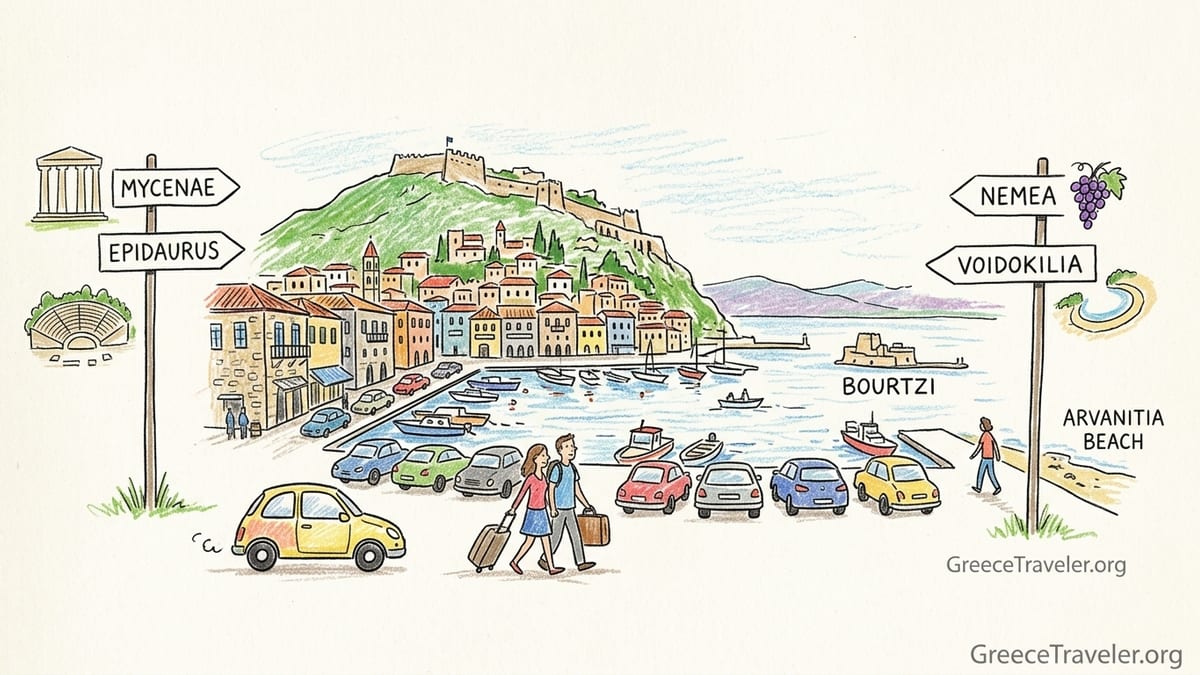
Nafplio: The Most Efficient Base for Mycenae, Epidaurus, and Nemea
If you want one base that feels like a vacation town but functions like a hub, Nafplio is the one I kept wishing I had more nights in. It is compact, atmospheric after dark, and practical for day trips: you can do a sunrise start to Mycenae, be back for a late lunch, and still take an evening swim without moving the car again.
The key detail that makes Nafplio work is that the Old Town is largely pedestrian, which sounds inconvenient until you learn the rhythm. Most travelers arriving with a car do a quick luggage drop near the edge, then park. The most useful free, close-to-everything option is the harbor area by the waterfront, where cars line up in rows a short walk from many Old Town addresses. It is not doorstep parking, but it is manageable if you pack like a road-tripper instead of a cruise passenger.
Beach access is another reason Nafplio behaves like a true base rather than a one-night stop. Arvanitia Beach sits effectively inside town and is around a 10-minute walk from the Old Town, with an easy promenade-style approach and a large parking area just before the beach if you do not want to walk. On days when I returned dusty from ruins, being able to rinse off and reset without another drive made Nafplio feel like I had built “recovery time” into the itinerary.
For early archaeological starts, Nafplio is simply positioned well. Epidaurus is often described as a short drive from Nafplio, and the practical point is that you can leave after breakfast and still arrive before tour buses peak. For Mycenae, I planned it like an early-morning site: the official summer hours listed by the Greek Ministry of Culture for Mycenae run from 08:00 to 20:00 starting May 2, 2026, and arriving near opening is the difference between hearing cicadas and hearing crowds. My personal note: I never regretted basing here, but I did regret trying to squeeze Nafplio into too few nights.
Monemvasia: The Southeast Base That’s Worth the Luggage Walk
Monemvasia is the rare “detour” stop that can still function as a base, especially for the southeast Peloponnese where distances to other major hubs stretch out. The big logistics truth is simple: cars are prohibited inside the Castle Town. That changes everything about where you stay and how you pack.
If you stay within the Castle, plan on a short-but-real luggage haul through a pedestrian gate and along stone lanes. Several properties inside the Castle explicitly advise the same strategy: drive up to the entrance, drop off passengers and luggage, then park along the road outside. Parking is free but not guaranteed close to the gate, so arriving earlier in the day is not just nicer, it is materially easier on your shoulders. I treat Monemvasia like an “arrive in daylight” town for this reason alone.
The upside of the car-free core is what happens after dark: dinner is genuinely walkable, and the town feels safer and calmer because traffic disappears. Even if you are tired from driving, you can still wander for a late meal without worrying about parking meters or narrow lanes. If you are traveling in shoulder season, do note that some Monemvasia businesses reduce hours, so I like to keep at least one simple backup plan: a taverna near the gate area or something you can grab earlier.
Would I unpack for one night here? If you are doing a full Peloponnese loop, one night can work, but only if you accept that the check-in and luggage factor is the “price” of the experience. Personally, I think Monemvasia rewards two nights: one to arrive and settle without rushing, and one to enjoy the morning light and a slower breakfast before you drive again.
Mani Peninsula: Areopoli or Limeni for Drama, Kardamyli for Ease
The Mani is where planning a base matters most, because the roads are slower and the landscape invites stops that wreck a tight schedule in the best possible way. Your base decision here is less about “what is central” and more about “how much friction do I want after sunset?”
Areopoli works well if you want a lived-in town feel with evening energy. It has the classic Mani aesthetic: stone lanes, towers, and a compact core that makes dinner possible without a car. The tradeoff is that the prettiest parts are not designed for vehicles, so I mentally plan for edge-of-town parking and a short walk. This is the pattern across much of the Mani: you park where you can, then you walk where you want.
Limeni, by contrast, is the postcard waterfront base. The practical issue is access and parking: Limeni’s waterfront area is narrow, and reliable advice for visiting is to park on the road above and walk down because turning space near the quay is limited. That is fine for a day visit; for an overnight, it means you should not book a place that assumes you can pull up right at the door unless the property confirms how arrivals work. Limeni can be magical at night, but I find it slightly higher-friction for luggage and car logistics than Areopoli.
Kardamyli is the “easy mode” option, especially if your Peloponnese loop is tight. It gives you the Mani vibe with fewer headaches: you have a clear harbor area, and there is a known free public parking spot near the harbor by the church, which is the sort of small detail that saves you 20 minutes of circling when you arrive hungry. If I were planning again with friends who hate logistics, Kardamyli would be my first pick for a Mani base, and I would do day drives deeper into the peninsula from there.
Pylos and Gialova: Messinia’s Best Base for Beaches and Big Sights
For Messinia, I like thinking in pairs: Pylos for a handsome, historic small town atmosphere, and Gialova for a breezier, beach-adjacent base with quick access to the lagoon and coastal drives. The good news is they are close enough that you can choose based on your personal evenings: do you want harbor-town strolls, or do you want to be nearer the beach scene?
If Voidokilia Beach is a priority, this base choice pays off immediately. Official Greek destination guidance places Voidokilia about 12 kilometers north of Pylos and explains a very practical approach: you can park near Gialova Lagoon and walk around toward Voidokilia, which is helpful when the dirt-road parking near the beach is busy. In real trip terms, that means you can set your morning up like this: coffee in Gialova, park by the lagoon, walk in, swim early, then be back for a late lunch without committing to an all-day beach marathon.
This is also a strong base for mixing archaeology with coast. The Palace of Nestor is the headline site in this zone, and published shore-excursion planning materials commonly describe it as about a 30-minute drive from Pylos. I treat that as a reminder to start early in summer heat, especially if you want time for a second stop the same day. If you are doing Ancient Messene from this region, opening hours listed by the local ephorate for the Archaeological Site and Museum of Ancient Messene are 08:00 to 20:00, which practically invites a morning entry before the sun turns the stadium into a skillet.
One-night stop or unpack? Here, unpacking feels worth it. Between beaches, lagoon walks, the fortress views around Navarino Bay, and easy dinners, Messinia is not just a “sleep and drive” zone. If I had to revise my own pace, I would add nights here, especially if traveling between late May and early October when long daylight turns even a simple evening into something you remember.
Ancient Olympia: A Functional Base for the Western Archaeological Zone
Ancient Olympia is not everyone’s idea of a romantic overnight, but it is efficient. If you are coming from Messinia or heading north toward Patras or the Ionian coast, sleeping in Olympia turns a long day into two manageable halves. More importantly, it gives you the kind of morning access that day-trippers rarely get: you can arrive at the archaeological site right when it opens and leave before midday heat and group tours build.
On the practical side, the town understands its role. Visitor information for the archaeological site notes that parking is available, and local business announcements in early 2026 discussed expanding parking capacity with new parking areas planned near the archaeological zone. Translation into traveler terms: Olympia is set up for cars, and arrival stress is lower here than in cliffside villages where you are negotiating stone alleys with a rental’s scratched bumper already in your mind.
Is Olympia a place where unpacking for one night felt worthwhile? For me, it depends on what else you are doing. If your priority is simply seeing Olympia on a fast loop, one night is functional and makes the next day calmer. But if you want beaches and late-night variety, Olympia can feel quiet after dinner. I would not plan more than one or two nights unless you are using it as a base for a wider western Peloponnese exploration.
The biggest base advantage is the early start. When an archaeological site has a last entrance time and daylight-driven rhythms, being five minutes away matters. If you care about photography or you want to read plaques without jostling, an overnight in Olympia is a strategic move rather than a “charming village” choice.
The Takeaway
If you only take one thing from this base-first approach, let it be this: the Peloponnese is easier when you choose towns that reduce friction, not just driving distance. “Friction” is parking, luggage walks, the question of whether you can find dinner after dark without moving the car again, and whether a one-night stay costs more time than it saves.
For maximum efficiency with minimum repacking, I would build a loop around four anchors: Nafplio for Argolid archaeology plus an easy swim-town reset; Monemvasia for the southeast, ideally two nights to justify the car-free logistics; one Mani base chosen by your tolerance for parking and walking (Kardamyli for ease, Areopoli for atmosphere, Limeni for waterfront drama); and Pylos or Gialova for Messinia’s beaches and major sites. Add Ancient Olympia when you want a western archaeology day to feel calm instead of rushed.
Where I wished I had stayed longer is clear: Nafplio and Messinia. They are the rare bases that do double duty, letting you do serious sightseeing and still feel like you are on holiday at night. Where I would choose differently next time: I would avoid treating Monemvasia as a rushed one-night box-check unless the itinerary truly demands it, because the pedestrian-only Castle Town deserves a slower rhythm than a quick luggage march and a single dinner.
FAQ
Q1. Which town is the most efficient base for Mycenae and Epidaurus?
Nafplio is one of the most efficient choices because it is a practical drive to both, while still being an enjoyable place to spend evenings and recover between day trips.
Q2. Is it hard to park in Nafplio if I stay in the Old Town?
You generally cannot park directly in the Old Town lanes, but the waterfront harbor area is a common free parking solution within a manageable walk for luggage if you pack sensibly.
Q3. Can I drive into Monemvasia’s Castle Town to drop bags?
Cars are prohibited inside the Castle Town. The common approach is to drop luggage near the entrance and then park outside along the road, walking in on foot.
Q4. Is one night in Monemvasia enough?
It can be enough on a fast loop, but many travelers find two nights more satisfying because the car-free logistics and walking approach feel more worthwhile when you are not immediately leaving the next morning.
Q5. Should I base in Areopoli, Limeni, or Kardamyli for the Mani Peninsula?
Choose Kardamyli for easier parking and a smoother base experience, Areopoli for a lively town feel, and Limeni if you prioritize waterfront scenery and accept more walking and parking constraints.
Q6. Which base is best for Voidokilia Beach?
Pylos or Gialova are the most practical bases. You can also use the Gialova Lagoon parking area and walk in toward Voidokilia when road access is busy.
Q7. Is Pylos a good base for the Palace of Nestor?
Yes. Pylos is commonly treated as a close hub for the Palace of Nestor, with driving times often described around the half-hour range, making early starts realistic.
Q8. Is Ancient Olympia worth staying overnight, or should I day-trip?
Overnight is worth it if you want an early, low-stress visit to the site and a calmer driving day. If you want nightlife or beach evenings, it may feel quiet compared with coastal bases.
Q9. What base choices minimize one-night unpacking fatigue?
A strong low-fatigue plan is Nafplio plus a Mani base plus Pylos or Gialova, adding Monemvasia only if the southeast is a priority, because Monemvasia’s pedestrian access adds “arrival effort.”
Q10. What is the single biggest mistake when choosing Peloponnese bases?
Picking towns for map distance alone and ignoring arrival friction: parking, pedestrian-only zones, luggage walks, and whether dinner is truly walkable after dark.