

I thought I knew Athens. I had done the Acropolis, the museum days, the Plaka strolls, the Monastiraki souvenir gauntlet, and the late-night souvlaki that somehow tastes better after a long walk. What I had not done was leave central Athens with a plan and enough time to let Attica reveal itself. The surprise was not that there were beaches, ruins, and wine country nearby. The surprise was how fast the atmosphere changed once I committed to moving in a widening circle, and how distinctly coastal, agricultural, and industrial Attica feels when you stop treating it like a day-trip backdrop. This guide is the route I actually used, the transport that worked, and the places that genuinely shifted my mental map of “Athens.”
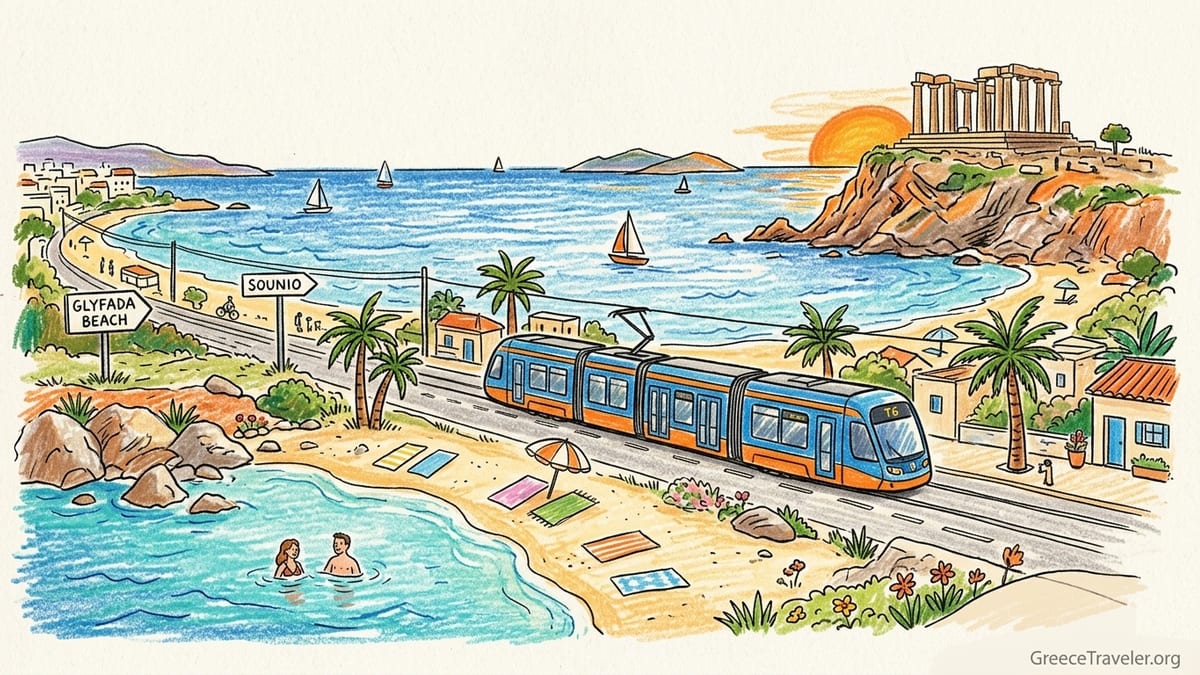
How I Escaped the Center: The Tram Ride That Reset My Athens Brain
I began the way I now recommend to anyone who wants to understand the Athens Riviera without a rental car: I walked to Syntagma and got on the tram. That alone felt like a small act of rebellion after days of Metro stations and marble steps. STASY’s tram lines T6 and T7 are the connective tissue that makes the Riviera feel like part of the city’s daily life, not an excursion that requires negotiation with a taxi driver.
I used line T6 from Syntagma toward Pikrodafni, then continued with the T6 and T7 connection toward Voula. On paper, the timetable looks straightforward, and STASY explicitly notes the Saturday 24-hour service on tram lines (a detail that matters if you do a late seaside dinner and don’t want to budget for a taxi back). In reality, I found the tram dependable but not fast. The point is not speed. The point is the gradual transition from dense blocks to lighter air, palms, marinas, and a coast-facing rhythm that felt miles away from the center even when I was still technically “in Athens.”
My most honest timing note: I stopped thinking in “kilometers” and started thinking in “coastal time.” The tram is scenic, but it is also a city tram with frequent stops. I treated it like a moving balcony. When I needed to be punctual for a sunset site, I did not rely on the tram alone, and that distinction shaped the rest of my planning.
Glyfada: The Beach Day That Cost Almost Nothing (If You Keep It Simple)
My first Riviera surprise was that not every beach day in Attica is locked behind a luxury gate. In Glyfada, I aimed for a simple swim and a long walk, not a curated beach club experience. Visit Greece describes Glyfada’s beaches as freely accessible with no admission required, and that matched what I experienced: I could show up with a towel, buy water and snacks nearby, and get in the sea without a wristband or a price list.
The swimming was the kind that makes you reset your shoulders. The water felt cleaner than I expected so close to a capital city, and the coastline was easygoing and practical rather than postcard-perfect. What stood out to me was how “weekday normal” it felt, even when there were plenty of people. In central Athens, crowds feel like friction. In Glyfada, crowds felt like a beach neighborhood doing what it does.
If you want an organized beach setup, you can absolutely find it along the Riviera, but my strongest advice is to decide what kind of beach day you want before you leave your hotel. My low-cost version was: tram down, swim, quick meal, tram back. It was not a “club day,” and I was happier for it. The most skippable part for me was trying to force a perfect beach aesthetic onto Glyfada. It shines when you treat it as a real city’s seaside district, not an island substitute.
Vouliagmeni: The Split Personality of the Riviera (Free Coves vs. High-End Sand)
Vouliagmeni is where the Riviera’s identity crisis becomes a feature. On one hand, you have coves and rocky edges that feel relaxed and local if you arrive with the right expectations. On the other, you have some of the most expensive, most tightly managed beach experiences in the region. Seeing both in the same day made Attica feel far more layered than the typical “Athens has beaches” line.
Astir Beach was my reality check. The official Astir Beach regulation document for 2026 makes it clear this is a controlled, ticketed environment with rules and a structured operation. I did not go in expecting a bargain, but I still found it useful to understand that in Vouliagmeni you can accidentally spend luxury-money without even realizing you’ve stepped into a luxury ecosystem. My best move was not trying to “win” at Astir. Instead, I treated it like a reference point, then built my own day around alternatives.
Lake Vouliagmeni was the experience that exceeded my expectations, largely because it felt uniquely Attica: a natural site operating with the polish of a spa. The 2026 Lake Vouliagmeni brochure lists spa operating hours as 11:00 to 19:00, which helped me plan the day around a clear window rather than guessing and hoping. I went for the sensation as much as the swim. The water had that distinct, enveloping feel that makes you linger longer than you intended, and the whole place felt like a different category from the open sea. If I organized this day again, I would do the sea swim first, then the lake later, when my body wanted warmth and stillness rather than salt and waves.
Temple of Poseidon at Sounion: The Sunset Is Real, but So Is the Logistics
Sounion is the Attica classic for a reason. It delivers the drama. But it also punishes casual planning. I learned quickly that the “just pop down for sunset” idea only works if you treat the journey itself as part of the evening and if you build in a buffer for traffic. The Riviera road can look smooth on a map and then become slow with beach-season movement.
For this trip, I made a deliberate choice: I did not drive. I took the KTEL Attikis bus from Athens to Sounio. A current 2026 timetable page verified on September 24, 2026 lists the Athens to Sounio route with an approximate duration of 1 hour 45 minutes and fares starting from €7.50. That figure aligned with what it felt like in real life: not a quick hop, but not an all-day commitment either. The bus ride also gave me something a rental car wouldn’t: I could watch the coastline and actually relax instead of white-knuckling my way through unfamiliar driving patterns.
The onsite ticketing detail matters here. Multiple sources still describe Sounion as a place where you should expect to buy your ticket at the physical entrance rather than assuming a seamless national e-ticket flow for standard entry. I planned accordingly and arrived early, because I didn’t want my sunset hour spent in a line. Once inside, I kept my expectations simple: wind, stone, sea, and the slow lowering light that makes everyone suddenly quiet. The view is as good as advertised, but the best part for me was how “edge of the region” it feels. Central Athens can feel hemmed in. Sounion feels like you’ve reached the end of something.
Lavrio: A Port Town With a Museum I Almost Skipped (I’m Glad I Didn’t)
Lavrio was my most unexpected Attica day, partly because I initially framed it as “the place you pass through to catch a ferry.” Once I arrived, it felt like a working town with its own story, and it gave me the gritty counterbalance to the Riviera’s curated sections.
I built my Lavrio day around the Archaeological Museum of Lavrion, and the practical details ended up shaping my timing. Hellenic Heritage lists summer hours (April 1 to October 31) as 08:30 to 15:30, with Tuesdays closed, and it lists a full ticket at €5.00. Those are the kinds of hours that can quietly wreck a day if you arrive late and assume you have all afternoon. I went early and treated the museum as my anchor, then wandered the town afterward.
What surprised me inside the museum was how it grounded the whole Lavreotiki region. It made the wider landscape feel like a place with layers rather than a strip of road leading to a port. Parking, too, was easier here than along the most in-demand Riviera pockets. Lavrio felt functional. It also felt less like I was sharing every view with a hundred other people, which is not something I could always say about the most Instagrammed Riviera stops.
Marathon: Quiet, Green, and More Emotional Than I Expected
Marathon was the day Attica turned rural on me. I expected history, but I didn’t expect the emotional texture of the place, or how different the air felt compared with central Athens. It was greener, quieter, and more spaced out, the sort of landscape where you can imagine distances being measured in footsteps and endurance rather than Metro stops.
I used the Archaeological Museum of Marathon as my orientation point. The official museum page emphasizes that opening hours change seasonally and that many museums are closed on Tuesdays, which is exactly the kind of detail that can turn a “quick museum stop” into a locked door if you don’t check before you go. In practice, it made me plan my Marathon outing as a morning and early afternoon commitment, not an end-of-day add-on.
This was not a beach day. It was a reset day. If you are stacking Attica excursions during an Athens stay, Marathon is the one I would keep separate from the Riviera. Pairing it with a coastal swim sounds efficient, but emotionally it felt like a different chapter of the region. I left wanting to sit somewhere simple, eat something straightforward, and let the day land. If I organized it again, I would commit to the area longer, possibly adding another nearby stop rather than rushing back into the city’s pace.
Elefsina: The Most Important Attica Surprise (And the One People Avoid)
Elefsina is where I felt Attica stop performing for visitors. The first impression is industrial, and I understood instantly why travelers skip it. But Elefsina ended up being the place that most changed how I understand the region: a town with rough edges, a waterfront mood, and an ancient story that is not packaged as gently as it might be somewhere else.
I planned this visit carefully because I had seen conflicting assumptions online about what is open. The official Archaeological Museum of Elefsina page is blunt: the museum is currently closed due to refurbishment and redisplay works. That could have been a deal-breaker, but the same official page still provides the opening hours and ticketing framework for the broader Elefsina visit, including summer hours listed as 08:00 to 20:00 (Tuesday closed) and a €10 ticket that includes the archaeological site. I treated this as a site-first day, not a museum day, and I was still glad I went.
The atmosphere shift was the point. Outside central Athens, you don’t get the constant soundtrack of tourism. In Elefsina, I felt like I was moving through a living place where people have errands and routines, with ancient remains integrated into the town’s fabric rather than fenced off as a separate world. Some stops in Attica are about beauty. Elefsina, for me, was about perspective. If you have only a few days and you want the most “this is more than Athens” feeling, this is the outing I’d argue for, even if it doesn’t look glamorous in photos.
The Takeaway
Attica surprised me because it does not behave like a single destination. The Riviera can feel like a sequence of micro-neighborhoods connected by tramlines and sea air. Sounion feels like an edge-of-the-world punctuation mark, and it rewards travelers who plan around transport reality rather than fantasy timing. Lavrio feels working and under-visited, with a museum that quietly explains the region. Marathon feels green and reflective. Elefsina feels honest and challenging in the best way, the kind of place that changes how you talk about Athens afterward.
If I did the whole region again from an Athens base, I would organize it like this: one low-effort tram day for Glyfada or Vouliagmeni; one fully committed late-afternoon-to-evening run for Sounion with a buffer for traffic; one early-start day for Lavrio with the museum timed to its hours; one separate day for Marathon; and one half-day or full day for Elefsina depending on your interest in archaeology and modern Greek urban texture. Most importantly, I would stop trying to force Attica into the same mental box as central Athens. The point is not to “see everything.” The point is to feel how quickly Greece changes once you stop orbiting the Acropolis.
FAQ
Q1. Can I reach the Athens Riviera from central Athens without a car?
Yes. I used the STASY tram from Syntagma via lines T6 and T7, which run toward the coastal suburbs and make beach days doable without driving.
Q2. Is the tram running late at night on weekends?
STASY notes that every Saturday there is a 24-hour service on the tram lines, which is helpful if you stay out late on the coast.
Q3. Are Glyfada’s beaches free to access?
Yes. Visit Greece states that access is unrestricted and no admission is required, which matched what I experienced with a simple towel-and-swim beach day.
Q4. Is Astir Beach in Vouliagmeni a public beach?
It operates as a controlled, ticketed beach with its own regulations. I treated it as a premium option rather than my default swim plan.
Q5. What are Lake Vouliagmeni’s spa operating hours?
The 2026 brochure lists spa operating hours as 11:00 to 19:00, which helped me plan my visit around a clear time window.
Q6. How long does the Athens to Sounio KTEL bus take and what does it cost?
A verified 2026 timetable page lists the trip at about 1 hour 45 minutes, with fares starting from €7.50, which felt realistic in practice.
Q7. Do I need to plan around museum closing days in Attica?
Yes. Several official museum pages note that many museums are closed on Tuesdays, and seasonal hours can change, so I always checked before committing to a day plan.
Q8. What are the Archaeological Museum of Lavrion hours and ticket price?
Hellenic Heritage lists it as 08:30 to 15:30 in both summer and winter seasons, Tuesday closed, with a full ticket of €5.00.
Q9. Is the Archaeological Museum of Elefsina currently open?
The official museum page states that the museum is currently closed due to refurbishment and redisplay works, so I planned Elefsina as an archaeological-site visit rather than a museum-focused stop.
Q10. How do I combine Attica day trips with an Athens stay without burning out?
I found it easiest to mix one low-effort tram beach day with one longer bus or car day like Sounion or Lavrio, and keep Marathon and Elefsina as separate, slower-paced outings.