


I tried the Athens Riviera the way most travelers actually do it: by picking a “base,” then seeing how it holds up after dark, after a swim, after a late dinner, and on the morning you need to get to the airport without drama. On this trip, I stayed overnight in Glyfada and Vouliagmeni, and I visited Cape Sounion as a long afternoon into sunset. They’re close on a map, but they feel like three different trips once you factor in transport, walking vs driving, the kind of dinner you can get without planning, and whether the evening has a pulse or goes quiet the moment the sun drops.
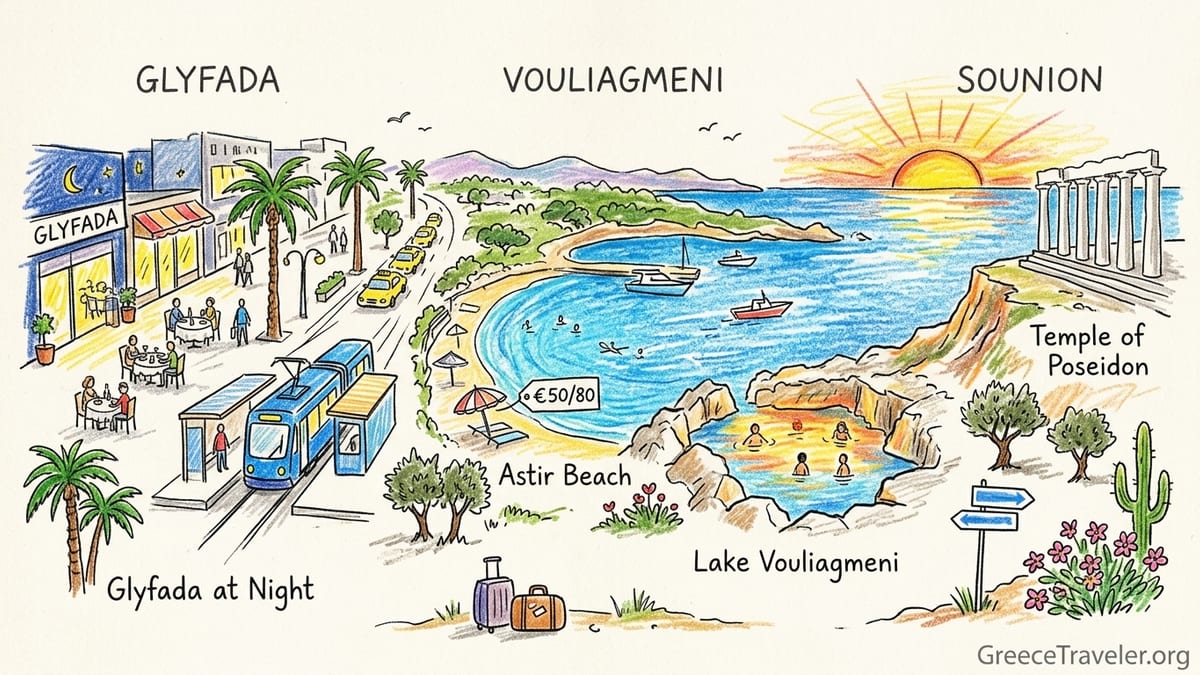
Where I Actually Stayed (and What “Base” Means on the Athens Riviera)
I stayed in Glyfada first, then moved down-coast and stayed in Vouliagmeni. I did Sounion as a dedicated outing, arriving mid-to-late afternoon and leaving after sunset. I’m being explicit about that because these places can blur together in guidebooks, but the “base” question is really a question of what your nights feel like. Day-tripping anywhere on the Riviera is easy. Living there for a few evenings is where the personality shows.
For this comparison, I judged each place on what I could do without a car, what the evening looked like once the beach crowd went home, and how dependent I felt on taxis. I also paid attention to friction points: parking, reservations, the “we’re hungry right now” test, and the “we’re wet from swimming and just want something simple” test. Those small moments decide whether a coastal base feels effortless or like a logistics puzzle.
One quick reality check: hotel inventory is deep in Glyfada and Vouliagmeni, with lots of options across styles and budgets. Sounion, by contrast, is inherently more isolated. The coastline is dramatic and the coves can be gorgeous, but once you commit to Cape Sounion as your overnight base, you’re committing to quiet evenings and fewer choices unless you drive.
Glyfada at Night: The Riviera’s “City Mode” After the Beach
My first evening in Glyfada felt like I’d landed in a coastal neighborhood that never really clocks out. I arrived with that classic travel mood of “I’ll just take a quick walk before dinner,” and suddenly it was an hour later and I was still moving, drawn along by storefront light and the easy rhythm of people doing their nightly stroll. The shopping spine is real here, and it changes the energy: even if you don’t buy anything, there’s always somewhere to drift next.
Dinner in Glyfada was the easiest of the three places, purely on volume and variety. When I wanted something casual, it was there. When I wanted something that felt like a proper night out, it was there too. What stood out wasn’t a single “signature dish,” but the convenience of being able to decide late. In many coastal towns, you need to choose and reserve early. In Glyfada, I could play it by ear and still feel like I had options.
Nightlife in Glyfada also felt more layered than I expected. There are obviously bars and late spots, but the key detail is that the streets still feel used after dinner. I passed gelato places and cafés with people lingering, and the atmosphere didn’t depend on one beach club. It felt like a suburb that happens to have sea air, not a resort that empties once the day ends.
Parking is the tradeoff. Glyfada is busy, and it shows in the way cars orbit for spaces. If you’re renting a car, you can do it, but you’ll feel the pressure more than in a quiet coastal pocket. I found that when I was walking and using public transport, the place made more sense. When I imagined doing it all by car, I pictured more circling than relaxing.
Swimming and Beach Time: Glyfada’s Convenience vs Vouliagmeni’s Iconic Water
Glyfada’s swim days felt built for “fit it in” travel: morning coffee, a quick dip, then back to the city if you want it. You can do a beach day without it swallowing your whole schedule. The coastline here is active and convenient rather than secluded. I was never under the illusion I’d discovered a hidden cove; instead, it felt like an accessible sea edge attached to a real neighborhood.
Vouliagmeni, by contrast, delivered the kind of swim day that becomes the day. The water and scenery felt more “postcard Greece,” and the choices ranged from coves where you can keep it simple to famously organized beach experiences. One of the headline options is Astir Beach, which is priced like a statement: its published tariffs are high in peak season, with adult tickets listed at about €50 on weekdays and €80 on weekends and holidays from May to September. That’s before you even start thinking about how much you want to spend on your exact setup for the day.
That pricing matters because it changes how you use the coast. In Glyfada, I’d pop down for a swim like I was running an errand. In Vouliagmeni, it’s easy to turn the beach into an event: you plan it, you arrive with intention, you stay longer, and you notice the details, like how the afternoon light hits the bay and how quickly the mood shifts as the sun slides toward evening.
Vouliagmeni also gives you a swimming alternative that feels like a detour into a different world: Lake Vouliagmeni, a warm mineral lake in a limestone setting. Recent published price lists for general admission have been in the high teens in euros depending on day, and that is exactly how it felt in practice: not “free nature,” but a paid, managed experience. Still, it’s the kind of place where you remember the sensation, not the receipt. I did my swim in the sea first on this trip, then used the lake like a reset button later, when I wanted warm water and a change of scenery.
Hotels and What You Really Pay For: Location, Walkability, and the “Last 500 Meters”
In Glyfada, the hotel question is mostly about how close you want to be to the action. You can stay near the beach edge and still be a short walk from shops and restaurants. That mattered in a very practical way: when I came back salty and tired, I could shower, change, and be out again without calling a taxi. Even the small detail of having a tram stop nearby can turn a stay from “pretty location” to “usable base,” because it expands your evenings.
Vouliagmeni’s hotel scene feels different because so much of the value is concentrated in immediate access: access to the bay, to polished beach experiences, to being able to step out and feel like you’re already where you came to be. The high-end reputation exists for a reason, but the more important distinction is that the neighborhood can feel curated. When you pay more here, you often pay to remove friction: fewer compromises, fewer transitions, fewer “we’ll do that tomorrow because it’s far.”
Hotel pricing changes constantly with season and availability, and I’m not going to pretend one screenshot equals a truth. What I can say from the ground is this: Glyfada offered more “normal” travel flexibility. I could choose based on budget and still end up walkable to food and evening life. Vouliagmeni felt more like a place where the hotel choice defines the trip, because the distance between pockets of activity can be short by car but not always pleasant on foot, especially if your plan involves beach gear and changing clothes.
Sounion, from my perspective as a visitor, looked like the opposite of “inventory depth.” It’s not a place where you browse dozens of competing hotels and decide later. The experience is driven by the landscape and the archaeological site, so your lodging tends to orbit that. When you stay near Cape Sounion, you’re paying for silence, views, and proximity to a sunset that people plan their entire day around.
Transport Reality: Tram Freedom in Glyfada, Taxi Dependence in Vouliagmeni, and Car Logic for Sounion
Glyfada won the transport test for me, hands down. The Athens tram lines are not fast like a metro, but they are psychologically easy. I liked the feeling of getting on near the coast and being delivered to central Athens without bargaining with traffic. STASY’s official tram timetable information makes it clear the tram network is designed for this exact coast-to-city link, and there is even Saturday 24-hour service on the tram and on Metro Lines 2 and 3, with the important caveat that airport routes are excluded from that 24-hour provision.
Airport access is the other piece travelers obsess over. Athens’ public transport pricing and airport bus fares are published by OASA, and the current listed Airport Express Bus ticket price is €5.50. That matters even if you never take the bus, because it anchors your expectations: it’s the low-cost benchmark against which taxis and transfers will feel expensive. The deeper point is that Glyfada makes it easier to build a trip where you don’t need a car, because you can stitch together tram rides, central Athens sightseeing, and beach time without turning every move into a paid ride.
Vouliagmeni is workable without a car, but I felt more dependent on taxis for the “last 500 meters” problem. You can absolutely do it by bus and on foot, but the coastline here is shaped by bays and peninsulas. That geography is beautiful, yet it can make walking routes feel longer than the map suggests. I found myself thinking in terms of “one taxi now, then walk later,” which is fine for couples and luxury-minded travelers, but it’s a different budget pattern than Glyfada’s hop-on-hop-off tram convenience.
Sounion is where the public-transport-only idea starts to feel limiting. Yes, you can visit without driving, but once you start imagining staying there, you’re really imagining a car or a driver. It’s an outing zone. The reward is that the drive itself becomes part of the experience, especially in late afternoon when the sea is bright and you’re following the coast toward the cape.
Sounion as a Place, Not a Postcard: Quiet Evenings, Big Sky, and One Main Event
I arrived at Cape Sounion with enough time to walk, settle in, and watch the light change. The Temple of Poseidon is the main draw, and it earns the attention. Even before you go in, the setting is doing most of the work: open horizon, wind, and that feeling of being on the edge of something. The official site information for the broader destination emphasizes what everyone already knows from photos: sunset is the headline moment, and it’s one of those scenes where people naturally lower their voices.
In practical terms, Sounion felt simple: you’re here for scenery, quiet, and the archaeological site. The sanctuary’s typical published visiting window is from around 9:30 a.m. to sunset, and a standard adult ticket has been listed at €20 in widely referenced visitor information. The exact closing time floats with daylight, which is part of the point. This is not a place where you “just pop by after dinner.” You plan your day around it, and you leave when the light tells you to.
After sunset, the atmosphere thinned fast. That’s not a complaint. It’s the defining feature. The coast here doesn’t perform for you with late-night promenades or shopping streets. It gives you quiet and darkness and the sound of water in coves. If you stay overnight, you’re choosing an experience where you may have a calm dinner, a drink with a view, and then a genuinely early night. Compared to Glyfada’s hum, it felt like turning the volume knob down to near-silence.
Parking in Sounion is a different story than parking in Glyfada. You may still have to be patient around peak sunset time, but it’s not the same constant city-suburb pressure. The bigger “transport” issue is not finding a space, it’s that you are largely locked into your choice of restaurant and evening plan unless you’re willing to drive again.
The Takeaway: Which Base I’d Choose (First Trip, Couples, Families, Luxury, Quiet Finale)
If I were planning a first Athens-plus-beach trip and I wanted the most forgiving base, I would choose Glyfada. It’s the place where you can improvise. You can sightsee in central Athens, come back for a swim, then wander out for dinner without feeling like the night requires a reservation strategy. The city connections are simply easier, and the evening atmosphere feels alive in a way that helps if you’re in Athens for only a few days and want every night to count.
For couples, I’d split the decision by travel style. If you want a trip with long swim days, a polished coastal mood, and the ability to make the beach the centerpiece, Vouliagmeni is the more memorable “romantic coast” base. It’s also where you can choose high-end beach experiences like Astir Beach, knowing the ticket alone can run about €50 on weekdays and €80 on weekends and holidays in peak season. That cost is not subtle, but if it’s within your plan, it buys a very particular kind of day.
For families, I’d lean Glyfada for practicality and options. Families often need flexibility: quick meals, different budgets, and the ability to pivot when someone is tired or sunburned. Glyfada’s density helps. Vouliagmeni can absolutely work for families too, but it’s more likely to turn into a “planned day” destination rather than a base where you can effortlessly do a little bit of everything.
For luxury travel, Vouliagmeni is the clearer match, especially if your idea of luxury is minimizing friction and maximizing time in a beautiful setting. For a quiet final few days, I wouldn’t force myself to stay in Sounion for the whole trip, but I would consider it as an intentional ending: one last swim in a cove, one sunset at the cape, one slow dinner, and then sleep in real silence before moving on. None of these bases is a universal winner. They’re three different ways to experience the same coastline, and choosing well is mostly about choosing the evenings you want to have.
FAQ
Q1. Which is the best base for an Athens trip where I also want the beach?
Glyfada is the most practical base because it balances beach access with easier connections to central Athens and plenty of dinner options.
Q2. Which base feels the most “resort-like” on the Athens Riviera?
Vouliagmeni feels the most resort-like, especially around its organized beaches and higher-end hotels, where the day is structured around swimming and staying by the water.
Q3. Is Vouliagmeni Beach expensive?
It can be. For example, Astir Beach publishes peak-season adult entry prices around €50 on weekdays and €80 on weekends and holidays, before any premium beach setups.
Q4. Is Lake Vouliagmeni worth it if I’m already swimming in the sea?
If you like distinct experiences, yes. It feels different from the sea: warmer water in a rocky, spa-like setting, typically with paid admission rather than a free-beach vibe.
Q5. Can I stay in Glyfada without renting a car?
Yes. Glyfada is one of the easiest Riviera bases without a car thanks to the tram connection and the neighborhood’s walkable dining and shopping areas.
Q6. Can I use public transport from the airport to the Riviera?
Yes. Athens’ public transport operator publishes airport ticketing and pricing, including Airport Express Bus tickets listed at €5.50, though routes and convenience vary by exact destination.
Q7. Do I need a car to visit Cape Sounion and the Temple of Poseidon?
You can visit without driving, but Sounion is much easier with a car or driver, especially if you want to stay past sunset or treat it as a relaxed half-day outing.
Q8. How long should I plan to spend at Sounion?
Plan at least a half-day including travel, time at the site, and sunset. The site’s closing time depends on sunset, so the experience is built around daylight.
Q9. Which base has the best nightlife?
Glyfada has the most consistent nightlife and evening street life, with enough variety that your night doesn’t depend on a single venue or beach club.
Q10. If I only have time to stay in one place, which should I choose?
Choose Glyfada for flexibility and city access, Vouliagmeni for a beach-forward and hotel-centered stay, or Sounion for a quiet, scenery-driven finale rather than a multi-activity base.