


I came to the Athens coast expecting a simple equation: the closer the beach is to the city, the more compromised the swim. What I found in Attica was messier and much more interesting. On some days I paid an entrance fee that felt outrageous, then swam in water so clear and calm it made sense of the entire Athens Riviera brand. On other days I skipped the ticketed gates, walked into a pine edged public cove, and got a better, quieter swim for the price of a freddo espresso from a kiosk.
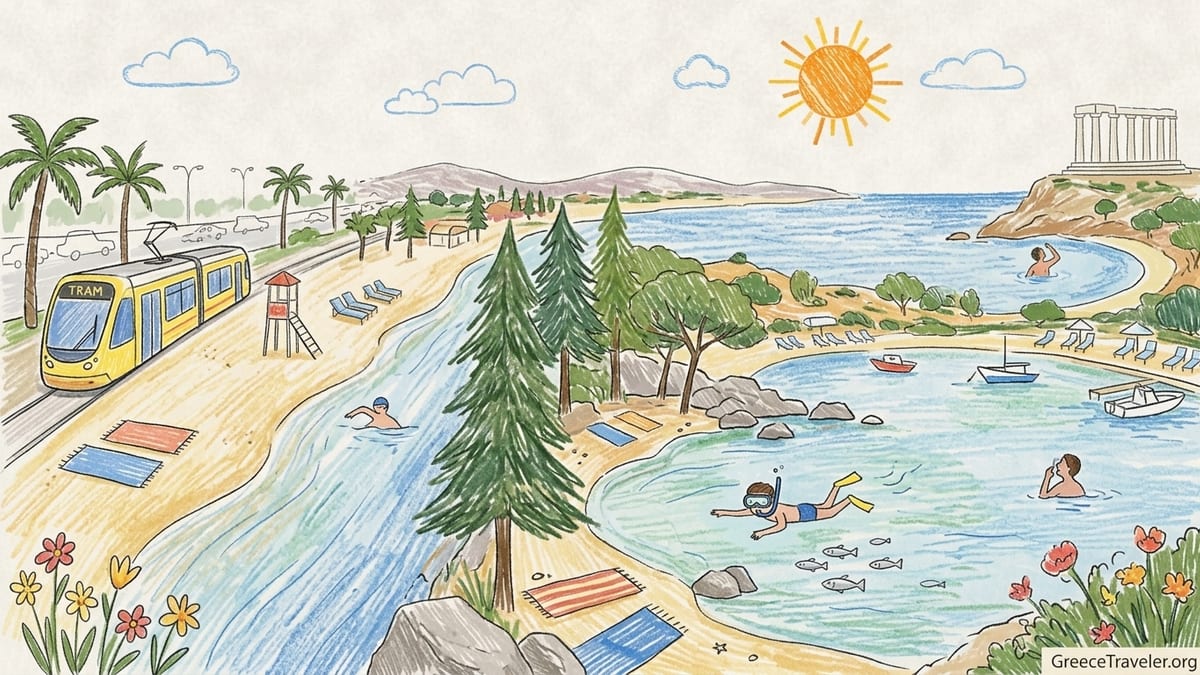
First, A Truth In Advertising: What I Actually Swam, And What I Only Researched
This article is written in first person because that is how I experienced the Athens coastline: stepping off a tram still wearing city dust, changing behind a towel, then easing into saltwater that somehow smelled cleaner than I expected for a capital. But I also want to be very clear about the boundary between my own swims and the beaches I researched for 2026 pricing and access rules.
I personally swam at Akti tou Iliou (Alimos), Akti Vouliagmenis, and the free public coves around Kavouri. I also made the longer southern day that almost everyone talks about and swam at Legrena and at the small bay below Cape Sounion, timing it so the Temple of Poseidon was the backdrop when I turned onto my back.
Everything else in this piece is included because it is a strong candidate for your own beach circuit, but it is not described as if I swam it. That includes Glyfada’s high end beach club options, Varkiza Resort, Lagonisi, Charakas, Schinias, and several quieter east and west Attica options where the best choice depends on wind, weekend traffic, and what you personally consider a good beach day.
When I mention specific 2026 prices and rules, they come from currently published price lists, operating regulations, and up to date booking platforms where available. If a beach does not publish a stable price list, I will say so and avoid pretending the numbers are fixed.
Alimos (Akti Tou Iliou): The City Beach That Actually Works
The first time I swam in Alimos, I had a very Athens moment: I could still hear traffic behind the palms, and the tram stop was close enough that you could almost treat the beach like an extension of a neighborhood park. But once I got into the water, the surprise was how usable the swim felt. The shoreline here is a mix of sand and fine pebbles, and the entry is forgiving, with depth building gradually rather than dropping off. I had small, consistent wavelets rather than real surf, and I did not feel a pull or strong current in the swimming zone.
Water clarity was better than I expected for a beach this close to the city. It was not the glassy, aquarium clarity you get farther south, but I could still see my legs, and that matters when you are trying to relax rather than brace for the unknown. The water temperature felt like classic high summer Aegean: warm enough to linger without rushing, but still cool on the first plunge if you had been baking on a lounger.
What you are really paying for at Akti tou Iliou is order. In summer 2026, the official entrance pricing is €10 on weekdays and €12 on weekends and public holidays, with reduced tickets for children 5 to 12 and seniors, and sunbed rental priced separately at €6 on weekdays and €8 on weekends. The beach operates with full facilities including showers, toilets, lockers, and lifeguards, and it keeps a consistent 08:00 to 20:00 rhythm through the season. If you want a “one decision” beach day near Athens that does not require a car, this is the clearest version of it.
For me, the value question came down to crowds and shade. In Alimos, natural shade exists in patches where trees and landscaped areas reach toward the beach, but it is not the pine canopy experience you get in Kavouri. On the busiest hours, the organized feel helps, but you do feel the density. If I were returning on a peak weekend, I would treat Alimos as an early swim and leave before the late afternoon surge.
Vouliagmeni (Akti Vouliagmenis): Paying For The Bay, Not The Hype
Vouliagmeni is the moment the Athens coast starts to look like the postcards, and Akti Vouliagmenis sits in a bay that protects you from the messy side of open water swimming. My swim here felt calmer than Alimos, with clearer water and an easier floating feeling once you were a few strokes off the sand. The depth increases gradually, so you can choose your comfort level: wade and chat at waist deep, or swim out until the beach noise softens.
What stood out most was the sense of an organized municipal beach that still feels like a real beach. There are facilities and a structured entrance, but it does not feel like a velvet rope club. When I went, crowd levels were busy but manageable, the kind of scene where you can still do a proper set of laps without constantly zigzagging. The bay shape keeps waves small, but it also means you notice any boat movement more, so I stayed inside the obvious swimming area.
For summer 2026, entrance fees at Akti Vouliagmenis are listed at €10 on weekdays and €15 on weekends and public holidays, with reduced categories and free entry for young children and some protected categories. Beyond price, what you are buying is predictability: showers, toilets, staffed entry, and the kind of basic beach infrastructure that makes the day easier if you are traveling with kids or simply do not want to improvise.
If your goal is pure swimming quality without paying luxury club rates, this is one of the most defensible tickets on the Athens Riviera. If your goal is a quiet beach day, it depends on timing. I would not come here for solitude at midday in August. I would come early, swim in the soft morning light when the bay is at its calmest, then either leave or accept that you are choosing convenience over emptiness.
Kavouri (Free Public Coves): Where I Stopped Paying And Started Enjoying It More
Kavouri was where my Athens Riviera logic flipped. After paying entrance fees elsewhere, I arrived at the Kavouri peninsula and realized how much the coast still offers for free if you are willing to bring a towel, walk a little, and accept that amenities are inconsistent. The coastline here is not one single beach but a sequence of sandy pockets, pebble edges, and rocky entries, with a promenade that lets you scope it out before committing.
I chose a sandy section where the water stayed shallow longer than I expected, and the swimming felt sheltered and friendly. The best part was the shade. Pines and greenery come close enough to the shore that you can actually get relief without renting an umbrella. That one factor can change the entire economics of your day, because it lets you stay longer without feeling forced into a sunbed package just to survive the heat.
In the water, clarity was noticeably better than Alimos and comparable to Vouliagmeni on a good day. Around the rockier edges, the water deepens faster, and that is where I did my slow, careful snorkeling with just goggles. I did not see anything dramatic, but I did see the basics that make Mediterranean snorkeling satisfying: small silver fish flashing in schools near rocks, and the occasional larger fish cruising past as if you are not there.
The tradeoff is that “free” is not the same as “empty.” On weekends, locals come early, and parking becomes a sport. But if you are willing to arrive earlier than you think you need to, Kavouri can be the best value swim on the central Riviera: no entrance gate, good water, and real shade that you do not have to pay for.
South To Sounion: Legrena And The Swim Beneath The Temple
The southern Attica coast is where the sea stops feeling like a city amenity and starts feeling like a destination. On my Sounion day, the swim was not just about water quality, it was about scale. The coastline opens up, the light changes, and even the drive or bus ride starts to feel like a trip rather than a commute.
Legrena was my “simple is better” beach. It is long, open, and not trying to be a club. When I swam there, the water felt clean and clear, with that satisfying turquoise edge when the sun hits the shallows. The entry was comfortable, and the space meant that even with other people around, you could find a patch that felt like yours. I did not have the same level of facilities as an organized Riviera beach, but that was the point. I brought what I needed, then just swam and dried in the sun without a soundtrack.
Sounion Beach, the small bay below the Temple of Poseidon, is the Athens region’s most cinematic swim. I eased in and then turned back toward the headland, and the columns were right there, high and bright, the kind of view that makes you stop mid tread. The water here is usually sheltered and gradually deepening, but it is a compact bay, and once day visitors arrive, the sand fills up quickly. It is also a place where the edges can turn rocky, so I would not come without basic water shoes if you are sensitive to footing.
Access to the beach itself is free, but the day can get expensive if you combine multiple paid elements: archaeological site admission, organized sunbeds in some sections, meals at nearby tavernas, and parking depending on where you leave your car. My advice is to treat it as a half beach, half culture day: swim earlier, then go up to the Temple later, or reverse it, but do not assume you will find space for a leisurely, peak hour sprawl right under one of Greece’s most famous viewpoints.
Researched Riviera Heavyweights (Glyfada, Varkiza, Lagonisi, Schinias): Worth It If You Want A Managed Day
There are beaches on the Athens coast where the sea is only part of the product. The rest is loungers, service, booking rules, and the feeling of having your day curated. If that is what you want, Attica does it well, but in 2026 the pricing differences are huge, so it is worth understanding what you are buying.
In Vouliagmeni, Astir Beach is the headline luxury option. For the 2026 season, published pricing places general admission at €50 on weekdays and €80 on weekends and public holidays, and entry can be tied to online booking rules and specific access regulations. This is not a casual decision beach. It is a planned splurge, and it makes sense only if you genuinely value top tier facilities and a tightly controlled environment over spontaneity.
Varkiza Resort, the modernized successor to the old Yabanaki, is one of the clearer examples of transparent 2026 rules. Its operating regulation sets entrance fees by season, with off peak periods listing €5 weekdays and €10 weekends, and peak periods listing €7 weekdays and €12 weekends. Sunbed sets are priced by row in the same regulation, with first row sets higher than second row and beyond. It also explicitly restricts bringing outside food and drinks onto the premises, which matters if you are trying to keep your beach day budget from ballooning. If you want an organized sandy beach with services and you accept the resort rules, Varkiza can be a rational middle ground between municipal beaches and ultra luxury clubs.
On the east side of Attica, Schinias is a different proposition. It is more about space and sand, and there are booking platforms that show specific beach bar packages, including low cost weekday options that bundle loungers with drinks. For example, one Schinias booking listing in 2026 shows a weekday package priced at €14 including two beach beds plus water and coffee, with weekend pricing higher. This is not the same as “the whole beach costs €14,” but it does show how the economics change once you move away from the central Riviera and toward a broader, more beach first landscape.
Lagonisi and the broader southern arc also include resort style options where admission can sometimes include sunbeds and umbrellas and sometimes not, depending on the property and the day. The key is to check whether you are paying a simple entrance or whether you are paying for a specific seating package. In 2026, the difference between those two approaches can be the difference between a modest beach day and a bill that feels like a hotel day pass.
The Takeaway: Where I Would Pay Again, And Where I Would Not
If you are trying to build a beach week around Athens without losing your mind to pricing and reservations, I would split the coast into two moods: “managed convenience” and “bring a towel and breathe.”
For managed convenience close to the city, I would pay for Akti Vouliagmenis again because the bay swim quality justifies the ticket when you want showers, easy access, and a predictable setup. I would also pay for Alimos on the right day, especially if I did not have a car and wanted a straightforward swim off public transit, but I would time it early or late to avoid the thickest crowds.
For the best pure value, I would stop paying and go to Kavouri, especially if I wanted shade and a swim that feels surprisingly clean and natural for how close it is to the city. The tradeoff is that you need to be self sufficient and patient about parking.
And for the “Attica is actually beautiful” day, I would do Legrena plus Sounion again, not because it is the most comfortable beach setup, but because the swim beneath the Temple of Poseidon is the kind of travel memory that does not compress into a price comparison.
FAQ
Q1. Which Athens coast beach is best if I do not want to rent a car?
Akti tou Iliou in Alimos is the easiest paid beach day by tram and bus, while Kavouri can also work if you are willing to combine public transit with some walking.
Q2. What is the 2026 entrance fee at Akti tou Iliou (Alimos)?
The published 2026 pricing lists €10 weekdays and €12 weekends and public holidays, with reduced categories and sunbeds priced separately.
Q3. What is the 2026 entrance fee at Akti Vouliagmenis?
The published 2026 pricing lists €10 on weekdays and €15 on weekends and public holidays, with reduced and free categories depending on eligibility.
Q4. Is Kavouri Beach free to access?
Yes, the public sections around Kavouri have free shore access, with some organized concessions in season that charge separately for seating and services.
Q5. Are Legrena and Sounion Beach free?
Beach access at both is generally free, but you may pay for extras like organized sunbeds in some areas, food, parking, and Temple of Poseidon archaeological site admission if you visit the ruins.
Q6. Is Astir Beach in Vouliagmeni really expensive in 2026?
Yes, published 2026 pricing lists general admission at €50 on weekdays and €80 on weekends and public holidays, and access is governed by detailed beach regulations and booking rules.
Q7. What are the 2026 entrance fees at Varkiza Resort?
According to its 2026 operating regulation, entrance is €5 weekdays and €10 weekends in off peak periods, and €7 weekdays and €12 weekends in peak summer periods.
Q8. Can I bring my own umbrella and snacks to organized beaches in Attica?
Rules vary. Municipal beaches often allow personal setups in free areas, while some resort style beaches explicitly restrict bringing outside food and drinks, so you need to check the current regulations before you go.
Q9. Where is the calmest swimming near Athens?
Sheltered bays like Vouliagmeni tend to be calmest, while more open stretches such as Anavyssos can pick up afternoon wind that makes conditions choppier.
Q10. Which Attica beaches are best for simple snorkeling?
Rocky edges around Kavouri and coves near Sounion are often better than long sandy bays for casual snorkeling, especially on calm days with clear water.