


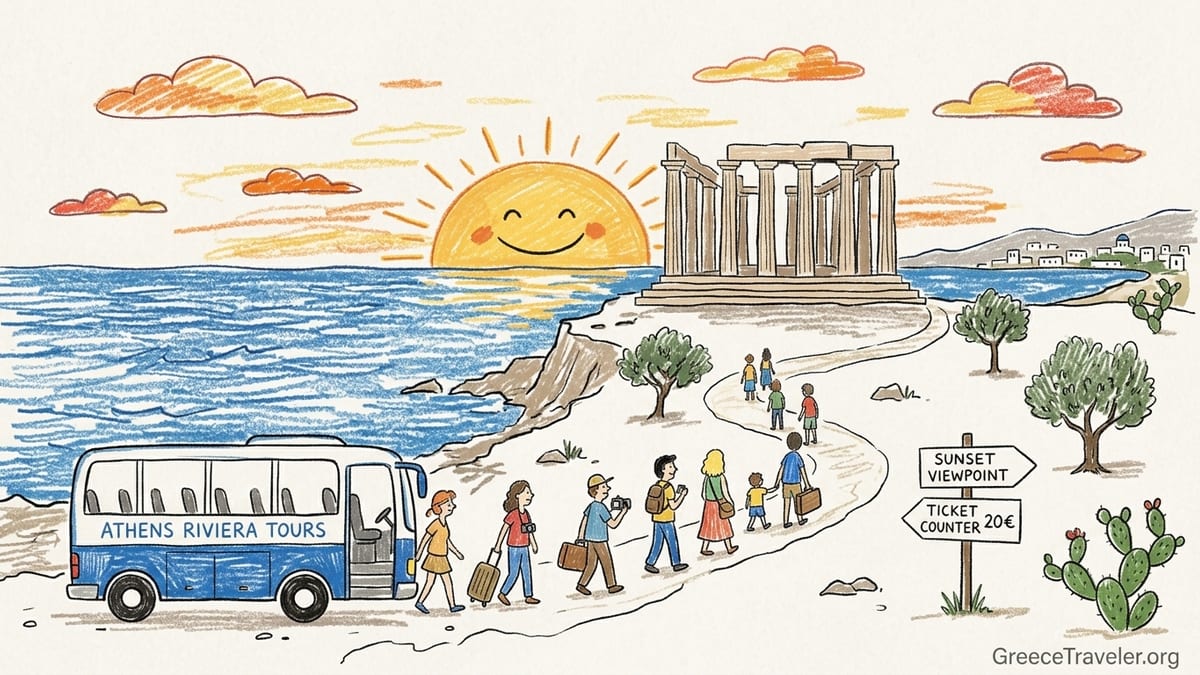
I took a late-afternoon Cape Sounion sunset tour from Athens because I wanted the full “Athens Riviera” experience without the stress of driving, parking, and timing the Temple of Poseidon’s sunset closing. What I got was a tightly paced, coach-based excursion that felt equal parts scenic road trip and timed sprint to a cliff-top viewpoint, with real trade-offs: you gain ease and atmosphere, but you sacrifice flexibility, swim time, and the chance to linger once the sky starts turning pink.
Booking, 2026 Tour Reality Check, and What I Actually Paid For
In 2026, Cape Sounion products tend to cluster into a few recognizable types: a four to five hour sunset coach tour (usually with a central meeting point), a small-group or private driver experience (often hotel pickup), or a fully independent run by public bus, rental car, or taxi. I chose a classic “sunset tour” format that departs according to the season’s sunset time rather than a fixed morning schedule, which matters because the archaeological site operates “until sunset” and last admission is close to closing.
My tour was priced like many of the entry-level coach offerings: a relatively low base fare for transportation and a tour leader, with the big add-on being the Temple of Poseidon admission at the gate. In 2026, the Temple of Poseidon archaeological site ticket is listed at €20 full price and €10 reduced, and the site follows a sunset-based closing time. That separate ticket is the single biggest reason two Cape Sounion tours can look similar online yet cost dramatically different totals once you factor in what is and is not included.
Before I went, I double-checked three things that can derail this half-day: the departure location rules, whether hotel pickup was included, and whether the tour promised a “stop” at Lake Vouliagmeni or beaches. Many sunset tours highlight the Athens Riviera drive, but that does not automatically mean swimming time. Some premium variants bundle entry or promise extra stops, but many do not, and the pacing is the whole point: get to Sounion before the golden hour crowds thicken, then get everyone back to Athens the same night.
Pickup: Where I Met the Group, Check-In, and the Coach Setup
My tour used a central Athens meeting point rather than hotel pickup. The check-in process was straightforward: a quick name check, a reminder that temple admission was extra, and a “be back here on time” speech that set the tone for the rest of the evening. If you are staying in Plaka, Syntagma, Monastiraki, or near Omonia, the central meeting point approach is convenient. If you are far from the center or traveling with small kids, hotel pickup can be worth paying for.
The vehicle was a modern, air-conditioned coach rather than a minivan. That matters in Athens heat because the best moment on this trip is outside on a windy headland, but the worst moment can be sitting in traffic in late afternoon. The coach was comfortable enough for a half-day, with the usual tour-bus dynamic: couples and families on the outside seats, solo travelers tucked in, and the first few rows taken by people who know they get less motion sickness there.
Departure was timed to the season. In 2026, some operators publish a rotating schedule with departures shifting through the year to match sunset, for example afternoons in winter and later afternoon in high summer. That rolling schedule is a practical clue you are booking a true sunset-centered product rather than a generic half-day coach run.
Getting Out of Athens: The Real Traffic, and What “Riviera Drive” Felt Like
The first leg felt like a reminder that Athens is a real working city, not a postcard. Leaving the center in late afternoon meant slow pockets and stop-and-go bursts as we threaded toward the coastal avenues. The tour leader filled the dead time with context about the coastline and the cape, but the actual lived experience was simple: you watch neighborhoods slide by, you feel the tempo change, and once you glimpse the sea, the whole bus mood lifts.
The coastal run through Glyfada, Vouliagmeni, and Varkiza is the part that sells people on this tour. It is not a remote “wild coast” drive. It is a Riviera lined with marinas, beaches, cafés, and organized swimming clubs, with the sea appearing and disappearing between buildings, palms, and parked scooters. At golden hour, even the everyday details look cinematic: light on balconies, reflections on car windows, and the Aegean flashing between bends.
If you have never been south of central Athens, this drive is a destination in itself. Glyfada feels like a modern seaside suburb with shopping streets and an urban beach culture. Vouliagmeni shifts toward higher-end resort territory, and you begin to see why so many Athenians treat this stretch as their weekend escape. By Varkiza, the coastline opens up and the road becomes more “road trip” than “city commute,” though you are still surrounded by real life: commuters, delivery trucks, and locals heading out for dinner.
Stops: What We Did and Did Not Stop For (And How It Changed the Pacing)
On my specific excursion, we did not stop for swimming, Lake Vouliagmeni, or dinner. The tour was built around one central promise: arrive at the Temple of Poseidon with enough time to walk up, see the sanctuary, and secure a strong sunset viewing position without feeling rushed. Adding a swim stop sounds dreamy, but on a four to five hour product it can become a stress multiplier. If you stop, you either shorten your temple time or gamble with traffic.
That said, Lake Vouliagmeni is the most tempting “wish we stopped” option because it is genuinely unique: a warm, mineral-rich lake in a dramatic setting. In 2026, published general admission pricing is commonly listed around the high teens in euros, with weekday and weekend pricing differing, and upgraded reserved seating packages costing substantially more. The catch is time. A proper lake visit is not a five-minute photo stop. Once you change, swim, shower, and settle back into coach timing, you have effectively turned your sunset tour into a longer excursion, and many operators avoid the risk.
If you are determined to swim and still do Sounion at sunset, my honest takeaway is that you should not force it into a standard coach sunset run unless the operator explicitly sells it as a combined itinerary with enough hours built in. A private driver or rental car is better for that two-stop rhythm. You can control how long you linger at the lake, you can eat when you want, and you can choose a beach stop that matches your vibe, whether it is a casual public stretch of sand or a high-end organized beach club.
Arrival at Cape Sounion: Ticket Line, Time on Site, and the Uphill Walk
We reached the Cape Sounion area as the light started to soften, which is exactly when the site feels most dramatic. The approach is a mix of practical logistics and anticipation: you see the headland, you see the parking area, and you can already sense the wind. The Temple of Poseidon sits high, and even before you climb, you feel the exposure to the sea.
Time on site was limited but workable. This is a common theme of group tours: you do not get “all evening,” but you do get enough time to make the climb, loop through the sanctuary area, and choose your sunset spot. My on-the-ground experience was that the first ten minutes disappear instantly: bathroom stop if needed, ticket purchase if you have not already, quick regroup, and then the real visit begins.
The walk up is not technically difficult, but it is an uphill push on exposed paths, often with little shade. In hot weather, that exposure hits harder than people expect, especially if you have been in an air-conditioned coach for an hour. I had water with me and was glad I did. Shoes mattered too. I saw people in slick sandals moving cautiously on the uneven surfaces and gravel.
The wind is real. Cape Sounion is not a sheltered viewpoint. Even on a warm day, the breeze can be strong enough to whip hair, tug at hats, and cool sweat fast once you stop moving. It is part of the magic, but it also shapes the comfort level. I wished I had brought a light layer, not for cold exactly, but for that wind-chill feeling you get once the sun drops lower.
Crowds and Sunset Conditions: The View, the Noise, and the “Golden Hour” Truth
Sunset at the Temple of Poseidon is famous for a reason: the columns glow, the sea below looks endless, and the horizon line makes every photo feel expansive. But the experience is not private or hushed. In peak season and on fair-weather days, it can feel like the entire cape is a shared ritual. People jockey for the cleanest angle, couples pose for long photo sessions, and tour groups arrive in waves as multiple coaches converge around the same time window.
What surprised me most was how quickly the vibe changes as the sun approaches the horizon. Thirty minutes before sunset, it is energetic and chatty. Ten minutes before, it becomes more focused. People stop walking and start watching. Phones go up, and the temple becomes a silhouette machine. If you want a calmer moment, aim to arrive early enough to appreciate the site itself before the entire crowd pivots toward the horizon.
Sunset conditions depend on haze and cloud cover. On my visit, the light was warm with a slight marine haze, which softened the contrast and made the sea look silvery rather than deep blue. It was still beautiful, but it reminded me that “sunset tour” does not guarantee a fiery sky. What it guarantees is that you will be there when the light is at its most flattering, even if the weather chooses subtlety.
Once the sun is down, the cliff-top wind becomes more noticeable. People who were comfortable in tank tops a half-hour earlier started reaching for layers, and the crowd slowly drifted toward the exit as staff timing and closing rhythms asserted themselves. The site is run on a sunset schedule, so you feel the clock without anyone needing to shout about it.
Return Journey After Dark: Coach Logistics, Comfort, and the “Athens Re-Entry”
The departure from Sounion is the most group-tour moment of the whole experience. You count heads, you find your seat, and you settle into the post-sunset quiet. Most people are tired in the best way, the way you feel after salt air and strong light. The coach windows become mirrors, and the coastline turns into scattered strings of lights as we rolled north.
Driving back after dark also changes how you perceive the Riviera. On the way out, it feels like a reveal: beaches, water, and evening glow. On the way back, it feels like returning to civilization. You pass lit restaurant terraces and nightlife pockets in the southern suburbs, and if you did not eat before the tour, this is the point where hunger becomes a topic of conversation.
Traffic returning to Athens can still be a factor, though it often feels smoother than the outbound run because you are no longer competing with the same commuter pattern. Still, arrival back in the center is not a “teleport.” Plan for the drop-off time to be approximate. If you have a late dinner reservation, buffer it. If you are catching a flight, do not do this tour on the same evening and assume you will glide back on schedule.
The tour ended where it began: a central drop-off point that made it easy to grab a taxi, hop on the metro, or walk back if you were staying nearby. Stepping out into the Athens night after standing on a wind-lashed cape is a funny contrast, and it made the excursion feel like a complete arc rather than a one-note sightseeing stop.
The Takeaway
If I were choosing again, I would still do Cape Sounion at sunset. It is one of those Athens add-ons that feels genuinely distinct from the city’s core sights, and it delivers a rare combination: ancient architecture, huge sea views, and a built-in daily finale. A coach sunset tour is the easiest way to get that experience without thinking about parking, navigation, or the site’s sunset-based closing rhythm.
But next time, my choice would depend on what I want the day to feel like. If my priority is simplicity, I would do a group sunset tour again, especially one with a clear central meeting point and a published seasonal departure schedule. If my priority is swimming, Lake Vouliagmeni, or an unhurried dinner in a coastal town, I would switch to a private driver or rental car so I could slow down and turn the Riviera into more than something I watched through a window.
Public transport is the budget option, and it can work if you are comfortable building your day around a limited timetable and a longer travel time. In 2026, published KTEL bus guidance for the Athens to Sounion route commonly lists a journey around one hour and forty-five minutes, with departures from the Pedion Areos area and a route that runs through Riviera stops like Glyfada, Vouliagmeni, and Varkiza. The trade-off is flexibility at the cape and certainty getting back after sunset.
In plain terms: a group sunset tour is best for first-timers who want an effortless postcard moment. A private driver or rental car is best for repeat visitors, swimmers, photographers who want more control, and anyone who hates being told exactly when to get back on the bus.
FAQ
Q1. How long is a typical Cape Sounion sunset tour from Athens in 2026?
Most sunset-focused products cluster around four to five hours total, with the departure time shifting through the year to match seasonal sunset.
Q2. Where do Cape Sounion tours usually pick up in Athens?
Many standard coach tours use a central meeting point in Athens rather than hotel pickup, while private tours and some small-group options often offer pickup from your accommodation.
Q3. Is the Temple of Poseidon admission included in the tour price?
It depends on the operator. Many lower-cost coach sunset tours exclude the archaeological site entrance, while some premium tours bundle it. Always confirm before booking.
Q4. How much is the Temple of Poseidon ticket in 2026?
The commonly published official price is €20 full and €10 reduced, with certain free-entry days and eligibility categories that can apply.
Q5. What time does the Temple of Poseidon close?
The archaeological site generally operates from morning hours until sunset, with last admission shortly before closing, so the exact closing time changes by date.
Q6. Is the walk up to the Temple of Poseidon difficult?
It is a short uphill walk rather than a long hike, but it is exposed to sun and wind. Supportive shoes and water make it more comfortable.
Q7. Are Cape Sounion sunset tours crowded?
They can be, especially in peak months and on clear-weather days. Multiple tours arrive in the same sunset window, and the best photo angles draw clusters.
Q8. Can I combine Lake Vouliagmeni swimming with Cape Sounion on the same day?
Yes, but it usually works best with a private driver or rental car, or with a tour specifically marketed as a combined itinerary with enough extra hours.
Q9. Is there a public bus from Athens to Sounion?
Yes. KTEL Attikis operates intercity buses to Sounion from Athens, but schedules can be limited, so you need to plan carefully around departure and return times.
Q10. What is the best way to do Cape Sounion next time: group tour, private driver, bus, or rental car?
For most first-timers, a group sunset tour is the easiest. For maximum flexibility, swimming, and dinner stops, a private driver or rental car is usually the better fit.