


I went to Cape Sounion for the same reason most people do: that famous sunset, with the Temple of Poseidon silhouetted on a cliff above the Aegean. What surprised me was how much the experience depends on timing, not just for the light but for tickets, queues, and the feeling of being herded out the moment the sky turns pink. This is the practical ticket-and-visit plan I used, what I’d do differently next time, and the exact rules I verified immediately before publication so you can plan without racing the clock.
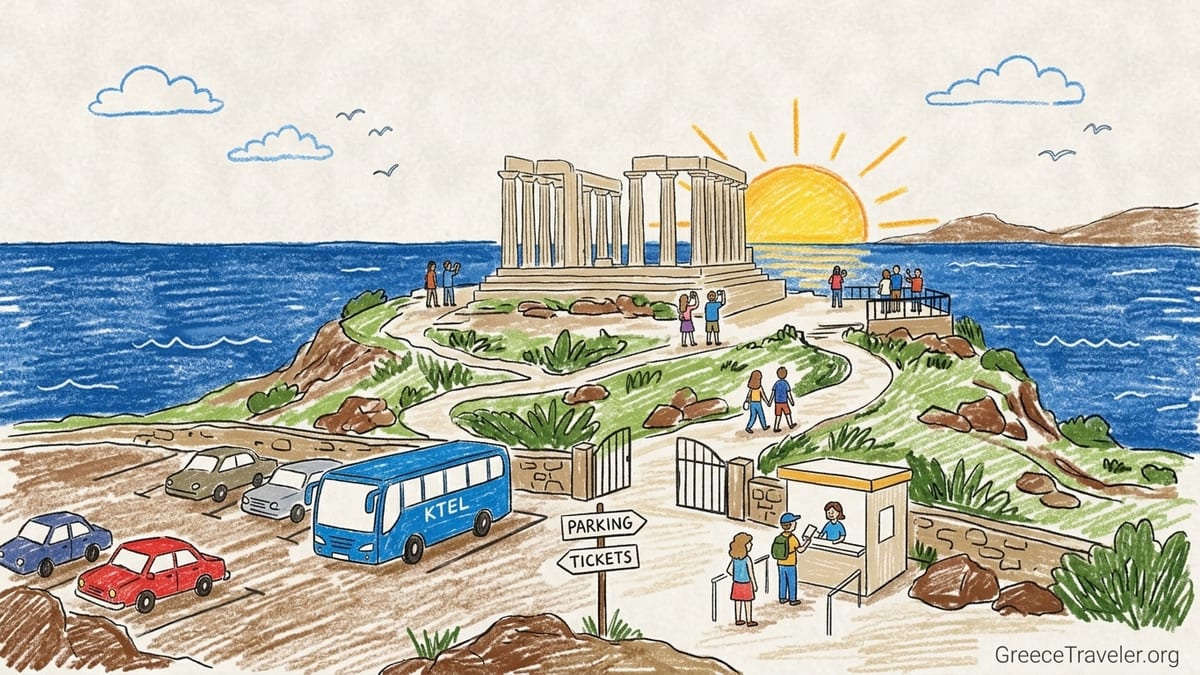
What I Verified Right Before Publishing (Hours, Prices, Rules)
Before I planned anything, I did the boring but essential step: I checked the official listing for the Archaeological Site of Sounion on Hellenic Heritage, because this is the kind of place where “closing time” is not a fixed number. It is tied to sunset, and that changes daily. On the official listing, the Temple of Poseidon at Cape Sounion is shown as open daily from 09:30 until sunset, in both the April 1 to October 31 period and the November 1 to March 31 period.
I also verified the ticket price right before publication. The official listing shows full admission at €20 and reduced admission at €10. If you have seen older blog posts quoting €10 as the full ticket, treat them as outdated and double-check the official listing again close to your own travel date.
The other rule I paid close attention to was last entry. The official listing states that last admission is 20 minutes before closing time. In real life, that means if sunset is at 19:50, you should treat 19:30 as your absolute last moment to pass the gate, and earlier if you want to actually enjoy the site rather than speed-walk it.
Finally, I confirmed free-admission dates as listed officially: March 6, April 18, May 18, the last weekend of September, October 28, plus the first and third Sunday of each month from November 1 to March 31. The site also lists closure dates and public holidays, including January 1, March 25, May 1, Easter Sunday, and December 25 and 26.
How I Bought My Ticket (And What “Official” Really Means Here)
For Cape Sounion, I approached tickets like I do for major Greek sites: I started by looking for an official online option. The official Hellenic Heritage listing includes a “Buy tickets” link that points to the Hellenic Heritage ticketing platform. In other words, there is an official place to start your purchase process from the government’s own tourism and heritage portal.
That said, my practical rule is simple: I consider a ticket “official” only if I reached it through an official listing or an official government cultural ticketing environment, not a reseller that happens to rank high in search. For Cape Sounion, I made sure the pricing matched the official €20 full and €10 reduced before I committed to anything.
On the day I visited, I still treated my ticket as only half the plan. The other half was timing. I planned my arrival to account for (1) the possibility of a short queue, (2) the walk from the entrance up to the temple viewpoint, and (3) the fact that sunset draws in waves of people who all want the same few photo angles at the same time.
If you are eligible for a reduced ticket, I recommend deciding early whether you want the reduced category hassle. The Greek Ministry of Culture rules generally require appropriate proof for reduced or free admission, and if you do not have it, you should assume you will be charged full admission at the gate or be asked to resolve it before entry. In practice, this can slow you down right when timing matters most.
Getting There Without Stress: Parking vs Bus, and My Arrival Time
I treated Cape Sounion as a timing-sensitive outing rather than a casual “swing by.” Even if you are coming from central Athens, the drive is long enough that small delays matter. The official listing describes the drive as about 65 minutes from the center of Athens, which is useful as a baseline, but I padded it because afternoon traffic on the Athenian Riviera and late-day tour departures can change the feel of that estimate.
I arrived by car, which made my timing more controllable than a bus or a sunset tour. The archaeological site lists parking among its amenities, and in my experience the lot is convenient, but it can feel compressed at peak sunset time. The key is psychological: if you arrive already anxious about parking, every extra minute in the lot makes you feel like you are losing the sunset.
If you arrive by bus, the official listing notes that the intercity KTEL bus runs from Athens with a departure point described as Aigyptou Square at Pedion tou Areos, and it notes about two hours travel time. That is doable, but it makes the return schedule matter just as much as the sunset. For a no-rush plan, I would rather arrive earlier and accept more time on site than gamble on a tight connection both ways.
My personal arrival target for a sunset visit was roughly 90 minutes before sunset. Not because you need 90 minutes to “see” the ruins, but because you need that buffer to absorb parking, tickets, photos, and finding a spot that feels calm. If you arrive 30 minutes before last entry, you can get in, but you will feel the clock ticking the entire time.
The Gate, The Queue, and What the Entrance Experience Felt Like
At Cape Sounion, the entrance experience is straightforward, but it is exposed. There is very little shade, and on a bright day the light bounces off the stone and the sea. If you end up queuing, it is not the kind of queue where you want to be sorting your wallet, looking for ID, and trying to figure out which ticket category you bought.
When I arrived, the line moved, but it thickened in bursts. The pattern made sense: organized tours tend to show up in clusters, and independent drivers arrive when they can find parking. If you show up right in that busy window, you can spend valuable light waiting outside the gate, then spend the rest of your visit trying to catch up.
Once I passed the gate, the “rushing” feeling eased immediately. The sea is right there, the wind hits you, and the site opens up. But the site also makes it clear, without saying much, that sunset is the deadline. Because closing is tied to sunset, the whole crowd shares the same unspoken countdown.
My advice is to treat the last-entry policy literally. The official policy is 20 minutes before closing, but you should plan to be inside earlier than that, because once you enter you still have walking time before you reach the best viewpoints. If you arrive at the gate near last entry, you might technically “make it” and still miss the calm, unhurried part that makes Cape Sounion special.
Walking Surfaces, The Uphill Reality, and How Long You Actually Need Inside
The walk at Cape Sounion is not extreme, but it is real. You are on uneven archaeological ground in places, with stone pathways and worn surfaces that can be slippery in the wrong shoes. I wore closed-toe walking shoes with decent grip and was glad I did, especially near the edges where people drift toward the best photo angles.
Inside the archaeological site, I found that a realistic “no-rush” visit time is about 60 to 90 minutes if you want to take photos, read a few signs, and move around to different viewpoints. If you only care about a quick look at the columns and a sunset photo, you could do it in less, but that is the exact approach that makes people feel rushed and annoyed.
The other time factor is crowds. Even if you move quickly, you will sometimes stop because a popular viewpoint clogs with people. That is normal and it does not mean you planned poorly, but it does mean you should avoid arriving so late that every pause feels like lost time.
If you are visiting with someone who has limited mobility, I would plan extra time. The site lists accessibility among its amenities, but in practical terms you are still dealing with an ancient hilltop environment. For a sunset visit, it is better to arrive early enough to move slowly and still feel relaxed.
My Sunset Strategy: Where I Went, When I Stopped Moving, and Why It Worked
I did not try to “do everything” right before sunset. Instead, I treated the golden hour as a fixed appointment, and I structured my time around being in position early. About 30 to 40 minutes before sunset, I stopped hopping from spot to spot and chose a viewpoint I liked, with enough space to stand without being shoulder-to-shoulder.
The viewpoint choice depends on what you want in your photos. Some people want the sun directly behind the columns for a silhouette. Others want side light on the marble so it glows warm and textured. I walked around earlier to see how the temple looked from different angles, then committed to one direction so I was not constantly weaving through other people in the final moments.
Crowds at Cape Sounion are not a problem so much as a rhythm. There is a pre-sunset buzz as everyone spreads out, then a tightening as the sky turns. The trick is to be settled before that tightening happens. If you are still searching for “the perfect spot” in the last 10 minutes, you will feel rushed even if the site is technically still open.
I also learned that wind can change your comfort level fast. Even after a warm Athens day, the headland can feel cooler and gustier as the sun drops. Next time I would bring a light layer in the car, because being cold makes you fidget, and fidgeting makes you more likely to lose your spot or stop enjoying the moment.
Did Visiting Close to Closing Feel Rushed? What I’d Change Next Time
Yes, visiting just before closing can feel rushed, even if you get in. The official schedule of “09:30 until sunset” sounds generous, but the sunset window compresses everything: your entry deadline, your walking time, your photo time, and the crowd’s collective urgency.
When I planned it well, I did not feel rushed. When I watched late arrivals, I could see the stress on their faces: they passed the gate and immediately speed-walked, phones in hand, trying to get the “classic” picture before the site began to empty out. That is not the energy you want at Cape Sounion.
My honest takeaway is that the “arrive right before sunset” strategy only works if you do not care about seeing the site beyond one viewpoint. If you want a genuine visit, with time to look at details and enjoy the landscape, you should arrive earlier than your instincts suggest.
If I did it again, I would still plan around sunset, but I would arrive about 2 hours before sunset rather than 90 minutes. That extra 30 minutes is not for more sightseeing. It is for removing pressure: parking calmly, entering calmly, walking slowly, and letting the place feel like a headland sanctuary rather than a race to a photo.
The Takeaway
Cape Sounion is one of those rare sites where the best experience is also the most timing-sensitive. The official rules matter: full admission is €20, reduced is €10, opening is daily from 09:30 until sunset, last admission is 20 minutes before closing, and there are specific free-admission dates and full-closure holidays you should check against your trip.
But the real secret is not the rulebook. It is giving yourself enough slack that you can stand still and watch the light change without thinking about the gate. If you plan to be inside well before last entry and choose your sunset position early, the visit feels expansive. If you arrive late, the same place can feel like a stopwatch.
My practical plan for most travelers is simple: aim to park and be through the entrance roughly 90 minutes before sunset, and if you hate feeling hurried, make it two full hours. Cape Sounion rewards people who show up with time, not just people who show up with a camera.
FAQ
Q1. What is the official ticket price for the Temple of Poseidon at Cape Sounion?
Full admission is €20 and reduced admission is €10, as listed on the official Hellenic Heritage page for Sounion.
Q2. What time does Cape Sounion close?
The archaeological site is listed as open daily from 09:30 until sunset, so the closing time changes by date.
Q3. What is the last-entry policy at Cape Sounion?
Last admission is 20 minutes before closing time, according to the official listing.
Q4. Are there any free-admission days for Cape Sounion?
Yes. The official listing includes March 6, April 18, May 18, the last weekend of September, October 28, and the first and third Sunday of each month from November 1 to March 31.
Q5. Is the site ever completely closed?
Yes. The official listing notes closures on January 1, March 25, May 1, Easter Sunday, and December 25 and 26.
Q6. How early should I arrive for sunset so I don’t feel rushed?
I recommend arriving inside the gate about 90 minutes before sunset, and closer to 2 hours before sunset if you want a relaxed pace and multiple viewpoints.
Q7. Is there parking at the Temple of Poseidon?
Yes. Parking is listed among the site’s amenities on the official Hellenic Heritage listing.
Q8. Can I reach Cape Sounion by public transport from Athens?
Yes. The official listing mentions intercity KTEL bus service from Athens with an approximate travel time of about two hours.
Q9. How much time do I need inside the archaeological site?
For a comfortable visit with photos and viewpoints, I would plan about 60 to 90 minutes inside, plus extra buffer for crowds near sunset.
Q10. What time would I arrive next time?
Next time, I would aim to arrive about two hours before sunset to avoid feeling pressured by parking, entry, and crowd congestion near the viewpoints.