


I came to Attica thinking I knew the script: Athens for the classics, then ferry out to the islands. What I didn’t expect was how quickly the “Athens suburbs” storyline falls apart once you start following Attica’s coastline and countryside routes on their own terms. In the same week, I floated in warm mineral water at Vouliagmeni, watched the sun drop behind Poseidon’s columns at Sounion, ate fresh seafood in a working port at Lavrio, and spent an evening in Elefsina where ancient ritual ground sits shoulder-to-shoulder with industrial history and a living festival calendar. If you’re deciding where to go beyond Athens, this is the short list of places that earned their time in my itinerary, with the practical details I wish I’d had before I left.
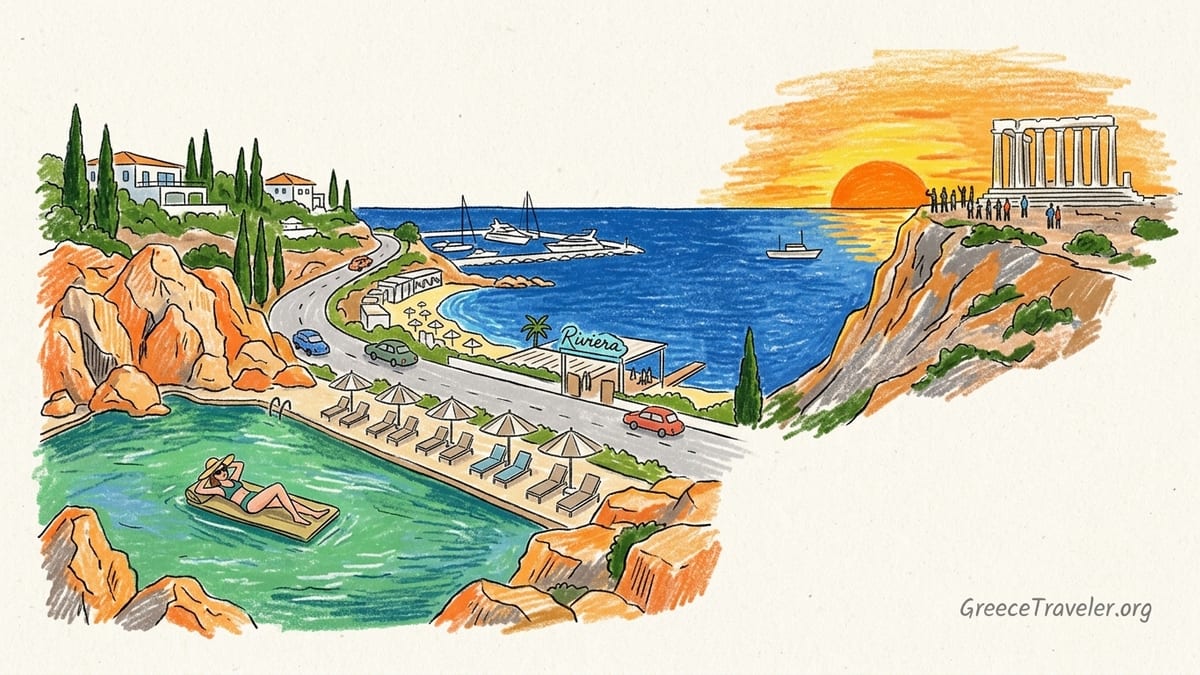
Vouliagmeni And The Athens Riviera: Where I Finally Slowed Down
I arrived on the Athens Riviera the way most people do: by accident, chasing a quick swim between museum days. But Vouliagmeni has a way of turning “a quick dip” into an entire afternoon. The neighborhoods south of the city feel like Athens exhaling, with long stretches of sea-front road, glossy marinas, and coves that make you forget you’re still within Attica. The atmosphere is equal parts resorty and local: morning walkers, families heading to the water, and couples dressed a little too well for the heat because they’re going somewhere beachfront for lunch.
My anchor stop here was Lake Vouliagmeni, because it’s not just pretty, it’s a real experience you can’t replicate on an ordinary beach day. The lake operates year-round with seasonal hours, so I checked the schedule before I went and planned my arrival for the morning when it’s calmer. What I did was simple: I paid entry, found a spot near the water, and spent a long time alternating between floating and sitting on the rocks letting the warmth soak in. The mineral-water feel is the point; I didn’t rush it. If you’re the kind of traveler who likes a timed itinerary, this is where I’d tell you to loosen it.
Food on the Riviera can be as polished or as casual as you want. On my Vouliagmeni day, I treated it like a real beach day, not a sightseeing sprint: coffee first, then something light after swimming, then a longer sit-down meal later. The practical reality is you’ll see both high-end beach clubs and more everyday spots within a short ride. If you want the Riviera without the “wallet shock,” it helps to decide upfront whether you’re paying for an organized beach setup or using the coastline for views and swims while you keep meals modest.
Time needed: if you only want a swim and a look, you can do Vouliagmeni as a half-day. But the stop becomes worthwhile when you give it breathing room. I’d call it a full-day place if you’re going to combine the lake with a Riviera promenade, a proper seaside lunch, and a late-afternoon sea view. Disappointing moment: the Riviera can feel engineered for comfort rather than character, so if you want raw, untamed scenery, don’t expect it here. What made it worthwhile anyway was how easy it was to access a high-quality “reset day” without leaving Attica.
Cape Sounion: The Sunset That Still Lives In My Camera Roll
Cape Sounion is the Attica classic that deserves its fame, but only if you approach it with realistic expectations: you are not going for an all-day archaeological deep dive. You’re going for a headland, a temple, and a horizon that makes you understand why ancient sailors cared about this point on the map. I timed my arrival for late afternoon because I wanted the famous light, and I immediately understood why the final hour of the day turns into a gentle stampede. Even before you enter the site, you can feel the mood shift: windier air, sharper smells of salt and scrub, and that quiet excitement people get when they know the view is going to deliver.
On site, what I actually did was straightforward: I walked up, circled the Temple of Poseidon slowly, then kept looping back to different edges of the cliff to see how the sea looked from each angle. The sanctuary area is compact, and that’s part of why it works so well as an excursion. You don’t need to “power-walk” it. You need time to pause, take photos, and let the scale of the landscape do its job. If you tend to rush ruins, Sounion is the place where I’d tell you to stop treating stone as a checklist item.
Practically, Sounion’s visiting day rises or falls on logistics: admission rules, closing times that track sunset, and crowd levels that spike at golden hour. I planned extra buffer for the return trip because leaving at the same time as everyone else can turn the road back into a slow crawl. For transport, you can do this by car or by regional bus, but either way the most important decision is not transport, it’s timing: arrive early enough that you’re not stressed, and leave with a plan so you’re not stranded after closing.
Time needed: a half-day is enough for the site itself, but I think Sounion is at its best when it becomes an evening. I budgeted time for a simple meal nearby after the temple, because you’ll be hungry and the coastline is built for that kind of post-sunset decompression. Worthwhile detail: the feeling of standing at the edge of Attica with the Aegean spread out below you is not something Athens gives you, no matter how many rooftops you climb. Disappointing detail: if you’re hoping for solitude at peak season sunset, you won’t find it. The view is shared.
Marathon: A Day Trip That’s More Than A Battle Name
Marathon is one of those names you think you understand until you show up and realize the landscape is the story. I arrived expecting a history stop, and I left thinking about geography: wetlands, open plains, low hills, and the long stretch toward the coast where the air feels different than central Athens. The atmosphere is quieter and more spacious, with families, cyclists, and visitors who came specifically for this area rather than stumbling into it from a hotel lobby suggestion.
My center of gravity in Marathon was the Archaeological Museum of Marathon, because it gave me the clearest context for what I was seeing outside. I planned my visit around opening hours because museums in Greece can be strict about last entry and seasonal schedules. Inside, I took my time with the collections tied to the area’s long human story, not just the famous classical moment. I also made sure I had water and a snack on hand, because once you start moving between sites and the coast, you don’t always want to stop exactly when the nearest cafe appears.
What I did next was push the day toward the shoreline, because Marathon without the sea feels incomplete. This is where the excursion becomes a “real day out” instead of a museum run. I wanted the contrast: from labels and artifacts to wind and sand. If you have the time and the weather, pairing Marathon with a coastal stop makes the whole route feel earned. Transport-wise, Marathon is doable by regional bus from Athens, but you need to pay attention to where you’re dropped off and how you’ll connect to any beach area you’ve chosen.
Time needed: if you only want the museum and one key stop, Marathon can be a half-day. If you want to do it properly, give it a full day and add the coast. Worthwhile detail: Marathon feels like Attica with elbow room, a place where the horizon is part of the experience. Disappointing detail: without planning, you can lose time waiting for connections, so it’s not the best “wing it” day trip unless you’re renting a car.
Lavrio: Port Town Energy, Mining History, And Seafood That Tastes Earned
Lavrio surprised me more than any other Attica stop because it isn’t trying to be pretty. It’s a working port town with an industrial backstory, and that honesty is exactly what made it compelling. I arrived by regional bus and stepped out into a place that felt busy in a practical way: ferries, workers, travelers lugging bags, and locals going about their day. If you’ve only seen the polished side of the Riviera, Lavrio is the antidote.
The must for me here was the Archaeological Museum of Lavrion. It’s small enough not to intimidate you and focused enough to make you pay attention to what made this region powerful: mines, metal-processing, and the broader Lavreotiki story. I treated it like a tight, purposeful visit rather than a wandering afternoon. This is not a mega-museum day. It’s a “learn the town’s DNA” visit, then get back outside where you can connect the exhibits to the landscape.
After the museum, I did what Lavrio does best: I ate by the harbor. I’m cautious about over-promising specific restaurants, but I can say the experience that made the stop worthwhile was simple and repeatable: order seafood you can’t fake, something grilled and salty, with a cold drink, and let the port atmosphere do the rest. You’ll hear chains clinking, engines idling, conversations that have nothing to do with tourism. It felt grounded in a way that’s increasingly rare in easy day trips.
Time needed: Lavrio can be a half-day if you focus on the museum and a harbor meal. It becomes a full day if you add nearby archaeological points in the Lavreotiki area, but note that at least some sites may require planning or arrangement rather than casual drop-in access. Worthwhile detail: the town gave me the most “real life” feeling I got outside Athens. Disappointing detail: if you’re looking for postcard charm, Lavrio can feel rough around the edges, and that’s exactly the point.
Elefsina: Ancient Sacred Ground, Industrial Memory, And A Festival Calendar That’s Still Alive
Elefsina is where Attica gets complicated in the best way. I arrived expecting an archaeological site and instead found a city with layers: ancient ritual space, long industrial identity, and a cultural revival that feels ongoing. The atmosphere is not the manicured serenity of Delphi-style tourism. It’s urban, real, and sometimes a little gritty, which made the sacred core feel even more dramatic when I finally stepped inside.
The Archaeological Site and Museum of Eleusis were the reason I came, and they’re the kind of place that benefits from reading a little before you go. Inside, I moved slowly, letting the layout guide me rather than trying to “hunt” highlights. What I actually did was spend time toggling between ruins and objects in the museum, because the on-site museum format makes it easy to connect fragments to context. The most worthwhile moment for me wasn’t a single artifact, it was the sense of standing in a place that once pulled in people from across the Greek world for mysteries we still can’t fully reconstruct.
Where Elefsina becomes unmissable, though, is when your timing overlaps with Aeschylia, the city’s long-running cultural festival. In 2026, the Aeschylia Festival runs from August 30 to October 3, and the opening event is traditionally held at the archaeological site. Even if you don’t plan your entire trip around performances, knowing the festival window helps you decide whether you want a quieter visit or a night that turns your day trip into an evening out with locals and visitors packed into the same cultural orbit.
Time needed: Elefsina can be a half-day for the site and museum, but I think it shines as a full day if you add a meal on the waterfront and, in festival season, an evening performance. Worthwhile detail: the contrast is the experience. You’re not just “seeing ruins,” you’re seeing how ancient and modern coexist in a city that’s still defining itself. Disappointing detail: if you want the sanitized, museum-like calm of more remote archaeological zones, Elefsina’s surrounding city energy can be jarring. I found that jolt meaningful rather than negative.
Mesogeia Wine Country: The Day I Traded Sea Views For Savatiano
After a few days of coastline and temples, I wanted a different kind of Attica: inland roads, farm edges, and a tasting that made the region feel agricultural rather than purely historic. Mesogeia wine country gave me that shift. The atmosphere out here is quieter and more utilitarian than visitors expect. You’re not driving into a fairytale vineyard valley. You’re arriving in working land near towns like Paiania and Markopoulo, where vineyards and modern life overlap.
I chose a structured visit rather than a spontaneous pop-in, and that decision mattered. At Markou Vineyards, the experience is designed as a guided winery visit with tasting, including time in their Wine Museum area and a tasting setup that pairs wines with simple food like cheese and baked goods. What I actually did was treat it as both a lesson and a break: listen, taste slowly, ask the obvious questions, then sit and let the flavors land. Savatiano is the grape I wanted to understand better in its home context, and Mesogeia is where it stopped being a label and became a place-based story.
Transport is the make-or-break here. If you’re planning to taste wine, you need a sober ride plan. The easiest version is to book a tour that handles transfers, or to designate a driver if you’re renting a car. The most disappointing outcome would be rushing through a tasting because you’re anxious about how to get back to Athens. I went in with a plan and it turned the day into something relaxed rather than logistical.
Time needed: Mesogeia works best as a half-day to full-day depending on how many wineries you add. I’d recommend a half-day if you’re doing one guided tasting and returning to Athens for dinner. Choose a full day if you want to pair wine with an inland lunch and slower countryside pacing. Worthwhile detail: it broadened my mental map of Attica. Not everything here is coastal or classical, and the wine day proved it.
The Takeaway
If you only do one stop beyond Athens, pick Cape Sounion for the emotional payoff: it’s compact, scenic, and genuinely memorable. If you want the best “I’m on vacation” day without leaving Attica, do Vouliagmeni and the Athens Riviera, but commit to giving it time so it doesn’t feel like an overpriced swim. For a day that’s history plus landscape, Marathon delivers, especially if you pair it with the coast. Lavrio is for travelers who like port-town reality and want a museum visit that explains the region’s industrial roots without pretending everything is marble and myths. Elefsina is the wildcard that becomes a favorite when you’re open to contrast, and it’s the one place where timing your trip to a seasonal event can transform a daytime visit into a night you’ll talk about later. And if you want to taste a different Attica, Mesogeia wine country is the inland counterpoint that makes the region feel whole.
The final thing I learned is that Attica isn’t a ring around Athens. It’s a set of routes. When you follow them, you stop thinking in “suburbs” and start thinking in day trips that feel like destinations.
FAQ
Q1. Is Cape Sounion worth it if I only have one extra day in Athens?
Yes. It’s one of the highest payoff half-day to evening trips in Attica because the site is compact and the sunset setting is exceptional.
Q2. How much time do I really need at Lake Vouliagmeni?
Plan at least half a day. It can be rushed in two hours, but it’s most worthwhile when you can linger and treat it like a reset day.
Q3. Can I visit Marathon without renting a car?
Yes, but it takes planning. Regional buses connect Athens with Marathon, and you should confirm where you’ll be dropped off and how you’ll reach any coastal stop you want to add.
Q4. What’s the most practical way to do Lavrio as a day trip?
Go by regional bus or car, visit the Archaeological Museum of Lavrion, then eat by the harbor. It’s an easy half-day if you don’t add extra sites.
Q5. Is Elefsina just an archaeological site, or is there more to do?
There’s more. Beyond the archaeological site and museum, Elefsina has a lively cultural identity, and the Aeschylia Festival can add a full evening program during late summer and early fall.
Q6. When is the Aeschylia Festival in Elefsina in 2026?
In 2026, it runs from August 30 to October 3, with the opening event traditionally held at the Archaeological Site of Eleusis.
Q7. What wine should I look for in Mesogeia wine country?
Savatiano is the signature local variety many visitors start with, and guided tastings in Mesogeia help you understand it in context.
Q8. Is the Athens Riviera better as a beach day or a sightseeing day?
It’s best as a beach day with sightseeing moments. You’ll get more out of it by choosing one or two stops and letting the coastline pace the day.
Q9. Which Attica destination is best for an overnight stay?
The Athens Riviera is the easiest overnight because it’s designed for leisure, dining, and late evenings by the sea. The others are more naturally day trips unless you want slower pacing.
Q10. Do I need to pre-book tickets for these Attica sites?
It depends on the place and season. Archaeological sites often work with day-of tickets, but sunset time at Sounion and popular experiences like Lake Vouliagmeni can be busiest at peak times, so checking official rules before you go is smart.