


The first surprise of Attica wine country is how close it sits to modern Athens. One minute you’re thinking about museum tickets and ferry schedules, the next you’re watching the light change over low, scrubby vineyards near the airport and realizing the city’s “house white” has a real place, real farmers, and a grape with more range than its reputation suggests. I went to Mesogeia, the broad inland swath east of Athens around Markopoulo, Koropi, and Peania, to taste Savatiano at wineries that currently welcome visitors. I left with a short list of bottles I genuinely wanted to carry home, and a completely different opinion of retsina than the one I arrived with.
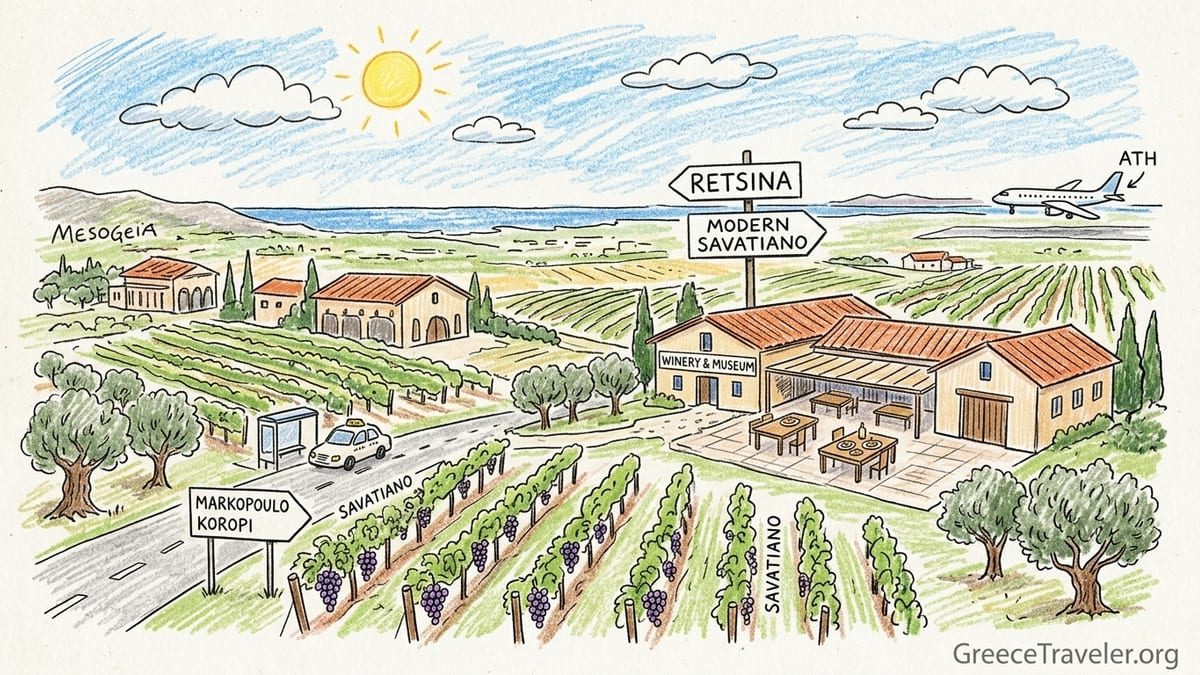
Getting Oriented: Mesogeia’s Vineyards, And Why Savatiano Matters
Mesogeia is the practical wine day trip: close enough to Athens that you can do tastings without giving up an entire island day, but rural enough that the landscape still reads as farmland. Official tourism sources describe Attica as having roughly 6,500 hectares of vineyards dominated by Savatiano and Roditis, and that scale makes sense once you start driving the back roads: vines pop up between fig trees, olive groves, and pockets of development, with the airport never far from the horizon.
If you’ve only met Savatiano in anonymous carafes at tavernas, it’s easy to file it under “simple.” That expectation is exactly what Mesogeia is best at dismantling. Savatiano can be crisp and citrusy in stainless steel, textural and savory on lees, unexpectedly structured from older vines, and surprisingly compelling as modern retsina when resin is used with restraint rather than as a blunt instrument.
What I didn’t expect was how often producers in this corridor treat Savatiano as a serious, signature grape rather than a neutral base. On the right day, with the right guide, you can taste the argument in real time: the same variety, different vinifications, and suddenly “Athens wine” feels like a category worth traveling for, not just something to drink because it’s there.
Winery Visit 1: Markou Vineyards In Peania, Where Savatiano Starts Making Sense
I reached Markou Vineyards in Peania by combining Athens public transport with a short taxi hop, the low-stress approach when you don’t want to drive after tasting. Markou publicly lists hours of operation as Monday through Saturday, 9:00am to 5:00pm, and notes it is closed Sundays, which helped me plan a weekday visit that still left time for a second stop. The visit itself is set up like a small museum day with wine at the end, and it works because it gives Savatiano context beyond the glass.
The Markou Wine Museum anchors the experience. The tour, as presented by the winery, begins on the grounds of a Savatiano vineyard plot beside the museum, then continues through exhibits and ends at an outdoor patio garden for the tasting. In practice, that meant stepping outside first to look at vines before the palate fatigue sets in, then returning to shade and old tools and stories, and finally sitting down at heavy wooden tables for wine with simple local bites.
My guide leaned into a theme that kept resurfacing all day: Savatiano is less about loud aromatics and more about texture, herbs, and the kind of “dry field” scents you only notice once someone names them. I tasted through a lineup that included a straight Savatiano bottling, a retsina made from 100% Savatiano, and a barrel-influenced Savatiano label that the official Athens guide specifically flags as worth seeking out. I also tried Markou’s Malagousia alongside, partly as a palate reset and partly because the region’s wineries often use Malagousia to show visitors something more overtly aromatic.
The tasting format here felt unhurried and educational rather than rushed, and I spent about two hours all-in, including the museum portion and time lingering on the patio. The bottle I most wanted to buy afterward was the barrel-fermented Savatiano style, because it contradicted my preconception most sharply: less “thin taverna white,” more structured and food-ready, with enough grip to stand up to grilled fish or lemony chicken without disappearing.
Winery Visit 2: Domaine Papagiannakos In Markopoulo, And The Retsina That Changed My Mind
For a second Mesogeia stop, I aimed for Domaine Papagiannakos near Markopoulo, which the official Athens guide highlights as a key public-facing winery in the area. The estate itself frames the visit as wine tourism “upon request,” meaning advance coordination is the rule rather than the exception. In other words, this isn’t a casual drop-in tasting room; you plan it, you confirm it, and you show up on time.
The setting is exactly what a day tripper hopes Mesogeia will be: a quiet pocket of vineyards and trees that makes Athens feel far away even though it’s close enough to do this between lunch and dinner. Their retsina is the headline for many visitors, and reading the producer’s own technical description before tasting helped calibrate expectations. This is Savatiano from older vines, fermented in stainless steel at controlled temperatures, with pine resin added during fermentation, designed to be balanced rather than aggressively resinous.
In the glass, the experience was a reset button. I arrived expecting the kind of pine-sap intensity that bulldozes food and dominates conversation. Instead, the resin read as a seasoning, with citrus lift and an herbal edge that made the wine feel deliberate. It didn’t taste like a gimmick or a dare. It tasted like something you could pair.
Food pairings are where modern retsina either wins you over or loses you. Here, with simple regional snacks, the wine finally clicked as a table wine rather than a novelty. I found myself thinking about classic seaside plates: fried small fish, grilled calamari, tzatziki, and tomato salads with oregano. By the end, the bottle I most wanted to buy wasn’t a trophy red, it was that retsina, precisely because it would travel home well as a conversation starter that actually tastes good.
Winery Visit 3: Nikolou Winery Near Koropi, A Deep Dive Tasting With Real Food
If your goal is to taste Savatiano in multiple “personalities” in one sitting, Nikolou Winery is designed for it. The winery’s experiences page makes it clear that tours and tastings happen only with prior reservation, and that the overall visit typically runs two to three hours. It also answers the real traveler question bluntly: yes, you can come by public transport, using the Koropi metro and suburban rail station as the transit anchor, then taking a short taxi ride from the station to the winery, commonly described as around five minutes.
That transport detail matters in Attica because it creates a safe, repeatable pattern for visitors who don’t want a rental car: metro to Koropi, taxi to winery, taste, taxi back, metro into the city. I followed that model and found it far less stressful than trying to piece together multiple buses, especially when you are on a tight schedule and want to arrive with a clear head for a structured tasting.
On the tasting side, Nikolou emphasizes hospitality with food: the winery states that tasting options include an individual plate for each visitor with appetizers, shared bread, olive oil and olives, and additional bites during the tasting, with sweet wine paired with a dessert bite. That is a very different feel from the “three pours and goodbye” model. It also means you can treat this as a late lunch, especially if you’ve had a light breakfast and plan to eat a full dinner back in Athens.
What I wanted here was contrast. The winery explicitly offers a “Savatiano Panorama” style experience built around multiple vinifications of Savatiano, including retsina variations and sparkling options. I treated it as a controlled experiment: how does the same grape behave when it’s handled in radically different ways? The answer, after a long, food-supported tasting, was that Savatiano’s biggest asset is not perfume, it is structure. When you taste it side by side across styles, you notice a consistent thread of body and savory herb tones that can carry more winemaking choices than I expected.
When it came time to think like a traveler buying bottles, my impulse purchases were the “table problem-solvers”: a clean, dry Savatiano for weekday drinking and a modern retsina for food nights. I also found myself tempted by the more experimental bottlings because they felt like bottles you cannot easily replace once you leave Greece.
Optional Stop North Of Mesogeia: Kokotos Estate In Stamata For A Different Attica Mood
Not every Attica wine day has to stay strictly east of Athens. If you’re building a two-day wine weekend, or you want to pair one Mesogeia winery with a northern Attica landscape change, Kokotos Estate in Stamata offers a contrasting atmosphere. Kokotos lists opening hours as 10:00 to 15:00 daily except public holidays, with an explicit request to call ahead for an appointment to visit. It also publishes a clear weekday pricing example: a private vineyard tour and tasting of three wines for 20 euros per person, with a stated duration of about 1.5 hours and a minimum charge for the private experience.
The appeal here is the format: the estate describes a walk by the vineyard with panoramic views, then a tour of the winery and barrel cellar, and finally the tasting in a room overlooking the vineyards. After the flatter, more open Mesogeia plain, the “panoramic” language is not marketing fluff. The air feels different, the light reads as mountain light rather than sea-breeze farmland, and the visit becomes as much about place as about labels.
For me, this stop functioned as a palate and mood reset: less focus on retsina identity debates, more focus on a classic winery narrative of vineyard, cellar, and table. I spent about 90 minutes door-to-door once on site, which made it realistic to combine with lunch in the northern suburbs or an afternoon return to Athens for museum time.
If your main mission is Savatiano in Mesogeia, you could skip Stamata. But if you’re the kind of traveler who wants your wine memories to include different landscapes, not just different winemaking techniques, it is a strong add-on, especially because the estate’s published pricing and duration make planning straightforward.
Guided Wine Tour Vs Going Independently: What I’d Do Differently Next Time
I’ve visited wine regions both ways, and Attica is one of those places where the choice changes the entire day. Going independently is cheaper, more flexible, and easier to shape around your schedule, especially because Mesogeia is so close to Athens that you can fit visits between other plans. The trade-off is friction: coordinating appointments, handling transport between wineries, and making sure you’re not stuck somewhere rural refreshing a taxi app.
Guided tours can solve those pain points, but you pay for the convenience. Publicly marketed half-day and full-day Mesogeia wine tours can run into the hundreds of euros per person depending on inclusions and group size, which may be a fair value for travelers short on time but is often more than the wine itself will cost. I’ve done guided tours elsewhere when the region is hard to navigate or when a guide unlocks meaningful access. In Attica, the main reason I would book a guided option is transport and sequencing: someone else driving, someone else keeping time, and the ability to taste without watching the clock.
For independent travelers, I’d plan one “deep” appointment-based winery per day rather than trying to sprint through three. Nikolou’s own guidance that a full visit runs two to three hours is a good example of why: if you treat visits seriously, you’ll want time to talk, taste, and decompress. Two wineries in one day is realistic if you start early and keep the tastings focused. Three is possible only if at least one is a short, prearranged tasting.
On transport, I found the hybrid method best: use the Athens metro and suburban rail to reach the Koropi area, then use taxis for the last-mile hops to and from wineries. That approach kept costs reasonable, avoided the risks of driving after alcohol, and still allowed me to move like a traveler rather than a tour participant. The key is to schedule your return window so you are not rushing through the last pours.
The Takeaway
I went to Mesogeia expecting to confirm what I thought I already knew: that Savatiano is “fine,” and retsina is something you try once as a joke. Instead, winery visits around Peania, Markopoulo, and Koropi made Savatiano feel like a grape worth chasing on purpose, especially when producers show it in multiple vinifications rather than a single house style.
The biggest shift was retsina. In the hands of estates treating resin like seasoning, not camouflage, retsina stopped tasting like a punchline and started tasting like a food wine with a point of view. It also made my taverna memories make more sense: retsina works best when it has something salty, garlicky, or briny to bounce off.
If I had to sum up Attica as a wine destination in one line, it would be this: it’s the easiest serious wine day trip you can do from Athens, and the wines you’ll want to buy are not necessarily the ones you expected to like. I arrived thinking I’d load up on aromatic whites. I left wanting Savatiano with texture, and a modern retsina I’d be proud to pour for friends back home.
FAQ
Q1. Do I need to book winery visits in Mesogeia in advance?
Yes for most serious visits. Several Attica wineries run tours and tastings by appointment, and some explicitly require advance booking for tastings and tours.
Q2. Which Mesogeia wineries are currently known to welcome visitors?
Markou Vineyards in Peania promotes daily tours and tastings during its stated business hours (closed Sundays). Domaine Papagiannakos offers wine tourism upon request. Nikolou Winery states tours and tastings are by prior reservation.
Q3. Can I reach Attica wineries without renting a car?
In many cases, yes. A practical method is to take the Athens metro and suburban rail to Koropi station, then use a short taxi ride for the last stretch to wineries in the area.
Q4. What are Markou Vineyards’ published opening hours?
Markou Vineyards lists hours of operation Monday through Saturday, 9:00am to 5:00pm, and notes it is closed on Sundays.
Q5. How long should I budget for a winery visit near Athens?
Plan at least 90 minutes for a short tour and tasting. Some wineries describe a full visit experience of roughly two to three hours, especially when food is included.
Q6. What does a Nikolou Winery visit include?
Nikolou describes a guided visit through production areas and cellar spaces followed by a tasting accompanied by food, including individual appetizer plates plus shared bread, olive oil and olives.
Q7. Has retsina improved, or is it still an acquired taste?
Both can be true. Modern producers in Attica make retsina designed to be balanced, with a finer pine character, and it can be far more food-friendly than many travelers expect.
Q8. What foods pair well with Savatiano and retsina?
Savatiano’s structure works with grilled fish, lemony chicken, and classic mezze. Modern retsina often shines with seafood, fried fish, tzatziki, and herb-forward salads.
Q9. Is a guided wine tour worth it in Attica?
It depends on your priorities. Guided tours can simplify transport and timing, but independent visits can be more affordable and flexible if you are comfortable arranging appointments and taxis.
Q10. If I only buy two bottles after tasting in Mesogeia, what should they be?
A dry Savatiano that shows texture and body, plus a modern retsina from a quality producer, is a strong two-bottle snapshot of what Mesogeia does best.