


I didn’t choose the Attica coast because I wanted a resort holiday. I chose it because I wanted Athens with a coastline I could actually use: morning swims, easy dinners by the sea, and the option to dip into the Acropolis-and-museums loop without feeling like I’d signed up for a daily commute. Over multiple trips I tested the Athenian Riviera the way most travelers do in real life: one neighborhood at a time, one dinner walk at a time, one taxi receipt at a time. This guide is written from those overnight stays, with an emphasis on what changed for me when I shifted bases and why base selection matters here more than the hotel you pick.
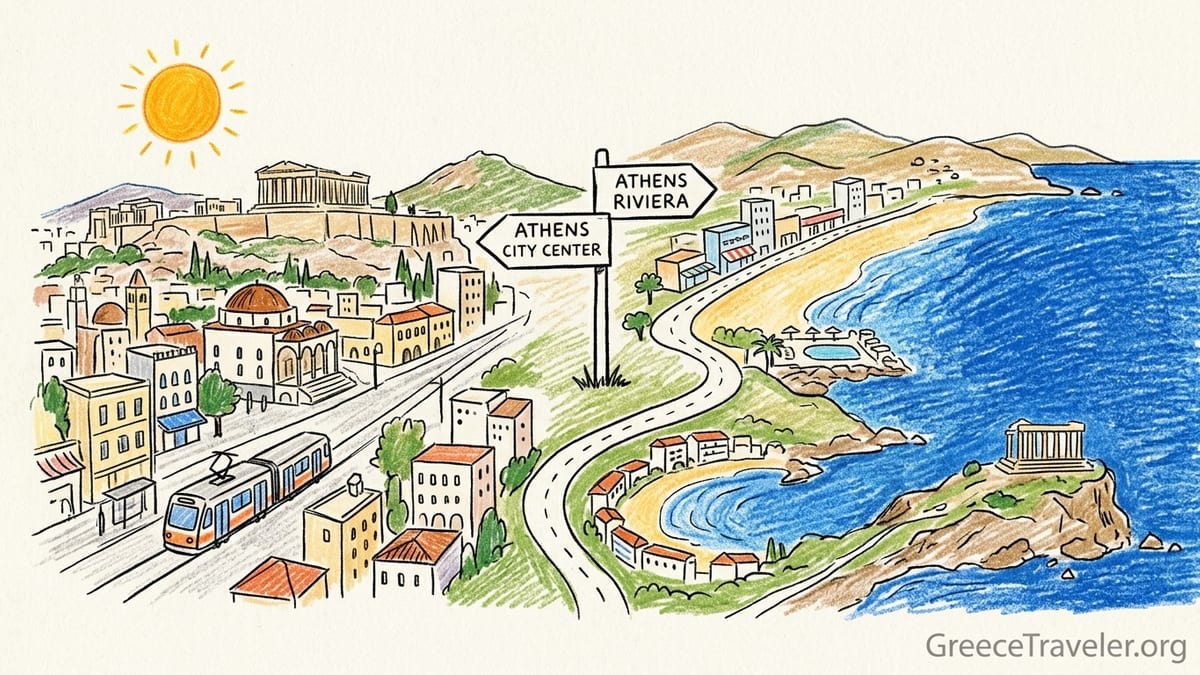
First, Decide If You’re Sleeping In Athens Or Using The Coast As Your Launchpad
If your Athens plan looks like: Acropolis Museum in the morning, Plaka in the afternoon, cocktails in Koukaki, and a late-night food stop after, then central Athens is still the easiest answer. The coast works best when you want a “two-speed” trip: culture on some days, saltwater and long dinners on others.
What surprised me is how different the Riviera feels depending on where you land. North-coast bases (like Glyfada) behave like suburbs with a beach option. Mid-coast bases (Vouliagmeni) feel like a compact resort town with high-priced beach clubs and a calmer rhythm. Farther south (Varkiza into Lagonisi) the coast becomes more car-oriented and “house party” quiet on weekdays, busy on summer weekends. At Sounion, you’re no longer doing Athens casually; you’re committing to a coastal break with one big headline sight.
The other big reality check is transportation. The Athens Tram exists and it’s genuinely useful for parts of the Riviera, but the airport is not on the tram, and late dinners plus long coastal stretches can quickly turn a “we’ll just use public transport” plan into a taxi-dependent holiday. In practical terms, the best base is the one that reduces the number of times you have to think about transport at all.
Glyfada: My Best “City-Plus-Beach” Compromise (When I Didn’t Need Perfect Quiet)
When I stayed in Glyfada, it felt like I’d placed myself in the middle of the action on the Riviera. There’s a strong “real neighborhood” energy here: retail streets, coffee culture, and lots of people heading out after dark. On nights when I wanted dinner and a walk afterward, Glyfada was the easiest coastal base for that specific routine. I could finish a meal, wander without a plan, and not feel like the streets emptied the moment the restaurant bill hit the table.
The trade-off was noise and “city friction.” Some streets carry steady traffic, and in peak season I noticed that the soundscape could be part waves, part motorcycles. This is not the base I’d choose if I needed absolute calm after 11 p.m. But it is the base I’d choose if I wanted to feel like I could go out every night without planning a ride home.
Beach access in Glyfada can be deceptively variable. You might be near the water on a map and still find yourself negotiating busy roads or deciding between a paid organized section and a more casual setup where you bring your own towel. For me, Glyfada was less about “the beach is right there” and more about “the beach is part of my day if I want it.” I’d swim or sit seaside, then pivot back into shopping streets and dinner without changing neighborhoods.
For Athens sightseeing days, Glyfada’s big advantage was that it didn’t feel isolated. The tram lines are a real factor for the broader area: Athens’ tram network includes Line T6 between Syntagma and Pikrodafni and Line T7 running along the coast between Asklipiio Voulas and Agia Triada, with STASY noting 24-hour tram service on Saturdays (airport routes excluded). The important lived detail is this: I was willing to do the ride for a museum day, but I never felt tempted to “pop into Athens for an hour” the way I would from a central base. Once you go in, you’re in for a longer outing.
Vouliagmeni: The Base That Made Beach Days Effortless (And Nights Feel Grown-Up)
Vouliagmeni is where I stayed when I wanted the Riviera to feel like a destination, not just a coastal extension of Athens. The neighborhood felt polished and self-contained, with the kind of quiet confidence that makes you slow down. My dinners here were the “sit longer, order dessert” kind, and walking afterward felt calmer and more coastal-resort than nightlife district.
From a practical standpoint, Vouliagmeni’s main advantage is the density of high-quality swim options. It’s one of the few places around Athens where you can structure an entire day around water without driving: start with a morning at the beach, take a long lunch, then pick a second swim spot late afternoon. I also liked that Vouliagmeni makes “just one swim” feel worth it, because the water and setting are a step up from what most first-time Athens visitors expect.
This is also where prices can jump. Vouliagmeni is home to Astir Beach, which operates with published rules and a strong “premium” posture. In summer coverage for 2026, Astir’s entrance fee and paid seating options are frequently discussed in Greek and expat media, and the venue itself publishes regulations for 2026. In other words, you can absolutely spend a fortune here if you treat the beach like a day club. The real-world workaround I used: I didn’t make every swim day an Astir day. Vouliagmeni still works even if you pick one splurge afternoon and keep the rest simple.
Vouliagmeni also gave me an “Athens escape hatch.” I could do central Athens one day, then do the opposite the next: a slow morning by the water, dinner close to the hotel, and an early night. If you’re building a trip for two people where one loves museums and the other wants the sea, Vouliagmeni is one of the easiest places to keep both happy with minimal negotiation.
Varkiza And Lagonisi: The Car-Oriented Coast That Felt Like A True Break (With A Catch)
Varkiza into Lagonisi was the stretch where the Riviera stopped behaving like a transit corridor and started behaving like a vacation coastline. On days when I wanted a quiet coastal break, this area did that best: fewer reasons to go “into town,” more reasons to stay local, and a sense that evenings were about the seaside rather than an agenda.
The catch is walkability after dinner. Depending on exactly where you stay, you might have a nice seafront stroll, or you might have a short walk that runs out of sidewalk and turns into “we should have taken the taxi.” I found myself paying much more attention to micro-location here than in Glyfada or Vouliagmeni. A hotel that looks near the sea can still feel cut off at night if the surrounding streets aren’t built for strolling.
Lagonisi also amplified the “beach access choices” question: free public spots versus paid resort-style beaches. Discover Greece notes that Lagonisi has a public beachfront as well as a fully equipped resort beach connected to a luxury hotel complex. That matches my experience of the area’s vibe: it’s easy to find calm coves and quieter water, but many of the glossy beach setups are tied to hotels or operate as paid experiences. It’s a great base if you want to pick your beach mood day by day, but less ideal if you want one simple, consistent beach right outside your door.
For Athens sightseeing, this base changed my behavior the most. I did fewer “Athens days” here because each day in the city felt like a bigger undertaking. If your trip priorities are 70% coast and 30% Athens, Varkiza-Lagonisi works beautifully. If it’s the other way around, this is where you start feeling like you misplaced yourself.
Sounion: The Base I Loved For Silence And Sunsets (But Not For Daily Athens)
Staying near Sounion felt like pressing pause on Athens entirely. The evenings were the highlight: the kind of quiet where the background noise is wind and distant traffic rather than voices outside your window. After dinner, walking was about the sky and the sea, not about storefronts and people-watching. If you want the coast to be the point of the trip, Sounion makes that clear immediately.
The obvious upside is the Temple of Poseidon and the whole Cape Sounion landscape. The less obvious upside is that it’s a strong “culture-and-swim” day even when you don’t feel like a museum. You can do the ancient site, then pivot straight to water without having to reorganize your day around transport back to Athens.
The downside is taxi dependence and the loss of casual variety. In Glyfada, I could change dinner plans at 9 p.m. and walk into a different scene. Near Sounion, you plan more. If the restaurant you wanted is booked or closed, you feel it. And Athens becomes a once-or-twice mission, not a daily option.
Public bus service exists between Athens and Sounion via KTEL Attikis, but you’ll still want to verify the latest timetable close to travel and understand that the “last bus” dictates your whole evening. One of the most important things I learned here: even when a bus exists, you may still end up in a taxi for the final leg if your accommodation isn’t directly on the route.
What About Northern Attica Or Piraeus-Side Coastal Bases?
I have also used coastal stays away from the classic “Riviera postcard” zone when my trip wasn’t really about swimming. Northern Attica and the Piraeus-side coast can make sense if you’re mixing Athens with ferries, events, or specific suburbs. But as a pure beach base, it’s simply a different coastline experience, and not what most travelers imagine when they say “Athens beach holiday.”
For example, the Palaio Faliro area has a developed seaside promenade and parks dating back to post-2004 redevelopment, which makes it pleasant for walking and casual evening time outdoors. What it did not give me, in the way Vouliagmeni did, was the feeling that I was one decision away from a truly satisfying swim. It felt like a waterfront city neighborhood, not a beach destination.
If your goal is day trips like Delphi, Meteora, or Peloponnese circuits, a central Athens base usually wins. The coast becomes a better choice when your day trips are coastal: Sounion, beach-hopping, or a “do nothing, then dinner” rhythm.
How My Base Changed Real Transit: Athens Sights, Airport Runs, And Dinner Logistics
On paper, everything on the Riviera is “close to Athens.” In practice, what mattered to me was the shape of the day. From the coast, an Acropolis day wasn’t just a museum visit; it became an outing with a definite start time, an earlier dinner, and a real return journey. I found myself doing fewer late-night city moments simply because getting back to the coast late felt like a different kind of tired.
Airport logistics are also more specific than most guides admit. Athens Airport taxis have a legally fixed flat rate to central Athens of €40 by day and €55 at night, which is unusually clear and predictable. But that fixed price is for the city center. If you’re staying on the coast, you’re outside the simplest fixed-fare narrative, and you should plan for a metered fare or prearranged transfer rather than assuming the “airport taxi price” you saw online applies to your Riviera hotel.
The tram helped me most on days when I wanted to avoid getting trapped in traffic. It’s not fast like a metro, but it’s steady, and it drops you into coastal areas without the parking stress that comes with renting a car. The key is to choose a base that’s actually convenient to a tram stop if you plan to use it. “Near the tram” can mean a 20-minute walk across big roads in summer heat if you pick the wrong block.
Finally, dinner logistics were the daily differentiator. In Glyfada, I walked after dinner almost every night because it felt natural and safe. In Vouliagmeni, I walked too, but it was quieter, more “resort evening.” In parts of Varkiza-Lagonisi, I walked only when I knew the route had sidewalks and lighting; otherwise, I defaulted to taxis. And near Sounion, I walked for atmosphere, not errands. Those patterns shaped my happiness more than beach photos ever did.
The Takeaway
If you want a true Athens trip with beaches as occasional add-ons, stay in central Athens and treat the coast as a day trip. You’ll see more, eat later, and you’ll stop thinking about transit.
If you want a city-plus-beach holiday where you can still do the Acropolis without burning a whole day, I would base in Glyfada or Vouliagmeni. Glyfada worked best for me when I wanted lively nights, lots of restaurant choice, and the feeling I could stroll after dinner. Vouliagmeni worked best when I wanted an upscale, calmer coastal rhythm with easy swim days and one or two splurge beach experiences.
If you want a quiet coastal break, pick Varkiza-Lagonisi or Sounion depending on how quiet you mean. Varkiza-Lagonisi gave me a “vacation coastline” feeling but required smarter micro-location choices to avoid constant taxis. Sounion delivered the most peaceful nights and the strongest sunset energy, but it’s not where I’d stay if I planned to visit Athens sights daily.
For a final night before flying home, I would choose based on stress tolerance. If you want the simplest airport story and an easy, fixed-fare taxi to the center, sleep in central Athens. If you want one last sea-view dinner and a calmer goodbye to Greece, a coastal hotel can be wonderful, but plan the airport transfer in advance and don’t assume the city-center taxi flat rate applies.
FAQ
Q1. Should I stay in central Athens or on the Attica coast?
Choose central Athens if you want late nights and nonstop sightseeing. Choose the coast if you want swim days and quieter evenings, and you’re okay with longer trips into the city.
Q2. Which coastal base felt easiest without renting a car?
Glyfada and Vouliagmeni felt the easiest for me because I could combine walking, taxis when needed, and tram access in the broader area without feeling stranded.
Q3. Which base is best for a city-plus-beach holiday?
Glyfada if you want more nightlife and restaurant variety, Vouliagmeni if you want a calmer, more resort-like feel with high-quality swim options.
Q4. Which base is best for a quiet coastal break?
Varkiza-Lagonisi if you still want choices and beach variety. Sounion if you want the quietest nights and a sunset-focused stay.
Q5. How realistic is it to sightsee in Athens every day from the coast?
It’s doable, but it changes the feel of your trip. For me it turned Athens visits into full outings rather than quick, spontaneous pop-ins.
Q6. Is the Athens tram genuinely useful for beach access?
Yes for parts of the Riviera, especially if your hotel is truly close to a stop. It’s steady and avoids parking stress, but it won’t solve airport transfers.
Q7. Are beaches on the Athens Riviera free?
Some are free public beaches where you bring your own towel and shade. Many organized beaches charge entry, and premium beach clubs can be expensive.
Q8. Is Vouliagmeni too expensive to use as a base?
It can be pricey if you do paid beach clubs daily. It still works if you mix one splurge day with simpler swim spots and keep dinners local.
Q9. What’s the simplest base for a last night before a flight?
Central Athens is simplest because the airport taxi fare to the city center is a fixed flat rate. Coastal hotels can still work, but plan the transfer and timing carefully.
Q10. If I only have two coastal nights, where would you put them?
I’d choose Vouliagmeni for the highest “vacation payoff” per night, especially if you want one great swim day and an easy, grown-up dinner scene.