


I went to Lake Vouliagmeni expecting a pretty swim. What I got was something closer to a bookable, timed, rules-driven “water experience” that felt more like a spa day pass than a beach day. The scenery is real, the mineral water is the headline, and yes, it’s one of the Athens Riviera’s most iconic swims. But the decision you make at checkout, basic entry or upgraded seating, and the way the lake manages capacity, timing, and what you can bring inside, ends up shaping the day as much as the turquoise water does.
Before You Go: What You’re Actually Buying With a Lake Vouliagmeni Ticket
Lake Vouliagmeni is not a “roll up with a towel and figure it out” beach. Swimming is only allowed with a ticket, and the lake operates like a controlled facility with a set capacity, staffed lifeguards, changing areas, and an on-site cafe-restaurant setup. That’s part of what makes it easy and part of what makes it feel different from the coast. You are paying for managed access to a protected natural site, plus the convenience layer built around it.
The first practical reality that matters: same-day reservations are not possible. That single line changes how you plan an Athens Riviera day, especially in high season when you might otherwise play it by ear. If you’re staying in central Athens and thinking, “I’ll see how hot it gets and decide,” the lake’s policy pushes you into planning ahead rather than chasing the weather.
Officially published operating hours vary by season across the year, with longer hours through late spring and summer. The annual schedule posted by the lake is specific by date ranges, and it’s the kind of detail you should check right before you travel because it is not “one schedule all year.” The lake also notes the water temperature varies seasonally, and the official range is roughly 22 to 29 degrees Celsius, which helps explain why people treat this as a shoulder-season swim, not just a July photo stop.
Then there’s the “how long can I stay?” question. The lake’s regulations state that your ticket expires 60 minutes after you exit the swimming area. In practice, that means you can’t treat the swimming zone like an in-and-out basecamp the way you would at a public beach. If you leave the swimming area to do something that counts as “exit,” you should assume you’re starting a clock, which makes the day pass feel more structured than casual.
Arrival In Vouliagmeni: The First Five Minutes Set the Tone
I approached Lake Vouliagmeni the way I approach most natural swims: arrive early, find a calm corner, swim, then decide if I want to commit to staying. The lake doesn’t really work that way, because your “corner” depends on what you book, what’s available, and how the facility is managing the day. It’s not unfriendly, but it’s organized.
One immediate advantage is that complimentary parking is listed among the lake’s facilities. If you’ve done the Athens Riviera in summer, you know parking alone can feel like a competitive sport. Having designated parking included takes a layer of stress off, especially if you’re driving down from central Athens or coming from a coastal hotel further along the shore.
The check-in flow feels closer to a venue entrance than a beach. There’s reception service, ticket rules, and staff directing people. That sounds obvious, but it matters: it’s not a stretch of sand where you wander until you find space. You arrive, you’re processed, you’re in a managed environment.
Crowd levels at Lake Vouliagmeni can spike because the capacity is limited. The lake’s published regulations cite a capacity of 300 people (with potential adjustments depending on government guidelines). That limit is the reason the lake can feel calm even on popular days, but it’s also why you can be denied entry if it’s full, and why planning and reservations matter in peak periods.
Booking And Check-In: Basic Entry vs Upgraded Seating Is the Real Decision
For summer 2026 coverage, you’ll see Lake Vouliagmeni discussed the way you see a beach club: a place with a base ticket and an upsell to better seating zones. That’s not just marketing language. The seating you choose changes your day, because shade, personal space, and “where you land” when you’re not in the water are huge factors at the lake.
Admission pricing is commonly discussed as weekday versus weekend, with different categories for adults and kids, plus reduced categories such as students. For 2026, local coverage has cited general adult admission as 17 euros on weekdays and 19 euros on weekends and official holidays, with children 6 to 12 priced lower, and children up to age 5 free. The same reporting also describes a menu of upgraded seat options, including pairs-based “sets” and cabanas, with prices that can climb into the 40 to 140 euro range depending on the day and what zone you pick.
I’m careful with that kind of information when I travel because third-party blogs go stale fast. What mattered to me was what the lake itself says about how tickets work: tickets are valid only for the day of issuance, non-transferable, and non-refundable. Reduced tickets require proof. It sounds strict, but it’s what keeps the system functioning when the lake is busy.
On the ground, the best way I can describe the decision is this: basic entry gets you in the water, but upgraded seating buys you time. If you’re only planning a swim and a drink, basic entry can make sense. If you want to linger, read, snack, do a second swim, and stay through midday heat, the comfort of your base matters, and the lake’s “bookable seating” approach starts to look like the difference between “I’ll stay an hour” and “I could stay all day.”
Changing Rooms, Lockers, And The Practicalities Nobody Puts In The Instagram Reel
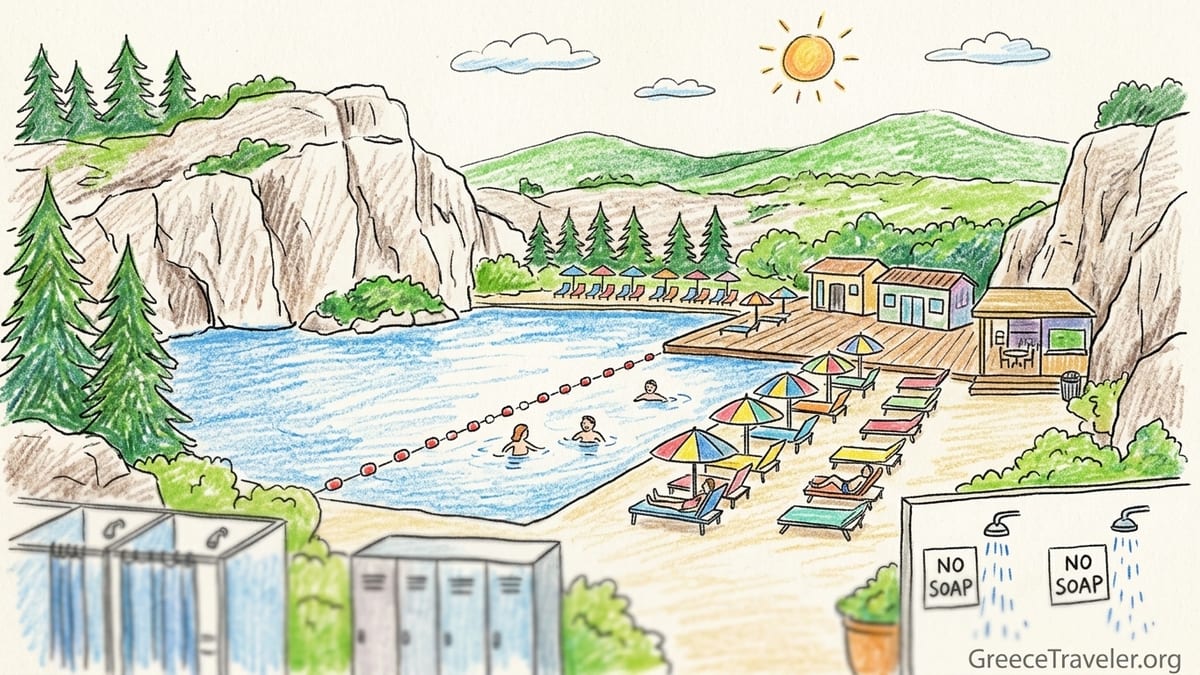
Lake Vouliagmeni lists lockers, changing rooms, and showers among its facilities, and that’s not a footnote. It’s the reason the lake works as a stop in a wider day. If you’re coming from a city hotel, the ability to change properly and rinse off makes it realistic to continue to dinner or onward to another destination without feeling like you’re hauling half the beach back with you.
I used the lockers because I didn’t want to be the person trying to keep a phone, wallet, and car keys dry on a sunbed. The regulations emphasize that lockers are provided near changing rooms for valuables, while also making the standard liability point: management is not responsible for loss or damage to belongings. Translation: use the locker, but don’t treat the place like an insured vault.
Showers are available with hot and cold water, but the lake’s rules prohibit using shampoo and soap, specifically for environmental reasons. That detail makes the lake feel less like a pool complex and more like a protected natural site with facility add-ons. You can rinse off. You can’t do a full “post-beach everything shower” with products.
One more practical note that shaped my day: you can’t bring in outside food and drinks. The lake’s official FAQ says outside food and drinks are not permitted, and directs you to the on-site restaurant and snack bar. That affects what you pack and how long you want to stay. At a normal beach, I’ll bring water, fruit, maybe a sandwich. Here, you either plan to buy refreshments inside or you plan to keep the visit shorter.
My Swim: Water Temperature, Depth, And What Felt Different From A Normal Beach
The first thing that felt different was the water itself. This isn’t seawater surf. It’s a thermal lake environment, and the lake openly frames the swim as “therapeutic” and seasonally warm, with temperatures that typically sit in the low-to-high 20s Celsius depending on season. The sensation is closer to slipping into a warm natural pool than bracing for a cold Aegean shock.
The second difference is the edges. At a beach, you walk in, you feel the sand shift, the water gets deeper gradually. At Lake Vouliagmeni, the swim zone is defined and clearly marked with floating buoys. The rules are explicit that swimming outside designated areas is prohibited. Instead of an open coastline, you get a contained swim space where lifeguards have a clear line of sight.
I’m not going to pretend I free-dove the whole lake. I swam easy laps and floated. The best moments were when I stopped moving and noticed how quiet it felt compared to the coast: less wind noise, no waves, and a kind of sheltered acoustics from the rock walls and trees. It felt like swimming inside a natural amphitheater.
How long did I actually want to stay? Longer than I expected, but not all day. For me, the “sweet spot” was about two to three hours on site. That included check-in, changing, a proper swim, time on my seat with a drink, and one more dip. Past that, I started to feel the difference between a lake facility and a beach: at a beach, I can sprawl, snack, nap, and drift in and out of the sea for six hours. Here, the structured environment made me feel done sooner, even though I loved the swim itself.
Seating, Shade, Food, And Crowd Level: The Day-Pass Reality Check
Seating is where Lake Vouliagmeni can feel like a Riviera venue rather than a wild swim. The lake lists sunbeds, tables, and umbrellas as part of the visitor setup. In the real world, that translates to a place where you can comfortably pause between swims, but where the quality of your pause depends on how crowded it is and what kind of seat you have secured.
I aimed for shade, because the lake day can quickly turn into “full sun off the water” exposure, and I didn’t want to burn in a place I came to relax. If you’re visiting in the high summer window, I’d treat shade like a priority rather than a bonus. The fact that there are upgraded areas on the lake map, and that upgraded seating is part of the 2026 pricing conversation, tells you what regulars are paying for: not more lake, but more comfort while you’re not swimming.
Food and drinks are integrated into the experience because you can’t bring your own. The official FAQ points visitors to the on-site restaurant and snack bar. That can be a positive if you want an easy day where you don’t think about packing anything, and a negative if you’re budgeting carefully. I found that it nudged the experience closer to a paid leisure venue: you’re not just buying water access, you’re buying into an ecosystem where your lunch and iced coffee are part of the spend.
As for crowds, the lake’s capacity cap is the key detail. Even when it felt busy, it didn’t feel like a packed urban beach where towels overlap. The tradeoff is psychological: the lake feels calmer, but also more monitored and managed. If you love the freedom of a public shoreline, you may feel slightly contained here. If you hate fighting for space, you will appreciate the structure.
Should You Combine It With Vouliagmeni Beach Or Cape Sounion? What Made Sense For Me
The most common pairing you’ll see in current travel coverage is Lake Vouliagmeni plus Cape Sounion, often marketed as a “swim and temple” day. Tour platforms still sell itineraries that run an Athens Riviera escape to the lake and then onward to the Temple of Poseidon. The logic is simple: the lake is a bookable swim, and Sounion is a sunset destination that feels grand even if you only have half a day.
From my perspective, combining the lake with Cape Sounion only makes sense if the lake is your earlier anchor, not a rushed stop. Because reservations and capacity management shape your entry, you don’t want to be stressed about a departure time the minute you arrive. If you’re doing Sounion later, I’d book the lake for the morning or early midday so you can actually enjoy the swim and still have energy for the drive and the historic site later.
Combining the lake with Vouliagmeni Beach can work, but I wouldn’t do it as a “two swims back-to-back” plan unless you’re the type who can’t sit still. The lake and the beach scratch different itches. The beach is salty, windy, open, and social. The lake is warm, contained, and quiet. What I liked was using them as different days or different halves: lake for the structured, comfortable, mineral-water swim; beach for a long, lazy coast session.
The practical limiter is cost. If you pay for the lake and then also pay for an organized beach entrance, sunbed set, or club minimum, you can turn one day into a serious splurge. I found it smarter to choose one “paid water experience” per day and let the other be simpler, like a public stretch of coastline or a quick stop for a coffee with a sea view.
The Takeaway: Is The Lake Worth It Compared With A Riviera Beach Club?
Lake Vouliagmeni felt worth it to me because it delivered something I cannot get from a typical Athens Riviera beach club: that warm, mineral-water sensation in a dramatic natural bowl, plus the feeling of swimming in a place that is treated like a protected site rather than just another shoreline. The lake is also operationally convenient: lockers, changing rooms, showers, lifeguards, and on-site food all make it easy to slot into a travel day.
But if your personal definition of “worth it” is a full-service lounging day, a beach club can win. A club day often buys you a predictable sunbed setup, longer lounging rhythm, and the simple joy of the sea. The lake’s rules, its no-outside-food policy, and the fact that you’re swimming inside a designated buoyed area make it feel less free-form than a beach day.
My honest comparison is this: the lake felt like a signature two-to-three-hour experience I would recommend to first-time Athens Riviera visitors who want something distinct. A beach club felt like the better choice for an all-day hang, especially if your group wants music, long lunches, and that “we’re posted here until sunset” energy.
If you’re torn, here’s the decision I’d make again: I would pay for Lake Vouliagmeni once per trip as the headline swim, then pick a simpler beach day elsewhere on the Riviera. That way the lake ticket feels like a memorable purchase rather than one more daily entrance fee in a week of them.
FAQ
Q1. Do I need a reservation to swim at Lake Vouliagmeni?
Same-day reservations are not possible, so if reservations are required for your date you’ll need to plan ahead rather than showing up last-minute.
Q2. What are Lake Vouliagmeni’s operating hours?
The lake posts an annual schedule with hours that change by season and date range, with longer hours through late spring and summer.
Q3. Can I swim without buying a ticket?
No. Swimming is only permitted with a ticket, and tickets are valid for the day of issuance.
Q4. Can I bring my own food and drinks inside?
No. Outside food and drinks are not permitted, and visitors are directed to the on-site restaurant and snack bar.
Q5. Are there lockers and changing rooms?
Yes. The lake lists lockers, changing rooms, and showers as available facilities.
Q6. Are showers available, and can I use shampoo?
Showers with hot and cold water are available, but the use of shampoo and soap is prohibited for environmental reasons.
Q7. What is the water temperature like?
The lake states the temperature varies by season and typically ranges from about 22 to 29 degrees Celsius.
Q8. Is the swim area open like the sea, or restricted?
Swimming is allowed only within the designated areas marked by buoys, and swimming outside those boundaries is not permitted.
Q9. How crowded does Lake Vouliagmeni get?
The lake’s regulations cite a set capacity and note entry can be denied when full, which helps keep the experience from feeling overpacked.
Q10. Does it make sense to combine the lake with Cape Sounion?
Yes, if you schedule the lake earlier in the day so you can swim without rushing, then continue to Cape Sounion later for the temple and views.