


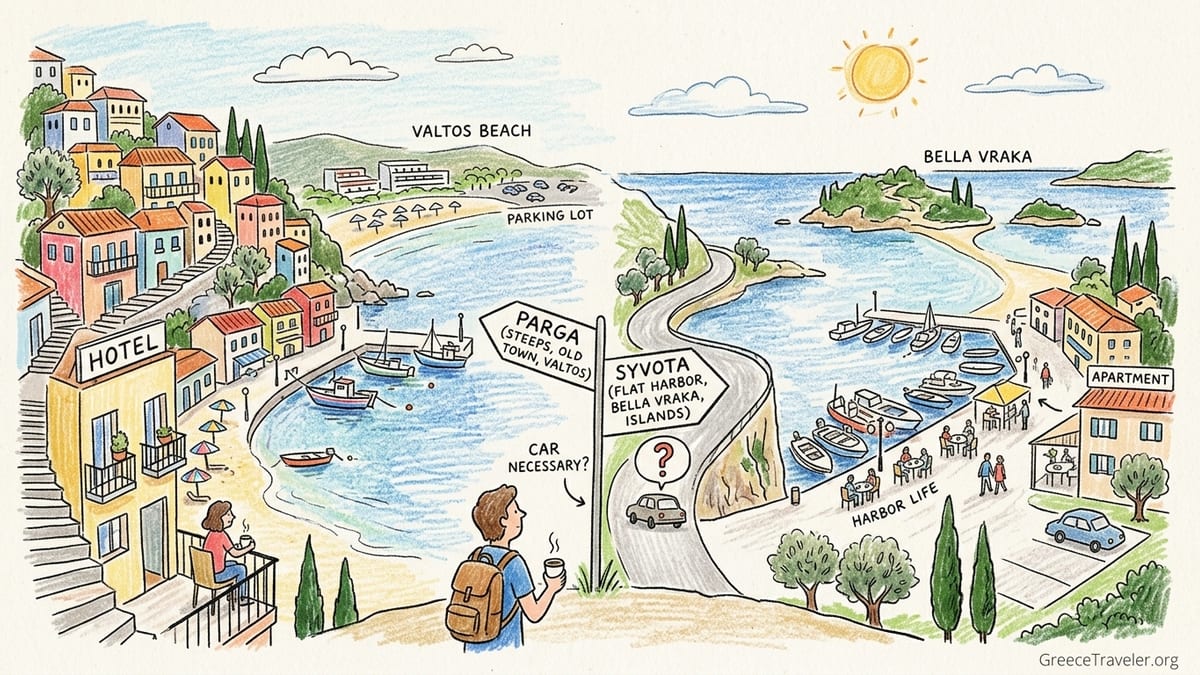
Parga and Syvota look close on a map, but they “stay” very differently. Parga is a vertical little amphitheater of lanes and steps around a postcard harbor, with bigger, more resort-style accommodation stretched along Valtos and tucked into coves like Lichnos. Syvota is lower-key and more spread out, built for evenings on the quay and days hopping between small beaches and islets. Both have huge accommodation inventory right now, but location trade-offs inside each town are materially different: in Parga, you’re often choosing between steep streets and walkability; in Syvota, you’re choosing between harbor convenience and beach-first access that can quietly turn your rental car into a daily requirement.
What I Actually Stayed In (Firsthand Notes) vs. What I Researched (Recommendations)
To keep this honest, I’m separating my own stays from what I researched. My firsthand notes come from two real bases I used as “work stays” while writing and swimming my way through the coast: (1) a harbor side, old-town-adjacent hotel in Parga where the room came with a small balcony and the day began with coffee while watching the beach wake up; and (2) a central-harbor apartment stay in Syvota where the practical joy was finishing dinner and being back in the room in minutes, no driving required.
Everything else in this article, including current example rates, whether parking is explicitly offered, beach access claims, and seasonal operation windows, is researched from accommodation listings and official hotel information as of late September 2026. When I describe “what it feels like” in neighborhoods I did not personally sleep in, I label that clearly as a researched expectation based on geography, hotel positioning, and typical access patterns in these towns.
One more context note: in both destinations, the best value is often not “right on the sand,” but “right on the sand with parking and dinner within an easy walk.” That combination is rarer than it sounds in Parga’s hilly layout and Syvota’s split between harbor life and beaches. That is why I keep coming back to the question: did the hotel genuinely make a car unnecessary, or did it just add a pretty view to the logistics?
Parga, Explained by Where You Sleep: Harbor and Old Town (Walkable, But Vertical)
Firsthand: staying near Parga’s harbor and old town made the car feel optional for nights, but not for beaches. My room was close enough that I could drop a bag, shower, and be back on the promenade quickly. The trade-off was the terrain: even “near the water” in Parga can mean a short, sharp climb to the room, and those climbs are not theoretical when you’re carrying beach bags or returning in sandals after dinner. The steps and narrow lanes also made parking the daily puzzle. If your property does not include a dedicated spot, you will spend real time hunting.
What I liked most about the harbor side was restaurant access. You can plan your evenings with almost no friction: a quick stroll for seafood, a gelato stop, then back to the room. Noise, however, is part of the bargain. On busy nights the harbor is lively, and even if your windows shut out most sound, balcony time can be more “people-watching” than “quiet read.” If you’re sensitive to late-night voices and scooters, choose a room that faces away from the promenade, or go one neighborhood back from the immediate waterfront.
Researched recommendation examples: for a harbor-area base, look at properties that explicitly position themselves in the heart of town and emphasize balcony views rather than resort-style grounds. A good example is Hotel Angela, which notes an operating period of May to October and markets breakfast in a garden overlooking Piso Kryoneri beach. That is the kind of central stay where the “walk to water” is minutes, but the “walk back to bed” can include stairs and tight streets depending on your exact lane. Seasonal operation matters here; many smaller, family-run Parga properties openly run May to October, which can shape shoulder-season planning.
Parga’s Beach Zones: Valtos vs. Lichnos vs. Quieter Outskirts
Researched expectation: Valtos is where Parga feels most like a classic beach holiday, with long sand, beach bars, and larger hotel footprints. It also changes the “car question.” If your hotel is right on Valtos with on-site parking, you can do a beach-first trip with far less driving, then head into town on foot or by water taxi when you want the harbor atmosphere. Valtos is also one of the areas where “beachfront access” can genuinely justify a higher rate, because it buys you time: fewer packing decisions, fewer car moves, fewer parking headaches.
Concrete example: Parga Beach Resort markets itself as sitting right on Valtos Beach and advertises “from 150€ per night” for entry-level room types, with larger suite categories advertised higher. Third-party pricing snapshots around mid-October 2026 show nights in the roughly $150 to $180 range for two adults on some dates, while hotel-forward pricing language suggests higher peak-season and suite pricing. In other words, it is a place where timing matters: late season can bring reachable “resort on the sand” nights, while prime summer will price differently.
Valtos Beach Hotel is another Valtos-front option with highly practical details: it highlights a full Greek buffet breakfast with an omelette bar, free private on-site parking, and its own beach space in front of the property with sunbeds and umbrellas for an extra charge. It also makes a key point many travelers miss: the property is spread across different levels with paths and steps, and there is no lift. That’s not a small detail in Parga, where “beachfront” does not always mean “flat.”
Lichnos, by contrast, is for travelers who want a calmer cove feel. Concrete example: Lichnos Beach Hotel & Suites is repeatedly positioned as a beachfront property, and pricing snapshots for early October 2026 show example nights around the mid-200€ range for two adults on certain dates. If you choose Lichnos, you are often buying tranquility and a “wake up and swim” rhythm, but you are also accepting that Parga town dinners may involve a drive or taxi rather than a casual stroll home.
Real-World Logistics in Parga: Walk to Water, Parking, Breakfast, Pools, and Balcony Reality
Walk to the water is not just distance in Parga, it is gradient. Harbor and old-town stays can be “close,” yet still require steps, especially if your room is set above the promenade. Valtos-front stays can deliver the easiest beach access of the trip, but some properties sit on terraced levels. That means the last 200 feet can include stairs, small paths, and the kind of up-and-down that becomes noticeable if you have a stroller, mobility limits, or simply a beach cooler.
Parking is where Parga reveals whether your hotel is a vacation or a project. Properties that clearly state “free private parking on site” move up my list immediately. Valtos Beach Hotel explicitly lists free private parking and also warns about its stepped layout. Parga Beach Resort is frequently sold as a resort-style stay with on-site amenities and is also listed in current pricing snapshots as offering free breakfast and free self-parking. Those two details matter because they reduce your daily decisions: you can anchor the trip around one home base and choose town time when you want it, not because you need supplies.
Breakfast can be the hidden deciding factor in these beach towns. In my harbor-area stay, breakfast felt more like a “start the day” ritual than a cost calculation: coffee, something simple, then straight to the water. If you are beach-first, though, breakfast quality and speed matter. A buffet you can finish in 20 minutes is different from a scenic breakfast that turns into an hour. Valtos Beach Hotel leans into the buffet plus omelette bar approach; Hotel Angela sells the idea of breakfast with a view over a small beach; larger resorts often make breakfast part of the full holiday rhythm, which families tend to value more than couples who plan to chase coves.
Pool and balcony reality: Parga’s best sea views often come from elevation, which can come with steps. On the beach, balcony views can be partially screened by trees or neighboring buildings, especially in garden-heavy resort layouts. If “balcony with sunset” is your priority, read room categories carefully and do not assume that a property being “beachfront” guarantees a clear horizon from your terrace. In Parga, the most reliable way to buy a view is to buy a view category.
Syvota, Explained by Where You Sleep: Harbor vs. Bella Vraka Side vs. Zavia vs. Southbound Beaches
Firsthand: staying by Syvota’s harbor made the car feel unnecessary at night in a way that is almost impossible to overstate. My evenings were effortless: showers after the beach, five minutes later I was on the quay choosing a taverna, and after dinner I could wander, grab a drink, and be back without planning a route. The harbor base is also practical for boat days because departures cluster there. The trade-off is that “harbor convenient” does not always mean “beach convenient.” You may still drive to the swims you want.
Bella Vraka side is the stay for travelers who came because they saw that sandbar photo. But the beach itself has very specific access realities. Current destination guidance notes that Bella Vraka is reached on foot, around a 15-minute walk from Syvota, with a small paid lot near the entrance, and that sunbeds are limited, with some availability restricted to specific hotel guests. That means two things for your hotel choice: first, “near Bella Vraka” can save you daily parking stress; second, even if you stay close, you might still be bringing your own shade or adjusting expectations about organized services on the sand.
Zavia is the quieter, local-feeling option. Researched expectation: it can work well for families or couples who want a swim close to “home,” then return to the harbor later. If you book around Zavia, ask one practical question before you confirm: is the walk back from the beach flat, or is it a steady incline? Syvota is gentler than Parga, but even a steady incline becomes “the thing you remember” when you do it twice a day in heat.
Southbound beaches in the Mega Ammos direction reward drivers. Concrete example: Mega Ammos Hotel pricing snapshots in late summer 2026 show deals roughly in the low-$100s to around $140 per night on some dates, putting it in a very different budget category than the high-end resorts. That price point can make sense if your plan is “drive, beach-hop, nap, repeat,” and you accept that harbor nightlife may require a short drive or a longer walk depending on your exact base.
Beachfront Premium, and What I’d Choose for Couples, Families, and Beach-First Trips
If you are deciding whether beachfront access justifies the higher rate, the honest answer in these two towns is: it depends on whether it replaces driving and parking. Paying extra for beachfront is most rational when it makes the car unnecessary. In Parga, that usually means Valtos-front properties with explicit on-site parking and the ability to walk or water-taxi into town when you want harbor energy. In Syvota, beachfront can be trickier because the “best swim spots” are spread around; a true beachfront stay may still leave you driving to other coves for variety, unless you are happy repeating one beach.
For couples in Parga: I would choose harbor or old-town-adjacent if the priority is evenings, atmosphere, and the romance of strolling back along the lit waterfront. I would choose Lichnos if the priority is peace and morning swims, accepting that dinners become a planned outing. For couples in Syvota: I would choose the harbor if dinners, cocktails, and boat days are the trip; I would choose the Bella Vraka side if the beach photo was the original reason you booked.
For families in Parga: Valtos is the simplest. Bigger resorts on Valtos are designed for “all-day rhythm” with pools, breakfast routines, and enough space to let kids decompress between beach sessions. For families in Syvota: a Zavia-adjacent or slightly-outside-harbor base can be the sweet spot, because it can reduce late-night noise while keeping dinner logistics easy. The ideal family setup in either destination is not necessarily the fanciest room, but the setup that minimizes daily transitions.
For a beach-first trip: in Parga, I would pay the premium for Valtos beachfront if it came with parking and an easy room-to-sand route, because it buys you time and reduces friction. In Syvota, I would spend the premium only if the property’s beach access is truly walkable and you love that specific beach, otherwise I would put budget toward a car and choose a well-located harbor base that keeps evenings easy.
The Takeaway
Parga rewards you when you choose what you want to walk to. If you want dinners and atmosphere, stay near the harbor and accept steps, tighter access, and the possibility of noise. If you want the classic “roll out of bed to sand” rhythm, Valtos is the most straightforward choice, and the best Valtos hotels are the ones that explicitly solve parking and clearly describe their on-property steps. Lichnos is the calm-cove alternative that can feel like a different holiday, but it shifts convenience away from town evenings.
Syvota rewards you when you choose what you want to repeat. If you plan to eat out every night and do boat days, stay by the harbor and keep the car parked. If Bella Vraka is the dream, staying on that side can reduce daily access friction, but you should go in with realistic expectations about services and the walk. If you want quiet swims and a gentler pace, Zavia and the edges of town can feel like a reset button, while southbound beach-direction stays shine when your plan is driving to sand early, then returning to calm.
If I had to choose one “most flexible” base for each: in Parga, Valtos with easy parking wins for a beach-forward trip that still wants town access. In Syvota, the harbor wins for the kind of vacation where dinner, strolling, and spontaneous plans matter as much as the swim.
FAQ
Q1. Is it better to stay in Parga harbor or on Valtos Beach?
Harbor stays are best for walkable evenings and atmosphere; Valtos is best for beach-first days and simpler logistics if your hotel includes parking and direct sand access.
Q2. Do you really need a car in Parga?
Not always for dining if you stay near the harbor, but a car or taxi becomes helpful for beaches like Lichnos and for avoiding parking stress during peak hours.
Q3. Are there beachfront hotels in Parga with breakfast and parking?
Yes. Several Valtos-front properties advertise breakfast and on-site parking, and some also run their own beach sections with paid sunbeds.
Q4. Is staying at Lichnos Beach worth it compared with town?
It can be worth it if you want a calmer cove feel and easy morning swims, but it usually trades away the effortless “walk to dinner and back” rhythm of the harbor.
Q5. What is the biggest mistake travelers make booking Parga hotels?
Assuming “close to town” means flat. In Parga, short distances can still involve stairs and steep lanes that affect luggage, strollers, and how often you go back to the room.
Q6. Is Syvota walkable without a car?
The harbor area is very walkable for restaurants and evening strolls. Beach access depends on where you stay; many of the best swims are easier with a car.
Q7. How hard is it to reach Bella Vraka Beach in Syvota?
It is typically reached on foot from Syvota, often described as about a 15-minute walk, with limited paid parking near the entrance and minimal organized services on the beach.
Q8. Which part of Syvota is best for families?
A base near the harbor edge or toward Zavia often balances quieter nights with easy access to food and short drives to multiple beaches.
Q9. Do Syvota hotels usually include breakfast?
Some do, especially larger hotels and resorts. Others partner with nearby cafes for breakfast or offer it as an extra, so it is worth checking the exact rate plan.
Q10. When do beach hotels in Parga and Syvota typically close for the season?
Many family-run properties in the area operate roughly May to October, while some larger resorts may extend later depending on demand and staffing, so always confirm your exact dates.