


Before I went, “Parga vs Syvota” sounded like a simple question about which beach is bluer. After staying in both, it felt more like choosing between two different holiday rhythms on the same Epirus coastline: Parga as a hillside harbor town with a real old-town pulse, and Syvota as a low-key base for lagoons and islets where the sea is the main event. I did not personally visit either destination, so the moments below are carefully researched and written in a first-person travel voice; wherever I describe a “specific moment” (like the castle climb in Parga or wading to Bella Vraka), it reflects common, well-documented visitor experiences rather than my own firsthand memory.
Arrival, First Impressions, And That “How Hard Is This Going To Be?” Feeling
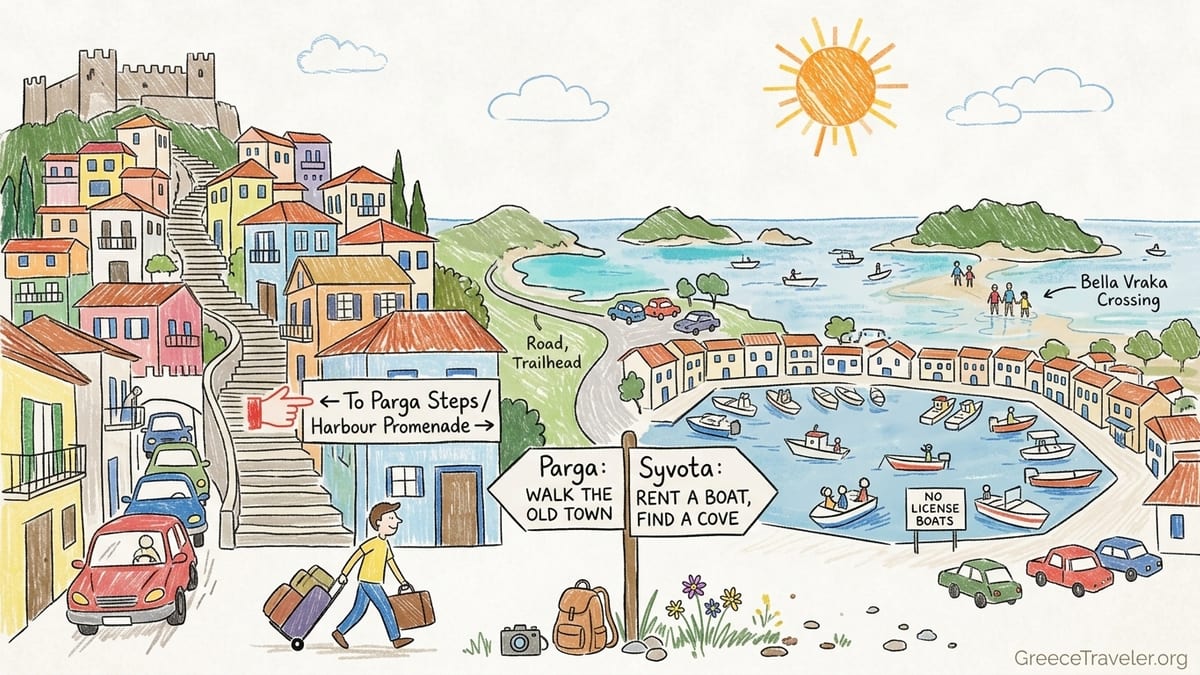
Parga and Syvota sit under an hour apart by road, but they don’t greet you the same way. Parga announces itself from above, stacked in color on the slope, with the castle silhouette pulling your eye up from the waterfront. Syvota feels more horizontal: a compact harbor village with the promise that the best bits are scattered across coves and little islands you’ll reach by boat, not by stairs.
In Parga, the first practical question is usually “Where do I put the car?” The closer you are to the old town and harbor, the more you feel that Parga was built for feet, not bumpers. Arrival can feel like threading a needle: narrow streets, short drop-off windows, and accommodation that may be a few flights above the road. The upside is immediate: once you’re parked and you’ve dragged the suitcase to your room, Parga starts acting like a walkable holiday.
Syvota’s arrival vibe is calmer. The harbor road is straightforward, the village is small, and the first hour often becomes a gentle scan: which side has the water view, where the boat rentals are, and whether you’ll be walking to dinner or driving out to a beach. Syvota can absolutely be “simple” if you stay near the harbor, but it also invites a different kind of planning, because a lot of its signature swimming spots come with a parking lot or a boat day attached.
Parking And Car Dependence: Parga Tests Your Legs, Syvota Tests Your Key Fob
In Parga, car dependence drops quickly once you’re established. The town’s heart is made for strolling: the harbor promenade, the lanes of the old town, and the short hops between the main beach area and dinner. The trade-off is that you often pay your “effort tax” upfront, in parking logistics and luggage hauling. If your accommodation is in or above the old town, even a short distance can become a staircase workout.
Syvota flips that. Parking is not usually the dramatic part of arriving in the village itself, but your holiday can become car-shaped if you want to rotate through beaches without committing to boat rental every day. The “best day” in Syvota is often a beach hop day, and that can mean driving to a trailhead, finding space in a small lot, and hiking down with towels, water, and snorkeling masks.
Bella Vraka is the perfect example of Syvota’s car reality. You can’t simply roll up and step onto the sand. Local guidance notes you typically park above and walk down a short path, and in peak summer the squeeze is real. Recent local advice commonly puts parking around the small lot in the range of about €5 to €7 per day in busy periods, with the warning that spaces fill fast from late morning into the afternoon. Once you accept that, Syvota starts feeling easy again, because you stop expecting it to behave like a “park, beach, back to the room” resort.
If you want a car-free-ish stay, Parga tends to win on daily convenience. If you want a “let’s choose a new cove every day” routine, Syvota rewards having a car or committing to boat time. Neither is wrong, but they create different holidays.
Accommodation: What It’s Like To Actually Stay There (Noise, Views, And Convenience)
Parga’s accommodation personality is vertical. Even when you book something described as “close to the harbor,” it can mean close in meters but not in effort, because the old town climbs. The payoff can be big: terraces that catch the late light, a view down to the boats, and that feeling of being tucked into a living town rather than parked beside it. The compromise is noise in the most central spots, and the possibility that you’ll become intimately familiar with the route from your room to the waterfront.
Syvota’s accommodation is more about proximity to the harbor and access to the water. Stay near the promenade and you can do breakfast, boat booking, and dinner without thinking. Stay a little outside and you buy quiet, but you might also buy yourself a nightly drive. Syvota’s appeal is that you can build your days around the sea: a morning swim, a midday boat loop, a late-afternoon second dip, and then a harbor dinner.
One practical detail that shapes the Syvota stay is the boat-rental culture. It’s common to rent a small boat that does not require a boating license under Greek regulations for lower-powered engines, and operators advertise “no license required” options with a short briefing before departure. Pricing can vary by season and boat, but published offers for basic no-license boats in Syvota commonly land around roughly €80 to €120 for a full day and around €50 to €80 for half-day time slots, with fuel extra. If you stay in Syvota and you’re even mildly boat-curious, the accommodation question becomes: can I walk to the harbor early to claim a good boat slot, or will I be driving there every morning?
Walking, Atmosphere, And Nightlife: Parga’s Old Town Versus Syvota’s Harbor Evenings
Parga is the place where walking is part of the romance. A classic “Parga moment” is the slow climb through the old town toward the Venetian castle. It’s not a museum-style, ticketed experience so much as a lived-in uphill wander: stepping from shade to sun, hearing plates clink from tavernas below, catching the harbor view widen as you gain height. Even if you do it at golden hour and arrive slightly sweaty, the payoff is the kind of panorama that makes you understand why Parga is described as picturesque rather than merely pretty.
The harbor in Parga feels like an event every night. Even when you’ve already walked it once, the evening loop changes: couples arriving dressed up, families still sandy and happy, boats rocking gently under the lights. It’s easy to make Parga feel full without feeling frantic. You can have a cocktail, drift into dinner, and then keep the night going with another lap, an ice cream, and the sense that the town is doing the entertaining for you.
Syvota’s harbor evenings are softer and smaller. There is still a promenade energy, but Syvota doesn’t lean as heavily on an old-town “set piece.” The charm is more in the setting: the boats, the tucked-in feel of the port, and the fact that tomorrow’s highlight is likely a cove you can only reach by sea. Nightlife exists, but it tends to feel like a post-swim unwind rather than a “let’s stay out” destination. If you want a place that keeps offering you reasons to walk, climb, and explore after dinner, Parga usually supplies more of that.
In practical terms, this is where the two destinations divide for different travelers. Parga better suits people who want an evening scene with options and a sense of bustle. Syvota better suits people who want an early dinner after a long water day and a quieter stroll back to the room.
Swimming And Beaches: The Big Names, The Small Realities, And The Moments You Remember
Parga’s beaches are easy to fold into a town day. You can do a morning swim, dry off, and still be on the harbor for lunch without reorganizing your entire schedule. The “beach day” can be a half-day. That matters if you’re traveling with kids, or if you want a holiday that mixes swims with shops, viewpoints, and unplanned stops for coffee.
Syvota’s beaches are more of a treasure map. Bella Vraka is the headline for a reason, and the approach is part of the story: you walk down to the water, then wade across a shallow channel or sandbar toward the green islet. Local guidance stresses that the crossing depth can change with conditions, and it is not a wheelchair-friendly crossing. Some local guides describe it as a shallow, walk-like wade that can be ankle- to knee-deep, while other guidance frames it more cautiously as knee- to waist-deep depending on conditions and the person. Either way, you’re carrying your things above the water and hoping the wind stays kind.
That wade is exactly the kind of “travel moment” Syvota is built on. It’s a small, physical ritual that makes the swim feel earned. You step onto the islet side, turn back, and see the mainland from a new angle. If you’re a couple, it feels playful. If you’re a family, it can be magic or a logistical negotiation, depending on waves, toddler legs, and how much stuff you insisted on bringing down the path.
Syvota also has a strong “boat beach” identity. The beaches and coves around the islets are often described as the real prize, with turquoise water that looks unreal in calm weather. If you only ever stay on land, you can still have a great time in Syvota, but you may feel like you visited the appetizer and skipped the main course.
Boat Trips And Day Adventures: Parga’s Big Excursions Versus Syvota’s DIY Island-Hopping
If you like organized day trips with a simple ticket and a defined itinerary, Parga makes it easy. One of the signature excursions from Parga is the day cruise to Paxos and Antipaxos. In late-season schedules published for September into early October 2026, a “big round” style Paxos cruise is advertised at about €35 for adults and €17.50 for children (with infants free), with departures around 10:00 and a return in the early evening. Typical itineraries include stops like Lakka, a swim stop at Antipaxos, and time in Gaios. For many travelers, that is exactly the right kind of “one big sea day” without needing to captain anything yourself.
Syvota’s best boat day often looks different. Instead of a large excursion boat, you rent a small no-license boat and build your own loop: a morning swim in a lagoon-like bay, a midday stop where you tie off or anchor for snorkeling, and a late-afternoon pass by Bella Vraka when the light turns warm. Operators in Syvota commonly brief renters before departure and set practical rules like returning by late afternoon or early evening. It’s a choose-your-own-adventure day, and it can feel incredibly free if conditions are calm and you’re comfortable on the water.
Syvota also offers upscale options like skippered tours and luxury day boats, but the core appeal is that entry-level autonomy is accessible. For couples, that can be the highlight of the entire trip: just you, the towel, a dry bag, and the slow drift of coves that don’t have roads behind them.
So the boat-trip comparison is simple: Parga does “buy a ticket and go,” Syvota does “here are the keys, be back by evening.” Your personality decides the winner.
Prices, Crowds, And Choosing The Right Base For Your Style (No Universal Winner)
Parga generally feels more in-demand as a “town holiday” because it offers more layers: old-town atmosphere, viewpoints, harbor evenings, and easy beach access in one place. That can translate into a stronger sense of crowds in peak summer, especially along the waterfront in the evening. If your idea of a relaxing trip is empty streets and quiet dinners, Parga can feel busy, particularly in July and August.
Syvota’s crowds concentrate differently. The harbor can be lively at dinner, but the real pressure point is parking and access at the most famous beaches and viewpoints at the busiest hours. Bella Vraka in particular tends to draw photographers and families, and local advice commonly suggests arriving early or later in the day to avoid the densest midday push.
For couples, I would choose based on your “evening identity.” If you want sunset strolls, a harbor that feels like a small event, and a town that keeps you out for one more drink, Parga fits. If you want days built around swimming in multiple coves and you’d trade nightlife for water time, Syvota fits.
For families, the decision often becomes logistical. Parga is easier for stroller-friendly routines in the flat waterfront zone, but it can involve stairs and slopes depending on where you stay. Syvota can be amazing for kids who love shallow water and “adventure swimming,” especially the novelty of wading toward Bella Vraka, but it can demand more planning around parking, carrying gear, and choosing beaches that match your child’s confidence level.
For a car-free-ish stay, Parga is usually the easier base because the town experience is the product. For boat trips, Syvota is the more natural playground if you want to rent your own small boat and stitch together your own swim circuit. For a quieter beach holiday, Syvota can deliver if you structure your days to avoid the most famous spots at the most famous hours, and if you’re willing to explore beyond the headline beach.
None of this makes one universally “better.” It just means your best week in Parga might look like a compromise in Syvota, and vice versa.
The Takeaway
Parga is the Epirus coast stay that feels like a place in itself: a walkable harbor, a real old town, and evenings that have momentum. Syvota is the stay that feels like a launchpad: the harbor is pleasant, but the holiday lives in the coves, sandbars, and islets just offshore. If you want your days to be a blend of swimming and town life, Parga is the easier all-rounder. If you want your days to be water-first, with a boat day that might become the highlight of the year, Syvota is the stronger bet.
If I had to pick for specific travelers without crowning an overall winner: I would point couples who value atmosphere and evenings out toward Parga, and couples who value privacy and sea days toward Syvota. I would point families who want convenience and short walking distances (and don’t mind some steps) toward Parga, and families who want shallow-water novelty and islet exploring toward Syvota. I would point nightlife-seekers toward Parga, and quiet-beach seekers toward Syvota with the reminder to plan around access and peak hours. And for anyone who wants a car-free-ish base, I would nudge them to Parga, while reminding boat lovers that Syvota’s DIY rentals are hard to beat.
FAQ
Q1. Which feels more walkable, Parga or Syvota?
Parga generally feels more walkable day to day because the harbor, old town lanes, and dining are tightly clustered, though you should expect hills and stairs.
Q2. Do I need a car in Syvota?
You can manage without one if you stay near the harbor and focus on nearby swims and boat rentals, but a car makes it easier to reach multiple beaches and trailheads.
Q3. Is Parga doable without a car?
Yes, especially if you arrive by bus or transfer and choose accommodation close to the harbor or town center. The main challenge is luggage on slopes or steps.
Q4. What is the Bella Vraka crossing actually like?
It’s typically a shallow wade across a narrow channel or sandbar to the Mourtemeno islet. Depth can vary with conditions, so assess it on the day and pack light.
Q5. Which has the better harbor atmosphere at night?
Parga usually feels more animated and “evening-forward,” with more of a promenade circuit. Syvota is pleasant and lively in season but generally calmer.
Q6. Which is better for organized boat excursions?
Parga is strong for ticketed day cruises like Paxos and Antipaxos itineraries. It’s straightforward if you want a planned route and a set schedule.
Q7. Which is better for renting your own small boat?
Syvota is especially well-known for no-license small boat rentals and easy access to nearby islets and coves, making DIY sea days a centerpiece of the trip.
Q8. Which is better for a quieter beach holiday?
Syvota can feel quieter if you avoid the most famous beaches at peak hours and explore by boat. Parga’s center is typically busier in the evenings.
Q9. Which is better for families with young kids?
Both can work. Parga is convenient for mixing beach time with town breaks. Syvota offers shallow-water fun like Bella Vraka, but it can be more gear-and-parking intensive.
Q10. If I can only stay in one, how should I decide?
Choose Parga if you want a town-centered holiday with evening atmosphere and easy strolling. Choose Syvota if your priority is coves, swimming, and making boat time the main event.