


I wanted Vikos Gorge to feel big from the inside, not just from a viewpoint. So I planned a full, point-to-point crossing on foot: descending from Monodendri into the canyon, following the gorge floor past springs and rockfall zones, and climbing out to Vikos village. It turned out to be one of those hikes that is never technically complicated in a single moment, but relentlessly demanding as a whole. The gorge doesn’t let you coast. It makes you work for every kilometer, and then rewards you with a kind of silence you can only find deep between limestone walls.
What I Checked Before Hiking: Season, Conditions, Weather, And Whether Guides Were Running
Vikos Gorge sits inside the Vikos-Aoos National Park in Zagori, and while the route is famous, it is still a mountain canyon crossing. In the days leading up to my hike, I verified that the classic full crossing described by Discover Greece is roughly 12.5 km with a typical 6 to 8 hour walking time, and that the most practical hiking season is generally framed as April through November. I treated that season window as a strong hint about what can go wrong outside it: ice on the upper paths, slick rock on shaded steps, and higher risk after heavy rain.
I also confirmed that guided hikes were actively being sold and operated, which is a good real-world signal that the route is considered runnable in the current shoulder season. Companies marketing full-day Vikos crossings were taking bookings, including trips that descend from Monodendri to the gorge and finish in Vikos or continue toward Papingo, depending on the program. Even if you plan to hike independently, checking whether reputable operators are running is a practical sanity check, especially if you’re traveling without local trail knowledge.
Finally, I checked the immediate forecast for Monodendri and the upper gorge area. On publication day (Saturday, September 26, 2026), the local forecast called for variable clouds with spotty showers and a high around 15°C, which is cool enough to hike comfortably but wet enough to make the stone descent potentially slippery. That combination shaped my footwear and timing: I wanted traction for damp stone and an early start so I wasn’t climbing out late if showers built in.
My Route Plan: Starting Village, Finish Point, And How I Handled The Shuttle Problem
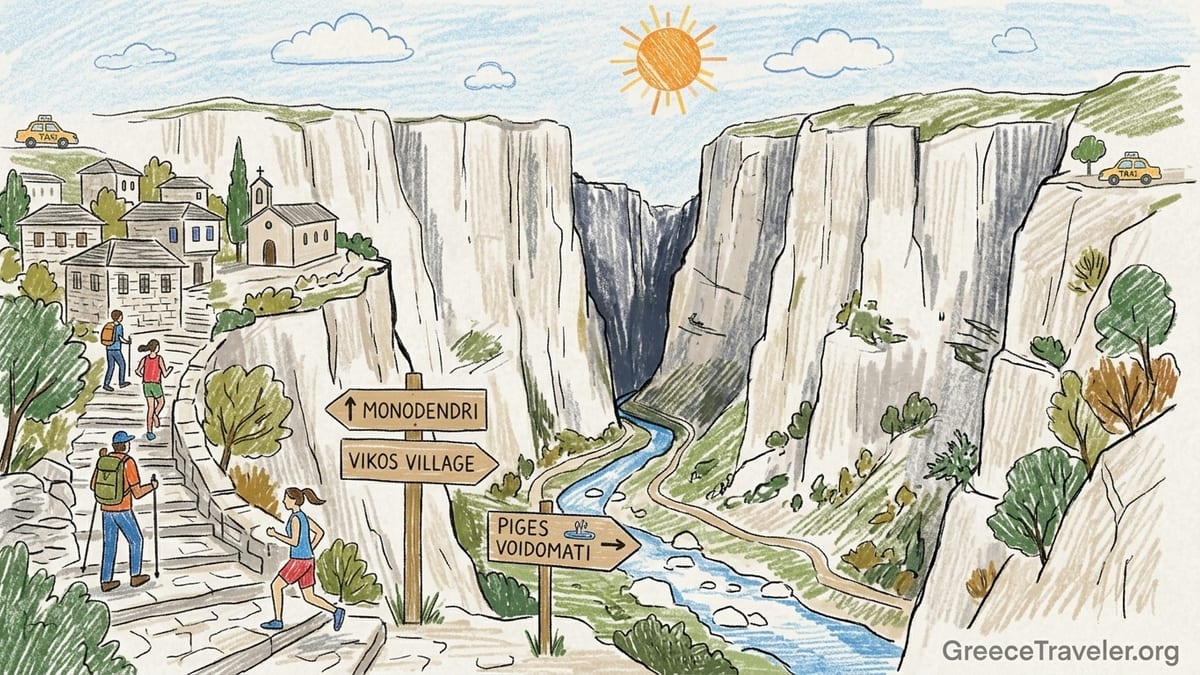
I did the classic line most people mean when they say “full crossing”: starting in Monodendri and finishing in Vikos village. That’s the direction described widely as the standard crossing, and it makes sense on the ground: you drop fast into the gorge and then gradually travel its interior before the final climb out. I intentionally did not add the extra leg to Mikro Papigo on this day, because I wanted the full crossing to be one complete effort, not a race against dusk.
Logistically, Vikos Gorge is a point-to-point hike unless you want to suffer the full crossing and then reverse it. The day becomes much simpler if you arrange transportation at one end. I organized a pre-booked taxi pickup at the Vikos village trail exit for a set time window, with the driver understanding that there is limited mobile reception in the Zagori villages and that I might not be able to message precisely when I arrived. In practice, that meant agreeing on a conservative pickup time and a clear meeting point in the village, not “somewhere on the road.”
For travelers trying to avoid taxis, bus timetables do exist for parts of Zagori, but they are not the kind of frequent, flexible transit that reliably solves a one-way canyon crossing at the exact moment you finish hiking. My advice is to treat public buses as a way to reach the region, and then use a taxi or hotel-arranged transfer for the hike day itself. The biggest risk isn’t cost, it’s being stranded at the wrong end at the wrong hour with no signal and no plan.
My Start Time, Gear, And The Reality Of Weight Inside A Gorge
I left Monodendri at 7:10 a.m. from the village center, after a quick coffee and a last check that my offline map was downloaded. My footwear was low-cut trail runners with aggressive lugs rather than hiking boots. On a dry day, boots are fine, but the old stonework on the descent can be slick when damp, and I wanted a shoe that sticks and flexes. I carried one pair of lightweight trekking poles as well, which paid for themselves within the first thirty minutes.
My pack weight at the trailhead was about 6.5 kg. That included a light shell for showers, a warm layer for the cool morning, a headlamp (even with an early start, I treat this as non-negotiable), a small first-aid kit, and food for a full day out. Water carried at the start was 2.5 liters. I do not recommend starting with less unless you have a firm plan for where you will refill and you know how your body reacts to long climbs after hours of steady dehydration.
Temperature at the top of the gorge was brisk enough that I began hiking in a thin long sleeve. Down inside the canyon, conditions changed by the hour. Shade was deep in the narrow sections, but wherever the gorge widened the sun found me quickly. The weather’s “spotty showers” materialized as brief misty pulses rather than a soaking storm, but those short wet intervals were enough to keep the stone steps and polished rocks feeling treacherous.
The Descent From Monodendri: Fast Elevation Loss, Slow Footwork
The first hour was the mental tax of the day. The descent from Monodendri into Vikos is steep, and it’s steep in a way that punishes sloppy steps rather than heroic lungs. The path drops on old stone paving and uneven steps that look tidy from a photo and then reveal themselves as a thousand ankle-height traps in motion. Loose rock sits on top of the stones, and tree roots run across the tread like slick cables. I moved slowly enough to avoid a fall, but the constant braking still lit up my quads early.
Underfoot, it shifted between cobbled kalderimi-style stonework and stretches of dirt and scree. Whenever the trail crossed damp sections, the stones felt polished, almost like wet marble. That was the first moment I was glad I chose trail runners with a sticky outsole and carried poles. The poles helped most when I had to step down off irregular ledges while my pack wanted to push me forward.
Scenery on the descent is easy to miss because you’re watching your feet, but I forced myself to pause and look up. The limestone walls begin as forested slopes and slowly become vertical architecture. You can sense the scale building even before you reach the gorge floor, like walking down a staircase into a cathedral that hasn’t fully revealed its ceiling yet.
Inside The Gorge: River Sections, Springs, And The Long Middle That Tests You
Once I reached the gorge bottom, the hike changed character. The effort stopped being “don’t fall” and became “keep moving.” The middle kilometers are a steady forward grind through a mix of rocky riverbed, packed earth, and boulder-strewn trail where the line is obvious but your pace is capped by the terrain. There were sections where the gorge felt broad and bright, and others where it pinched in and the walls rose like smooth, pale blades.
Water appears and disappears in the way limestone landscapes often do. In some stretches, the river presence is more implied than seen, and then suddenly you’re next to cold, clear flow that looks unreal against the white stones. I treated every reliable water point as a strategic opportunity: drink, top up, and reset. Even in cool shoulder-season temperatures, the gorge is long enough that small errors compound.
I took my main food stop on a flat cluster of stones near the water, roughly around the midpoint of the crossing, where the sound of flow covered the quiet crunch of other hikers passing. Lunch was deliberately simple: a cheese-and-bread sandwich, salted nuts, and a piece of fruit. I didn’t want anything that would sit heavy in my stomach before the climb out. I also used that break to check my feet for hot spots, because this is the kind of hike where a small rub becomes a real problem by hour six.
Fatigue arrived in layers rather than a single wall. First it was legs from the descent, then shoulders from carrying water and food, then the mental fatigue of constant foot placement on uneven rock. The gorge is not a place where you can zone out for long. Even when the trail is obvious, a single inattentive step can mean a twisted ankle far from quick help.
The Climb Out To Vikos Village: The Part Nobody Should Underestimate
The hardest part of my day wasn’t the steep early descent. It was the final climb out toward Vikos village after hours already spent moving over rough ground. The ascent is not a short sting, it’s a steady draining pull that asks you to find a second wind when you thought you were simply going to “walk out.” The grade is consistent enough to keep your heart rate up, and the terrain is still uneven enough that you cannot just march mindlessly.
Shade on the climb came and went. When the trail ran under trees, it felt like a gift. When it popped into exposed sections, even mild sun felt sharp after being cooled by canyon shade and river air. I kept my pace intentionally conservative, taking short standing rests rather than long sits, because sitting made my legs feel like they were locking up. My last meaningful break was a five-minute stop for water and a small snack before the final push, when I could tell my body was trying to negotiate a bargain: stop now, or pay later.
I reached Vikos village mid-afternoon. My total moving time, not counting rests, was about 6 hours and 25 minutes. Total elapsed time was roughly 7 hours and 20 minutes including longer stops for food, foot care, and photography. That put me right in the realistic window suggested for the crossing, but it didn’t feel like a “casual 6 to 8 hours.” It felt like a full day where every minute of sloppiness would have charged interest.
Navigation, Weather Hiccups, And What “Difficulty” Felt Like In Real Life
Navigation in Vikos Gorge is straightforward most of the time because the gorge itself funnels you, but there are still junctions where a tired hiker can make a wrong call. I carried a phone with an offline map and used it twice to confirm I was still tracking toward Vikos village, not drifting toward a Papingo exit. Signage existed, but I never assumed the next marker would appear exactly when I wanted it. I also made one deliberate habit: at every junction, I stopped fully, drank a sip, and decided calmly, instead of drifting into the “obvious” path while breathing hard.
The weather issue that mattered was not dramatic rain, it was intermittent dampness. Brief showers and mist made the stones slick, and slick stones made the entire descent more dangerous than the forecast might suggest. If a heavier rain system had moved in, I would have treated that as a genuine stop-and-reassess moment. Canyons and gorges have their own logic in storms, and even when flash flooding is not likely, slippery footing and rockfall risk are enough to justify turning around.
So how difficult did it feel? Not “extreme,” but absolutely not easy. If you’re a regular hiker who is comfortable moving for 6 to 8 hours, you can do it, but it will still feel like work because the terrain constantly taxes stabilizer muscles, not just cardio. It’s the kind of hike where your average pace looks slow on paper, and yet you finish feeling like you earned every kilometer.
I also kept in mind that the area is a protected national park with safety rules that are stricter than many visitors assume. The official guidance emphasizes staying on designated paths and not wandering off near streams and cliffs, and it also highlights restrictions that surprise some travelers, including rules around camping and other activities. The point is simple: treat Vikos as wilderness, not a city-park trail with a dramatic view.
The Takeaway
A full Vikos Gorge crossing from Monodendri to Vikos village is one of the most immersive canyon hikes you can do in Greece because it forces you to experience the gorge at human scale: limestone walls towering above, cold water appearing at your feet, and long quiet stretches where your only job is careful forward movement. It is not a hike that rewards rushing, and it is not a hike that forgives casual footwear or an under-filled water bottle.
If you want my most practical takeaway, it’s this: solve transport first, start early, carry more water than you think you need, and treat the descent with the respect you’d give an icy staircase. The gorge is about endurance, not heroics. When you finish the climb out to Vikos village, you’ll understand why the route’s “6 to 8 hours” is not a generic label but a real day out, earned minute by minute.
FAQ
Q1. Is the Monodendri to Vikos route considered the “full” Vikos Gorge crossing?
Yes. It’s the classic point-to-point crossing most travelers refer to, starting in Monodendri and exiting at Vikos village.
Q2. How long is the Vikos Gorge crossing and how many hours should I plan?
Plan for roughly 12.5 km and a full day on foot, commonly about 6 to 8 hours depending on pace, stops, and conditions.
Q3. Do I need a guide to hike Vikos Gorge?
No, many hikers do it independently, but guided day hikes operate in-season and can simplify navigation and end-to-end transport.
Q4. What’s the hardest part of the hike?
For many people, it’s the final climb out to Vikos village after several hours on rocky terrain, when fatigue is already high.
Q5. How early should I start?
Early morning is best. It reduces heat exposure, gives you time for breaks, and lowers the risk of finishing near dusk.
Q6. How much water should I carry?
Carry enough for long dry stretches. Many hikers start with 2 liters or more; exact needs depend on weather and your body.
Q7. Are trail runners okay, or do I need hiking boots?
Trail runners can work well if they have strong grip, especially on slick stone. Boots can also work; traction matters most.
Q8. What if the forecast mentions showers?
Showers can make the stone descent and bouldery sections slippery. Slow down, use poles if you have them, and be ready to reassess.
Q9. How do I handle transport at the end?
Arrange a taxi or transfer in advance, or coordinate through your accommodation. Don’t assume you’ll have reliable mobile signal.
Q10. Is Vikos Gorge appropriate for beginners?
It can be too demanding for true beginners because of duration, steep descent, and uneven terrain. It’s best with prior hiking experience.