


I landed in Ioannina with a neat plan and a dangerous assumption: that Epirus would drive like the rest of mainland Greece. On a map, Zagori, Metsovo, Tzoumerka, Parga and Syvota look close enough to stitch into one relaxed loop. On the road, Epirus has other ideas. Mountain distances are deceptive, village lanes narrow without warning, and the roads you slow down for are exactly the ones you came to see. This is how I connected Ioannina, Zagori, Metsovo and the coast without rushing, using the sensible motorway where it mattered, slowing down where it paid off, and accepting that a couple of places deserved two nights instead of a constant shuffle of hotel keys.
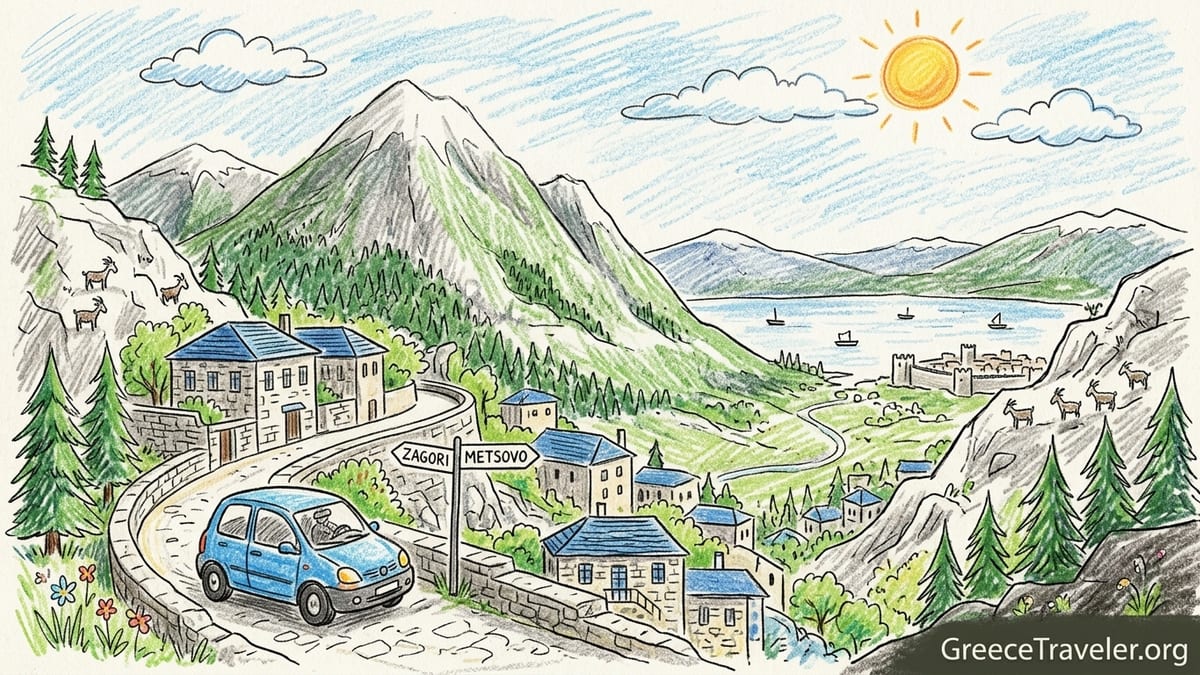
Rental-Car Pickup in Ioannina: Start Small, Start Calm
Ioannina Airport is compact, which is exactly what you want when you are about to drive into the Pindus mountains. At the airport, the Hellenic Civil Aviation Authority lists the main rental brands you are likely to see or coordinate with: Avis/Budget, Hertz/Thrifty, Europcar, and Sixt. In practical terms, that meant I could step out of baggage claim, confirm the paperwork, and be rolling within the hour, instead of spending half a day on an airport shuttle to an off-site lot.
I deliberately chose a small car rather than trying to “upgrade” my way into comfort. In Epirus, size is not luxury, it is stress. The moment you turn from the main roads toward Zagori or Tzoumerka, you trade wide lanes for tight bends, stone walls, and parking situations that look like dares. A small hatchback felt like the difference between enjoying a village arrival and holding up a whole lane while I tried to reverse around a goat herd.
Before leaving the airport perimeter, I set a rule I kept repeating for the rest of the trip: do not let today’s driving steal tomorrow’s daylight. I also checked that my headlights were strong and correctly aimed. That sounds fussy until you have met Epirus at dusk: steep drop-offs, patchy street lighting, and hairpins that arrive fast when you are tired. If you can avoid night driving here, do it.
Ioannina as a Base: Why I Gave the City Two Nights
Ioannina is not just a gateway, it is the smartest place to get your rhythm before the mountains. I stayed two nights at the start, and in hindsight I would do it again. One night is enough to “see” Ioannina, but two nights is what makes the whole road trip feel unforced. It gave me a buffer to pick up the car, adapt to local road etiquette, and still have an evening to walk the lakefront rather than collapsing over a steering wheel shaped like a question mark.
The second night also acted like an insurance policy. If your flight arrives late, if your rental pickup takes longer than expected, or if weather turns the mountains moody, you are not immediately forced into a long first drive. Epirus rewards travelers who treat time like part of the landscape, not a problem to solve.
From a practical driving standpoint, Ioannina is also where I did my first fuel top-up without pressure. I did not want my first search for a petrol station to happen on a mountain road where the “next village” might mean another half hour of bends. In September 2026, national-average Euro 95 petrol prices in Greece were reported around the low €2-per-liter range, and I used that mental benchmark to avoid overthinking every receipt. What mattered more than chasing the cheapest pump was simply staying comfortably above half a tank before heading into Zagori or Tzoumerka.
Route 1: Ioannina to Zagori Without Rushing (Monodendri Side)
My first mountain push was the classic: Ioannina into Central Zagori, aiming for Monodendri. The drive is short enough on paper to tempt you into thinking you can do it as a casual morning outing, but it still deserves a slow approach. Multiple current guides put Monodendri roughly 38 kilometers from Ioannina, often around 50 to 60 minutes depending on conditions, and that range feels honest once you are actually behind the wheel.
Even when the scenery is perfect, the road asks for attention. You are dealing with bends that tighten unexpectedly, occasional rockfall grit near the shoulder, and village entries that go from “country road” to “stone lane” in a blink. In Central Zagori, the lanes can narrow between stone houses and parked cars, and I learned to treat every blind corner as if a delivery van, a local truck, or a goat might be occupying my side.
Zagori is where I first regretted a post-sunset drive. I had lingered at viewpoints longer than planned, told myself it was “only” an hour back, and ended up driving narrow sections with limited lighting while trying not to dazzle oncoming cars. The lesson was immediate: in mountainous Epirus, “one hour” late can be the difference between a scenic return and a tense return. If you want to see Vikos viewpoints or do short walks, build your day around being parked before dark, not arriving back at your hotel before dark.
I also quickly understood why people who know this region warn against constant hotel changes. Zagori is not a one-night destination if you want it to feel like more than a drive-by. Two nights is the sweet spot: one full day for the Monodendri and Vitsa and Kipi side, and another day if you want to continue toward other villages or even reposition toward Aristi or the Papingo side without constantly packing and unpacking.
Linking Zagori to Metsovo: The Sensible Connection (Not a Forced Loop)
The cleanest way I found to connect Zagori and Metsovo without inventing a “perfect loop” was to return toward the main arteries and let the motorway do its job. Metsovo is served by the A2 (Egnatia Odos), and that matters because it turns what could be a draining mountain crawl into a manageable hop. From Ioannina to Metsovo, the driving distance is commonly listed around 49 kilometers and roughly 40 to 45 minutes by car in normal conditions, and that matched what I experienced when I didn’t hit tunnel slowdowns or a slow-moving truck convoy.
This is also where toll planning becomes real money, not theoretical advice. On Egnatia Odos in 2026, the Pamvotida toll station in the Ioannina area is published around €1.95 for a passenger car, and the Malakasi (Metsovo) toll station is published around €2.35 for a passenger car. I kept a few small bills and coins handy, but I also noticed more booths accepting cards than I expected. Still, I would not bet your whole day on every toll lane playing nicely with a foreign card.
Driving Egnatia feels easy until it doesn’t. The operator’s driver-information pages for the motorway note regulations affecting tunnels, including situations where one lane is closed in longer tunnels, which can create sudden compressions in traffic flow. It is not scary, but it is the kind of detail that makes the difference between “we’ll be there in 40 minutes” and “why are we crawling into this tunnel right now?”
Metsovo itself is exactly where I was glad I had not booked just one night. One night is doable if you are treating Metsovo as a lunch stop with a sleep, but two nights lets you enjoy it at village speed: a late afternoon arrival without pressure, a full day to wander, and a departure the next morning that doesn’t begin with a frantic search for parking and a rushed coffee. Parking is also part of the reason. In the core, spaces can be tight, and arriving early or arriving with time to circle once or twice is far better than arriving at peak dinner hour.
The Coast Add-On: Ioannina to Parga and Syvota (And Why I Didn’t Try to “Day-Trip” Everything)
After mountains, the Ionian coast can feel like a reward, but it is also where itineraries get unrealistic. The most practical move I found was not trying to stitch coast and deep mountains into the same day, but using Ioannina as the pivot. Ioannina to Parga is commonly described as about 86 kilometers and roughly 1 hour and 20 minutes by car, and once you are actually driving it, that estimate feels plausible if you avoid the temptation to stop at every viewpoint on the descent.
Parga and Syvota are also close enough to each other to link without strain. The road distance between Parga and Syvota is commonly listed around 27 kilometers, which makes it feel like a natural pairing for a coastal two-night stay: one day for Parga’s waterfront rhythm, another for Syvota’s bays, boat time, or simply a slower beach day. What I avoided, on purpose, was doing Ioannina to Parga to Syvota and back to Ioannina as a single “easy day.” You could do it, but you would spend a lot of your best daylight in the car.
On coastal roads, the stress changes shape. It is less about hairpin terror and more about summer traffic patterns, scooters, and parking. In Parga especially, I treated parking like an activity, not an afterthought. When I arrived late afternoon, I had to accept a slightly longer walk rather than insisting on finding the closest possible spot. That choice saved my mood and probably saved my bumper.
The coastal section is also where weather can flip your plan. Mountains bring fog and sudden temperature drops; the coast brings afternoon glare and, depending on season, winds that make a beach feel cooler than expected. I kept a simple rule: if I was doing the coast, I started earlier than I thought I needed to, just to protect the return drive from becoming a “why is it suddenly dark?” situation. Epirus does not forgive casual late departures.
Optional Mountain Detour: Ioannina to Tzoumerka (Why It Demands Its Own Overnight)
Tzoumerka is the section of Epirus that punishes the fantasy of “just popping in.” Even the basic geography hints at it: this is big mountain country with villages spread across ridges and valleys rather than clustered along a single convenient corridor. For a practical anchor, I used Pramanta as a reference point. Local destination guides describe Pramanta at about 828 meters altitude and around 58 kilometers from Ioannina. That number looks modest until you remember what those 58 kilometers actually are: bends, gradients, and frequent slowdowns behind local traffic on narrow stretches.
If you want Tzoumerka to feel like something you actually experienced rather than a stressful drive with a quick photo, you need an overnight. Ideally two. One night can work if you are content with a scenic arrival, dinner, and a short morning walk before leaving. Two nights gives you the breathing room that mountain destinations demand: time for waterfalls, monasteries, short hikes, and those unplanned pauses when you realize the view deserves more than five minutes.
This is also where I had my strongest “never again” after-dark moment. I misjudged daylight and ended up driving a twisting section after sunset, with limited street lighting, occasional oncoming high beams, and the kind of blackness that swallows road edges. Nothing dramatic happened, but the tension was enough to convince me: in Tzoumerka, plan your day so your car is parked before dusk. If you want a sunset, find a spot you can walk to from your accommodation rather than chasing it by car.
Fuel planning matters here more than it does on the coast. In larger towns, refueling is easy. In mountain villages, it can be “available” without being convenient. I topped up whenever I was back on a main road, and I did not let the tank drop low just because my navigation promised the next village was close. Epirus villages can be close as the crow flies and still feel far when the road insists on switchbacks.
The Takeaway
If you want to connect Ioannina, Zagori, Metsovo and the coast without rushing, the best strategy is accepting that Epirus is not a place to “collect.” It is a place to settle into. Ioannina earns two nights because it makes everything else smoother. Zagori rewards two nights because the best moments happen when you are not watching the clock. Metsovo is more than a motorway stop, and it becomes memorable when you give it at least a full day. Parga and Syvota work beautifully as a paired coastal chapter, but only if you stop trying to turn the sea into a quick detour between mountain drives.
The road infrastructure gives you options that are genuinely sensible. The A2 (Egnatia Odos) is the backbone that makes Ioannina and Metsovo easy to connect, with published 2026 toll prices at key stations like Pamvotida near Ioannina and Malakasi near Metsovo. But the same trip also requires humility: mountain distances are deceptive, daylight disappears faster than you expect in valleys, and the most stressful driving is almost always the driving you attempted late because you were trying to “fit one more thing in.”
My final, practical rule for Epirus is simple: every time you are tempted to change hotels, ask whether you are doing it for variety or because it is truly the most sensible drive. In this region, fewer bases and slower days create the road trip you imagined when you first looked at the map.
FAQ
Q1. How many days do I need for an unrushed Epirus road trip linking Ioannina, Zagori, Metsovo and the coast?
Plan around 7 to 10 days if you want two nights in Ioannina, two in Zagori, one or two in Metsovo, and two on the coast.
Q2. Is Ioannina a good place to pick up a rental car for Epirus?
Yes. Ioannina Airport is close to the city and lists major rental brands, making it a practical starting point before heading into the mountains.
Q3. Which places in Epirus truly deserve two nights rather than one?
Zagori is the clearest two-night destination, and Ioannina also benefits from two nights as a buffer. Tzoumerka often feels better with two nights if you add it.
Q4. What is the most sensible way to connect Zagori with Metsovo without forcing an unrealistic loop?
Use Ioannina as the pivot and connect to Metsovo via the A2 (Egnatia Odos). It keeps the link efficient and preserves daylight for village time.
Q5. Are there tolls on the A2 (Egnatia Odos) near Ioannina and Metsovo?
Yes. Published 2026 toll tables list stations including Pamvotida (Ioannina area) and Malakasi (Metsovo area), with passenger-car prices in the low single-digit euros per station.
Q6. How long is the drive from Ioannina to Parga?
It is commonly described as about 86 km and around 1 hour 20 minutes by car, depending on traffic and stops.
Q7. Can I pair Parga and Syvota in the same coastal chapter?
Yes. They are close enough to link comfortably, and the road distance between them is commonly listed around 27 km.
Q8. Is it realistic to do Zagori as a day trip from Ioannina?
You can, but it often feels rushed. Many travelers find that at least two nights in Zagori makes the driving effort worthwhile.
Q9. What is the biggest driving mistake to avoid in Epirus?
Driving after dark on mountain roads when you are tired. Plan your days so you are parked before dusk, especially in Zagori and Tzoumerka.
Q10. What should I budget for fuel in Greece in 2026?
Fuel prices change, but national weekly averages in September 2026 put Euro 95 petrol a little above €2 per liter, so remote mountain driving can add up quickly.