


I expected my first rafting day in Zagori to be all adrenaline and soaked sneakers. What I got on the Voidomatis River was quieter, colder, and far more beautiful than I’d imagined, with a few punchy moments that reminded me I was still on moving water. This is exactly how my run unfolded, from where we met and how we got to the launch, to how the wetsuit fit, what the splashes felt like, and which parts were genuinely exciting. After my personal review, I’ve also included the practical 2026 booking details I researched afterward, including operators, minimum ages, trip length, inclusions, seasonal conditions, and cancellation rules.
Where We Met (And Why That Meeting Point Matters)
Our group met at a rafting base in Kleidonia, the kind of place that feels half outdoor clubhouse, half staging area. It was practical: parking nearby, a clear check-in flow, and facilities that made it obvious this wasn’t an improvised operation. I liked that it was anchored to one fixed spot, because in Zagori you can lose time fast if you’re trying to coordinate multiple moving parts on narrow mountain roads.
I’d picked this style of setup intentionally. Some Voidomatis trips meet at a dedicated rafting base in Klidonia (Kato Voidomatis), and that matters because the day is a loop. You check in, get fitted, take a short transfer to the river, then finish downstream and shuttle back to the base to change. The best part of starting at a base is that your dry clothes and shoes can stay in a known place rather than bouncing around in someone’s trunk.
Getting there felt like a classic Zagori approach: winding roads, dense green pockets, and occasional openings where stone bridges and river valleys flicker into view. We came in by car, and if I did it again I’d build in extra buffer time, not because the distance is huge but because the roads make you slow down and the scenery keeps making you want to pull over and stare.
The Launch Logistics: Transfer To Aristi Bridge And First Look At The River
After check-in, we did the usual rafting-day shuffle: forms, quick headcount, and a gear handoff that made the pace feel organized rather than rushed. Then we loaded into a short transfer that brought us to the start, the Aristi Bridge area, which is a common put-in for Voidomatis runs. Even before we touched the water, the setting did something to my brain: the river looked unreal, the kind of clear that makes you think you’re seeing a trick of light.
Standing near the bridge, you can feel that this river is a real system, not a theme-park ride. There’s flow, but it’s not chaotic. The banks feel alive and shaded, and the canyon walls and forest don’t present as a postcard panorama so much as a tight, enclosing corridor. It’s the sort of landscape where sound changes. Voices soften. Water noise takes over.
I also clocked something I didn’t expect: how quickly “launch” happens once the guides decide it’s time. One minute you’re adjusting straps and listening to instructions, the next you’re stepping into the river edge, holding the raft steady, and trying to look calm while your feet meet water that is much colder than any summer lake back home.
Gear Fit: Wetsuit, Neoprene Shoes, Life Jacket, Helmet
My wetsuit fit was the first thing that made me relax. The staff sized me without drama. The suit was snug at the shoulders and thighs, which is what you want, but not so tight that breathing felt restricted. I wore a swimsuit underneath, and I’m glad I did, because changing afterward is easier and you’re not stuck with damp base layers.
The neoprene shoes were a bigger deal than I’d predicted. They weren’t fashion-forward, but they did exactly what they’re supposed to: keep your feet insulated and protected when you’re stepping on slick stones near the shoreline. If you’re thinking you’ll wear old running shoes instead, I’d reconsider. Neoprene shoes plus a wetsuit is a system, and on this river, the cold is a central character.
The life jacket fit came down to a tightness check: the guide tugged at the shoulder straps and made sure it couldn’t ride up. I appreciated that. On calm water, a loose PFD feels like a nuisance. In moving water, it’s safety equipment that needs to behave predictably. Helmet on next, chin strap snug, and suddenly I felt like I belonged in the raft, even if I was brand-new to this particular river.
Operators on the Voidomatis commonly include neoprene suits and shoes, plus a waterproof jacket layer, helmet, and life jacket as part of the trip inclusions, which matched what we experienced on the ground. That’s worth knowing because it changes what you need to pack: swimsuit, towel, and something warm and dry for afterward become the essentials.
The Briefing: Paddling Commands, What To Do If You Fall In, And The Mood Check
The guide briefing was short, clear, and confidence-building. We covered the basics: how to hold the paddle, how to brace your feet, and what commands meant. The tone was calm rather than hyped, which I liked because it kept everyone focused. The message was basically: this is fun, but it’s still a river, so we do things the correct way.
The most useful part for me was the “what if you fall in” segment. It’s not the kind of thing you want to imagine, but it’s exactly what reduces panic. We practiced the posture and the logic: don’t stand up in moving water, keep your feet up, look for the guide, follow instructions. As a first-timer, I found that one explanation changed my whole mindset from “hope nothing goes wrong” to “I know what I’m supposed to do if something happens.”
The guide also did what I think every good river leader does: a quick mood check. You can tell when someone is quietly nervous. In our raft, there were a couple of us who were chatty and ready, and one friend who got quiet once the helmet went on. The guide noticed and adjusted, giving that person simple, direct tasks to keep them engaged rather than spiraling into overthinking.
On The Water: Raft Size, Current Feel, Easy Stretches, And The “Oh, Hello” Moments
Our raft felt like the standard group setup you see on this river, with a guide plus a small crew. On the Voidomatis, trips are often done in larger rafts designed for groups, and some experiences also mention 8 to 10-person rafts depending on the operator and water level. What mattered from my seat was that it felt stable. The boat didn’t twitch at every ripple. It tracked steadily, which is exactly what you want on a first run.
The current speed, in plain language, felt like a moving walkway that occasionally turned into a playful shove. Most of our descent was easygoing, with long calm sections where you can paddle, glide, and actually look around. That surprised me. I’d assumed rafting meant constant action. Instead, the Voidomatis gave us breathing room to learn rhythm and teamwork before anything got spicy.
Then came the more exciting sections, and they arrived in short bursts. The raft would nose into a faster tongue of water, the guide would call a few commands, and suddenly the river had texture. Not terrifying, but lively. Water slapped the side tubes. The raft tilted just enough that I could feel the difference between flat water and moving water with intent. If you’ve never rafted before, those moments feel like a big deal even when the river is considered manageable.
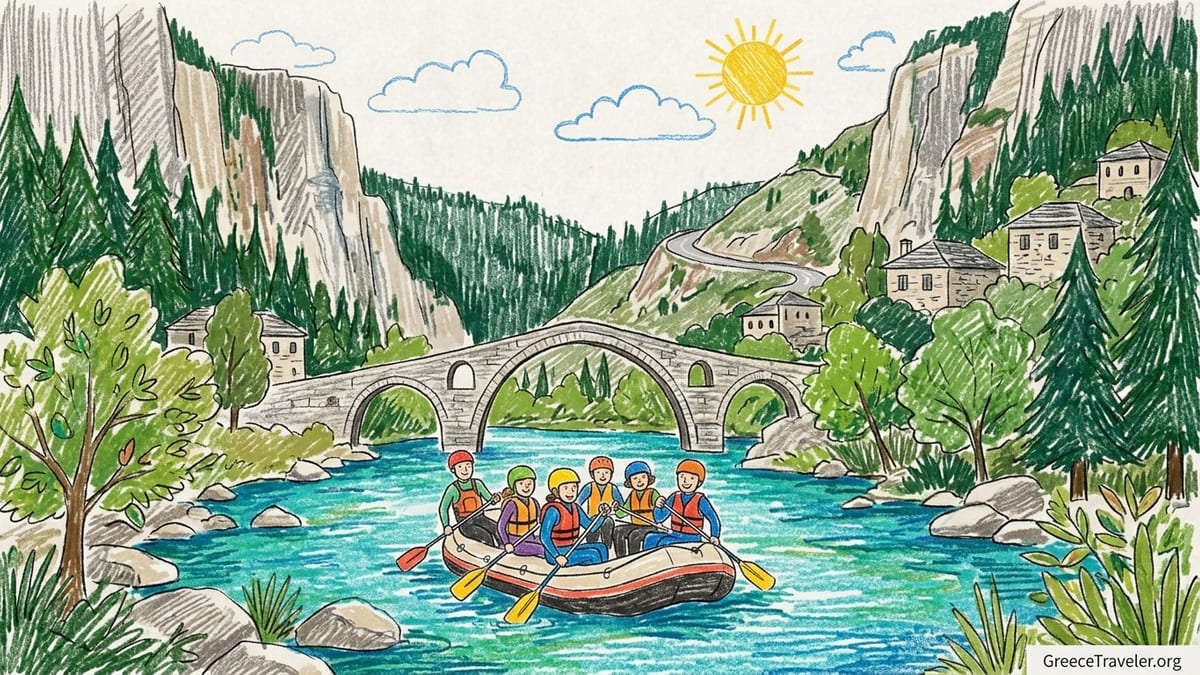
One of the standout “proper rafting” moments on typical Voidomatis routes is passing beneath and around the stone bridge landmarks, including the arched Klidonia bridge area that many operators highlight as a signature feature of the run. Seeing that kind of structure in person, from river level, makes the landscape feel closer and more dimensional than any roadside viewpoint.
Stops, Splashes, And The Cold: What The River Actually Felt Like
I need to be blunt: the Voidomatis felt cold in a way that made me laugh out loud the first time I got splashed. Not because it hurt, but because it was so instantly bracing. The wetsuit did its job, but any exposed area, like hands or the little gaps where water finds your wrists and neck, reminded you immediately that this is mountain-fed water.
We had a couple of natural pauses where the guide let us float in a calmer pocket and reset. Those stops mattered for the group dynamic. They gave the nervous paddlers a chance to breathe and they gave the confident paddlers a chance to look around without trying to do everything at once. If you’ve ever traveled with a mixed-skill group, you know those little “reset” moments can save the whole vibe.
As for swimming, the cold factor becomes a real decision point. Some tours on the Voidomatis explicitly include opportunities for swimming and even small jumps, and the river is famous for being clear and cold. If you choose to get in, it’s not a casual warm-water float. It’s a wake-up call. I personally found splashes invigorating, but full immersion would be a commitment, especially outside peak summer.
It’s also worth knowing that there are claims floating around online about the Voidomatis staying at a constant 4°C year-round. I would treat that as an oversimplification for most visitors’ planning purposes. What I can say from personal experience is that it felt cold enough that I was grateful for proper neoprene gear, and I wouldn’t want to do it without a wetsuit.
Who Found It Easy, Who Struggled, And Whether Beginners And Families Seemed Comfortable
In our raft, the experience split in a predictable way. The two people who do a lot of general fitness and outdoor activities took to paddling instantly. They liked the teamwork and didn’t mind getting splashed. I was somewhere in the middle: comfortable quickly, but still learning how to coordinate paddle strokes without wasting energy.
The most challenged person in our group was a friend who is perfectly active in day-to-day life but gets anxious when things feel unpredictable. For them, the hardest part wasn’t the paddling. It was the anticipation right before a faster section, when the raft would accelerate and the water sound would change. Once the guide called commands and we started working, they actually did better. It was the waiting that spiked their nerves.
Beginner-friendliness is the reason the Voidomatis is recommended so often. Many operators describe this section as Class I to II, and the overall vibe matches that description: exciting in moments, but not relentless. From what I observed, this is the kind of rafting where first-timers can succeed quickly, because the raft is stable and the guide is doing constant micro-corrections.
Families also seemed comfortable, with a big asterisk: cold water changes everything. If you have kids who love chilly water and don’t mind being wet, this can be an incredible first rafting trip. If your kids hate cold hands and wet clothing, you’ll want to pick your season carefully and ask the operator what extra layers they provide on cooler days.
What I’d Wear Differently Next Time (And What I’m Glad I Brought)
Next time, I’d change one main thing: I would bring warmer, drier clothing for immediately after the trip, including a truly warm top layer that I can put on while still slightly damp. The post-raft chill is real, especially if the air is cooler or shaded at the base. A lightweight jacket is fine, but a warmer layer would have made the transition more comfortable.
I would also bring a towel that’s more substantial than my usual travel microfiber. Microfiber is fine for hotels. For cold-water rafting, I wanted something that felt like a real reset, the kind of towel you can wrap around your shoulders while you peel off neoprene and regain feeling in your fingers.
Footwear-wise, I was happy to use the provided neoprene shoes on the water, but I was very glad I had simple slip-on footwear for afterward. When you’re cold and tired, fiddling with wet laces is annoying. If you’re road-tripping through Epirus, this is the kind of small comfort that makes the rest of your day smoother.
Finally, I’d pack an extra dry bag for car logistics. Even if your phone stays off the river, you’ll end up with damp items. Keeping your post-raft clothing sealed off from wet gear makes the drive back to Aristi, Papingo, or wherever you’re sleeping feel cleaner and more relaxed.
2026 Reality Check: Operators, Ages, Trip Length, Inclusions, Seasons, And Cancellation Policies
If you’re planning this for 2026, here’s what I found when I researched current offerings after my trip. First, official destination guidance from Discover Greece describes hiking or rafting along the Voidomatis as generally taking 2 to 4 hours and being available year-round, subject to conditions. They also note that rafting trip duration varies with difficulty choice and water level, with higher water up to May and spring and autumn often described as best for rafting conditions.
For a straightforward rafting-only outing, Trekking Hellas lists a Voidomatis rafting experience with an approximate total duration of 3 hours, with a 6.7 km route and a difficulty grade of 2/6. Trekking Hellas also lists pricing at €45 per person with a minimum of two participants. Their inclusions list is comprehensive: IRF-certified guides, all necessary rafting equipment including neoprene suit and shoes, waterproof jacket, helmet, life jacket, plus photos, local transfers for the activity, liability insurance, and VAT. Their stated participation requirements include basic physical condition, knowledge of swimming, and no previous experience required.
Minimum ages are not identical across every operator or season, so it’s worth reading the fine print. Trekking Hellas states a minimum age of 4 years and above for the Voidomatis rafting experience, with a note that the minimum age requirement is 4 years old during summer months. Alpine Zone, another operator offering Voidomatis rafting, states ages as 03+ in summer and 08+ in winter, and positions the trip as ideal for beginners and families. Active Nature describes a Class I route of about 2 hours on the river over around 7 km and describes it as suitable for beginners and families with children 5 years old or older.
Cancellations also vary by platform. Trekking Hellas cancellation terms as published via Discover Greece for the rafting tour specify a tiered policy: full refund more than 16 days before, 15% refund between 6 and 15 days, 50% refund between 3 and 5 days, and no refund within 0 to 2 days. Alpine Zone publishes a simpler free-cancellation window of up to 24 hours before the activity. If you’re booking through a reseller, read both the reseller policy and the operator policy, and keep a screenshot of the terms that apply to your confirmation.
Seasonal conditions are the other big variable. The Voidomatis is often marketed as suitable year-round, but conditions still dictate what “good rafting” feels like. At lower water levels, trips can feel gentler and sometimes bumpier over shallow rocks. At higher water levels, the current reads more powerful and sections can feel more dynamic. If your main goal is scenery and a safe introduction for beginners, lower water might be perfect. If your goal is more excitement, ask specifically what the river level has been doing and what that means for the day’s pace.
The Takeaway
My first run on the Voidomatis River didn’t feel like conquering whitewater so much as being invited into one of Zagori’s most intimate landscapes. The river was cold enough to command respect, gentle enough to make beginners feel capable, and just lively enough in short bursts to give me that adrenaline punctuation I’d hoped for.
If you want a first rafting experience where you can learn paddling without feeling like you’ve signed up for chaos, this is an excellent choice. If you go in expecting nonstop rapids, you might be underwhelmed, but if you go in wanting a confidence-building river day in a national-park setting, the Voidomatis delivers that in a way that feels both accessible and real.
Plan for cold water, pack smarter for the after-raft moment, and choose your operator based on the details that matter to your group: minimum age, included gear, and cancellation terms. Do that, and your biggest problem will be deciding whether you’re celebrating afterward with coffee in Aristi or dinner deeper in the Zagorochoria villages.
FAQ
Q1. How long does Voidomatis River rafting usually take?
Most organized experiences are planned as a 2 to 4 hour activity overall, depending on water conditions and the exact program, with many rafting-only trips lasting about 3 hours including briefing and transfers.
Q2. Is the Voidomatis River suitable for first-time rafters?
Yes. The common rafting section is typically marketed as Class I to II, designed to be manageable for beginners with a guide, while still offering a few lively sections.
Q3. Where do rafting trips on the Voidomatis usually start and finish?
A common route runs from the Aristi Bridge area down to the Klidonia Bridge area, with operators using a rafting base in Kleidonia or Kato Voidomatis for check-in, changing, and shuttle logistics.
Q4. What is the minimum age for rafting the Voidomatis?
It depends on operator and season. Examples published for 2026-style offerings include minimums around 3 to 5 years old in summer for some operators, with higher minimum ages in winter for certain providers.
Q5. Do I need previous rafting experience on the Voidomatis?
No. Many operators state that no previous experience is required, as long as participants follow the guide’s instructions and meet basic fitness and safety requirements.
Q6. What equipment is usually included with a guided Voidomatis rafting tour?
Common inclusions are neoprene wetsuit and neoprene shoes, life jacket, helmet, and a splash or waterproof jacket layer, plus paddles, rafts, guides, and typically local transfers needed to run the route.
Q7. What should I bring that operators usually do not provide?
Bring a swimsuit (or spare underwear to wear under neoprene), a towel, and warm dry clothing for afterward. If you wear contacts, consider a secure strap or bring glasses protection for splashes.
Q8. Is rafting on the Voidomatis available year-round?
Organized rafting is generally promoted as available year-round, but it is always subject to weather and river conditions, and operators may adjust routes or cancel if conditions are unsuitable.
Q9. What are typical cancellation policies for Voidomatis rafting?
They vary. Some operators publish free cancellation up to 24 hours before start time, while others use tiered refund schedules depending on how far in advance you cancel.
Q10. When is the best season for Voidomatis rafting in Zagori?
Spring and autumn are often highlighted as providing excellent conditions. Water levels can be higher up to May, and the character of the ride can change depending on seasonal flow.