


I went to Parga and Syvota expecting two easy, postcard-perfect days on the Ionian Sea: one to Paxos and Antipaxos, and another to Syvota’s Blue Lagoon, also called Pisina. What I got was better than the brochure in color and scenery, but far more specific in the lived details: the exact quay where you line up, the moment you realize the sun deck is already full, the slap of the bow on afternoon chop, the slightly frantic “back on board” whistles, and the truth about how much swimming time you really get before the captain lifts anchor.
Before You Book: What “Daily Cruises” Really Means in Parga and Syvota
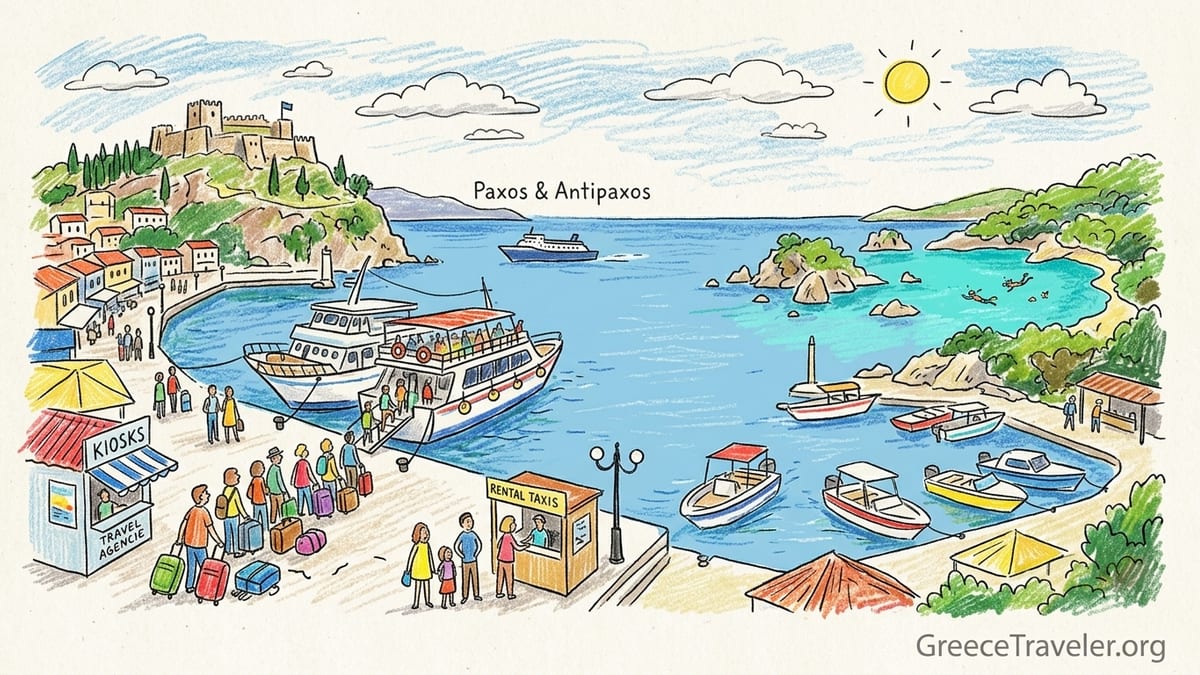
If you’re researching these trips, you’ll see the same claim repeated in official tourism guidance: organized day cruises to Paxos and Antipaxos leave from Parga and Syvota daily in season, generally with departures around the 9:00 to 10:00 window. That lines up with what I saw on the ground in summer: by mid-morning, both towns feel like they’re on a boat-tour conveyor belt, with ticket kiosks and travel agencies funneling people down to the water.
“Daily” also has a second meaning you only appreciate once you’re standing on the quay with a coffee and a wet towel: daily if the weather allows it. Official guidance for Antipaxos day cruises notes that trips are dependent on weather conditions, and in practice that can mean a late-night text from an agency, a reschedule, or a refund or voucher depending on the operator. Plan your itinerary so a cancellation does not break your trip. I always put my “must-do” boat day earlier in my stay so I have a buffer day to rebook.
Syvota’s Blue Lagoon is its own machine. Visit Greece describes daily cruises from Syvota’s port to Pisina, and it also emphasizes that this coastline is set up for sea access, with water taxis and rental boats running daily connections to beaches and small islets. That is a big deal for how your day feels: in Syvota, you can build a shorter, more flexible water day that is not locked to a single big-boat schedule.
My Parga Departure: The Quay Below the Castle, the Check-In Queue, and the Real Boarding Feel
My Paxos and Antipaxos day started on the Parga waterfront, at the town quay just below the Venetian castle hill, where day-cruise boats moor bow-in and load passengers off the promenade. It is not a “terminal” experience. It is more like lining up for a floating bus: you find your boat by name, show your ticket or booking confirmation, and step aboard across the gangway while crews shout last names and direct people to sit quickly so the boat can depart on time.
My operator’s timing matched what many Parga schedules advertise: meeting in the morning and a departure not long after, with the crowd building fast if you arrive late. I got there early enough to choose seating without stress, and I’m glad I did. On a full boat day, the best shade and the least windy seats are gone first, and once the boat pulls out, you are not swapping places unless someone offers.
Boat size and layout matters more than people admit. The vessel I rode on was a mid-size excursion boat rather than a tiny speedboat: big enough to have an indoor cabin, outdoor seating, and a top deck area where sun-seekers immediately claimed every inch. That kind of boat is comfortable for a full day, but it also creates a specific tradeoff: you get toilets and a proper bar or snack counter, but you also get a high passenger count and a louder, more crowded vibe once the music goes on and the guide starts calling out landmarks over the speakers.
Noise is constant in a way I didn’t fully anticipate. Between the engine hum, the public-address announcements, the clatter of cups from the bar, and the wind, it is not a quiet cruise. If you’re sensitive to sound, the indoor cabin can feel calmer, but it is warmer and can smell faintly of sunscreen and sea-damp clothes as the day goes on. Outdoors is breezier and more pleasant, but the wind and spray can be relentless when the boat hits open water.
Paxos and Antipaxos on an Organized Cruise: Sea Conditions, Swim Stops, and Time in Gaios
The crossing toward Paxos felt smooth at first, then more animated once we left the most sheltered stretch of coast. On my day, the sea was not rough in a scary way, but the late-morning chop was enough that standing at the rail required a steady stance. This is where your seat choice shows up in your body: forward seats tend to feel more impact as the bow rises and falls, while mid-ship feels steadier. If you get motion sickness, bring what you know works for you and use it before you feel queasy.
My cruise followed the familiar “greatest hits” pattern promoted for the Parga to Paxos run: a caves segment, a swimming stop at Antipaxos, and time in Paxos’ capital, Gaios. What surprised me was how structured the swim stop actually is. Many itineraries quote something like 45 to 50 minutes at the Antipaxos swim area, and that is close to the lived reality: by the time the boat anchors, the crew drops ladders, and everyone cycles through the same entry and exit points, your personal in-water time can feel shorter than the headline number.
Water clarity at Antipaxos is not hype. When I slid in, the visibility felt pool-like, the kind where you can see your legs clearly beneath you and watch sunlight flicker on the pale seabed. But the experience depends on crowding. On my day, multiple boats were anchored in the same general area off Voutoumi, and that changes the atmosphere. You are not “alone in a lagoon.” You are sharing a turquoise cove with other excursion groups, and you will sometimes swim around clusters of people staying near ladders because they are nervous about open water.
The moment that made the day feel slightly rushed was Gaios. Some Parga excursions advertise around an hour and a half in town, while other styles of cruise build closer to two to two and a half hours. My experience landed closer to the shorter side. It was enough time for a quick walk along the waterfront, a coffee, and a fast meal if you move with purpose. It was not enough time to wander slowly, shop leisurely, and still feel like you had “found” the town. If your dream is Gaios itself, the organized cruise is a sampler, not a deep visit.
On the return, the afternoon sea state felt bouncier, and the boat energy shifted. Wet hair dried into salt, people went quiet or sleepy, and the top deck thinned because the wind picked up. This is also when the “big boat” tradeoff becomes most obvious: you have comfort and facilities, but you are locked into a single schedule. When the captain turns back, your day is effectively over whether you personally feel finished or not.
Syvota’s Blue Lagoon (Pisina): What the Cove Was Like, How Crowded It Felt, and What Snorkeling Actually Gave Me
The Blue Lagoon day felt fundamentally different because Syvota is built for short sea hops. Visit Greece describes daily cruises departing from Syvota’s port to Pisina, and it also highlights snorkeling and even glass-bottom boat options in the area. That matches the local reality: there are frequent departures, multiple styles of boat, and a steady flow of visitors cycling in and out of the same photogenic water.
I boarded in Syvota at the town port in the morning, in the harbor area where small excursion boats and taxi boats work continuously. The vibe was more casual than Parga’s big day-cruise lineup. You can feel that this is a boating village: people are walking down with masks and fins, families are negotiating seats, and crews are turning boats around quickly for the next run.
Pisina itself is beautiful, but it is not a secret. On my day, the cove was clearly popular, with boats coming and going and clusters of swimmers gravitating toward the easiest entry points. The most “Blue Lagoon” color tends to concentrate where the sun hits the shallows and the seabed is pale. When multiple boats are present, you can still find clear water, but the surface can get busy with floating bodies, snorkelers, and occasional splashes from people jumping in near ladders.
Snorkeling here is enjoyable, with good visibility and that bright, tropical-looking palette the Ionian is famous for. But set your expectations correctly: this is not a reef destination. What I loved was the simple pleasure of hovering above the seabed, watching fish flick through rocks and grass, and letting the light do the work. If you bring your own mask and snorkel, you can stay in the water longer and make the stop feel richer. If you do not, you can still swim, but the “underwater world” will feel more like a quick peek than an activity.
What matters most at Pisina is timing. If you arrive with several other boats, the cove feels like a shared attraction rather than an escape. If you hit it earlier, or on a shoulder-season day, you get more of the quiet-lagoon effect. In peak season, I treated it like a gorgeous swim stop, not a solitude fantasy, and that mindset made it more satisfying.
Organized Cruise vs Renting a Small Boat: Where I Felt the Difference Most
I did both styles in the broader Parga and Syvota area, and the differences were not subtle. The organized cruise is a packaged narrative: you are shown caves, dropped into a famous swim spot for a fixed window, and given a short slice of a port town. It is easy and efficient. You pay a per-person price, you do not think about navigation, and you do not worry about docking. If you are traveling without confidence on the water, it is the simplest way to get the postcard highlights in a single day.
Renting a small boat in Syvota felt like stepping out of a crowd and into your own pace. Visit Greece explicitly points out that nearby beaches are served by water taxis and rental boats with daily connections, and you feel that ecosystem immediately. Instead of one long day loop, you can build a sequence: a calm swim, a second cove, a beach lunch, and then one more dip before returning. The best part is not speed. It is control. If a cove is crowded, you leave. If the wind picks up, you retreat into a sheltered bay. If you find water you love, you stay.
I only recommend the small-boat route if you are comfortable with basic boat handling and local rules, or if you hire a skipper. In peak season, there can be a lot of traffic, and it is not the place to learn from scratch under pressure. That said, a skipper changes everything. You can focus on the water, the color, and your swim, while someone else handles anchoring, spacing, and safe routing.
Cost comparisons are where people get tripped up. Organized cruises from Parga are widely advertised from around the mid-30-euro range per adult for the day, while more premium or different departure points can cost more. Meanwhile, private transfers or private boat options can quickly jump into several hundred euros depending on boat type and whether you are booking a one-way or round trip. If you are a couple, the organized cruise is usually the budget winner. If you are a group, splitting a skipper boat can start to make emotional and practical sense because you are buying back time, space, and flexibility.
Schedules, Prices, and Weather Cancellations: What I’d Check Now Before You Walk to the Port
For Paxos and Antipaxos, official travel guidance frames the main season as May through September, with organized day cruises departing from Corfu, Parga, and Syvota daily in season, typically in the 9:00 to 10:00 departure window. In Parga specifically, you will also see published operator schedules showing morning departures and late-afternoon or early-evening returns depending on route length. The most important practical point is not the exact minute on the brochure. It is that you should treat check-in as earlier than departure and arrive with time to find the right boat on a busy quay.
Price-wise, I saw Parga-to-Paxos day cruise pricing advertised from about €35 per adult on common routes, with child pricing often reduced. That number is meaningful because it sets expectations: it is not a luxury product, it is mass tourism done efficiently. You can absolutely have a beautiful day on that budget, but you should not expect unlimited space or a quiet, bespoke pace.
Syvota’s Blue Lagoon has another layer: shorter, more frequent trips exist, and some official guidance even lists operating hours for the Blue Lagoon boat-trip experience window. In practice, that translates to more choices and more last-minute flexibility. If your morning looks windy, you may be able to swap to a later departure. If the water looks perfect, you can commit on the spot. If you want the least crowded water, ask what time the first boats reach Pisina and aim for earlier rather than later.
Weather cancellation policies vary dramatically by seller. Some big online tour listings advertise free cancellation up to a set window before departure, while local ticket offices may offer rescheduling or credit if the boat does not run. The operational rule on the water is simple: if sea conditions are unsafe, the captain cancels or alters the route. The financial rule is not universal. Before you pay, I would ask one direct question: if the boat does not go due to weather, do I get a refund, a voucher, or a choice?
The Takeaway
My Parga day to Paxos and Antipaxos delivered exactly what you want from the Ionian: glowing water, dramatic coastline, and that unmistakable feeling of swimming somewhere iconic. It also delivered what brochures rarely emphasize: a crowded boat, a fixed rhythm, and a swim stop that feels shorter once you factor in the reality of getting hundreds of people in and out of the sea safely.
My Syvota Blue Lagoon day felt more playful and modular. The water at Pisina earns its reputation, but it is popular for a reason, and in peak season you should expect company. What makes Syvota special is the access culture: daily cruises, water taxis, and rental boats create options. If you want a calm, choose-your-own-adventure sea day, Syvota makes that easier than Parga.
If I had to choose only one organized excursion, I would pick the Paxos and Antipaxos day because the sense of “crossing to islands” makes it feel like a real journey. If I had to choose the best overall boat day for pure swimming joy and flexibility, I would choose a Syvota small-boat day, ideally with enough experience or a skipper so I could relax into the water instead of managing logistics.
FAQ
Q1. Do Paxos and Antipaxos cruises really leave daily from Parga and Syvota in summer?
In the main season, organized day cruises are widely described as running daily from Parga and Syvota, typically with morning departures, but they remain weather-dependent and can be canceled on rough sea days.
Q2. What time should I arrive at Parga port for a Paxos Antipaxos day cruise?
Plan to arrive well before the advertised departure so you can find the correct boat on the quay, check in, and choose a seat, especially in July and August when boats fill quickly.
Q3. How long do you actually get in Gaios, Paxos on a day cruise from Parga?
It depends on the operator, but many itineraries allow roughly 1.5 to 2.5 hours in Gaios. In practice, it can feel tight once you factor in walking, ordering food, and paying.
Q4. Is the Antipaxos swim stop enough time to enjoy the water?
The water is stunning, but the swim window can feel short because anchoring, ladder access, and passenger volume reduce your personal in-water minutes. Bringing your own snorkel gear helps maximize the stop.
Q5. How clear is the water at Antipaxos?
On a good-weather day, the water can be extremely clear with bright turquoise tones and excellent visibility, especially in shallower areas near the popular beaches.
Q6. Is Syvota’s Blue Lagoon (Pisina) crowded?
In peak season it can be busy, with multiple boats and swimmers sharing the same cove. The experience is still beautiful, but it feels like a popular attraction rather than a secluded spot.
Q7. Is snorkeling at Pisina worth doing if I’m not a strong swimmer?
Yes, if you stay close to your boat’s ladder or in calm shallows. Visibility is typically good, but it is not a reef, so the main reward is clear water, light, and small fish rather than dramatic coral scenery.
Q8. What’s better: an organized cruise or renting a small boat in Syvota?
Organized cruises are easy and budget-friendly per person. Renting a small boat or hiring a skipper offers more flexibility and space, but costs more and requires comfort with boat handling or a professional driver.
Q9. What are typical prices for Parga to Paxos Antipaxos cruises?
You will often see adult prices advertised from around €35 for common full-day routes, with reduced child pricing. Premium or different boat types can cost more.
Q10. What happens if wind cancels my boat trip?
Safety comes first and routes can be canceled or changed. Refunds and rescheduling rules depend on the seller, so confirm whether you receive a refund, a voucher, or the option to move dates before paying.