


Crete has more than 600 named beaches stretched along roughly 1,000 kilometres of coastline, which means the real challenge is not finding a beautiful place to swim, but choosing the right beach for your style of holiday. A family with toddlers needs shallow sand, parking and shade. Hikers and strong swimmers may be happy to trade comfort for drama. This guide focuses on Crete’s headline beaches Balos, Elafonissi, Falassarna, Preveli, Vai, Matala and Seitan Limania plus a handful of reliable, family friendly north coast resort beaches and compares them by sand versus pebbles, shallow water, facilities, crowds, parking and access.
How to Match Crete’s Beaches to Your Trip
Before zeroing in on Balos or Elafonissi, it helps to decide what you actually want from a beach day. On Crete, the same coastline can shift from fine sand to round pebbles in a few hundred metres. In practice, this means you can find yourself driving an hour to a photogenic cove and then realise it is too rocky for your toddler or too exposed to the wind for a nervous swimmer. Thinking in terms of sand type, depth, wind exposure, and how much comfort you expect from facilities and parking will save you time and frustration.
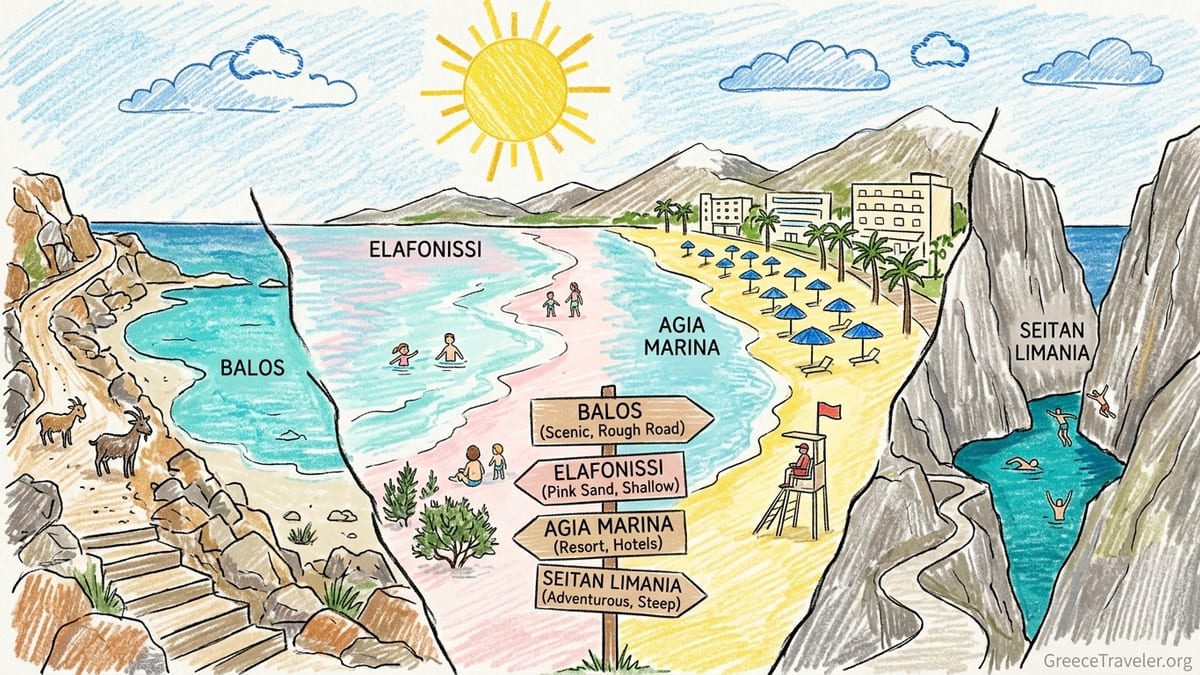
As a rule, the big name lagoon beaches such as Balos and Elafonissi are about scenery first and convenience second. They offer soft sand and shallows but require long drives, rough tracks or boats, and they are often very crowded between late June and early September. By contrast, long resort strips like Agia Marina near Chania, Rethymno town beach or Stalis east of Heraklion tend to be less dramatic but deliver easy access, lifeguards in season, restaurants and hotels directly on the sand, which matters for families, older travellers and anyone without a hire car.
Season and timing also change how a beach feels. In high summer, parking at Elafonissi can cost a few euros in private lots and fill by mid morning, while a pair of sunbeds with umbrella typically runs around 10 to 15 euros for the day. Arriving before 9 am or after 4 pm can mean a cooler walk from the car, easier parking and fewer people in the water at the busiest spots. In shoulder months like May, June, late September and early October, you often find space even at famous beaches, though the sea can feel cooler in early season, especially in shallow lagoons where overnight temperatures drop.
Finally, think in regions. If you are based in Chania with only a few days, driving four hours round trip to Elafonissi, plus another full day to Balos, might be less enjoyable than combining one headline beach with a day at nearby Falassarna and a relaxed afternoon on Agioi Apostoloi or Agia Marina right outside the city. In Rethymno or Heraklion, you may prefer to treat Balos and Elafonissi as full day excursions from a west coast stay instead of forcing them into an already tight itinerary.
Balos: Iconic Lagoon With a Price in Time
Balos, on the northwestern tip of Crete, is one of the island’s most photographed beaches: a shallow turquoise lagoon backed by the islet of Gramvousa and a rocky headland. The sand here is mostly fine and pale with some crushed shell that can give a faintly pink hue in places. The lagoon area is very shallow, often knee deep for long stretches, which makes it good for paddling and for children who like to splash rather than swim, while older swimmers usually walk out to the deeper outer edge for a proper dip.
The main trade off at Balos is access. From Chania, most visitors either drive about one hour to the small port of Kissamos and then take a day boat that stops at Gramvousa before anchoring off Balos, or they tackle the rough dirt road from Kaliviani to the car park above the lagoon. The road is legal to drive in standard rental cars but is bumpy, narrow in places and usually has goats on the verges; rental companies often warn you that damage from this road is not covered. After parking, there is a descent of several hundred stone steps to the sand and a corresponding climb back in the afternoon heat, which is demanding for small children, anyone with limited mobility, or travellers carrying a lot of gear.
Facilities at Balos are basic. In peak season you can usually find a limited number of sunbeds and umbrellas, portable toilets and a simple beach canteen. Prices are typical for remote sites, so many visitors bring snacks and plenty of water from Kissamos. There is no shade away from the rented umbrellas. Between about 11 am and 3 pm the beach fills with day cruise passengers and the central lagoon can feel busy. If you want quieter photographs and less crowded water, arriving by car before 9 am, or staying until after the boats leave in late afternoon, transforms the experience.
Balos suits travellers who prioritise scenery and do not mind a long approach, some hiking and fewer comforts. It is less suitable as a casual half day with young children, and it is not ideal if you want to pop back to your hotel for a siesta, since Chania is around 75 to 90 minutes away once you factor in the dirt road or the boat schedule.
Elafonissi: Shallow Pink Lagoon and Family Favourite
Elafonissi, on the remote southwest corner of Crete, is famous for its shallow turquoise lagoon and patches of pale pink sand created by crushed shells. The water inside the lagoon is exceptionally shallow, often less than one metre deep for long distances, and you can usually wade to the islet of Elafonisi in under ten minutes. This makes it one of the safest feeling beaches for small children and weaker swimmers, although the sea can feel surprisingly cool before the shallows warm up on breezy days.
Access involves a long but scenic drive from Chania of roughly 75 kilometres, much of it on mountain roads with bends and villages where you slow down for pedestrians. Many people plan it as a full day trip with a stop at a tavern such as Glykeria or other viewpoints along the route. Near the beach you find a large sandy parking area and several private lots. In practice, parking conditions change year by year, and there have been reports of unofficial attendants charging for spaces that are supposed to be free, so it is worth checking current local advice and being cautious about where you park. Arriving before about 9 am or after 4 pm usually avoids the worst crowding at both the entrance road and the car parks.
The eastern side of Elafonissi, facing the lagoon, is well organised in season with rows of sunbeds and umbrellas, lifeguards, basic toilets and several kiosks selling drinks and snacks. Expect to pay around 10 to 15 euros for a pair of sunbeds with umbrella for the day, which is good value if you base yourself there with children. As you walk further along the islet the crowds thin, facilities disappear and the atmosphere becomes more natural, with low dunes and juniper or cedar bushes for minimal shade. Many families with older children choose to keep the organised area as a base and then explore along the island in short walks.
Elafonissi is especially appealing for families who value shallow water and soft sand over quiet. In July and August the first rows of umbrellas may fill by mid morning, and by lunchtime the lagoon can feel like a busy outdoor pool. For a less crowded experience in high season you can visit in late afternoon when many excursion buses have left, or use Elafonissi as a shoulder season base in June or late September when the sea is still warm but the beach feels calmer.
Falassarna and the West Coast: Sand, Surf and Space
Falassarna, on the west coast north of Elafonissi, offers a very different feel. Instead of a single enclosed lagoon, this is a series of wide sandy bays facing west into the open sea. The main beach, Pachia Ammos, is long, straight and sandy with clear water and depth that increases steadily but not abruptly, which suits confident swimmers and older children. In calm conditions you can wade out comfortably, but on windier days there is more surf than at Elafonissi or Balos, which some visitors love for bodyboarding and others may find too rough for toddlers.
The sand at Falassarna is soft and golden, with some small pebbly patches near the waterline depending on winter storms. Facilities are good without feeling overbuilt: several clusters of rental sunbeds and umbrellas, a range of beach bars and tavernas behind the sand, and free or low cost parking on dirt tracks close to the sea. Prices for sunbeds are broadly similar to Elafonissi, but there are more choices where you can simply lay a towel in the free zones between organised sections if you prefer not to pay.
One of Falassarna’s strengths is space. Even in August, the beach rarely feels as hemmed in as Elafonissi or smaller north coast coves, and it is relatively easy to walk ten minutes along the sand and find a quieter patch. Because it faces west, sunset here is spectacular on clear evenings, and a common pattern is for visitors staying in Chania to spend the afternoon at the beach and then have an early dinner at a taverna looking over the sea before driving back.
For families and mixed groups, Falassarna works well as a more relaxed alternative to Elafonissi. You still get fine sand and clear water, but with easier road access from Chania, more room to spread out and a choice of tavernas and simple accommodations close to the shore if you want to stay overnight rather than drive back the same day.
Preveli, Vai and Matala: South and East Coast Characters
Preveli, on Crete’s south coast in the Rethymno region, combines a pebble beach, a freshwater river and a palm grove that feels almost tropical. The beach itself is mostly coarse sand and small pebbles, with the river running into the sea and forming a shallow pool where children often paddle. This is not a classic soft sand family beach because pebbles dominate at the waterline, but the scenery is memorable and boat trips from nearby Plakias make it an attractive day out for older children and adults.
Access to Preveli is either by boat from Plakias or Damnoni or by road to a clifftop car park followed by a steep stairway descent that takes around 15 to 20 minutes and feels longer on the way back in the heat. Facilities are limited to a seasonal canteen and basic toilets. For many visitors that is part of the appeal, but it does mean you should bring water, hats and suitable footwear for the path. Crowds are moderate compared to Balos or Elafonissi, but in peak season the central area by the river can still feel busy around midday when the boats arrive.
On the far east coast, Vai is famous for its large natural palm forest behind a crescent of pale sand. The main beach area has soft sand with some small pebbles and usually gentle entry into the sea, though it becomes deeper more quickly than Elafonissi. The shore is organised with sunbeds, umbrellas, showers and a beach restaurant, and there is a paid parking area behind the palms. Because of the unique scenery, Vai attracts coach excursions, especially in August, so visiting early morning or late afternoon is again the best strategy if you prefer fewer people.
Matala, south of Heraklion, is different again. The main bay has a mix of coarse sand and small pebbles and quite deep water close to shore. Its cliffside caves, once occupied by hippies in the 1960s and 1970s, give the village a bohemian feel. The beach is fully organised, with sunbeds, umbrellas, lifeguards in season and tavernas directly behind the sand. For strong swimmers and adults, Matala is very enjoyable, but for families with small children the relatively quick drop off and occasional stronger waves mean you need to supervise closely or consider nearby Kommos, which offers a longer stretch of sand and more gradual depth.
Seitan Limania: Spectacular but Not for Everyone
Seitan Limania, on the Akrotiri peninsula northeast of Chania, is one of Crete’s most dramatic small beaches. A narrow, rocky inlet twists inland between high cliffs to a tiny pocket of pale sand and small pebbles. The water is a stunning shade of turquoise and quickly becomes deep, which appeals to confident swimmers and those who like to jump from the lower rocks when the sea is calm. It is a remarkable sight in person, and many travellers come as much for the view from the clifftop path as for swimming.
Reaching the beach involves driving on a paved but steep road from the village of Chordaki to a parking area above the cove, then hiking down a rough, rocky path that takes about 10 to 20 minutes depending on fitness and how often you stop to take photographs. The descent requires proper shoes rather than flip flops, and the climb back up can be challenging in midday heat. There are no facilities on the beach itself: no toilets, no shade, no lifeguards and no kiosks, which means you must bring water, snacks and anything you need and carry your rubbish back up.
Sand here is limited. The narrow strip of shore is mostly coarse sand and small stones, and the space fills quickly in high season. Because the cove is small, even a moderate number of visitors can make it feel crowded. Many people treat Seitan Limania as a short visit rather than a full beach day, combining a couple of hours here with a stop at a taverna on Akrotiri or a swim at one of the easier beaches closer to Chania.
Given the steep access, lack of shade and depth of water, Seitan Limania is not suitable for young children, anyone with mobility issues or travellers who are uncomfortable on exposed paths. If you fit the profile of strong swimmer with good footwear and you time your visit for early morning or evening, it can be a highlight of a Chania stay. For most family groups, however, it belongs in the sightseeing category rather than the go to daily swim.
Family Friendly North Coast Beaches With Hotels on the Sand
Most of Crete’s large resort hotels line the north coast from west of Chania to far east of Heraklion. This is where you find long stretches of sand or sand and fine shingle with shallow entries and all services directly behind the beach. For many travellers, especially with children or limited mobility, these are the beaches you will use most often, reserving the famous lagoons as occasional excursions.
Near Chania, Agia Marina and neighbouring Platanias form a continuous sandy bay. The sand is soft, the entry to the sea is generally gradual and during the main season there are lifeguards, water sports and many beach bars. A typical mid range hotel here might have a pool almost at the sand and a gate opening directly onto its designated section of beach with sunbeds for guests. This arrangement means you can move easily between room, pool, restaurant and sea without dealing with parking or long walks, which is a major advantage with toddlers and pushchairs.
Closer to Chania city, the cluster of small coves at Agioi Apostoloi offers sandy, relatively shallow bays sheltered from the prevailing north winds, with playgrounds and parks immediately behind. Many locals choose these for weekend swims with children because you can park nearby, find shade under trees and walk a few metres to the water. On the other side of the island near Heraklion, resorts such as Stalis and Malia have long sandy beaches backed by hotels, apartments, tavernas and shops. The water here is usually shallow and flat in calmer weather, and in high season the main sections are fully organised with sunbeds, umbrellas and lifeguards.
Rethymno town beach is another practical choice. It is a long sandy strip directly in front of the town’s seafront hotels and apartments, with a promenade, restaurants and shops just across the road. The sand is fine, the entry to the water is mostly gentle, and families appreciate being able to combine a cultural stroll around the old town with an easy afternoon on the beach without moving the car. East of Rethymno, smaller resort villages like Bali or Panormos offer more sheltered bays, often with very shallow water and a handful of small hotels or guesthouses right at the shore.
On the Lasithi side, places like Almyrida and Elounda are popular for younger families. Almyrida has a sandy beach and shallow, protected water, with tavernas and small hotels directly behind the sand. Elounda’s main beach is similarly shallow and organised, and many upscale hotels in the wider Mirabello Bay area feature private sandy coves or platforms with steps straight into the sea. In all these north coast locations, the key advantage is simplicity: you step out of your room and you are almost immediately at a usable, safe beach without needing to plan a day trip.
Choosing Between Regions and Planning a Realistic Beach Itinerary
With so many options, the most useful decision is often not which single beach is the best, but which cluster of beaches fits your base. If you stay in or near Chania for a week, for example, you can comfortably include a day at Elafonissi, another at Falassarna, and a morning at Seitan Limania combined with a gentler afternoon swim at Agioi Apostoloi. Balos is also reachable from Chania, but because of the long boat trip or rough road and hike, many travellers choose either Balos or Elafonissi on a short stay, not both.
From Rethymno, you are well placed for Preveli and the south coast coves around Plakias and Damnoni, plus day trips to Bali or Panormos on the north and even long day excursions west to Falassarna or east towards Heraklion and beyond. Here, the choice is often between spending more time on the convenient town beach, which has full facilities and is right outside the hotel, or driving further for more dramatic scenery but fewer comforts.
If your base is near Heraklion, you will probably swim most often at north coast resort beaches such as Amoudara, Agia Pelagia, Stalis or Malia, and then consider longer drives east to Matala or north to the Lassithi region for Vai. Because these drives can easily turn into three or four hour round trips once you include scenic stops and traffic, it is wise to treat each famous beach as a full day out, starting early to secure parking and to enjoy cooler hours on arrival.
When planning, it helps to match each day to energy levels. A demanding outing like Balos or Seitan Limania, with its hike in the sun, pairs best with a rest day at the hotel beach the following day. Travellers who underestimate the time and heat involved in some of these excursions often end up too tired to appreciate the scenery. Building in time for simple swims at the beach directly outside your hotel or in a sheltered north coast bay can make the headline days more enjoyable.
FAQ
Q1. Which of these famous beaches is best for young children and non swimmers?
Elafonissi is generally the best fit, thanks to its very shallow lagoon, soft sand and lifeguards in season. Falassarna and many north coast resort beaches like Agia Marina, Rethymno town beach and Stalis also offer gentle, sandy entries and full facilities, which make life easier with toddlers and cautious swimmers.
Q2. If I only have one day from Chania, should I choose Balos or Elafonissi?
Balos offers the more dramatic lagoon scenery but requires either a boat trip with fixed timings or a rough road and a steep hike, while Elafonissi involves a long but straightforward mountain drive and no major walking once you park. If you are travelling with children or prefer easier logistics, Elafonissi is usually the better choice for a single long day from Chania.
Q3. Are Balos and Elafonissi suitable for people with limited mobility?
Both present challenges. Balos has a long stairway from the car park and uneven ground on the lagoon edge. Elafonissi is flat once you reach the sand, but parking surfaces can be rough and distances from car to umbrellas are not always short. For travellers with significant mobility issues, a resort beach such as Agia Marina, Rethymno town beach, Stalis or Elounda, where hotels open directly onto the sand and access paths are paved, will be far more comfortable.
Q4. Where can I find good beaches right outside the hotel without driving?
On the north coast, many hotels in Agia Marina and Platanias near Chania, in Rethymno town, in Bali and Panormos, and in the Stalis and Malia area east of Heraklion are directly on long sandy beaches. In these resorts you often step from the hotel garden or pool area straight onto an organised stretch of sand with sunbeds for guests, eliminating the need for daily driving or parking.
Q5. Is Seitan Limania safe for children or nervous swimmers?
Seitan Limania is not recommended for young children or anyone uneasy in deep water. The path down is steep and rocky, there is no shade or lifeguard, and the water becomes deep very close to shore. Families are usually better off at sheltered bays such as Agioi Apostoloi, Almyrida, Elounda or the organised sections of Elafonissi and Falassarna.
Q6. What is the difference between Falassarna and the typical north coast resort beaches?
Falassarna is a large, open west facing bay with wide natural sand, clearer views and more space between umbrellas. It feels less built up than long resort strips and is excellent at sunset. North coast resort beaches like Agia Marina, Stalis or Malia are more developed and convenient, with hotels, bars and shops directly behind the sand, but they can feel busier and more commercial in high season.
Q7. Is it worth staying overnight near any of these famous beaches?
If you have the flexibility, staying a night near Falassarna, Elafonissi or in the Kissamos area for Balos lets you enjoy early morning and late evening light with far fewer people. For example, a small hotel or apartment above Falassarna allows you to walk down to the sand before day trippers arrive and to linger for sunset without facing a late drive back to Chania in the dark.
Q8. How expensive are sunbeds and parking on these beaches?
Prices vary by year and operator but, as a guide, a pair of sunbeds with umbrella on organised sections of Elafonissi, Falassarna, Vai or major north coast resorts often costs around 10 to 15 euros for the day. Parking is free at some beaches and low cost or run by private operators at others. Because arrangements change regularly, it is sensible to carry small cash, arrive early to have more choice and check for official signs before paying attendants.
Q9. Which beaches have more pebbles than sand, and what does that mean in practice?
Preveli, parts of Matala and some smaller coves have a mix of coarse sand and pebbles, especially at the waterline. Pebbles are less comfortable for barefoot children and for lying directly on the shore, so most visitors bring water shoes and use sunbeds or thick towels. If you strongly prefer soft sand underfoot, focus on Elafonissi, Falassarna, Balos’s lagoon and the many sandy resort beaches on the north coast.
Q10. Can I visit multiple famous beaches in one day, such as Balos and Falassarna?
In theory you can combine, for example, a morning boat trip to Balos with a late swim at Falassarna, but in practice the driving and walking involved make most combinations tiring, especially in summer heat. A more relaxed approach is to dedicate a full day to each headline beach and use nearby resort beaches or hotel front stretches for shorter, spontaneous swims on the remaining days.