

Thessaloniki is one of Greece’s best bases for day trips. Within two to three hours you can reach beaches, alpine peaks, royal tombs and steaming thermal springs. This guide compares the classic excursions from Thessaloniki and explains, in practical terms, how to reach each one by rental car, organized tour, public bus or train.
How to Choose the Right Thessaloniki Day Trip
Most travelers visiting Thessaloniki have time for one or two full-day excursions, so it helps to match destinations with your interests and the season. Beach lovers gravitate to Halkidiki in late spring through early autumn, while hikers and mountain enthusiasts focus on Mount Olympus in the milder months of May, June, September and October. History and archaeology fans usually prioritize Vergina (Aigai), Pella and sometimes Dion, which combine easily with a relaxed taverna lunch in a nearby village. For dramatic scenery, Meteora’s cliff-top monasteries are unmatched, but it is the longest day trip of all.
Logistics also matter. Several of these destinations are straightforward by public transport, while others are much easier with an organized tour or a rental car. For instance, Edessa and Pella are linked by regional buses, and Kalambaka (for Meteora) can be reached by train and bus combinations, but Pozar thermal baths sit in a valley that requires at least one transfer and usually a taxi at the end. Organized tours, offered by local operators and global platforms, start around 60 to 110 euros per person for shared buses, with private options often starting around 200 to 250 euros per group for nearby sites and rising for longer routes.
Time on the road is another deciding factor. Halkidiki’s first peninsula starts about one hour from Thessaloniki by car or direct bus, while the trip to Meteora can take about three and a half to four hours each way by tour coach, depending on traffic. Mount Olympus trailheads such as Litochoro and Prionia are generally reached in one and a half to two and a half hours by car, but public transport adds time for transfers. If you are traveling outside peak summer, shorter drives like Vergina, Pella or Edessa often feel more relaxed and leave extra time to explore Thessaloniki itself.
Finally, think about whether you prefer independence or a guided experience. Renting a small car for a day can cost from about 35 to 60 euros in low to shoulder season, plus fuel and tolls, and gives you freedom to stop in villages or viewpoints. Guided tours, on the other hand, provide commentary at sites like the Royal Tombs of Aigai or the Meteora monasteries, and they remove the stress of driving on unfamiliar roads.
Halkidiki: Beach Escape from the City
Halkidiki is Thessaloniki’s classic seaside escape, famous for its three peninsulas that resemble a trident jutting into the Aegean. For a straightforward day trip, most visitors focus on the Kassandra peninsula or the western side of Sithonia, where resorts and organized beaches cater to short stays. Popular spots like Nea Potidea, Hanioti, Pefkochori and Sani offer long sandy beaches, sunbed rentals, and beach bars that serve coffee, fresh juices and seafood lunches. In high summer you will find Thessaloniki residents driving down early in the morning to claim a sunbed and returning after sunset.
Reaching Halkidiki without a car is relatively simple. Intercity buses depart from Thessaloniki’s Halkidiki bus station, which is linked to the city by local bus line 45 from the main KTEL Makedonia terminal. Recent Halkidiki bus timetables show multiple daily departures to popular towns such as Nea Moudania, Kallithea and Nikiti in summer, with journey times of roughly one to two hours depending on distance. Tickets are typically in the range of 8 to 15 euros one way, and you usually buy them at the station ticket office. In peak August weekends, buses can sell out, so it pays to buy tickets earlier in the day if possible.
By rental car, the drive from Thessaloniki to Nea Moudania often takes about 50 to 60 minutes, largely on good-quality national roads. Continuing toward Kallithea or the eastern side of Kassandra adds another 20 to 40 minutes, so it is realistic to leave Thessaloniki around 8:00 in the morning, enjoy a full beach day, and be back in the city by late evening. Fuel costs for the round trip typically stay under 30 euros for a compact car. Parking near organized beaches fills up by late morning in late July and August, but many beach bars maintain private lots for customers.
Organized day tours from Thessaloniki to Halkidiki often combine beach time with a short boat cruise. For example, some tours offer a full-day cruise departing from Ormos Panagias around Sithonia, visiting Blue Lagoon–style coves and including swim stops and a light lunch, with coach transfers from central Thessaloniki and per-person prices that commonly start around 60 to 90 euros in high season. These are convenient if you want a relaxed, no-driving day with guaranteed shade, food and drinks on board, but independent travelers may find self-drive options more flexible, especially if they want to explore quieter beaches off the main resort strips.
Meteora: Monasteries on the Rocks
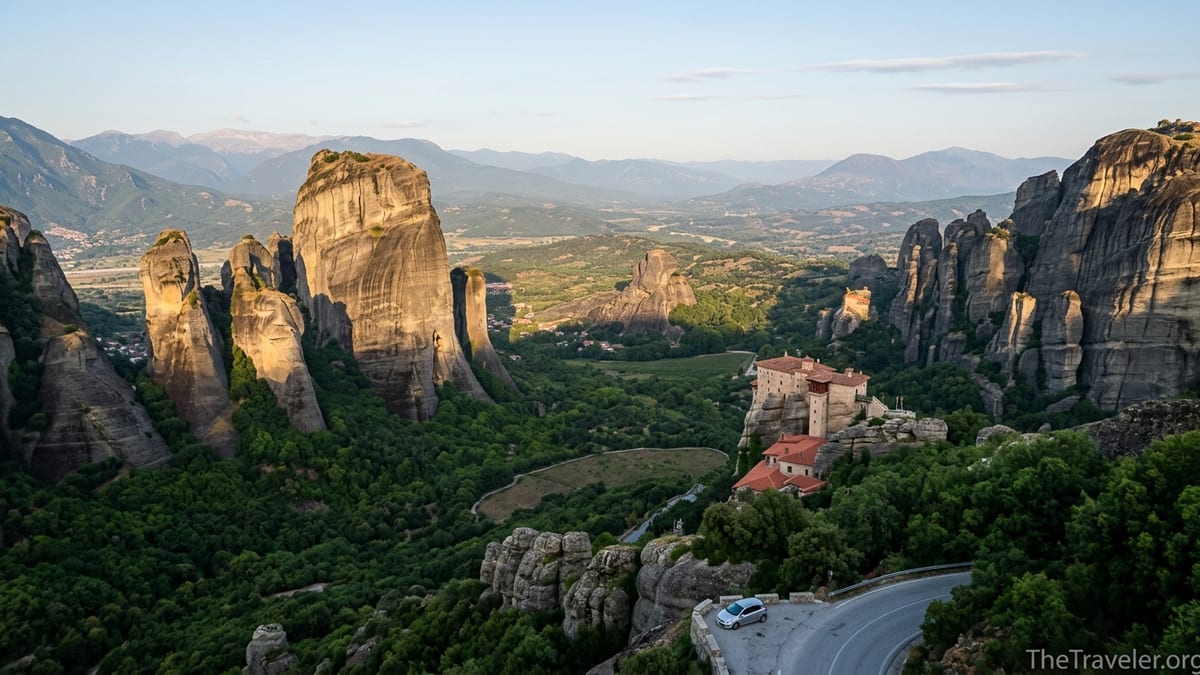
Meteora is one of Greece’s most spectacular landscapes: sandstone pinnacles capped by centuries-old monasteries. It is just feasible as a long day trip from Thessaloniki, though it involves more travel time than any other destination in this guide. Most visitors base themselves in the town of Kalambaka or the village of Kastraki, which back directly onto the rock formations. A typical organized day tour from Thessaloniki departs around 8:00 in the morning, reaches Meteora around noon, and spends four to five hours visiting two or three monasteries and several viewpoints before returning to the city by night.
Guided tours remain the most practical way to experience Meteora in one day. Several operators advertise Thessaloniki-to-Meteora trips that include coach or bus transport and a guided tour of the monasteries from around 75 to 110 euros per person, depending on inclusions. Some companies also offer small group or private versions that can exceed 200 euros per person when group sizes are very small. These tours typically take a highway route via Larisa and Trikala, which keeps driving straightforward. Once in Meteora, guests transfer to smaller minibuses that can navigate the narrow, winding roads up to the monasteries themselves.
Public transport is possible but not ideal for a same-day visit. Kalambaka is connected to the rail network through regional trains from Thessaloniki with transfers at intermediate stations such as Palaiofarsalos or Larisa. Recent traveler reports mention journeys taking around five to six hours including waiting time for connections, which makes it difficult to enjoy the monasteries and return the same day without an overnight stay. One-way train fares vary by train type and booking timing but are often in the range of 20 to 35 euros per person. Regional buses also serve Kalambaka, typically connecting via Larisa or Trikala, yet they follow a similar timescale.
Driving from Thessaloniki to Meteora is another option for confident drivers. The route mainly follows modern highways toward Larisa and then local roads to Trikala and Kalambaka, totalling around 230 to 250 kilometers one way, or roughly three and a half hours of driving in light traffic. Tolls on the main highway segments can add up to a noticeable cost, so a round-trip budget of 25 to 40 euros for tolls and fuel is realistic for a compact car. If you want to minimize stress, many travelers choose to drive down the previous afternoon, stay overnight in Kalambaka or Kastraki, visit the monasteries in the morning, and only then return to Thessaloniki.
Vergina (Aigai), Pella and Ancient Macedonia
For those interested in Alexander the Great and the Macedonian kingdom, the archaeological sites of Vergina (ancient Aigai) and Pella are among the most rewarding day trips from Thessaloniki. Vergina, about one hour and a quarter by car, is home to the underground museum housing the royal tombs of Philip II and other Macedonian nobles. The museum’s dimly lit vaults and richly decorated gold artifacts give a powerful sense of the era. Pella, about 45 minutes from the city, features the remains of the Hellenistic capital’s grid-plan streets, mosaics and palace complex spread across a tranquil plain.
Several tour companies sell combined “Pella and Vergina” day trips from Thessaloniki, typically lasting eight to nine hours and including transport, a licensed guide and free time in each museum. Prices for such shared excursions often fall around 60 to 90 euros per person, with private vehicle and guide arrangements running significantly higher, sometimes from 150 to 250 euros per group or more depending on duration and group size. These tours usually pick up guests from central hotels or meeting points and handle all logistics, including the scheduling of museum visits to align with opening hours.
Independent travelers can reach both sites with a rental car. The drive to Pella follows the Egnatia Odos corridor west and then local roads through farmland, while Vergina lies near the town of Veria, accessible via the main highway toward Kozani. It is realistic to leave Thessaloniki around 9:00, visit Pella’s site and museum in late morning, continue to Vergina for a late lunch in a taverna, explore the royal tomb museum mid-afternoon, and still be back in Thessaloniki by early evening. Museum entrance fees may change over time but are generally moderate by European standards; many visitors budget about 10 to 20 euros per person in total for site tickets.
Public transport exists but demands planning. Regional KTEL buses link Thessaloniki with Veria, and from there local taxis can bring you the short distance to Vergina. Likewise, buses run to the modern village near Pella, though services may be infrequent outside commuter hours. A practical example is taking a morning bus from Thessaloniki’s main KTEL station to Veria, then a taxi for the last 12 or so kilometers to Vergina, spending two to three hours at the museum and archaeological park, and returning via the same route. This works best on weekdays when bus frequencies are higher.
Mount Olympus and Dion: Myth, Mountains and Hiking
Mount Olympus, legendary home of the Greek gods, rises sharply from the coastal plain southwest of Thessaloniki. Even if you are not a serious hiker, a day trip to the region offers dramatic scenery, short walks and cultural visits. Many itineraries combine the archaeological site of Dion, at the foot of the mountain, with the mountain village of Litochoro or short hikes into Enipeas Gorge. On clear days you can see the peaks of Mytikas and Skolio towering above the forests, often dusted with snow outside midsummer.
Thessaloniki to Litochoro by car is a drive of roughly one and a quarter to one and a half hours along the A1 highway, with another 20 to 30 minutes up to Prionia, the highest point on the mountain that standard cars can reach in good weather. This makes it feasible to leave Thessaloniki after breakfast, visit the Dion site and museum mid-morning, drive up to Prionia or walk sections of the Enipeas trail, and return to Thessaloniki after dinner. Fuel and toll costs for this loop are usually modest, often totaling less than 40 euros for a small group in a compact car.
Public buses run from Thessaloniki to towns such as Katerini and Litochoro, though frequencies and schedules can vary by season. Once in Litochoro, you may need to rely on taxis or pre-arranged transfers to reach higher points like Prionia or Gortsia, where hiking routes begin. For example, travelers often report arranging a local taxi to take them up to Prionia in the morning and either wait, return at a fixed time, or leave them to hike down to Litochoro along the marked Enipeas trail. Budget-conscious hikers sometimes share taxis with others met on the bus or in the village to spread costs.
Organized excursions from Thessaloniki to Mount Olympus and Dion typically last a full day and include visits to the archaeological site, the museum and one or two short walks or viewpoints on the lower slopes. These tours often start around 60 to 90 euros per person in shared groups and can be more expensive for private arrangements. They are particularly useful if you want an introduction to Olympus without worrying about interpreting trail maps or driving mountain roads. Serious summit attempts, on the other hand, are better planned as overnight trips with local mountain guides and refuges rather than as rushed day excursions.
Edessa Waterfalls and Pozar Thermal Baths
Northwest of Thessaloniki, the town of Edessa is known for its dramatic waterfalls, where a river plunges over a cliff at the edge of town. Wooden walkways and viewpoints make it easy to see the falls from several angles, and in summer visitors often feel the cool spray from the water. Cafes and tavernas cluster around the waterfall park and in the upper, older part of town, making Edessa an easygoing destination for travelers who like gentle strolling rather than intensive sightseeing.
About an hour’s drive beyond Edessa lie the Pozar (Loutra Pozar) thermal baths, a complex of outdoor and indoor pools fed by natural hot springs in a forested valley near the village of Loutraki. The main outdoor pool typically maintains a comfortable hot temperature, while natural sections of the river, mingling hot and cold streams, provide spots to sit and soak. Visitors pay a modest per-person entrance fee to use the pools, and small changing facilities and snack kiosks are on site. In cooler months, steam rising from the river against the backdrop of the gorge creates a striking atmosphere.
Several tour operators combine Edessa and Pozar in a single day trip from Thessaloniki, usually departing around 8:00 or 9:00 and returning in the early evening. Shared group prices often start around 60 to 90 euros per person, sometimes including basic entrance fees to the thermal facilities but not always. These tours typically allow one to two hours at Edessa’s waterfalls and at least two hours at Pozar, enough time for a long soak and a casual meal at one of the nearby tavernas serving grilled meats, salads and local wine.
Reaching Edessa by public transport is relatively straightforward. Regional KTEL buses connect Thessaloniki with Edessa several times a day, with journey times of around one and a half to two hours and ticket prices that are generally under 15 euros one way. From Edessa to Pozar, however, public transport options are sparse, and travelers often rely on local taxis or pre-arranged transfers, which can substantially increase costs for solo travelers. Because of this, Pozar is particularly well suited to those with a rental car or those joining an organized tour, where the cost of the private valley transfer is shared across the group.
Rental Car, Bus, Train or Tour: What Works Best?
Choosing how to get around from Thessaloniki depends on your comfort with driving, your budget and how many people you are traveling with. For two or more travelers, renting a car for a day often works out more economical than joining a group tour, especially for shorter routes such as Halkidiki, Pella, Vergina, Edessa or Mount Olympus. A realistic day budget might combine a rental car at around 40 to 60 euros, 20 to 40 euros in fuel and tolls, and parking fees where applicable. Splitting those costs between two or three people quickly becomes competitive with a shared tour that charges per person.
Public buses from Thessaloniki are run by regional KTEL companies for most intercity routes. The main KTEL Makedonia station handles buses to destinations like Veria, Katerini, Edessa and further afield, while a separate Halkidiki bus terminal serves the peninsulas to the southeast, linked to the city by a designated local bus line. Tickets are usually purchased at station counters, though for some busy routes advanced reservation is possible or recommended. While buses are budget friendly, they can be slower than cars due to intermediate stops, and schedules may not always align perfectly with museum or site opening hours.
Trains are less central for these specific day trips, though they do connect Thessaloniki with towns along the main Athens corridor and with Kalambaka for Meteora via transfers. Recent traveler accounts often report that train journeys to Kalambaka take longer than some people expect due to connection times, which is one reason many visitors opt for dedicated Meteora tour buses or self-drive itineraries with an overnight stay. For destinations like Pella, Vergina, Pozar or Halkidiki, buses or cars remain the default modes of travel.
Organized tours offer the clearest value when destinations are remote, involve complex connections, or benefit greatly from expert commentary. Meteora, the royal tombs at Vergina, and some Mount Olympus routes fall into this category. For example, a day tour from Thessaloniki to Pozar thermal baths and Edessa that costs around 70 euros per person may seem high at first glance, but it bundles door-to-door transport, access coordination, and guiding in one price. For solo travelers who would otherwise need to pay for multiple bus tickets and private taxis, a tour can actually be the more economical and time-efficient choice.
Planning Tips and Seasonal Considerations
Timing your trip from Thessaloniki is crucial for a good experience. Halkidiki’s beach season realistically runs from late May through late September, with July and August bringing the warmest water and the most crowds. Visiting in June or early September often combines pleasant temperatures with more available sunbeds and easier parking. Meteora and Mount Olympus, by contrast, are best in spring and autumn, when temperatures are moderate and hiking is more comfortable. Winter visits to Meteora can be magical under snow, but road conditions may be unpredictable and daylight hours short.
Start times matter too. Summer heat in inland sites like Vergina, Pella and Dion can be intense by early afternoon, so plan to arrive at opening time whenever possible. For example, a schedule that leaves Thessaloniki at 8:00, reaches Pella around 9:00, and finishes the outdoor sections by midday will feel far more relaxed than a late-morning departure. The same principle applies to Edessa and Pozar: arriving at the waterfalls or the thermal baths before midday often means fewer crowds and easier photography.
Practicalities such as clothing and payment can affect your day. Many monasteries at Meteora and churches at archaeological sites enforce modest dress codes, often requiring covered shoulders and knees, and some Meteora monasteries ask women to wear skirts rather than trousers, though wrap skirts are sometimes available at the entrance. Carry small cash for entrance fees, parking and cafe stops, since card acceptance is widespread but not universal, particularly in smaller villages. For hot springs like Pozar, bring swimsuits, flip-flops and a lightweight towel you do not mind getting slightly discolored by mineral water.
Finally, check operating hours and any seasonal schedule changes shortly before you travel. Museum and site schedules can shift between summer and winter seasons, and public transport timetables are occasionally updated during the year. Local tourist information offices in Thessaloniki, as well as accommodation hosts, are good resources for confirming practical details like current bus frequencies or the operating status of smaller attractions that may close on certain weekdays.
FAQ
Q1. Can I visit Meteora from Thessaloniki as a day trip without joining a tour?
It is possible but not ideal. Train and bus combinations can take around five to six hours each way, leaving limited time at the monasteries. Most travelers either join a dedicated coach tour or rent a car and stay overnight in Kalambaka or Kastraki.
Q2. What is the easiest beach area near Thessaloniki to reach without a car?
The western part of Halkidiki, especially around Nea Moudania and Kallithea on the Kassandra peninsula, is among the easiest to reach thanks to frequent intercity buses from Thessaloniki’s Halkidiki bus station, with journey times of about one to two hours.
Q3. Is it worth renting a car in Thessaloniki for day trips?
For two or more people, renting a car often makes financial and logistical sense, especially for destinations like Halkidiki, Pella, Vergina, Edessa, Pozar and Mount Olympus, where public transport can be slow or involve multiple transfers.
Q4. How much do organized day tours from Thessaloniki usually cost?
Shared tours typically start around 60 to 90 euros per person for nearby sites like Pella, Vergina, Edessa, Pozar or Mount Olympus. Longer or more complex trips, such as Meteora, often run between about 75 and 110 euros per person, with private options costing more.
Q5. Which day trip is best if I am interested mainly in ancient history?
Vergina (Aigai) and Pella are the top choices for ancient Macedonian history, while Dion at the foot of Mount Olympus offers another significant archaeological site. Many travelers combine Pella and Vergina in one day to see both the royal tombs and the former capital.
Q6. Can I combine Edessa and Pozar thermal baths in a single day trip?
Yes. Many organized tours and self-drive itineraries visit Edessa’s waterfalls in the morning and continue to Pozar for afternoon bathing. Public transport beyond Edessa is limited, so this combination works best by car or organized excursion.
Q7. Are the Pozar thermal baths open year-round?
The Pozar thermal baths generally operate throughout the year and are particularly appealing in cooler months when the outdoor pools steam against the cold air. Specific opening hours can vary slightly by season, so it is wise to confirm close to your travel date.
Q8. Do I need hiking experience to enjoy Mount Olympus as a day trip?
No. Many day visitors simply walk short, well-marked sections of trails near Litochoro or Prionia, visit the Enipeas Gorge, or explore the archaeological site of Dion. Summit attempts, however, require good fitness, proper gear and usually an overnight stay in a mountain refuge.
Q9. How crowded is Halkidiki in July and August?
Halkidiki becomes very busy in late July and August, especially on weekends, when many residents of Thessaloniki head to the coast. Expect full buses, busy parking areas and popular beaches with all sunbeds reserved by late morning during peak weekends.
Q10. If I have only one day trip from Thessaloniki, which should I choose?
The best choice depends on your interests. For beaches, pick Halkidiki; for dramatic scenery, choose Meteora; for ancient history, visit Vergina and Pella; and for a mix of nature and relaxation, Edessa and Pozar make a satisfying combination.