


The northern Aegean does something few Greek regions manage: it combines quiet, authentic islands with just enough tourist infrastructure for an easy family holiday. Parents usually hear the same names first Thassos, Samos, Lemnos, Lesvos and Chios yet each suits a different style of family travel. Rather than simply listing hotels, this guide compares these five islands the way families actually experience them, from flight and ferry complexity to shallow swimming, road distances, restaurants, activities and whether you really need a rental car.
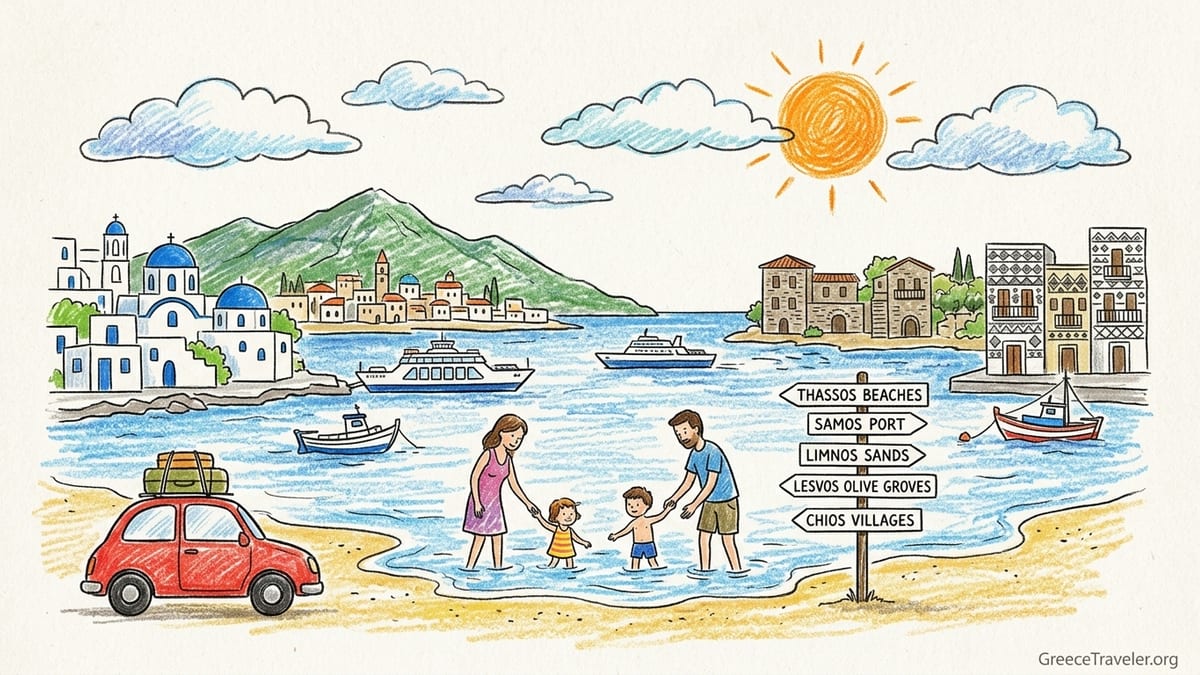
How the North Aegean feels with kids on board
Compared with the Cyclades or Dodecanese, the North Aegean islands attract fewer package crowds and party groups. That makes them attractive for parents who want space, real Greek towns and prices that still feel reasonable in summer. At the same time, they are not tiny resort islands. You are choosing between small and compact Thassos, mid-sized Samos and Lemnos, and large Lesvos and Chios, where driving times shape every day of your holiday.
Families also discover that seas differ sharply by island and even by coast. Golden Beach on Thassos runs for around 3.5 kilometres with very shallow water where toddlers can wade out tens of metres from shore, while exposed stretches of Samos or Chios can bring waves and currents that suit confident swimmers more than small children. Long, sandy bays on Lemnos and Lesvos give older kids room to roam without crowding around a single organised section.
Finally, there is the question of atmosphere. Thassos and Samos feel more traditionally “holiday island,” with beach bars, ice-cream kiosks and seafront promenades such as Pythagoreio on Samos or Skala Potamia on Thassos. Lemnos and Lesvos feel spacious and quietly local. Chios sits somewhere in between, adding a deeper cultural layer with the fortified mastic villages in the south and a workaday island capital that never became a pure resort town.
Getting there and around: flights, ferries and rental cars
For families travelling from western or northern Europe, the first decision is whether to rely on seasonal package flights or connect through Athens or Thessaloniki. Thassos stands out as the only island here without its own airport, but in practice it is one of the easiest to reach. Charter and scheduled flights serve Kavala on the mainland in summer, from where a 15 minute taxi ride takes you to Keramoti and a 35 minute car ferry crosses to Limenas on Thassos. Because sailings are frequent in high season, families can usually land, cross and be in their accommodation within a few hours of touching down.
Samos, Lemnos, Lesvos and Chios all have small regional airports with direct summer flights from several European countries plus regular connections from Athens. A family flying from London, for example, might find a weekly charter to Samos or Lesvos with a major tour operator, while those travelling off peak often route via Athens with a short domestic hop. Prices change from year to year, but families commonly report summer one way fares in the range that makes booking early worthwhile, especially if you need checked baggage and seat selection together.
Once on the islands, the rental car question becomes critical. Thassos is compact enough that no single beach sits more than about 45 minutes from another, and many families stay in Skala Potamia or Skala Panagia then add only short taxi rides or a small car hire for a day or two. Public buses exist, but parents with strollers and beach gear often find timetables limiting. On Samos, Lemnos, Lesvos and Chios, a car transforms what you can do. Towns and beaches can lie 20 to 40 kilometres apart, and while taxis are available in main resorts such as Pythagoreio on Samos or Petra on Lesvos, they add up quickly if you are moving a family of four or five several times a day.
Driving itself is generally straightforward for confident drivers. Roads on Thassos and Lemnos tend to be quieter, with a single ring-road and relatively short spurs to the beaches. Lesvos and Chios involve longer, hillier drives; reaching the Petrified Forest area in western Lesvos or the medieval mastic villages of south Chios easily becomes a full day outing. For a typical week, many families book a compact automatic for at least four or five days, picking it up at the port or airport and planning a mix of driving days and simple beach days close to base.
Thassos: compact, green and built around easy beaches
If your priority is shallow swimming, short drives and a feeling of everything being close, Thassos often comes out on top. Golden Beach, wrapping around the bay between Skala Potamia and Skala Panagia, is the island’s family flagship. The sand is soft, the entry to the sea is gradual, and the water typically stays shallow for tens of metres, which allows small children to play at the edge while parents stay nearby on sunbeds or towels. Several cafes and tavernas line the seafront, and in high season small amusement rides and playground structures appear near Skala Potamia, so evenings can be spent with an ice cream and a stroll rather than another car journey.
Because Thassos is ringed by beaches and relatively small, you can base yourselves in one spot and still see much of the island. A family staying in Skala Potamia can drive to the island capital Limenas for a harbourfront dinner in about 20 minutes, then spend another day exploring the south coast beaches near Potos and Psili Ammos, where the sand remains soft but the sea deepens a little faster. Many visitors comment that no drive exceeds 45 minutes, which makes naps in car seats and quick returns to the hotel straightforward even with toddlers.
Accommodation is mostly low-rise and small scale, with studios, apartments and family run hotels dominating. In practice this means kitchenettes for preparing snacks, shared pools and a more personal feel rather than large water parks or all inclusive resorts. For example, parents might choose a simple two bedroom apartment a block back from Golden Beach, use the on site pool in the late afternoon, then walk five minutes to a taverna where children can play in the sand while waiting for grilled fish and fries. Package operators from central and northern Europe maintain a steady inventory of these properties, underwriting direct flights to Kavala in summer and keeping Thassos firmly on the family map.
The main limitation is variety. Thassos has some excellent coves and an attractive mountain interior, but compared with Lesvos or Chios it offers fewer “big day out” attractions such as major archaeological sites or large museums. For many parents that is a plus. Days revolve around swimming, beach hopping, maybe a trip into a mountain village such as Panagia for a shaded lunch among springs and traditional houses, then back to the coast before bedtime.
Samos: beach life with a more developed tourist infrastructure
Samos is the next step up for families who still want beaches first but also appreciate a bit more built up infrastructure. The island has several distinct bases. Pythagoreio, a small harbour town near the airport, combines a seafront promenade and sheltered shingle beach with a larger organised stretch at nearby Potokaki, which runs westwards and offers rows of sunbeds, beach bars and water sports suitable for teenagers. To the north, Kokkari sits beside a photogenic bay backed by tavernas and cafes, with smaller beaches like Lemonakia and Tsamadou a short drive away.
For young children, one name recurs: Psili Ammos. This sandy beach near the Turkish coast is often recommended for its shallow water that stays waist deep far from shore and for its relaxed tavernas just behind the sand. Families staying in Pythagoreio or the south coast resorts often drive here for a full day. Unlike Thassos, where almost every beach is sandy and shallow, Samos has a mix of pebbly coves and shingle strands, so choosing base and daily beach according to your children’s ages matters.
Tourist services on Samos are among the most developed in the North Aegean. In practical terms, that means a wider choice of mid range hotels with family rooms, some low rise resorts with kids’ clubs and pools, frequent boat trips and organised excursions. A family might, for example, spend one day on a boat tour from Pythagoreio to nearby coves with swim stops and a barbecue lunch, another day visiting the Heraion archaeological site and a monastery, and another following a short signed trail to a waterfall in the island’s green interior. English is widely spoken in resort areas, and menus, pharmacy opening hours and car hire desks are geared to international visitors.
The trade off is that parts of Samos feel busier and more built up than Lemnos or Lesvos. In high summer, sunbeds on Potokaki or the beaches near Kokkari can book out by late morning, and parking fills quickly on narrow roads to small coves. With a car and a willingness to drive 20 to 40 minutes, however, you can still find quieter spots and small inland villages where tourism fades into the background.
Lemnos: long sandy beaches and room to breathe
Lemnos, or Limnos, appeals strongly to families who prioritise long sandy beaches, space and a laid back atmosphere over dense tourist infrastructure. The island is known for having more than a hundred mostly sandy beaches, many of them long arcs with shallow water and only light development. Around the main town of Myrina, beaches such as Richa Nera and Platy are fully organised with sunbeds, beach bars and shallow entry, making them natural bases for younger children. Platy in particular is widely described as a default family beach, with fine sand, gentle surf and enough length that it rarely feels crowded even at peak times.
Further afield, Keros on the east coast combines a sandy bay with consistent wind, drawing windsurfers and kiteboarders while still keeping a wide, shallow section suited to paddling children. Other long beaches like Thanos, Evgati and Zematas give families the classic Greek experience of parking near the sand, choosing between a serviced section with sunbeds and a quieter stretch, and settling in for the day. The feel is more open and natural than parts of Samos or Thassos, with fewer large hotels and more spaced out beach bars.
Logistically, Lemnos sits in the middle tier. It has an airport about 20 minutes from Keros and 25 to 30 minutes from Myrina, served by domestic flights and a handful of seasonal international services, as well as ferries from mainland ports that usually run several times a week in summer. Once there, a car makes sense for most families. Distances between Myrina, Platy and the eastern beaches are measured in tens of kilometres rather than just a few, and public buses are limited. On the upside, traffic is light and parking at beaches is generally easy, removing much of the stress that comes with driving on more crowded islands.
Accommodation trends towards small hotels, self catering apartments and, in some cases near Keros, low key glamping-style tents and bungalows aimed at families who like nature and water sports. This mix suits parents looking for a slower holiday: mornings on the beach, a long lunch in a taverna serving local pasta and cheeses, then perhaps a short drive to explore Myrina’s castle or an inland village before returning to base. Lemnos works best for children who are old enough to enjoy beach days without needing a constant programme of formal activities.
Lesvos: variety, real towns and low key discoveries
Lesvos is the North Aegean’s all rounder, a large island of real working towns, long beaches, quiet gulfs and striking volcanic western landscapes. It suits families who like variety and are happy to drive. On the south coast, Vatera stands out as one of the longest beaches in Greece, a many kilometre stretch of sand and shingle with scattered tavernas and small hotels rather than wall to wall development. Parents often choose a family run hotel directly on the beach, allowing older children to play in front of the property while adults watch from the terrace. Different sections of Vatera vary in depth and surface, so it is worth checking a couple of points along the shore to find the best match for your children’s ages.
On the north coast, Petra and nearby Anaxos offer a more traditional holiday feel with seafront tavernas, small hotels and manageable beaches where families can alternate between swims and short village walks. The town of Molyvos adds a hilltop castle and cobbled alleyways, though its main beach is pebbly. Between these and the sheltered inlets of the Kalloni Gulf, where shallow water and birdlife combine into quiet days out, Lesvos gives families several distinct coastal bases to choose from.
Where Lesvos really differs from the smaller islands is in the range of non beach activities. Children can visit the Petrified Forest museum in Sigri, with its fossilised tree trunks and a small earthquake simulator, explore castles in Mytilene and Molyvos, watch saltpan birds around Kalloni or take a half day olive oil or ouzo themed tour, adapted to include food stops and short walks rather than long lectures. This variety breaks up a two week stay in a way that a pure beach island sometimes cannot.
The trade off is scale. Drives between main areas can reach 60 to 90 minutes, and the network of winding roads means you need to plan days realistically. Many families choose one base, such as Petra in the north or Vatera in the south, then add one or two overnight side trips rather than trying to criss cross the island daily. A rental car is essential for anything beyond the immediate resort area, but once you accept that, Lesvos becomes one of the most rewarding islands in Greece for curious children and parents.
Chios: culture and beaches for curious families
Chios is less well known on the mainstream family holiday circuit, yet it quietly combines safe swimming with some of the most distinctive cultural experiences in the North Aegean. Most families base themselves either near Karfas, the main sandy resort about 7 kilometres south of Chios Town, or in the mastic villages area of the south. Karfas offers a gently shelving sandy bay, lined with small hotels, apartments and tavernas, plus easy taxi or bus access into the island capital for evening strolls along the harbour. For children who are fine with a modest amount of waves and slightly deeper water than on Thassos, it makes a practical base.
Several other beaches, such as Komi and Emporios in the south, offer sand or fine pebbles, clear water and family friendly tavernas directly behind the shore. Older children and teenagers often appreciate the contrast between beach days and exploring the interior. Villages such as Mesta and Pyrgi, with their medieval alleyways and, in the case of Pyrgi, geometric black and white designs on the house walls, turn into memorable half day excursions. It is easy to combine a morning in a shaded village square with an afternoon swimming at a nearby bay.
Reaching Chios is straightforward by air from Athens and by ferry from Piraeus or neighbouring islands, with journey times that reward a longer stay. Once there, a rental car is strongly recommended for families. Distances are not extreme, but the most interesting sights and many of the better beaches lie scattered around the island’s southern half. Roads are generally in good condition, and traffic outside Chios Town stays light. A typical family itinerary might include a base in Karfas with two or three day trips to the mastic villages, the black pebble beach of Mavra Volia and the monasteries and viewpoints in the hills above town.
The feel of Chios is more lived in than on Thassos or even Lesvos. The island has a significant local economy beyond tourism, including shipping and agriculture, so visitors share tavernas with residents year round. For some families this is exactly the appeal: beaches that are busy at weekends but quiet midweek, restaurants that serve local dishes as a matter of course, and a sense of being in Greece rather than in a purpose built resort.
Comparing beaches, activities and on the ground family experience
When you line these five islands up, their family personalities become clearer. Thassos is the easiest for simple beach holidays with younger children, built around shallow bays like Golden Beach and short drives. Samos adds more formal tourist infrastructure: larger resorts, organised excursions and a wider range of developed beaches, from Psili Ammos to Potokaki and the coves near Kokkari. Lemnos offers long, sandy, often uncrowded beaches such as Platy, Thanos and Keros together with a quiet, authentic atmosphere. Lesvos is about variety and depth, scattering family friendly shores like Vatera, Petra and Anaxos around an island of real towns, museums and nature reserves. Chios stands out for culture plus beaches, where a day might combine a swim at Karfas or Komi with exploring the alleys of a fortified village.
In terms of shallow swimming, Thassos and specific pockets of Samos and Lesvos have the edge. Golden Beach on Thassos and Psili Ammos on Samos are bywords for toddler friendly water among regular visitors, while sections of Vatera and parts of Lemnos’ Platy Beach give similar security for families willing to scout the shoreline a little. For long sandy walks and space, Lemnos and Lesvos score highly, with Keros, Evgati and Vatera providing multi kilometre stretches that never feel truly crowded.
Activities also differ. On Thassos, the focus is water and short trips to mountain villages or a small archaeological site near Limenas. Samos offers boat trips, waterfalls and the Heraion, and is a convenient springboard for escorted day cruises along the Turkey coast. Lemnos adds water sports at Keros and light hiking around volcanic landscapes and sand dunes near Gomati. Lesvos layers in the Petrified Forest, birdwatching at Kalloni’s saltpans, castles and olive oil themed experiences. Chios brings medieval villages, mastic related visits and monasteries into the mix, suiting older children and teenagers keen on stories and history.
On the ground, prices for sunbeds, family restaurant meals and mid range accommodation are generally lower than on headline Cycladic islands. A typical seafront taverna dinner for two adults and two children might run to a moderate bill including soft drinks and a carafe of house wine, with variance between busier resorts and quieter villages. Many parents note that on Lesvos, Lemnos and Chios in particular, local eateries feel aimed at residents first, visitors second, which keeps menus broader and portions generous. Package heavy parts of Thassos and Samos, by contrast, have more clearly international menus alongside traditional Greek dishes.
The Takeaway
Choosing the “best” North Aegean island for a family means matching the island’s character to your own travel style and your children’s ages rather than chasing a single winner. Thassos excels for first time family trips and holidays with toddlers, thanks to its compact size, shallow sandy bays and straightforward logistics via Kavala. Samos suits those who want beaches plus tourist infrastructure, balancing developed resorts and excursions with pockets of quieter coast. Lemnos is for families who dream of long, sandy, often half empty beaches and do not need a big programme of organised activities.
Lesvos rewards families who are ready for more driving and more discovery. Its variety of beaches, real towns and nature and culture experiences makes it ideal for a 10 to 14 day holiday. Chios is the choice for families, especially with school age children and teenagers, who want culture plus beaches and are intrigued by the idea of exploring medieval villages and mastic groves as well as swimming.
In practice, current tour operators recognise this diversity and maintain dedicated North Aegean family inventories, packaging Thassos, Samos, Lemnos, Lesvos and Chios in ways that highlight their individual strengths. For independent travellers, the same logic applies. Start by deciding how important shallow water, long beaches, compact driving and cultural excursions are for your family, then pick the island whose character aligns most closely. The North Aegean rewards that kind of thoughtful match with holidays that feel both relaxed and genuinely memorable.
FAQ
Q1. Which North Aegean island is best for a first family holiday with young children?
Thassos is usually the easiest starting point thanks to its shallow sandy beaches like Golden Beach, compact driving distances and straightforward ferry connection from Kavala.
Q2. Do we need a rental car on these islands if we are staying in a beach resort?
On Thassos you can manage with limited car use, but on Samos, Lemnos, Lesvos and Chios a rental car for at least part of your stay greatly expands what you can see with children.
Q3. Which island has the best long sandy beaches for older kids who like space?
Lemnos and Lesvos stand out for long, often uncrowded sandy stretches such as Platy and Thanos on Lemnos and Vatera on Lesvos, where families can spread out comfortably.
Q4. Where should we go if we want culture and history as well as beaches?
Lesvos and Chios are strong choices, offering castles, medieval villages, museums and traditional inland towns alongside family friendly beaches like Petra, Vatera, Karfas and Komi.
Q5. Is Samos too busy for families who prefer quieter holidays?
Resort areas like Pythagoreio and Kokkari can feel lively in August, but with a car you can still find quieter coves and villages, especially if you travel in late June or September.
Q6. How difficult is it to reach these islands from abroad?
Thassos requires a flight to Kavala plus a short ferry, while Samos, Lemnos, Lesvos and Chios all have small airports with summer international flights and regular connections from Athens.
Q7. Which island works best without a package holiday or tour operator?
All five can be visited independently, but Lesvos and Chios in particular lend themselves to tailor made trips using local hotels, car hire and flexible itineraries built around your family’s interests.
Q8. Are the seas generally calm enough for nervous swimmers and toddlers?
Conditions vary, but sheltered spots like Golden Beach on Thassos, Psili Ammos on Samos, sections of Platy on Lemnos and parts of Vatera on Lesvos usually offer gentle, shallow water.
Q9. What about food choices for picky eaters or children with simple tastes?
All five islands have tavernas serving familiar grilled meats, pasta, fries and salads alongside local dishes, and resort areas typically offer basic international options too.
Q10. If we have ten to fourteen days, is it better to combine islands or stay on one?
With children, most families find it easier to choose one island, especially a larger one like Lesvos or Chios, and explore it properly rather than juggling multiple ferry schedules.