


The North Aegean islands remain some of Greece’s most rewarding yet least understood regions. Spread along the northeastern Aegean, Lesvos, Chios, Samos, Ikaria, Lemnos, Thassos and nearby Samothrace combine raw nature, serious history and authentic village life with beaches that still feel like a discovery. This guide uses concrete examples and on-the-ground details to help you match each island to your travel style, whether you care most about beaches, food, culture, hiking, archaeology, nightlife, nature or simply somewhere quieter to switch off.
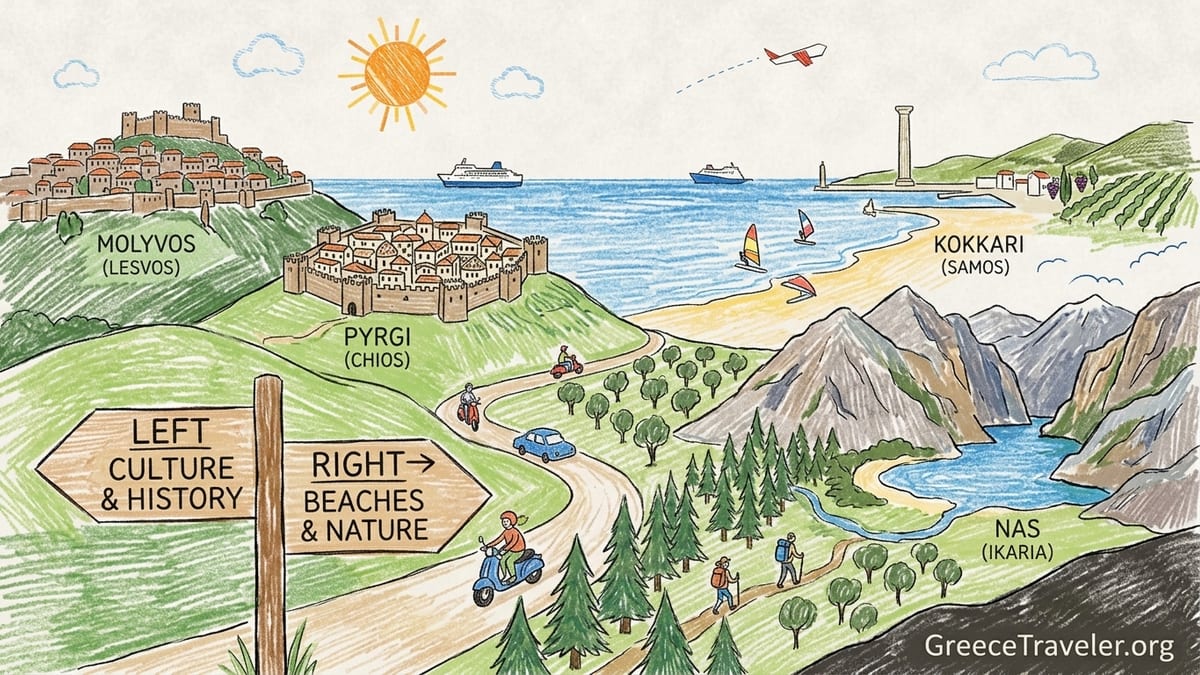
How to Choose the Right North Aegean Island for You
If you only remember one thing about the North Aegean, make it this: these islands are not about quick resort fixes. Distances are larger, bus services can be sparse outside July and August, and many of the best beaches or villages need a car or scooter. In return, you get waterfront tavernas where dinner for two with fresh fish, house wine and salads often stays around a moderate budget, and you still hear mostly Greek spoken at the next table.
For culture and layered history, Lesvos, Chios and Samos stand out. Molyvos on Lesvos delivers a complete medieval hilltop town; Mesta and Pyrgi on Chios are among Greece’s most atmospheric fortified villages; and Pythagoreio and the Heraion of Samos form a UNESCO World Heritage archaeological landscape. Travelers who want to spend days wandering cobbled lanes, small museums and old ports should start with these three.
For beaches and a relaxed holiday feel, Lemnos, Thassos, Ikaria and Samos all excel in different ways. Lemnos and Thassos have easy access sandy beaches lined with low-rise accommodation. Ikaria’s north coast around Armenistis blends long surf-friendly strands with wild coves like Nas that you reach via steps and short paths. Samos offers bright-water beaches near Kokkari and calmer family spots around Pythagoreio. If nightlife is a priority, look first at Samos and Ikaria’s summer festivals rather than expecting Mykonos-style clubs.
Hikers and nature lovers gravitate to Ikaria, Samothrace, Lesvos and Samos. Ikaria’s network of signed paths connects mountain villages, ravines and remote beaches. Samothrace is all about lush gorges and the famous vathres, rock pools formed by waterfalls. Lesvos offers coastal and inland trails around the Petrified Forest and bird-rich wetlands, while Samos has paths leading into forested hills and to the Heraion. Those seeking very quiet travel should consider Lemnos and off-peak visits to Lesvos and Chios, where even in high summer it is easy to find empty stretches of coast once you leave the main hubs.
Lesvos: Molyvos, the Petrified Forest and a Food Lover’s Island
Lesvos is the largest of the North Aegean islands and feels more like a small province than a holiday island. Molyvos (also known as Mithymna) on the north coast is its headline destination, a tiered stone village spilling down from a Byzantine castle to a small harbor. You can stay in restored stone guesthouses halfway up the slope and walk five to ten minutes down to the fishing port, where tavernas grill sardines and octopus beside the water. In peak season you might see menus advertising sardines from nearby Skala Kallonis, often served simply grilled with lemon, a reminder that Lesvos is one of Greece’s key fishing and olive-oil islands.
The village itself is strong on culture rather than nightlife. Cobbled lanes are lined with small craft shops, a few wine bars and mezedopoleia serving ouzo with shared plates. Expect evenings to revolve around long dinners and low-key live music rather than clubs. Beach time is available too: below Molyvos a long stretch of coarse sand and pebble beach offers sunbeds and simple beach bars, while a short drive brings you to Petra and Anaxos for softer sand and shallower waters that suit families.
The island’s geological star is the Petrified Forest of Lesvos around Sigri and Eressos in the west. Here, a protected geopark showcases fossilized tree trunks and root systems preserved by volcanic activity millions of years ago, with outdoor walking paths around exposed fossils and an indoor museum that explains the region’s ancient ecosystem. This area is excellent for slow travel. Distances from Molyvos are long, so many visitors plan a full-day loop by car, stopping at the beach and village of Skala Eressou for a swim and a late lunch in one of the seafront tavernas that cater to both Greek families and independent travelers.
Lesvos is also quietly superb for birdwatching and rural drives. The wetlands near Kalloni attract spring and autumn migratory birds, and inland villages such as Agiasos on the slopes of Mount Olympos give a feel for mountain life with old kafeneia, traditional sweets and views over chestnut forests. Food-focused travelers will notice that even basic tavernas pride themselves on local ingredients: olive oil from family groves, cheeses like ladotyri, and ouzo from distilleries in Plomari and Mytilene. Overall, Lesvos suits travelers prioritizing culture, food, nature and quieter beaches over high-energy nightlife.
Chios: Mesta, Pyrgi and the Volcanic Shores of Mavra Volia
Chios combines strong cultural interest with a subdued but real beach offering. Its southern mastiha (mastic) villages are the island’s unique draw. Mesta is a fortified medieval settlement built as a defensive maze, where narrow vaulted lanes twist between stone houses. Many guesthouses occupy restored historic buildings around the central square, so you can step out in the evening straight into a cluster of tavernas serving local goat, homemade pasta and dishes scented with mastic.
Nearby Pyrgi is instantly recognizable for its geometric black and white xysta patterns decorating the facades of houses. Walking through the village feels like moving through an open-air art installation, but this is a working community with elderly residents sitting in doorways and children cycling through the alleys. Culture here is lived rather than curated. Small cafes on the main square serve thick Greek coffee and mastic-flavored spoon sweets, and it is easy to spend an afternoon simply watching village rhythms.
For beaches and raw volcanic landscape, head to Mavra Volia near the village of Emporios. This pebble beach is fringed with dark, almost black stones set against very clear blue water, the result of volcanic activity in the area. There are usually a couple of simple beach bars and umbrellas in summer, but it still feels far from mass tourism. The seabed shelves quickly, which experienced swimmers enjoy, though families with small children may prefer the shallower adjacent coves. Many visitors combine a swim here with lunch at the small harbor of Emporios, where tavernas serve seafood and local Chios beer at outdoor tables.
Chios does not compete with party islands in nightlife, but Chios Town has a scattering of bars and cafes near the port that fill on summer evenings, especially when local students return. The island’s real strengths remain culture, village architecture and food. Road trips through the south pass through mastic groves and viewpoints over a rocky coastline. North of the main town, more remote villages and monasteries appeal to hikers and those who enjoy driving mountain roads with big views. Chios works well if you want a culturally rich base with a couple of striking beaches rather than a pure beach holiday.
Samos: Pythagoreio, Kokkari and the Heraion
Samos offers one of the most balanced mixes of beaches, archaeology, nature and moderate nightlife in the North Aegean. The harbor town of Pythagoreio, built around an old fortified port, anchors the southeastern coast. Its waterfront is lined with small hotels and family-run pensions above the quayside, and in the evening restaurant tables spill almost to the water’s edge. Here you can order grilled fish priced by the kilo, plates of local cheeses and salads, and carafes of Samos muscat wine produced in the island’s hills.
Just inland, the archaeological site of the Heraion showcases the remains of a monumental sanctuary to Hera, with a single standing column visible from afar. Along with the ancient city remains near Pythagoreio and the Eupalinos Tunnel, an impressive ancient aqueduct, this area is recognized as a UNESCO World Heritage site. You can comfortably visit the tunnel, local archaeological museum and Heraion over a full day using a rental car, with time left for a late swim at a nearby beach.
On the north coast, Kokkari is Samos’ classic seaside village, a cluster of whitewashed houses around a small port with cafes and ouzeries right on the water. Two long pebble beaches curve away from the village, with clear water and a mix of loungers with service and quieter stretches. Winds can pick up here, attracting windsurfers and keeping the water fresh and cool. Accommodation in Kokkari ranges from simple studios behind the beach to mid-range hotels with breakfast terraces overlooking the bay, making it a comfortable base for a week of swimming and short excursions.
Nature lovers will appreciate Samos’ green interior, where roads climb through pine forests and vineyards. Hiking routes connect mountain villages, and several paths lead down to less-developed coves. While Samos does have some nightlife in Pythagoreio and Vathy, it remains relaxed: think cocktail bars, live music nights and harbor strolls rather than mega-clubs. Travelers who want reliable beaches, substantial archaeology, scenic drives and enough dining options to vary their evenings will find Samos a strong all-round choice.
Ikaria: Armenistis, Nas and a Wild Hiking Island
Ikaria has a reputation for slow living and long-lived residents, and it appeals particularly to hikers and travelers who value nature and a slightly alternative atmosphere. The north coast village of Armenistis is the island’s main tourist settlement, yet it still feels low-key. A small harbor shelters fishing boats, and a short walk away long sandy strands like Livadi and Messakti offer some of Ikaria’s most popular beaches with clear water and gentle surf. Above the shore, clusters of pensions and small hotels step up the hill, so you can book a room with a balcony view of the sunset without needing a large resort complex.
Armenistis works well as a base because you have tavernas, cafes and mini-markets within a few minutes’ walk, and you can join boat trips or local hikes from here. Prices tend to be slightly lower than in more famous islands, with simple rooms often available at reasonable nightly rates outside peak August. Food is a highlight: family-run tavernas serve slow-cooked goat, greens with olive oil, pies and local red wine, and evenings stretch late as both visitors and locals linger over carafes and conversation. In high summer, nearby villages host panigyria, traditional festivals with live music and communal meals that can run until dawn.
Just a short drive west from Armenistis, Nas offers a very different feel. The small beach sits in a cove where the Chalaris River meets the sea, backed by a gorge and ruins of an ancient temple to Artemis. Access is via a steep path and steps from the roadside tavernas, which means the beach keeps a wilder character. The pebbly shore and clear green water attract swimmers and those seeking a more bohemian atmosphere, and the gorge above is a starting point for hikes inland. The sunsets here are spectacular, with the sun sinking directly into the open Aegean beyond the cove.
Ikaria as a whole is excellent for hiking and quieter travel. Roads are winding and public transport limited, so renting a car gives you access to mountain villages, thermal springs around Therma and remote beaches on the south coast where you may share the sand with only a handful of people. This is not a nightlife island in the conventional sense, but the combination of panigyria, late dinners and impromptu music sessions creates its own social scene. If your priorities are nature, walking, low-rise development and a slower pace, Ikaria is one of the strongest options in the region.
Lemnos and Thassos: Easy Beaches and Low-Key Villages
Lemnos sits roughly midway between the mainland and Lesvos and remains one of the least crowded North Aegean islands. Its low, rolling landscape hides a generous number of beaches, many of them long sandy bays with shallow waters. Around the main town of Myrina, you can walk from the harbor through backstreets to reach two organized beaches framed by a dramatic castle on the hill. Families appreciate how easily beach days slot into a relaxed routine here: breakfast in a cafe under the plane trees of Myrina’s main square, a short stroll or drive to the sand, then back into town for grilled fish or souvlaki at tavernas overlooking the fishing harbor.
Exploring further by car reveals quieter shores such as Keros, which has become a low-key surf and kiteboarding hub thanks to consistent winds and a broad arc of sand. Here you find small-scale beach bars and a handful of glamping-style accommodations set behind the dunes rather than big hotel blocks. Inland, Lemnos offers a scattering of rural villages and some lesser-known archaeological sites, but its main strengths are space, easy-going beaches and a sense that tourism and local life are still balanced.
Thassos, closer to the mainland and reachable by short ferry from Kavala or Keramoti, is greener and more mountainous. A ring road circles the island, linking coastal villages and beaches so you can sample several in a day if you have a car. Popular spots like Golden Beach offer soft sand and full services, while places such as Aliki combine a compact beach with the ruins of an ancient sanctuary and marble quarries above the bay. Inland villages including Theologos and Panagia retain stone houses and fountains, and some tavernas there are known for spit-roasted lamb and other meat specialties.
Thassos is particularly good for travelers who want a mix of accessible beaches, modest hiking in pine-covered hills and traditional villages. Accommodation ranges from self-catering studios to small hotels, and prices are often slightly lower than on islands further south. Nightlife tends to concentrate in Limenas (Thassos Town) and a couple of larger resorts, but the overall feel is family-friendly. Both Lemnos and Thassos are excellent choices if you prioritize beach time, casual tavernas and a relaxed pace over big-name sights.
Samothrace: Waterfalls, Vathres and Rugged Nature
Although administratively linked with the Evros region rather than the North Aegean islands, Samothrace is often paired with Thassos in itineraries and offers a very different experience. This is an island for hikers and nature lovers first and foremost. From the main port of Kamariotissa a road leads inland to the village of Chora, perched on the slopes of Mount Saos. From here and from the road toward Therma, trails descend into gorges cut by streams coming off the mountain, where waterfalls have carved a series of natural pools known as vathres.
These vathres are Samothrace’s signature attraction. Reaching the more famous ones, such as those in the Fonias or Gria Vathra gorges, usually involves hikes of 30 minutes to two hours, sometimes scrambling over rocks or wading through shallow water. In return, you can swim in cold, clear pools beneath small waterfalls shaded by plane trees, a welcome contrast to the hot, dry landscapes common elsewhere in the Aegean. This is a place to pack sturdy shoes and a daypack rather than flip-flops and beach toys.
Samothrace does have beaches, mostly pebbly and backed by steep hills, and a few simple beach bars open in high season. However, the island is not ideal if you want long sandy strands within steps of your accommodation. Instead, it appeals to those happy with basic seafront rooms or campsites and days spent alternating between gorge hikes, swims in vathres and evenings in small tavernas that serve local goat, herbs and greens. There is a notable archaeological site, the Sanctuary of the Great Gods, set in a wooded valley near Paleopoli, which adds a layer of mystery and history to the island’s profile.
Public transport is limited, so most visitors either bring a car on the ferry from Alexandroupoli or rent one on arrival. In return for this extra effort you get some of the wildest landscapes in the northern Aegean, with a fraction of the visitor numbers of more famous islands. Samothrace works best as a destination for hikers, canyoning enthusiasts and travelers who care more about waterfalls and mountain views than about classic beach scenes.
The Takeaway
Choosing among the North Aegean islands is less about finding a single “best” place and more about matching your priorities to each island’s strengths. Lesvos is a standout for food, culture and varied landscapes, with Molyvos and the Petrified Forest route offering a combination of history, beaches and geology. Chios shines through its mastic villages and the dramatic volcanic shore at Mavra Volia, a good fit for architecture and village life with a handful of memorable swims.
Samos provides one of the most balanced packages, blending credible beaches around Kokkari and Pythagoreio with serious archaeology at the Heraion and Eupalinos Tunnel. Ikaria draws those who value hiking, wild coves and a relaxed, slightly bohemian atmosphere centered on Armenistis and Nas. Lemnos and Thassos offer easier, family-friendly beach holidays with plenty of space and low-rise development, while Samothrace stands apart as a rugged retreat built around waterfalls, vathres and long days on the trail.
In practical terms, travelers focused on beaches and convenience will do well with Lemnos, Thassos and parts of Samos. Culture and archaeology fans should prioritize Lesvos, Chios and Samos, while serious hikers and nature seekers will find their best match in Ikaria, Samothrace, Lesvos and Samos. Nightlife, where it exists, is mostly in the form of harbor bars, village festivals and relaxed late dinners rather than clubs. If quieter travel, local food and uncrowded landscapes sound appealing, the North Aegean islands reward those who take the time to explore beyond Greece’s headline destinations.
FAQ
Q1. Which North Aegean island is best if I want mostly beaches and easy access?
Lemnos and Thassos are the most straightforward choices for beach-focused trips, with many sandy bays close to accommodation and relatively gentle driving. Parts of Samos, especially around Kokkari and Pythagoreio, also work well if you want beaches within walking distance of your hotel plus some sightseeing.
Q2. Where should I go for the strongest combination of culture and archaeology?
Samos and Lesvos offer the richest mix. Samos has the UNESCO-recognized Pythagoreio and Heraion, along with a good archaeological museum, while Lesvos combines medieval Molyvos, Ottoman-era buildings in Mytilene and smaller museums with the geological interest of the Petrified Forest region.
Q3. Is Ikaria a good choice if I do not plan to rent a car?
You can enjoy a short stay in Armenistis or nearby beaches without a car, since many guesthouses, tavernas and the shore are within walking distance. However, to reach mountain villages, remote beaches and hot springs, renting a car or arranging local transfers makes a big difference, especially outside the peak summer bus schedule.
Q4. Which islands are best for hiking and nature rather than nightlife?
Ikaria and Samothrace are top choices for hiking, gorges and wild landscapes, with many marked paths and natural swimming spots. Lesvos and Samos are also strong, offering a blend of trails, forests and coastal walks. Nightlife on these islands is limited to village festivals, bars and late dinners rather than club scenes.
Q5. How busy are Molyvos, Mesta and Pyrgi in summer?
Molyvos, Mesta and Pyrgi see a noticeable increase in visitors from late July to late August, especially on weekends, but they rarely feel overwhelmed compared with more famous islands. If you prefer quieter lanes and easier parking, consider visiting in June, early July or September, when most shops and tavernas are still open.
Q6. Are the beaches suitable for children on these islands?
Yes, though conditions vary by spot. Shallow sandy beaches around Lemnos, Thassos and some parts of Samos are particularly family-friendly. Places like Mavra Volia on Chios or Nas on Ikaria have deeper water or steeper access and are better for confident swimmers and older children rather than toddlers.
Q7. What kind of budget should I expect for food and accommodation?
Prices vary by island and season, but in many North Aegean destinations a main course at a taverna typically stays within a moderate range, with fresh fish priced higher by weight. Simple double rooms in guesthouses often remain more affordable than in the Cyclades, especially outside August, so overall costs can be reasonable for longer stays.
Q8. Is it practical to combine several North Aegean islands on one trip?
Combining two islands such as Lesvos and Chios, or Thassos and Samothrace, is feasible if you plan around ferry schedules and allow for travel days. Distances and connections mean it is usually better to focus on one or two islands in depth rather than trying to rush through many in a short time.
Q9. Do these islands work for off-season travel?
Spring and autumn can be excellent times to visit if you value hiking, birdwatching and quieter villages, especially on Lesvos, Samos and Ikaria. Some beach facilities and smaller accommodations close outside high season, so you should check opening dates and be prepared for cooler sea temperatures and a calmer nightlife scene.
Q10. Which islands are best suited to very quiet, slow travel?
Lemnos, much of Lesvos outside the main towns, and parts of Ikaria and Samothrace are ideal if you are looking for simple routines, local tavernas and uncrowded landscapes. Choosing small villages as a base, renting a car and staying at least a week lets you settle into the slow rhythm that defines the North Aegean experience.