


The North Aegean islands reward slow, curious travelers, but the ferry map here is more like a patchwork of local corridors than one neat circular route. To make sense of it, you need to think in realistic clusters: Lesvos and Chios together, Samos with Ikaria and Fourni, Lemnos as a northern hub, and Thassos and Samothrace as satellite islands served from different mainland ports. This guide walks you through how those clusters connect, what to expect from overnight ferries and cabins, and how to plan a practical North Aegean itinerary using current real‑world ferry patterns rather than theoretical lines on a map.
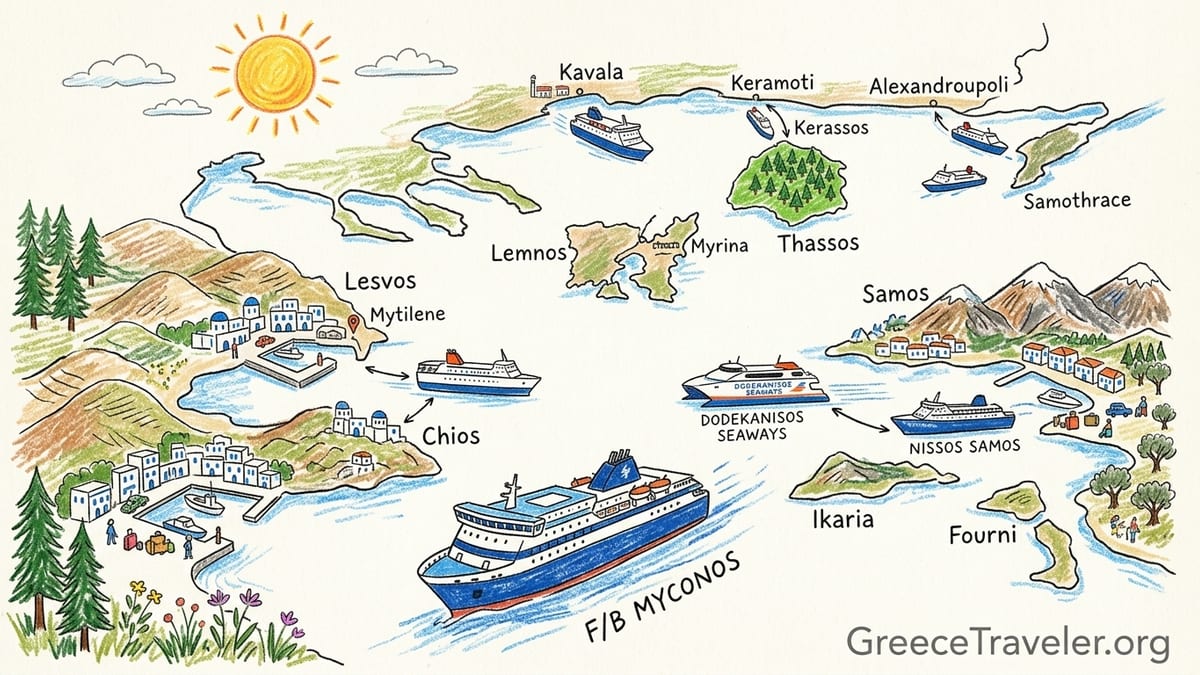
How North Aegean Ferry Networks Really Work
On the map, it is tempting to trace a grand loop from Piraeus up through Chios and Lesvos, across to Lemnos, then down via Samothrace and Thassos to end in Kavala or Thessaloniki. In practice, the ferry system in the North Aegean does not operate as a continuous ring. Instead, services concentrate on a few main corridors that reflect local demand and subsidized lifeline routes, with gaps and seasonal variations you cannot ignore when planning an island hopping trip.
The most reliable year‑round spine is the long Piraeus to Kavala route via several North Aegean islands. Conventional ferries such as Blue Star Myconos and similar vessels typically sail overnight from Piraeus and can call at Syros or Mykonos, then Ikaria, Fourni, Samos, Chios, Lesvos and Lemnos before reaching Kavala. In summer, this route often operates several times per week; in winter, frequencies drop and individual segments might only be reachable on specific days, so it is essential to check real schedules rather than assuming daily links.
Alongside that long axis, short inter‑island links form natural mini‑networks. Lesvos to Chios is one such corridor, with near‑daily services all year. Samos to Ikaria and Fourni is another, usually supported by a mix of big conventional ferries and smaller high‑speed or regional ships. Further north, Lemnos connects to Kavala and Agios Efstratios, and in summer sometimes onward to Lesvos or even Samothrace, but these are far less uniform. Thassos and Samothrace sit to the north and northwest and are effectively served from separate mainland gateways, which makes folding them into a multi‑island Aegean chain harder than it looks on paper.
For trip planning, this means you should anchor your itinerary around a couple of these robust corridors, using overnight ferries between Piraeus and the North Aegean as your long‑haul backbone, and then adding 1 or 2 realistic clusters rather than attempting to stitch together every island in one journey.
Lesvos and Chios: The Most Reliable Inter‑Island Link
The Lesvos to Chios route is the workhorse of the North Aegean and the closest thing the region has to a guaranteed year‑round inter‑island connection. Current schedules show ferries operating 7 days a week throughout the year between Lesvos (typically Mytilene or occasionally Sigri) and Chios town, sometimes routing via the smaller port of Mesta on Chios depending on the ship and season. Services are usually operated by large conventional ferries such as Blue Star vessels, many of which are configured for long Aegean crossings with restaurants, lounges and open decks.
For travelers, this route makes it straightforward to combine at least two major North Aegean islands in one trip. A typical summer pattern might see an evening departure from Mytilene around 19:00, arriving in Chios just before midnight, or an early morning link in the opposite direction. Ticket prices fluctuate with demand, but a one‑way economy seat for a foot passenger is often in the range of 25 to 40 euros, while taking a standard car can roughly double or triple that cost depending on the company and season. Booking at least several days ahead in August is sensible, especially if you need a vehicle space.
The same ferries that link Lesvos and Chios often form part of longer Piraeus to Kavala routes. For example, an overnight ship might leave Piraeus in the evening, call at Chios before dawn, reach Mytilene around breakfast time, then continue north to Lemnos and on to Kavala. You can take advantage of these through‑services to reposition between clusters without backtracking to Athens. A practical example: spend four nights in Lesvos, take an evening ferry to Chios, stay three nights, then board an overnight ferry northward to Lemnos or onward to Kavala for mainland connections.
One important nuance is that while Lesvos and Chios enjoy very regular service, direct links from either island to other North Aegean destinations such as Samos are much more sporadic. In some seasons there might be a weekly or twice‑weekly ship connecting Chios and Samos along the Piraeus–Ikaria–Samos–Chios–Lesvos axis, but travelers cannot rely on a daily boat. When planning, always start by locking in your Lesvos ↔ Chios segment, then see how it lines up with any long‑distance overnight ferries you intend to use on either side.
Samos, Ikaria and Fourni: A Compact Eastern Cluster
To the southeast, Samos, Ikaria and Fourni form another realistic island hopping cluster. Ferries running along the Piraeus to North Aegean line often call at both Samos and Ikaria, typically at the ports of Karlovasi or Vathy on Samos and either Agios Kirykos or Evdilos on Ikaria. On top of those large conventional ships, regional operators such as Dodekanisos Seaways have historically run high‑speed catamarans linking Samos (usually Pythagorio) with Ikaria, Fourni, Patmos and other Dodecanese islands, especially from late spring to early autumn.
In practical terms, this means that in July or August you might find multiple options in a given week to travel between Samos and Ikaria. A real‑world pattern in recent seasons has been a very early morning conventional ferry, sometimes leaving Samos before dawn and arriving in Ikaria around sunrise, with a basic deck ticket costing under 15 euros, plus a faster regional catamaran on certain days. In shoulder months, those high‑speed services may thin out or stop altogether, leaving only the big overnight ships that pass through a couple of times a week. Travelers who base their plans on last August’s timetable may find far fewer options in late May or October.
Fourni, the small island group between Samos and Ikaria, can often be visited as a side‑trip from either island when schedules line up. For instance, you might stay in Ikaria’s Agios Kirykos and take a mid‑morning catamaran to Fourni for an overnight stay, then return to Samos two days later. Because Fourni depends heavily on subsidized routes, departure days and times can change from year to year. Allow slack in your itinerary for weather‑related disruptions, especially in spring and autumn when strong Meltemi winds are common.
One strategy that works well is to fly into Samos from Athens or via Kusadasi on the Turkish coast, spend several nights splitting time between Vathy and the beaches around Kokkari, then hop to Ikaria for a week of slow travel, perhaps including a visit to Fourni. From Ikaria you can then pick up a Piraeus‑bound overnight ferry or continue north on a ship that calls at Chios or Lesvos, with the understanding that these through‑connections are usually less frequent than the core Samos–Ikaria crossings.
Lemnos as a Northern Hub and Its Links to Kavala
Lemnos sits roughly in the middle of the northern Aegean and operates as a junction between island and mainland routes. The most consistent modern pattern is the Kavala to Lemnos ferry, currently served by operators such as Seajets using large conventional vessels like the Aqua Blue. Schedules typically offer several sailings a week, with journey times often in the range of 4 to 6 hours depending on intermediate stops and conditions. Many of these ferries offer cabins, numbered seats and garages for vehicles, which makes them attractive for travelers driving through northern Greece.
From Lemnos, onward connections vary by season. Timetables commonly show links south or southwest to Agios Efstratios and sometimes to Lesvos, as well as occasional summer extensions to Samothrace or other Northern Aegean ports. However, these routes are not as predictable as the Lesvos–Chios or Samos–Ikaria corridors. In some years there might be a weekly Lemnos–Mytilene (Lesvos) sailing that allows you to hop from the Kavala–Lemnos line into the eastern islands; in others, the only direct island‑to‑island option may be a long overnight ferry that ties Lemnos into the Piraeus–Chios–Lesvos axis.
To use Lemnos effectively as a hub, a common strategy is to approach it from the mainland. For example, you could travel by bus or car to Kavala, take an afternoon ferry to Myrina, Lemnos, stay several days exploring the island’s volcanic landscapes and beaches, then continue either back to Kavala or onward by ferry if that year’s schedules permit. In high summer, you might find a routing such as Kavala–Lemnos–Lesvos–Chios–Samos on certain days of the week, but in spring and autumn you should be prepared to return to Kavala and reposition overland.
In price terms, the Kavala–Lemnos crossing can be good value for the distance. Foot passenger tickets on recent schedules often start somewhere around 20 to 30 euros one way, with inside cabins adding a substantial but not prohibitive premium for overnight sailings. Driving a car onboard typically costs a similar amount again, making a family road trip that includes Lemnos and Thassos a realistic option if you budget for fuel and tolls on top of the ferry fares.
Why Thassos and Samothrace Use Separate Mainland Gateways
Thassos and Samothrace belong geographically to the northern Aegean, but from a ferry planning perspective they behave more like short‑hop satellites of the Thracian and Macedonian coasts than links in a longer island chain. Thassos, for example, is connected by frequent roll‑on roll‑off ferries from the small port of Keramoti to Limenas (Thassos Town), and from Kavala to Skala Prinos on the island’s west side. Municipal information and local operators report several daily departures on both routes in high season, with crossings from Keramoti taking about 35 minutes and from Kavala roughly 75 to 90 minutes, using basic open‑deck ferries designed for commuters and holidaymakers.
Tickets for Thassos ferries are typically bought at kiosks right at the port shortly before departure rather than online far in advance, and prices are straightforward: you pay per passenger plus a flat rate for vehicles. A real‑world example in recent summers would be a single adult ticket from Keramoti to Thassos for well under 10 euros and a small car for perhaps three to four times that, which makes spontaneous day trips from the mainland very common. Because of this commuter‑style setup, long‑distance inter‑island ships rarely call at Thassos; there is simply more need for short, frequent shuttles than for occasional through‑services.
Samothrace, to the northeast, is similarly tied to the mainland rather than to its neighboring islands. Its primary link is the Alexandroupoli to Samothrace ferry, normally operating year‑round with more frequent sailings in July and August. Crossing times hover around two hours, and ships are again conventional car ferries with indoor lounges and open decks. In some summer seasons there have been occasional connections between Samothrace and Lemnos, but these tend to be limited, sometimes weekly, and can disappear in subsequent years if subsidies or contracts change.
For island hoppers, the practical implication is that Thassos and Samothrace are best treated as standalone detours from a northern mainland base such as Kavala or Alexandroupoli rather than part of a continuous island‑to‑island journey. A typical itinerary might see you spend a few days in Kavala, take the short ferry to Thassos for three or four nights, then return and drive east to Alexandroupoli for another multi‑day side trip to Samothrace. Trying to combine Thassos, Samothrace and the eastern North Aegean islands like Lesvos or Chios in one continuous ferry sequence is possible only in particular years and usually involves long, poorly‑timed overnight legs.
Piraeus, Kavala and Other Key Departure Ports
Most international visitors will pass through Piraeus or Kavala at some point in a North Aegean itinerary. Piraeus, the main port of Athens, functions as the southern gateway. From here, large conventional ferries operate year‑round to Ikaria, Samos, Chios and Lesvos, often overnight. These ships typically depart in the early evening, between about 19:00 and 22:30 depending on the route, and arrive at their first North Aegean call before dawn. For example, an overnight departure from Piraeus might reach Chios in the early morning and Lesvos mid‑morning, continuing later to Lemnos and Kavala.
Kavala, on the northern mainland, is the principal northern gateway to Lemnos and also an important jumping‑off point for Thassos via nearby ports, as well as for occasional routes to Agios Efstratios, Lesvos or Samothrace in peak season. Travelers driving from Thessaloniki or further west can reach Kavala in a few hours on good highways, park near the port and board an afternoon or overnight ferry. This makes Kavala an excellent starting or finishing point if you want to avoid backtracking all the way to Athens after exploring the islands.
Other ports play supporting but sometimes crucial roles. Lavrio, southeast of Athens, occasionally has summer routes operated by companies such as Seajets that connect to Chios (often via the smaller port of Mesta), Lemnos and Kavala, creating a sort of alternative axis to the main Piraeus line. On the islands themselves, remember that some larger islands have multiple ports with different roles. Samos has Vathy, Karlovasi and Pythagorio; Ikaria has Evdilos on the north coast and Agios Kirykos in the south. A Piraeus ferry might serve Evdilos and Karlovasi, while a regional catamaran might link Agios Kirykos and Pythagorio, so you need to pay attention not just to island names but to specific ports when booking tickets.
In practice, many travelers will combine both gateways. For example, you might fly into Athens, take an overnight ferry from Piraeus to Lesvos, island hop to Chios and then to Lemnos, and finally sail to Kavala, where you can either continue overland through northern Greece or catch a domestic flight back to Athens. Planning in this direction builds naturally on the northbound flow of many overnight sailings and avoids the need to race back south against the timetable.
Overnight Ferries, Cabins, Vehicles and Seasonal Frequency
Given the distances involved, overnight ferries are a core tool for exploring the North Aegean. Ships on the Piraeus to Ikaria–Samos–Chios–Lesvos–Lemnos–Kavala axis are conventional car ferries with multiple accommodation types. At the basic end, you can buy a deck or economy seat that gives you access to indoor lounges and open decks; many budget travelers simply claim a corner with a sleeping bag. The next step up is a reserved airline‑style seat in a quiet lounge. Beyond that, you will find two‑, three‑ or four‑berth cabins, often with private bathrooms, arranged along interior corridors like on a small cruise ship.
Real‑world pricing varies, but as a ballpark, an Athens to Lesvos overnight in summer might cost around 40 to 60 euros for a simple seat and 120 euros or more for a private outside cabin for two, depending on demand and early‑booking offers. Adding a car can add another 70 to 120 euros one way, though prices shift from year to year. Cabins are popular with families and anyone who wants to arrive rested, so they can sell out on Friday nights, long weekends and around August 15, when many Greeks travel for the Assumption holiday. Booking these overnight segments early, especially if you are moving in the peak window from late July to late August, is worth the effort.
Seasonality is perhaps the single biggest planning trap in the North Aegean. While Lesvos–Chios now operates all year, often daily, and Piraeus has year‑round links to all the major North Aegean islands, the more peripheral inter‑island connections are far less stable. Routes like Samos–Chios or Lemnos–Lesvos might exist only a couple of days a week in July and August and disappear entirely in late autumn. High‑speed regional ferries to Fourni or smaller ports may operate from May to October, with the densest schedules in mid‑summer. Wind or technical issues can also cancel individual sailings at short notice.
If you are planning a spring or autumn trip, the safest approach is to build your itinerary around the year‑round backbone routes, leaving ample buffer days between long jumps. For example, in late September you might fly into Athens, take a Piraeus to Chios overnight, spend several nights there, then continue to Lesvos on the dependable daily route before tying back into an overnight ship north to Kavala. Attempting a complicated three‑island sequence that relies on a once‑weekly Lemnos–Lesvos ferry in shoulder season could leave you stuck if that sailing is canceled or rescheduled.
The Takeaway
The North Aegean rewards travelers who are willing to match their plans to the realities of the ferry map rather than forcing the map to fit a fantasy loop. Lesvos and Chios form a sturdy eastern pair with daily year‑round links; Samos, Ikaria and Fourni work well together when seasonal services are running; and Lemnos connects naturally to Kavala and occasionally to its southern neighbors. Thassos and Samothrace, meanwhile, are best approached as separate short‑hop detours from the northern mainland rather than steps on an inter‑island ladder.
By understanding these clusters, using Piraeus and Kavala as your long‑haul anchors, and treating overnight ferries as an integral part of the journey, you can craft a North Aegean itinerary that feels adventurous without being stressful. Check current schedules carefully, book cabins and vehicle spaces in advance for key overnight legs, and leave yourself enough time on each island to get beyond the port and into the villages, beaches and quieter corners that make this region special. Done right, North Aegean island hopping becomes less about racing from pier to pier and more about stringing together a handful of memorable, well‑connected stops.
FAQ
Q1. Can I visit all the North Aegean islands in one continuous loop by ferry?
In practice it is very difficult. The ferry network works in clusters rather than a perfect circle, and many links are infrequent or seasonal. Most travelers focus on one or two realistic clusters, such as Lesvos–Chios or Samos–Ikaria–Fourni, and use Piraeus or Kavala as start or end points.
Q2. How often does the Lesvos to Chios ferry run, and do I need to book early?
The Lesvos–Chios route currently operates year‑round, often with daily sailings and sometimes more than one per day in high season. Foot passengers can sometimes buy tickets close to departure, but in July and August or if you are traveling with a car or want a cabin, it is wise to book in advance.
Q3. Is it easy to combine Samos and Ikaria on the same trip?
Yes, Samos and Ikaria are one of the more practical North Aegean pairs. In summer there are usually several ferries a week between them, including both large conventional ships and smaller regional vessels. Outside peak season the frequency drops, so you should check current schedules and allow flexibility.
Q4. How do I reach Fourni, and can it be a day trip?
Fourni is typically served by ferries that run between Samos, Ikaria and sometimes other islands. In high summer, you might be able to visit on a long day trip from Ikaria or Samos when schedules align, but weather and frequency make an overnight stay more reliable. Always confirm departure and return days before committing to accommodation.
Q5. What is the best way to include Lemnos in a North Aegean itinerary?
Lemnos works best when approached from Kavala on the mainland, using the relatively regular Kavala–Myrina ferry. In some seasons you can continue south by ferry to Lesvos or other islands, but these links are not guaranteed. Many travelers visit Lemnos as a standalone island or as part of a loop with Kavala and Thassos.
Q6. Why are Thassos and Samothrace usually reached from the mainland rather than other islands?
Both Thassos and Samothrace rely on short, frequent car ferries from nearby mainland ports like Keramoti, Kavala and Alexandroupoli. Long‑distance inter‑island ferries rarely stop there, and when they do it is usually only in high season. Treating them as side trips from the mainland is simpler and more reliable than trying to link them directly with other islands.
Q7. Do I need a cabin on overnight ferries between Piraeus and the North Aegean?
You do not have to book a cabin, as deck and reserved seats are usually available, but many travelers find a cabin worthwhile for comfort on journeys that can last 8 to 12 hours. Cabins are especially recommended if you are arriving late at night, traveling with children, or sailing during busy August dates when lounges can be crowded.
Q8. How far in advance should I buy ferry tickets in the North Aegean?
For peak summer travel, booking long overnight routes, cabins and vehicle spaces several weeks in advance is sensible. For shorter local crossings, especially commuter‑style routes to Thassos or Samothrace, buying tickets a day or even an hour before departure is often fine. Outside July and August, you usually have more flexibility but should still secure crucial legs early.
Q9. Are North Aegean ferry schedules reliable in spring and autumn?
Core routes like Piraeus–Chios–Lesvos generally operate year‑round, but margins can be thinner, with fewer sailings per week. Secondary inter‑island links and high‑speed services may reduce frequency or stop entirely. Weather can also affect sailings. If traveling in shoulder seasons, leave buffer days around key connections and avoid itineraries that depend on a single weekly ferry.
Q10. Can I take a rental car on the ferries between islands?
Many ferries accept cars, but not all rental companies allow their vehicles to be taken on ferries or between islands without written permission. Always check your rental contract and request authorization in advance. When permitted, you will need to book a vehicle space on the ferry and factor in the extra cost, which can be significant on longer overnight routes.