


Choosing between the North Aegean islands and the Cyclades is really choosing between two very different Greek island experiences. On one side you have big, green, quietly traditional islands like Lesvos, Chios and Ikaria. On the other, the famous whitewashed villages and busy ferry routes of Mykonos, Santorini, Naxos and Paros. Both can deliver a brilliant holiday, but they suit different travelers and trip styles. This guide breaks down the differences so you can match the right island group to your budget, interests and time frame.
Getting There and Getting Around
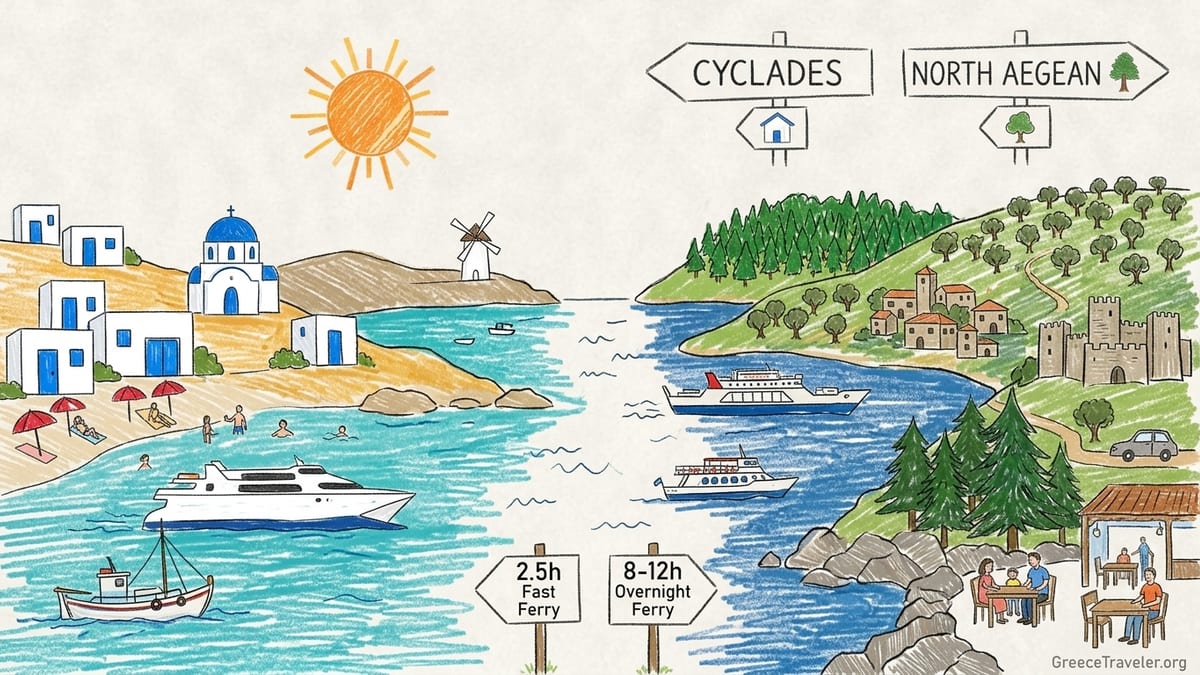
If you want simple logistics and short ferry rides, the Cyclades usually win. Fast ferries run from Athens ports such as Piraeus and Rafina to popular islands including Mykonos, Santorini, Paros and Naxos throughout the long summer season. Typical crossings like Piraeus to Paros or Naxos can take about 3 to 4 hours on a conventional ferry, or closer to 2.5 hours on a high‑speed service. Once you are in the Cyclades, the network between islands is dense. For example, Paros has frequent boats to Mykonos, Naxos, Ios and Santorini, which makes it easy to build a 7 to 10 day island hopping itinerary.
Reaching the North Aegean requires more commitment. Conventional ferries from Piraeus to Chios or Lesvos can take roughly 8 to 12 hours depending on stops, and many sail overnight, arriving early in the morning. Some routes also depart from Kavala in northern Greece to islands like Limnos and Lesvos. Samos and Ikaria are sometimes linked with both Piraeus and nearby Dodecanese islands by regional ferries, which means schedules can feel more complicated and less frequent than in the Cyclades. These longer journeys discourage casual weekend visitors, which is part of why the North Aegean still feels so untouristed.
Within each island group, getting around also feels different. In the Cyclades, compact islands like Ios, Mykonos or Milos can often be explored easily with buses and short taxi rides, especially if you stay near the main town or a popular beach. Island‑to‑island hops such as Naxos to Paros or Mykonos to Tinos can be as short as 30 to 60 minutes, so you can travel light and move often. In the North Aegean, the larger landmass of Lesvos or Chios means longer distances. Renting a car is almost essential if you want to explore mountain villages, hidden coves and archaeological sites scattered around these big islands.
For travelers with just 5 or 6 nights, the straightforward ferry network and shorter crossings of the Cyclades usually make more sense. If you have 10 to 14 days, or you enjoy long overnight crossings that feel like part of the adventure, committing to a North Aegean base like Samos, Lesvos or Ikaria becomes much more realistic.
Landscape, Atmosphere and Architecture
The visual difference between these two island groups is striking. The Cyclades are Greece’s postcard: whitewashed cube houses, blue‑domed churches and dry, rocky hillsides rolling down to bright turquoise bays. Step into the lanes of Mykonos Town or the cliffs of Oia on Santorini and you are in a very polished, photogenic environment designed around tourism. Even less famous islands like Serifos or Folegandros share that classic Cycladic look of sugar‑cube houses stacked around a central hilltop village.
The North Aegean islands feel more like miniature self‑contained worlds. Lesvos and Chios are dominated by olive groves and pine forests, while Samos is known for green valleys and vineyards. Architecture is more varied and less stylized. Instead of uniform white cubes, you might see stone mansions in Molyvos on Lesvos, fortress‑like medieval villages such as Mesta and Pyrgi on Chios, or pastel‑colored neoclassical houses in coastal towns like Vathy on Samos. Many villages look and feel like real working communities rather than curated resorts.
This difference in atmosphere shapes everyday experiences. A sunset drink in Naoussa on Paros or Fira on Santorini might come with sweeping caldera views and a chic cocktail list. A similar moment in the North Aegean could be a glass of ouzo at a simple harborside kafeneio in Skala Eresou on Lesvos or Armenistis on Ikaria, surrounded mostly by Greek families and a handful of repeat visitors. Both are memorable, but the mood is very different.
If you want the feeling of “I have arrived in that picture I have seen all my life,” the Cyclades are hard to beat. If you prefer a more lived‑in, less manicured setting where tourist infrastructure blends with local life, the North Aegean will likely feel more authentic and relaxed.
Beaches, Swimming and Outdoor Activities
Both regions have excellent beaches, but the character of those beaches varies. In the Cyclades, Paros and Naxos are standouts for long sandy stretches like Agios Prokopios and Plaka (Naxos) or Santa Maria and Golden Beach (Paros), often with sunbed rentals, beach bars and water sports. Mykonos is known for organized party beaches such as Paradise and Super Paradise, while Milos and Ios offer dramatic coves and cliff‑backed inlets. Many Cycladic beaches have at least some facilities in peak season, from simple tavernas to full beach clubs with DJs.
North Aegean beaches tend to be quieter and more spread out. Lesvos has long sand and pebble bays like Vatera and Petra, and the relaxed crescent of Skala Eresou, where you can still find a mix of simple rooms, small tavernas and a low‑key beach bar scene. Chios offers everything from volcanic black‑pebble shores such as Mavra Volia to small, sheltered coves along its western side. Samos has scenic beaches like Tsamadou and Psili Ammos, while Ikaria is known for more rugged spots such as Seychelles Beach, reached by a short but steep hike.
For active travelers, Cycladic islands offer plenty of boat trips to nearby islets, sunset sailing around Santorini, and beginner‑friendly windsurfing and kitesurfing on Naxos and Paros where conditions are often steady and schools are well established. Hiking tends to be shorter coastal or ridge walks, though islands like Amorgos and Andros have more extensive trail networks.
In the North Aegean, outdoor activities often feel wilder and less commercial. Hiking through pine forests above Agios Kirykos on Ikaria or along old mule paths in central Lesvos may bring you through working farmland and tiny hamlets with hardly any tourist services. Birdwatching is popular on Lesvos in spring and autumn, and hot springs can be found on islands such as Ikaria and Lesvos. Organized tours and rentals exist, but they are fewer, which means more planning and sometimes more independence, but also more freedom from crowds.
Hotels, Prices and Value for Money
Accommodation prices are one of the clearest differences between these island groups. In peak summer, a standard double room in a midrange hotel or stylish guesthouse in Mykonos or Santorini can easily start from the high hundreds of euros per night, especially if you want a view or pool. Even on more affordable Cycladic islands like Naxos or Paros, centrally located rooms in July and August often cost more than equivalent places on Lesvos, Chios or Samos, particularly in well known beach areas.
In the North Aegean, hospitality is often family run and priced for a mix of Greek visitors and long‑stay European guests. You can still find simple studios or apartments near the sea that remain relatively affordable, especially outside the absolute peak weeks of early August. For example, in many North Aegean towns it is common to see small pensions offering basic but clean double rooms at prices that would be hard to match on Mykonos or Santorini during the same period. Larger, resort‑style hotels do exist, but they are far less dominant than in the Cyclades.
Dining follows a similar pattern. A waterfront dinner in Naoussa on Paros or Little Venice in Mykonos might involve modern Greek cuisine, fresh fish and cocktails, but at prices comparable to major European cities. On Lesvos or Chios, meals in traditional tavernas are often significantly cheaper for similar quality, especially if you order local specialties like sardines, meze plates and house wine or ouzo. You are more likely to eat where locals eat, rather than in a row of restaurants solely aimed at visitors.
If you are traveling on a tight or moderate budget and want to stay a week or two in one place without counting every euro, the North Aegean usually offers better overall value. Cyclades islands, especially the big names, deliver more polished hotels, design‑driven boutiques and glamorous bars, but you will pay a premium for the setting and convenience.
Nightlife, Culture and Local Life
The Cyclades have some of Greece’s strongest nightlife infrastructure. Mykonos and Ios are famous for beach clubs, late‑night bars and clubs that run until dawn in July and August. Even more relaxed islands like Paros and Naxos now have a solid bar scene, with craft cocktails, wine bars and DJ sets around their main towns and ports. If you want to combine beach days with late nights out in a dense, walkable neighborhood, the established Cycladic hubs make that easy.
Nightlife in the North Aegean is more low‑key and seasonal. In university‑oriented towns such as Mytilene on Lesvos or Vathy on Samos you will find bars and a younger crowd, but even there the scene is more about simple waterfront cafés and ouzeries than high‑energy clubs. In villages like Armenistis on Ikaria or small harbors on Chios, evenings often revolve around long taverna dinners, local panigiri festivals with live music, or casual drinks under plane trees in the main square. It feels less like a resort entertainment strip and more like stepping into local social life.
Cultural experiences also differ. Cycladic islands offer well maintained historic centers, small museums and some notable archaeological sites, such as the ancient site of Akrotiri on Santorini or the sacred island of Delos near Mykonos, accessible by short boat trip. However, tourism now drives much of the visible activity in many Cycladic towns, especially in peak season, so daily rhythms can feel shaped around visitors.
In the North Aegean, working agriculture and fishing remain very visible. Lesvos is one of Greece’s main olive oil and ouzo producers, and visiting an olive press or a small ouzo distillery can be as interesting as a museum. On Chios, the mastiha villages showcase the unique cultivation of the mastic tree, while Samos has wineries producing sweet dessert wines and increasingly modern dry whites. Markets, cafés and village life follow local routines first, with tourism woven in rather than dominating. For travelers who enjoy slow observation and everyday culture, this is a major draw.
Best Fit for Families, Couples and Island Hoppers
For families, the choice depends on what you want from the trip. Cycladic islands like Naxos and Paros are excellent for kids thanks to shallow sandy beaches, plenty of family‑friendly hotels with pools, good bus networks and easy access to boat excursions. Supermarkets, pharmacies and rental services are concentrated and convenient. If your children are younger or you want a simple week of beach time without too much driving, these islands are very practical.
The North Aegean suits families who enjoy road trips and quieter, nature‑focused days. On Lesvos or Samos, you can mix beach time with visits to mountain villages, short hikes and cultural stops without battling crowds. Self‑catering apartments are common, which makes it easy to cook or picnic. The trade‑off is that you may need to rent a car for most of your stay, and travel days to and from the islands can be long, especially with overnight ferries involved.
For couples, Cycladic islands like Santorini and Milos remain classic romantic choices, with boutique hotels, sunset terraces and polished dining options. Many honeymoon itineraries pair Santorini with quieter Cycladic islands such as Folegandros or Koufonisia for a mix of glamour and seclusion. Prices reflect that demand, especially for rooms with views, hot tubs or private pools.
Couples who value privacy, authenticity and exploration over iconic views may find the North Aegean more rewarding. It is easy to base yourselves in a small pension overlooking Skala Eresou beach on Lesvos or in a stone house near Mesta on Chios, rent a car and spend days discovering little coves, monasteries and tavernas that see few tour groups. The mood is less about luxury experiences and more about shared discovery and everyday pleasures.
For island hoppers, the Cyclades are the clear winner in terms of practicality. You can design a route such as Athens to Syros to Paros to Naxos to Santorini in 10 to 12 days with relatively short ferry legs and many daily departures in peak season. In contrast, the North Aegean islands are more widely spaced, with fewer cross‑links. Hopping from Lesvos to Chios to Samos is possible but usually involves longer, less frequent sailings that require close attention to timetables. Many travelers instead pick one North Aegean island and explore it deeply rather than moving around.
Trip Length, Season and When the North Aegean Wins
Trip length is crucial in deciding between these regions. If you have under a week and it is your first time in Greece, a Cyclades itinerary built around a short ferry from Athens and an internal hop or two lets you see a lot without feeling rushed. It is entirely realistic to spend 3 nights on Paros and 3 nights on Naxos or Santorini within a 6 or 7 night window, using fast boats between islands and flights or ferries back to Athens at the end.
With 10 days or more, the North Aegean becomes easier to justify. You can take an overnight ferry to Lesvos, wake up in Mytilene, then spend a full week exploring beach villages like Petra and Anaxos, the medieval town of Molyvos and the island’s interior. Alternatively, you might combine Samos and Ikaria using regional ferries, allowing a few days on each. The slower travel rhythm means you spend more time in each place and less time changing hotels.
Season matters as well. Cyclades hotspots can feel very busy in July and August, when cruise ship passengers and international holidaymakers all converge. Shoulder seasons such as late May, June, September and early October are more comfortable, but some smaller islands wind down by mid‑October. In the North Aegean, peak crowds are rarely an issue, and many visitors are Greek families who travel in August. Spring and autumn can be especially pleasant, with mild weather, quieter beaches and good value on accommodation.
The North Aegean often suits travelers who have already done a classic Cyclades circuit or who are less interested in ticking famous names off a list. If you prefer long stays, road trips, local tavernas chosen because they are full of Greek voices, and you do not mind longer ferry journeys, the North Aegean delivers a sense of discovery that is harder to find on Mykonos or Santorini today.
The Takeaway
If your dream is whitewashed villages, effortless island hopping and big‑name destinations, the Cyclades are the straightforward choice. They offer shorter ferries, dense connections, polished hotels and a wide spectrum of nightlife and dining, from relaxed beach bars to international‑style clubs. For first‑time visitors with limited days, that convenience is hard to beat.
If you value authenticity, quieter beaches, lower prices and the feeling of sharing space with local life rather than a purely tourist scene, the North Aegean may well be a better fit. These larger, greener islands reward time and curiosity, from olive groves and mastiha villages to working harbors and mountain hamlets. They are less suited to high‑energy nightlife and rapid island hopping, and more to slow exploration.
In practice, many travelers start with the Cyclades to experience that classic Greek‑island image, then return on a later trip for a deeper dive into the North Aegean. Thinking honestly about your priorities, budget, and how much you enjoy long ferry journeys versus quick hops will point you toward the right group. Both regions can deliver an unforgettable Greek island holiday, just in very different flavors.
FAQ
Q1. Are the North Aegean islands or the Cyclades better for a first trip to Greece?
For most first‑time visitors, the Cyclades are easier because of shorter ferries, famous sights and dense connections. The North Aegean is better if you already know Greece or you prioritize quieter, more local experiences.
Q2. Which region is cheaper for hotels and food in summer?
In general, the North Aegean is more budget friendly. You are more likely to find reasonably priced family‑run rooms and tavernas on islands like Lesvos or Samos than in hotspots like Mykonos or Santorini in July and August.
Q3. Is island hopping possible in the North Aegean?
It is possible but less convenient. Routes such as Lesvos to Chios or Samos to Ikaria exist, yet they are less frequent and involve longer sailings. Most visitors pick one North Aegean island and explore it in depth instead of hopping.
Q4. Do I need a car on these islands?
On larger North Aegean islands like Lesvos, Chios and Samos, a car is very useful, especially if you want to visit mountain villages and remote beaches. In the Cyclades, islands like Mykonos, Paros and Naxos have better bus networks, so you can manage without a car if you stay near main towns or popular beaches.
Q5. Which islands are best for families with young children?
For easy logistics, shallow sandy beaches and lots of services, Cycladic islands such as Naxos and Paros work very well. Families who enjoy quieter settings and car‑based exploration may prefer North Aegean islands like Lesvos or Samos.
Q6. Where will I find better nightlife?
The strongest nightlife is in the Cyclades, especially Mykonos, Ios, Paros and parts of Santorini, which have busy bars and clubs in peak season. The North Aegean offers mostly low‑key tavernas, cafés and local festivals rather than big clubbing scenes.
Q7. How long should I stay to justify going to the North Aegean?
Because ferries are longer and less frequent, it is sensible to plan at least 7 to 10 nights if you choose the North Aegean. That allows you to absorb the travel time and still relax. Shorter trips of 4 to 6 nights usually fit better with the Cyclades.
Q8. Are the beaches better in the Cyclades or the North Aegean?
Both regions have great beaches, but the style differs. Cyclades islands like Naxos and Paros have many organized sandy beaches with facilities. North Aegean islands feature more low‑key and varied shores, from long quiet bays to small pebbly coves, often with fewer crowds and fewer beach clubs.
Q9. Is it worth paying extra to stay on Santorini or Mykonos?
It can be worth it if you value iconic views, luxury hotels and a lively atmosphere. However, if your priority is value and space to breathe, you might prefer to visit Mykonos or Santorini briefly, then base yourself on a quieter Cycladic island or in the North Aegean.
Q10. Which region should I choose if I want a more authentic, local feel?
The North Aegean is usually the better choice for authenticity. Islands like Lesvos, Chios, Samos and Ikaria see fewer international visitors, and their towns and villages feel more like everyday Greece, with tourism present but not dominant.