


The North Aegean islands are some of Greece’s most rewarding but least understood destinations. Their scale and spread out villages mean that on several of these islands, having a rental car does not just add comfort, it fundamentally changes what you can see in a week. This guide explains how car rental works on Lesvos, Chios, Samos, Ikaria, Lemnos and Thassos today, with concrete examples, typical prices and practical tips for airport pickup, insurance, deposits, village roads, beach access and ferry rules.
Do You Really Need a Car on These Islands?
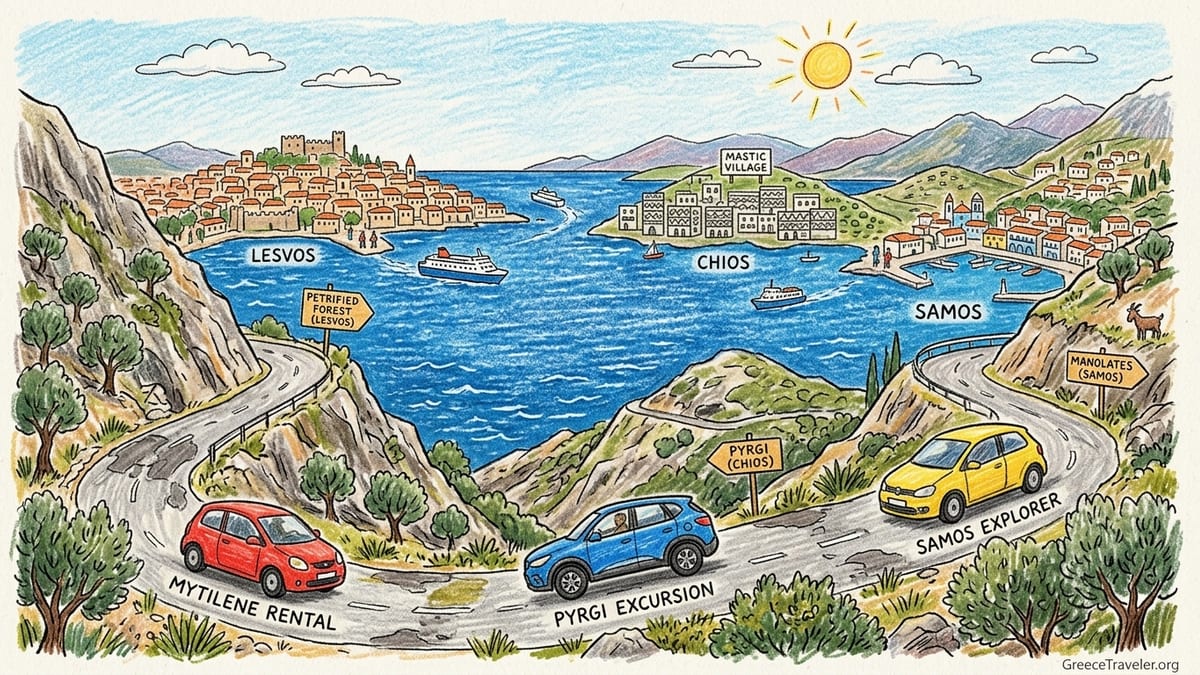
Lesvos, Chios and Samos are large, mountainous islands with scattered villages and limited public transport. On Lesvos, for example, the drive from the capital Mytilene to the western village of Sigri takes around two and a half hours, with bus connections that are infrequent and seasonal. Without a car, visiting both Petra and Molyvos in the north and the petrified forest in the west within a few days becomes logistically difficult.
Chios is similarly spread out. Popular areas such as the medieval mastic villages of Pyrgi and Mesta, the beaches around Komi, and the northern mountain villages like Volissos are all in different directions from Chios Town. Scheduled buses mainly serve the town and a few coastal villages, and often only a couple of times a day. A rental car lets you comfortably base yourself in a single village and still make day trips to the south and north of the island.
On Samos, distances are shorter but the island has two main hubs, Pythagoreio and Karlovasi, plus numerous beaches and mountain villages such as Manolates and Vourliotes. The bus network focuses on connecting these hubs to Samos Town and the airport, but does not offer the flexibility needed to reach smaller coves or to combine, say, a morning hike in the interior with an afternoon swim in the west. Travelers who rent a compact car at Samos International Airport can easily visit Psili Ammos beach one day and the mountain villages above Kokkari the next.
Ikaria, Lemnos and Thassos are smaller in population but still benefit greatly from having your own wheels. Ikaria’s attractions are scattered along twisting roads between Armenistis, Evdilos and Agios Kirykos, with limited buses. Lemnos’ sandy beaches stretch around a broad, low island, and Thassos’ ring road encircles a coastline of coves and small resorts. On all three, relying on taxis becomes expensive after a few rides, while a rental car for a few days often costs the equivalent of four or five taxi trips.
Airport Pickups and Main Rental Hubs by Island
Lesvos, Chios and Samos have established airport rental markets with several on-site or near-airport agencies. At Mytilene International Airport on Lesvos, visitors commonly find desks or meet-and-greet service from brands such as Budget and Thrifty, alongside local companies that deliver cars directly outside arrivals. Booking in advance typically allows you to walk out of baggage claim, sign the contract at a small counter or in the parking lot, and drive away within 15 to 20 minutes.
Chios Island National Airport is smaller but similarly straightforward. International chains like Avis sometimes work through local franchises, while island-based companies offer airport delivery with staff holding a sign in the arrivals hall. Many visitors arriving on domestic flights from Athens or Thessaloniki pre-book compact manuals that are dropped at the curb, often with a very short handover process compared with bigger Greek islands.
Samos International Airport, serving package holiday traffic and independent travelers, hosts several well-known brands such as Enterprise alongside regional players. For example, a traveler landing on a Saturday afternoon in high season might pick up a pre-booked small hatchback from a global brand at the airport parking area, then drive 10 minutes to Pythagoreio. The airport’s compact size makes pickup and return efficient, but queues can form on weekend changeover days, so online check-in or fast-track options, when offered, can save time.
Ikaria, Lemnos and Thassos rely more on local companies, but airport and port delivery is increasingly common. On Ikaria, agencies like Icarian Way, Ikaria SlowGo or Ikarian Drive arrange handovers at Ikaria Airport near Agios Kirykos or at the ports of Evdilos and Agios Kirykos, often including hotel delivery within a certain radius. On Lemnos, many renters collect their cars at Myrina port or Limnos Airport shortly after arrival. Thassos is usually reached by ferry from the mainland port of Keramoti, so most visitors either rent on the island at Limenas or Skala Prinos, or drive their mainland rental onto the ferry if allowed by their contract.
Typical Prices, Car Types and Manual vs Automatic
Prices vary by season, island and demand, but some patterns are consistent across the North Aegean. In high summer, a small manual hatchback such as a Fiat Panda or Hyundai i10 on Lesvos, Chios or Samos often costs in the broad range of 35 to 55 euros per day when booked a few months ahead, with cheaper deals in shoulder months like May, June and late September. On Ikaria, Lemnos and Thassos, local agencies sometimes quote slightly lower base prices outside peak dates, though availability can be limited in August.
Manual transmission remains the default in Greece. Automatics are widely available on the larger islands but in smaller numbers, often at a noticeable premium. For instance, if a manual compact on Lesvos in July is quoted around 45 euros per day, the equivalent automatic might be closer to 60 to 70 euros per day with the same company. On Ikaria or Lemnos, an automatic SUV or crossover in August can book out entirely, so travelers who cannot or prefer not to drive manual should reserve several months in advance.
Vehicle categories run from basic city cars to small SUVs. On islands with steep roads and rural tracks, many visitors appreciate a slightly higher clearance car such as a small crossover, especially on Ikaria and in the hill villages of Samos. However, most agencies explicitly forbid driving on rough, unpaved roads, regardless of vehicle type. A typical contract for a small crossover on Ikaria, for example, will often exclude insurance coverage if the car is taken onto non-asphalt tracks, even if the road leads to a popular beach.
Families and groups commonly opt for compact SUVs or station wagons to handle luggage and multiple passengers. On Lesvos, a family of four might rent a mid-size manual sedan from an international brand at the airport to accommodate two large suitcases and beach gear, paying a moderate supplement over a compact. On Thassos, groups sometimes rent two small cars rather than one large van, as parking is easier in small beach villages when using compact vehicles.
Insurance, Deposits and Payment: What to Expect
Greek law requires third-party liability insurance as standard, but this only covers damage or injury to others. Rental offers in the North Aegean typically include basic collision damage waiver with an excess, which is the amount you remain responsible for in the event of damage. On Lesvos or Samos, that excess is often in the several-hundred-euro range for a compact car. To reduce or eliminate the excess, renters can purchase additional coverage, either from the rental company or through a separate policy obtained before travel.
At the airport agencies on Lesvos, Chios and Samos, it is common for staff to place a pre-authorization hold on your credit card equal to the excess amount or a fixed security deposit. For example, a traveler renting a small car from a global brand at Samos Airport might see a hold of around 600 to 900 euros that is released after the car is returned without new damage. Local agencies on Ikaria or Lemnos sometimes opt for a lower deposit for older cars or waive the hold entirely if renters purchase their own full coverage option, but this varies widely.
Payment is generally taken either in advance online or on collection. Major credit cards are widely accepted at airport locations, while some smaller agencies on Ikaria or Thassos also accept debit cards or cash, especially for walk-up rentals. However, even when you pay with cash, many companies still require a card for the deposit. Reading the contract is important, particularly regarding windscreen, tire and underbody coverage, which are often excluded from basic packages but frequently damaged on rural roads.
Travelers booking through local specialists or tour operators sometimes pay a separate booking deposit weeks or months before arrival, then settle the balance with the island agency at pickup. In such cases, the rental company’s own insurance and deposit rules still apply at collection. Keeping all paperwork and taking time-stamped photos of the car at pickup and return is a practical safeguard if any disputes about damage arise later.
Driving Conditions, Village Roads and Parking Challenges
Driving on the North Aegean islands is generally relaxed once outside the main towns, but village roads and mountain routes require attention. Lesvos has long stretches of good asphalt, yet some older roads in the interior are narrow with sharp bends. Approaching hilltop villages like Agiassos or the lanes around Molyvos castle, streets can be barely wide enough for one car, with stone walls on both sides. In these conditions, a small vehicle is easier to maneuver than a wide SUV, and new drivers may feel more comfortable with something compact.
On Chios and Samos, traditional villages often pre-date cars, so streets can suddenly taper into pedestrian alleys. In places like Pyrgi on Chios or Manolates on Samos, many visitors park on the outskirts and walk into the historic center. Rental companies generally encourage this approach, as squeezing through cramped alleys not only risks scrapes but may invalidate insurance if you ignore no-entry or local resident signs. Expect to reverse carefully around blind corners and yield to local traffic, especially delivery trucks and buses.
Ikaria has a particular reputation among experienced Greece travelers for twisty mountain roads and dramatic drops, especially on the northern route between Armenistis and Evdilos and the more remote roads toward the island’s interior. Surfaces are mostly paved but can be patchy. Speeds are low, and nighttime or bad-weather driving is best avoided if you are unfamiliar with the island. For many visitors, hiring a car with strong brakes and good tires, and scheduling longer drives in daylight, makes a big difference to comfort and safety.
Lemnos and Thassos are generally flatter, but challenges include gravel access tracks to remote beaches and informal parking around busy coves. On Lemnos’ sandy shoreline, rental agencies commonly forbid driving through deep sand or onto dunes to reach isolated spots. On Thassos, the main ring road is straightforward, but turning into popular beach parking areas in August can involve tight spaces and improvised parallel parking. In all cases, it pays to plan for extra time to park when visiting busy beaches or festivals.
Reaching Beaches and Remote Sights by Car
One of the biggest advantages of renting a car on these islands is access to quieter beaches and inland highlights that are difficult to reach otherwise. On Lesvos, a car allows easy day trips to remote spots like Tavari and the nearby beaches of the island’s west, or repeated visits to different hot springs and bay villages in the Gulf of Gera. Travelers based in Molyvos with a car can explore Petra, Anaxos and the inland villages in a single day without watching the bus timetable.
Chios rewards drivers with access to a string of distinctive southern beaches like Mavra Volia near Emporios, known for its dark pebbles, and further coves where public buses do not reach or operate only in high season. A rented compact car makes it feasible to combine morning sightseeing in the mastic villages with an afternoon swim, then a sunset stop at a viewpoint on the drive back to town. Without independent transport, many visitors choose just one of these areas for an entire day.
On Samos, a car opens up both the lush, forested north and the drier, beach-lined south. Drivers can set off from Pythagoreio to explore Tsamadou and Tsabou beaches near Kokkari, then climb to Vourliotes or Manolates for cooler evening air and tavernas. Similarly, a car on Ikaria means being able to reach the long beach at Seychelles near Magganitis on the south, attend a village panigyri festival late into the night, and still return to your accommodation safely, adjusting your departure to quiet road conditions.
Lemnos and Thassos are filled with mid-sized beaches where irregular buses and taxi costs would otherwise limit how many you can visit. On Lemnos, a rental allows you to tour the sandy bays around Plati, Thanos and Evgatis from a base in Myrina, and to reach the eastern wetlands and dunes without being tied to group excursions. On Thassos, a car lets you circuit the island’s ring road over a couple of days, stopping at different coves such as Golden Beach, Paradise Beach and smaller, unnamed inlets that you might only spot from the road.
Ferry Rules, Island Hopping and Taking Cars Between Islands
Many visitors to the North Aegean consider combining islands, for example Lesvos and Chios, or Samos and Ikaria. It is technically possible to take cars on inter-island ferries, but standard rental contracts frequently restrict this. Large international brands and many local agencies specify that their vehicles are not allowed on ferries without written permission, and even when permission is granted, any damage during ferry transit may not be covered by insurance.
In practice, most travelers who plan to visit two or more islands choose separate rentals on each. For example, a couple might rent a car at Mytilene Airport on Lesvos for five days, return it before boarding an overnight ferry to Chios, then pick up another car on Chios for the next leg of their trip. This approach avoids extra ferry charges for vehicles and reduces the risk of disputes between ferry and car rental companies in the unlikely event of an incident.
Thassos is a special case because many visitors arrive by car from the Greek mainland. Travelers who have rented a vehicle in Kavala or Thessaloniki often ask whether they can take it on the ferry from Keramoti to Thassos. Some mainland agencies allow this with prior authorization and sometimes an extra fee, while others prohibit it outright. Reading your mainland rental conditions carefully, or choosing to rent directly on Thassos instead, is important to avoid unexpected costs or invalidating insurance.
On smaller islands like Ikaria, ferry schedules themselves can change due to weather or operational reasons, so combining car rental with flexible ferry tickets is sensible. Renting locally on arrival, or arranging an airport pickup that matches your specific flight, is often more straightforward than trying to coordinate transporting a rental vehicle from another island, especially when overall distances are relatively short once you are on the ground.
Practical Booking Tips and Realistic Expectations
Availability on these islands, especially Ikaria and Lemnos, can become tight in late July and August. Travelers who wait until the week before arrival may find only older cars or larger, more expensive models left, or in some cases no availability at all. For example, visitors reporting last-minute searches on Ikaria at the height of summer often mention significantly higher prices compared with bookings made earlier in the year and limited choice of transmission type.
Booking early through an island-based agency or a reputable broker that clearly states the local supplier can help secure the right size and transmission. Providing your flight or ferry details lets the company adjust pickup if schedules shift slightly. It is also wise to reconfirm the reservation a few days before arrival, especially on smaller islands where offices might close mid-day, and to confirm whether someone will meet you with a sign or if you should walk to a nearby office.
When comparing offers, look beyond the daily rate and check what is included. Unlimited mileage is standard on many islands, but some companies on smaller islands cap daily kilometers, charging per extra kilometer driven. Additional driver fees, child seats and out-of-hours pickup at airports can add noticeable amounts. For instance, a quote that appears 5 euros per day cheaper might end up more expensive once you add a nightly airport delivery fee for a late flight.
Finally, set realistic expectations about the vehicles themselves. On these islands, especially away from the main airport chains, fleets may include cars that are several years old, with minor cosmetic wear. As long as they are mechanically sound and rated roadworthy, this is normal and helps keep prices in check. Photographing any existing dents and scratches at pickup, and keeping fuel and return instructions in mind, usually ensures a smooth experience and a stress-free end to your island stay.
FAQ
Q1. Do I really need to rent a car on Lesvos, Chios or Samos?
For most travelers, yes. These islands are large with scattered sights and limited buses, so a car lets you comfortably reach beaches, villages and inland areas in a short stay.
Q2. Are automatics easy to find on the North Aegean islands?
Automatics are available, especially at the airports on Lesvos, Chios and Samos, but they are fewer and cost more than manuals, so advance booking is essential in peak season.
Q3. How much should I budget per day for a small car in summer?
As a rough guide, expect a compact manual to cost somewhere around the mid double digits in euros per day in July and August, with slightly lower prices in shoulder months.
Q4. Is driving on Ikaria really difficult?
Ikaria’s roads are twisty and often hug steep hillsides, but speeds are low and surfaces are mostly paved. Confident drivers who avoid night driving and take their time usually manage fine.
Q5. Can I take my rental car on ferries between islands?
Often not without written permission. Many contracts either forbid ferry use or state that any damage on board is not covered, so most travelers rent separate cars on each island.
Q6. What kind of insurance do I actually need?
Basic liability is included by law, but most travelers choose some form of damage waiver with a manageable excess, plus either extra coverage or a separate policy to reduce their potential out-of-pocket costs.
Q7. Are village roads too narrow for larger cars or SUVs?
Many old village streets are very narrow, so compact cars are easier to maneuver and park. If you choose an SUV, plan to park on the edge of villages and walk into the center.
Q8. Is parking a problem near popular beaches?
In July and August, parking at major beaches on all these islands can be crowded by late morning. Arriving earlier or later in the day usually makes finding a spot much easier.
Q9. Can I rent a car on Thassos if I arrive without a vehicle?
Yes. Several local companies rent cars near the main ports and resorts, so you can walk off the ferry from the mainland and pick up a car on the island itself.
Q10. What documents do I need to rent a car in the North Aegean?
You will need a valid driving licence, a passport or ID card, and usually a credit card in the driver’s name. Some non-EU visitors may also need an international driving permit, so it is best to check requirements before travel.