


I arrived at the Evros Delta with a rental car full of optimism and optics. A scope, two pairs of binoculars, field guides crammed with sticky notes and a rough list of target species, from Dalmatian pelicans to glossy ibises. What I did not have was the single most important item for a foreign birder who wants to get beyond the public tracks in this corner of northeastern Greece: a border-zone permit arranged in advance through the Greek authorities. Within two hours I had been politely turned back from a checkpoint, watched a boat tour leave without me, and realised that in Evros, assuming the delta works like an ordinary national park is a recipe for a wasted day.
How My "Perfect" Evros Delta Plan Fell Apart
The plan looked solid on paper. I would drive from Alexandroupoli to the visitor information centre near Traianoupoli just after it opened, pick up a detailed map, then spend the morning exploring the western, more accessible side of the delta by car. After lunch in nearby Feres, I had booked a late-afternoon boat trip through the canals, which promised close views of herons and, if we were lucky, flamingos feeding in the shallow lagoons. I had read half a dozen articles that said more or less the same thing: drive the dirt roads, climb the birdwatching towers, and let the wetlands deliver.
The reality began to diverge from the plan as soon as I started asking about access beyond the main public tracks. Staff at the management unit offices that oversee the Evros Delta and nearby Dadia protected areas explained that parts of the delta lie inside a supervised border zone, because the river forms the land border between Greece and Turkey. Foreign nationals who want to enter these controlled sections for birdwatching or photography need a special permit issued through the Greek police and military authorities. The offices warn that the process is time consuming and tell visitors to contact them by email for instructions well before travelling.
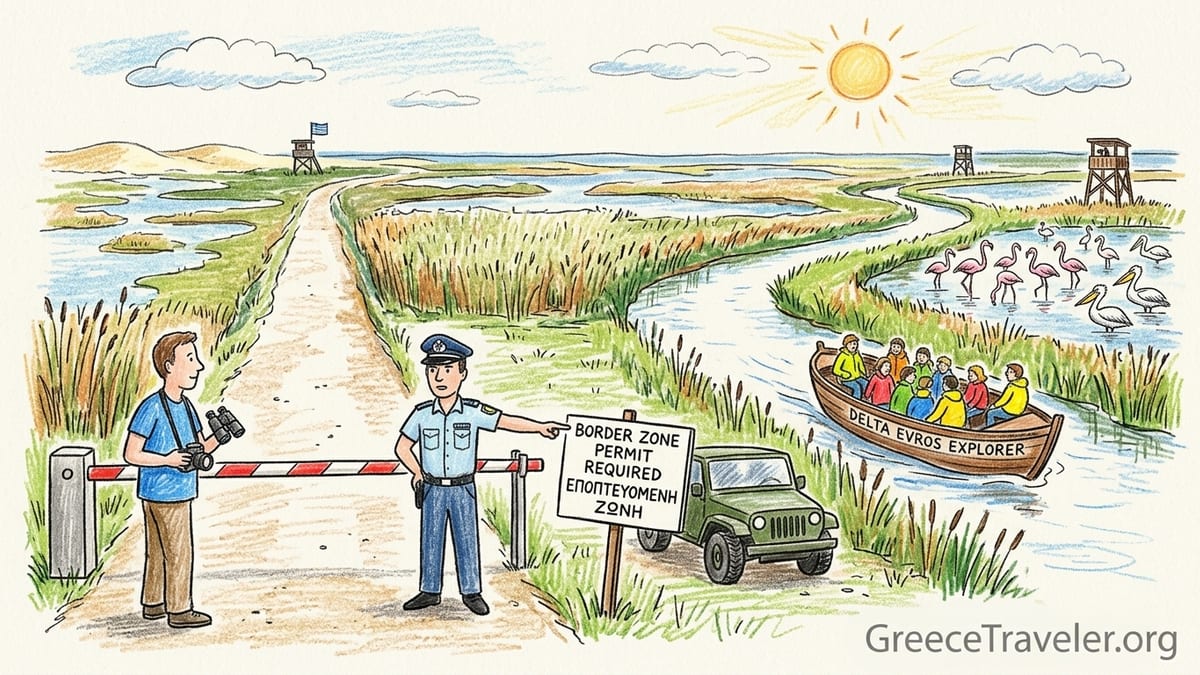
I had not done that. At a barrier southeast of Monastiraki, where one of the internal roads continues into the deeper delta, police and army personnel checked my passport and calmly explained that I could not proceed without the permit. There was no drama, just a firm reminder that this was an active border zone, not a drive-in safari park. The controlled area was exactly where I had hoped to spend my prime birding hours, and watching the road continue into the reeds without me was a humbling lesson in preparation.
The second blow came when I tried to shift my focus to the water. A local operator, Delta Evros Explorer, runs small boat excursions into the delta, often coordinated through the information centre at Traianoupoli or the tourism office in Feres. The boats are accompanied by eco-guides who know the channels, sandbars and seasonal roosts far better than any outsider. On busy weekends and during spring and autumn migration, these trips can fill quickly. I had assumed I could call the day before and slot into an afternoon tour. Instead, I found myself on a waiting list as the one departure that fit my schedule chugged away down the canal without me.
A Wetland at the Edge of Two Countries, Not an Ordinary Park
Part of the problem is that Evros Delta is often described in the same breath as more straightforward bird reserves. Official descriptions emphasise that it is a Ramsar-listed wetland, a Natura 2000 site and a national park of around 188 square kilometres of lagoons, sand dunes, marshes and reedbeds near the river mouth southeast of Alexandroupoli. Several hundred bird species have been recorded here, which makes it one of Greece’s most important bird habitats and a magnet for both local and international birdwatchers.
All of that is true. What tends to be downplayed in the glossy copy is that this bird paradise is also a frontline border landscape. The river itself largely marks the land boundary between Greece and Turkey, and the southern reaches of the delta are laced with military infrastructure, patrol routes and observation posts. This context shapes everything from which dirt roads are open to the public to how close a private vehicle is allowed to get to certain canals or sandbars that look inviting on satellite maps.
The Evros Delta is therefore divided, in practical terms, into different zones. The western part, including areas near Anthia marshes and Drana Lagoon, can be accessed on public roads after checking in at the visitor centres. There are birdwatching towers, short walking routes and spots where you can scan lagoons from the roadside. deeper sections of the delta fall within a supervised border zone that requires prior authorisation for foreigners who want to enter on foot or by vehicle, even if their sole intention is birdwatching.
None of this means the entire delta is under military lock and key. It is possible to have a rewarding day on the western fringes, especially in winter when ducks and geese concentrate in more visible rafts, or in spring when migration pushes birds along the more accessible margins. But if you travel all the way to Evros expecting that every track and tower described in older trip reports will be open to you as a foreign visitor, you are likely to discover a more constrained, and more controlled, reality.
The Crucial Rule: Border-Zone Permits Take Time
The key logistical rule for foreigners is simple but easily missed in the excitement of planning: if you want to enter the supervised border zone inside the delta, you need to arrange a permit in advance, and that process can take time. The management unit responsible for the Evros Delta and nearby protected areas states clearly that all non-Greek visitors who wish to visit the national park for tours and birdwatching in the supervised zone must secure an entry permit issued by the Hellenic Police and the Greek Army. They emphasise that this is a time consuming procedure and actively advise foreign citizens to contact the management unit by email before planning their trip for detailed guidance.
In practice, this means that last minute birding whims do not work well here. You cannot just wake up in Alexandroupoli, see that the weather looks good, and decide to drive straight into the heart of the delta with your passport in your pocket and hope for the best. At checkpoints in and around the supervised zone, mixed teams of police and army personnel may check identification, verify permits and, if you do not have permission, politely send you back. This is not a matter of arguing your case as a nature tourist. It is a legal requirement in an area that has also seen irregular migration and intensified border surveillance.
It is equally important to understand what the permit does not cover. You do not need military permission to visit every part of the Evros wetlands. The visitor centres, public birdwatching towers and roads that stop short of the internal barriers remain accessible without special authorisation, although you should still carry your passport or national ID because Greek police have the right to ask for identification in border regions. The permit only applies to the supervised zone itself, and the route and duration of your authorised visit may be defined in the paperwork.
If you intend to visit as part of a guided tour, many operators will help with the bureaucracy, but they cannot conjure a permit out of thin air the same day you arrive. They need your full name, passport details and travel dates to submit the request, and they are constrained by the response time of the authorities. On my own trip, the absence of this single paper wall cut off entire sections of the map that I had mentally explored from my desk at home.
Visitor Centres, Boats and Guides: What Actually Operates Now
After my border-zone plans collapsed, I regrouped at the official visitor infrastructure, which is where most travellers should begin. The management unit lists two key information points for Evros Delta visitors. One is the Information Centre at Loutra Traianoupolis, inland from the wetlands, which keeps daytime hours and serves as a hub for eco-tourism and guided excursions. The other is the Tourist Information Centre in Feres, closer to the wetter part of the delta, which can also provide advice, maps and contact details for local guides and boatmen. Both ask visitors to get in touch in advance by phone for service, especially outside peak times.
From these centres, guided activities radiate outward. The official tours of the delta are often organised as boat excursions along natural canals, departing from a pier reached by a shuttle service arranged through the Feres tourist office or directly with an operator. One long-established local provider, trading as Delta Evros Explorer, runs small covered boats that travel at low speeds along the reed-fringed channels. They highlight a standard one hour route that introduces visitors to typical riverine habitats and, when conditions cooperate, visible waterbirds along logs and banks.
Prices for these boat trips are refreshingly transparent. A typical one hour excursion for adults has been advertised at around 17 euros per person, with reduced rates of roughly 10 euros for children up to about ten years old. There is usually a minimum overall charge, around 80 euros, to ensure the trip runs even with a small group. Longer custom trips of about three hours, which penetrate farther into the canal network and linger at particularly rich spots, are negotiated individually, often for private groups or specialist birdwatchers who want more time in the field.
The visitor centres themselves are not mere ticket booths. At Traianoupoli, the exhibitions explain the ecological value of the delta and its role in the wider network of protected areas in Eastern Thrace. Staff can discuss water levels, which affect which tracks are driveable and which towers are accessible, and they will be frank about current constraints. When I visited, one distant track recommended in a decade old birding report was effectively off limits due to both flooding and security controls, yet that same report still floats around the internet without warning banners. Talking to people on the ground is essential here.
Where Guides Help: Permits, Language and Local Realities
One of the most persistent myths in online trip reports is that independent birders are better off without guides in Evros. While there is plenty you can do alone in the publicly accessible areas, a good local guide becomes invaluable as soon as you brush against the supervised zones or want to maximise a short visit. Several operators based in Alexandroupoli, Feres and the surrounding villages run birdwatching tours that include transport, optics on loan and the administrative heavy lifting required for foreign clients.
Some of these guides work closely with the management unit and will proactively ask overseas guests for passport details and planned dates weeks in advance, specifically so they can request supervised-zone access where it is realistic. Others confine their tours to the open western sectors and the river channels that boat operators are authorised to use, which still offer rich birdwatching without the need for deeper permits. In both cases, guides bring crucial language skills. Not all checkpoint personnel speak English, and explaining that your spotting scope is not a piece of surveillance equipment is easier in Greek than in halting gestures.
A concrete example from my visit captures this gap. A small group of Greek birders arrived at the same checkpoint where I had been turned around. Their leader, a local guide, had the necessary documents already approved, including a list of names and vehicle details. Within fifteen minutes they were waved through. They knew which tracks were currently open, which fields had been ploughed and were now unattractive to geese, and which lagoon edges had drawn recent reports of pelicans. I, on the other hand, was left cruising the public roads, grateful for distant views but very aware that my planning had left a lot of the delta off-limits.
This is not to say that guides are mandatory for every Evros trip. If you have several days, are comfortable driving rough dirt roads and are happy to focus on the accessible western sections and boat tours, you can experience plenty independently. But for tight itineraries, for photographers chasing certain species, or for anyone uneasy about border formalities in a foreign language, investing in at least one guided day can make the difference between frustration and fulfilment.
Flamingos, Pelicans and the Marketing Gap
Many promotional images of the Evros Delta are dominated by charismatic species. Dalmatian pelicans cruise across mirror-calm lagoons in soft morning light. Lines of greater flamingos march through perfectly still shallows, their reflections uninterrupted by wind or heat haze. Spoonbills and herons pose at point blank range against a backdrop of lush green reeds. These scenes do occur, but they represent the most photogenic corners of a highly variable and seasonal landscape rather than the guaranteed daily experience.
The birdlife in Evros shifts dramatically with the calendar, water levels and weather. In mid winter, the delta can hold large numbers of ducks, geese and swans, but heavy rain may flood tracks and push birds farther into inaccessible corners. In spring, waders and herons move through, but strong winds can churn the lagoons and keep birds low and scattered. In late summer, heat and evaporation may leave some pools shallow and distant, with birds hugging the remaining water far from observation towers. On my visit, a hot spell combined with low water meant the famous flamingos were present, but mostly as pale specks in the heat shimmer, not the close flock I had imagined from tourism brochures.
There is also the human comfort factor. Many images of pelicans show cool light and gentle mist, yet in reality, daytime temperatures in late spring and summer can climb high, and the open delta offers little shade. Mosquitoes thrive in the damp margins of lagoons and canals, and on still evenings they can be fierce. Boat operators address this with canopies and slow speeds that create a breeze, but you still want long sleeves and serious repellent if you plan to focus through binoculars rather than swat insects. None of this undermines the magic of the place, but it does challenge the notion of a gentle, effortless birding cruise.
The visibility of birds along the publicly accessible roads can be equally fickle. On one morning I had excellent views of glossy ibis and squacco herons from a roadside pullout not far from Feres. The next day, with a slight shift in wind direction and water on a nearby field, the same spot felt almost empty. Guides and boat crews who are on the water several times a week adapt quickly to these changes. Travellers relying solely on static online descriptions from years past are more likely to be in the wrong place at the wrong time, binoculars trained on an empty reedbed.
A Pre-Booking Checklist to Avoid My Mistakes
After my own tangle with Evros logistics, I rewrote my planning process from scratch. The first item on my checklist for any future visit is documentation. I would scan the photo page of my passport and keep a digital copy ready to send to the management unit or a local guide if I want to request access to supervised zones. I would note my planned dates, accommodation base and whether I will have my own vehicle. That way, when I contact the official management office or a tour operator, they have the information required to advise realistically on permits and routes.
The second item is direct communication with on-the-ground institutions. Before booking flights, I would email or call the Information Centre at Loutra Traianoupolis or the tourist office in Feres to ask about current access conditions, opening hours and available tours on my intended dates. Office schedules can shift with seasons and staffing, and certain periods, such as national holidays or heightened border tensions, may affect what is feasible. A fifteen minute conversation with a staff member who answers the phone daily is more reliable than an undated blog post.
Third comes equipment and personal comfort. At a minimum, I would pack a solid pair of binoculars in the 8x or 10x range, plus a light tripod and scope if I plan to scan distant lagoons from towers. In summer and early autumn I would add high quality insect repellent, a wide brimmed hat, sun protection and a refillable water bottle, because distances between shady spots are significant once you leave the villages. A light windproof layer matters more than you might expect on open boats, especially when they move slowly along exposed channels.
Finally, I would treat guides and boat operators as partners rather than last-minute add ons. That means asking, at the time of booking, exactly which parts of the delta a given tour can legally access, whether they assist overseas guests with border permits when needed, and what happens if weather or security constraints change plans at short notice. Reputable operators are transparent about these issues. If a provider shrugs off questions about permits or insists that “we never have any problems at the checkpoints,” I would consider that a red flag rather than reassurance in a region where the border is a daily operational reality.
The Takeaway
So is the Evros Delta worth the logistical headaches for foreign birdwatchers. In my view, yes, but only if you respect that you are entering both a major wetland and one of Europe’s most politically sensitive borders. This is not an easy add on to a casual beach trip, nor a place where you can improvise access on the fly. It rewards those who read beyond the romantic imagery, engage with local institutions and plan around permits, seasonality and security.
A dedicated trip makes sense when you have a genuine interest in wetland birdlife and at least two or three days to adjust plans on the ground. Winter and early spring can be outstanding for waterfowl and raptors. Late spring and early autumn can sparkle with migration. In these windows, a licensed guide or organised boat trip is not a luxury but a strategic tool, especially if you are flying in from abroad with limited time. They can help navigate the supervised border zone rules, interpret rapidly changing water conditions and maximise your chances of real encounters with pelicans, flamingos or rare raptors rather than hunting for them blind.
On the other hand, if you have only a single spare afternoon in Alexandroupoli between other commitments, Evros may not be the best bet unless you can secure a confirmed place on a short boat tour or are content with a brief stop at an observation tower. The delta does not bend easily to rushed itineraries, and the controlled nature of access means there will be days when whole sectors remain literally out of bounds to casual visitors.
What my own missteps in Evros drove home is that advance preparation is not an optional extra here. It is the bridge between the abstract promise of a famous Ramsar wetland and the concrete reality of standing in silence as thousands of birds lift off a lagoon at first light, with the low profile of border outposts on the horizon and your paperwork safely in order back in the car. That tension between wild nature and hard politics is part of what makes the Evros Delta unique. To experience it fully and responsibly, you have to plan for both.
FAQ
Q1. Do all areas of the Evros Delta require a special border permit for foreign visitors.
No. The western section, visitor centres, main observation towers and certain roads are open without special military permission. Permits are only required for entering the supervised border zone inside the delta.
Q2. How far in advance should I start the permit process for the supervised border zone.
You should contact the Evros Delta management unit or a licensed local guide several weeks before your trip, since the permit is issued through Greek police and army channels and can take time to arrange.
Q3. Can local guides or tour operators handle the permit application for me.
Many established guides and boat operators assist foreign clients with the paperwork, but they still need your passport details and travel dates well in advance and cannot guarantee last minute approvals.
Q4. Where should I start my visit if I arrive without any prior arrangements.
Your best first stop is one of the official visitor centres, either at Loutra Traianoupolis or in Feres, where staff can explain current access rules, available boat trips and which roads and towers are open.
Q5. Are boat trips suitable for serious birdwatchers or only for casual tourists.
Boat excursions are useful for both. Casual visitors get a scenic overview, while birders gain low level access to channels and reedbeds that are difficult or impossible to reach by road.
Q6. What wildlife can I realistically expect to see on a short visit.
Depending on the season, you may see herons, egrets, glossy ibises, various ducks and, at times, pelicans or flamingos, but exact species and viewing distances change with migration and water levels.
Q7. When is the best time of year to plan a dedicated birdwatching trip to Evros.
Late winter and early spring are excellent for waterfowl and raptors, while spring and early autumn bring strong migration. High summer can be hot, mosquito heavy and less comfortable for long field sessions.
Q8. Do I need my own car to explore the Evros Delta.
A car is very useful for reaching towers and roadside vantage points, but if you do not want to drive, you can still experience the delta through organised boat trips and some guided tours that include transport.
Q9. What should I pack for a day of birding in the delta.
Bring binoculars, sun protection, insect repellent, sturdy shoes, water, snacks and a light windproof layer for boat journeys. Photographers may also want a tripod or monopod and a telephoto lens.
Q10. Is the Evros Delta a good destination for beginners or families with children.
Yes, provided you manage expectations. Visitor centres and short boat tours work well for families, but you should plan around heat, insects, and the fact that some areas are off limits due to border controls.