


The first time I saw Soufli written on a road sign, it was paired with a small silk cocoon logo on a brochure from my hotel in Alexandroupoli. Until then, “Greek silk” sounded like a romantic footnote to the Silk Road. A day in Soufli, however, showed me how deeply this town once lived and breathed sericulture, from mulberry orchards to whirring reeling machines and the patient work of women unwinding cocoons by hand.
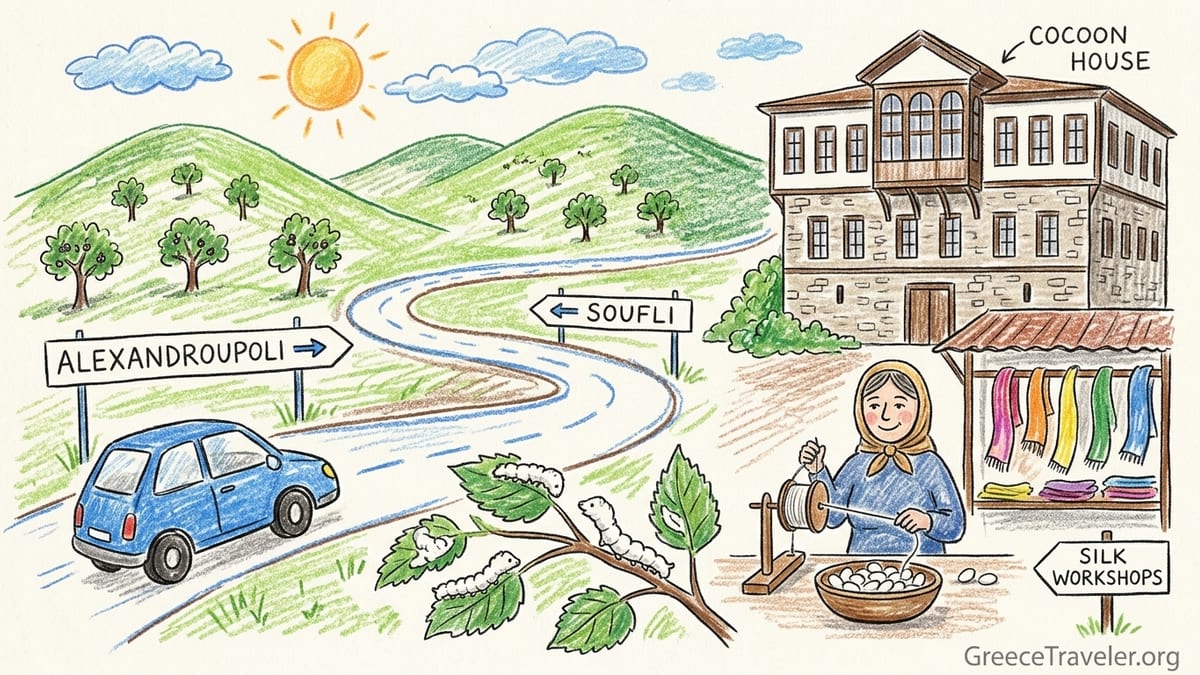
Getting to Soufli: Following the Old Silk Route from Alexandroupoli
I started my silk pilgrimage in Alexandroupoli, the coastal city that serves as a practical base for exploring the Evros region. Early in the morning, I picked up a small rental car near the port and pointed it north toward the Bulgarian border. The route is simple: follow the National Road EO2 along the Evros valley toward Orestiada. Soufli sits roughly halfway, about 65 kilometers from Alexandroupoli. With little traffic outside rush hours, the drive takes around 50 to 60 minutes, passing flat farmland, distant hills and the ever-present ribbon of the Evros River.
Travelers without a car can reach Soufli by KTEL bus from Alexandroupoli’s main bus station. The ride is slightly longer than driving, often around one and a half hours depending on stops. On the day I went, there were morning and early afternoon departures, though schedules can change, so it is important to confirm at the station. The bus dropped passengers on Soufli’s main road, a straight spine lined with low buildings, a few cafes, and small shops with silk scarves fluttering in the windows.
What struck me on arrival was how compact Soufli feels. The main sights sit within easy walking distance along or just off the central avenue. This makes it realistic to explore the town on foot, connecting the museums, historic cocoon houses and workshops in a single loop. I planned my route around opening hours, starting with the PIOP Silk Museum, adding the privately run Art of Silk Museum, and leaving time for cocoon houses and artisan shops before looping back to the bus stop.
Soufli is not a polished resort village, despite its recognition by the World Tourism Organization’s Best Tourism Villages initiative in 2021. It looks like a working small town of northeastern Greece: tractors on side streets, elderly men in kafenia, and a main road that still feels more local than touristic. That makes the silk heritage feel authentic rather than staged, but it also requires a bit of planning, especially regarding museum opening days.
The PIOP Silk Museum: Inside a Cocoon House and Merchant Mansion
My first real contact with Soufli’s silk world came at the Silk Museum operated by the Piraeus Bank Group Cultural Foundation (PIOP). The complex occupies two restored buildings facing an inner courtyard: the late 19th-century Kourtidis mansion and an adjoining cocoon house. Walking through the entrance, I stepped from the modern street into the faded prosperity of Soufli’s silk boom in the late 1800s and early 1900s, when wealthy merchants built these impressive residences to manage their sericulture businesses.
Before my visit, I checked the museum’s official information to avoid turning up on a closed day. At the time of writing, the PIOP Silk Museum in Soufli operates with set seasonal hours, and it is important to note that Tuesday closures have existed in other museums in the same network. When I visited, it was open on a weekday morning, but I confirmed by phone the day before. The ticket desk offered a modest admission fee in line with other regional museums in Greece, with reduced rates for students and seniors. The staff spoke Greek and English and provided a leaflet explaining the exhibition route.
The ground floor introduces Soufli’s geography and history, situating the town along historic trade routes near the Ottoman frontier and later the Greek-Bulgarian border. Maps and archival photos show mulberry plantations, river transport along the Evros and the gradual rise of family-based sericulture. I learned that silk here was not a minor sideline. By the late 19th century, sericulture was central to the local economy, to the extent that, as historical accounts note, almost every household participated during the key months of May and June when silkworms were raised and cocoons collected.
Upstairs, the exhibition becomes more technical and immersive. One side of the upper floor focuses on pre-industrial sericulture: wooden racks used for silkworm trays, tools for cutting mulberry branches, simple temperature-management solutions and old photographs of women and children surrounded by trays of worms. Nearby sections explain how families carefully guarded silkworm eggs, known as “spores,” from one year to the next, and how they timed the hatching to coincide with the sprouting of mulberry leaves. It is one thing to read that silkworms eat mulberry leaves; it is another to see period tools and realize the daily labor of supplying fresh leaves for thousands of hungry larvae.
Learning the Life Cycle of the Silkworm: From Mulberry Leaf to Cocoon
One of the most memorable exhibits for me was a series of diagrams and preserved specimens that walk through the complete life cycle of the silkworm. At the PIOP museum, panels explain how the domesticated silkworm, Bombyx mori, has been cultivated for millennia and is now entirely dependent on humans. The cycle begins with tiny, pinhead-sized eggs that must be kept under carefully controlled conditions until the temperature and mulberry foliage are right. When the eggs hatch, the larvae go through several “instars,” or growth stages, shedding their skin at each stage while feeding almost continuously.
Standing in front of the display, I realized how vulnerable this system is. A delayed spring, a bout of mold or disease, or a sudden heatwave could wipe out an entire season’s income. The panels in Soufli describe how families monitored humidity and temperature in their cocoon houses, opening windows or lighting braziers to stabilize conditions. In wealthier households, entire floors were dedicated to silkworm rearing, with large open halls known locally as “krevatia,” designed for airflow and space to stack trays.
Where the museum becomes particularly engaging is in its explanation of the cocoon itself. One section focuses on how each larva, after weeks of feeding, spins a continuous filament of silk that can reach hundreds of meters in length. It does this by secreting liquid fibroin from its silk glands and hardening it when exposed to air. Soufli’s displays describe this in accessible language, comparing the cocoon’s layered structure to the tight coils of a ball of fine thread. Models and cross-sections reveal the cocoon’s density and how it protects the developing pupa inside.
Although the PIOP museum does not keep live silkworms year-round, interpretive texts and occasional seasonal demonstrations (announced locally) replicate the atmosphere of an active cocoon house. On my visit, I watched a short video filmed in Soufli homes, showing families feeding worms, cleaning trays and preparing for the harvest. The scenes echoed the object displays around me, tying the scientific explanations back to the everyday rhythm of local life.
Unwinding, Dyeing and Weaving: How Soufli Turned Cocoons into Cloth
After following the silkworm from egg to cocoon, the museum turns to what happens next: transforming fragile cocoons into durable thread and luxurious textiles. One section, labeled around the theme of “unwinding” the cocoon, explains the reeling process in detail. Historically, Soufli households used hand-operated reels and simple basins of hot water. The heat softened the sericin, the natural gum that binds the filament layers, allowing several filaments to be drawn out together and twisted into a usable thread.
In the exhibition, I examined a collection of early mechanical reels and larger, semi-industrial machines that appeared in Soufli in the late 19th and early 20th centuries. Metal basins, multi-spool reels and drive belts show how the town gradually scaled up from purely domestic work to more organized production. Labelled diagrams and photographs show workers, mostly women, seated side by side, hands moving quickly to catch the beginning of each filament from a softened cocoon and guide it into the twisting mechanism.
The museum also dedicates space to dyeing and weaving. Sections of the upper floor describe natural dyes once used in the region, including plant-based yellows, reds and browns, alongside later adoption of synthetic dyes. Samples of dyed skeins, arranged by shade, illustrate how subtle the color variations can be. A small display of pattern drafts and jacquard cards hints at more complex weaving techniques introduced when Soufli began to compete in wider markets.
What impressed me most is that the PIOP Silk Museum connects technical stages to final products. In one room, bolts of Soufli silk, narrow ribbons and examples of embroidered garments demonstrate what local workshops produced for export and for domestic use. Another case focuses on everyday items: silk kerchiefs worn by local women, finer shawls for festive occasions, and practical yet decorative bands used in dowries. This helps visitors understand that silk here was not only a luxury export, but also an integral part of social life and status in Soufli.
Art of Silk Museum: A Private Take on the Same Story
From the PIOP museum, I walked a few hundred meters along the main street to the Art of Silk Museum, a private museum associated with the Tsiakiris family, who have been involved in silk production for several decades. The museum occupies a restored neoclassical building from the 19th century, its stone facade and tall windows testifying to the prosperity that silk once brought to Soufli.
Before entering, I checked the officially published hours. At the time of my visit, the Art of Silk Museum advertised daily opening hours with different winter and summer schedules: roughly 10:00 in the morning to evening, extending up to 9:00 p.m. in the warmer months. Published information indicated that it opens every day, not closing on Tuesdays. Admission was clearly posted at 3 euros for adults, with reductions for students, unemployed visitors, seniors and groups, and free entrance for children under 18 and certain local categories. This transparent pricing made it easy to decide to step inside.
The museum’s layout is more compact and commercial than the PIOP space, but it offers a strong overview of the same topics: silkworm biology, cocoon production, reeling and weaving. The difference lies in the style of presentation. While PIOP feels like a classic cultural foundation museum, with interpretive panels and thematic sections, the Art of Silk Museum leans toward an experiential approach, using multimedia, lighting and a narrative that links the past directly to the Tsiakiris family’s current production.
During my visit, a staff member offered an informal guided explanation in both Greek and English, summarizing the silkworm life cycle and pointing out key machines. There was no additional fee for this short tour. I appreciated that some panels were multilingual, with at least Greek and English texts that were easy to follow, and that the exhibits included actual machinery and tools rather than only photographs. The final part of the museum transitions naturally into a shop, but it did not feel like a hard sell. Instead, it allowed me to move from theoretical understanding to handling real textiles.
Cocoon Houses, Tzivre Silk Mill and Soufli’s Role in Silk Trade
Leaving the museums, I wanted to see where sericulture physically shaped the town. Soufli is known for its distinct “cocoon houses,” or “bitsiklikia,” and for historic mills such as the Tzivre industrial complex. Cocoon houses are imposing multi-story buildings, mostly from the 19th and early 20th centuries, whose architecture was designed to serve silk production. Many feature large upper-floor halls without internal walls, used solely for raising silkworms on stacked wooden frames, while family life unfolded on lower floors.
Strolling through the central district, I could pick out these buildings by their vertical scale, regular rows of windows and sometimes by small explanatory plaques. Some have been restored as guesthouses, others are still in private use or awaiting rehabilitation. Contemporary descriptions explain that these structures emerged as Soufli’s sericulture intensified and wealthier families invested in dedicated silkworm facilities rather than improvising within simple village houses. Walking past them, it was easy to imagine the interior filled with racks of leaves and the faint rustle of worms feeding.
A short walk from the center leads to the Tzivre silk mill complex, a landmark of Soufli’s industrial age. From the outside, its hefty stone buildings and tall chimney recall a period when Soufli shifted from purely domestic production to a more organized silk industry exporting to European markets. Official tourism information notes that the wider area is accessible at all hours, while guided tours inside restored sections operate by appointment. On the day I visited, there was no scheduled tour, but even seeing the buildings from the outside contributed to understanding Soufli’s scale of operations in its heyday.
Historically, Soufli’s position near the Evros River and at the crossroads between the Aegean coast and the Balkan interior turned it into an important node for sericulture and trade. In the late Ottoman period and the early decades of the Greek state, merchants here could move silk thread and textiles toward the ports of the northern Aegean and inland markets across today’s borders. That heritage of cross-border exchange, rural craftsmanship and landscape preservation helped Soufli secure recognition in 2021 as one of the “Best Tourism Villages” by the World Tourism Organization. The award acknowledges efforts to protect both cultural and natural resources, but walking through town it is clear that not every building has been restored and not every attraction feels curated. The label highlights potential rather than guaranteeing that every corner will be polished.
Meeting the Artisans: How to Recognize Real Soufli Silk
For many visitors, Soufli equals silk shopping. I wanted to experience it differently: starting from understanding the material and only then deciding if, and what, to buy. After visiting the museums, I stepped into several workshops and shops along the main street and nearby side roads. Some were clearly linked to long-established families in sericulture, while others looked more like generic souvenir outlets.
In one family-run workshop close to the Art of Silk Museum, the displays included scarves, ties, shawls, and fabric lengths arranged by weave and pattern. When I asked about production, the owner explained which items were woven in Soufli and which were produced in other parts of Greece or abroad. Locally woven pure silk scarves were priced higher, often in the range of a few dozen euros depending on size and complexity of the pattern, while blends and imported items were significantly cheaper. The key, he said, was to ask directly about origin and composition and to look for small variations that reveal hand-finishing rather than mass production.
I learned to distinguish genuine Soufli silk by paying attention to labels, texture and the story attached to each piece. Local artisans were usually proud to explain their process: where the silk thread comes from, whether it is pure or blended, and which patterns are traditional for the area. Handles of pure silk feel cool and smooth but not slippery, with a slight weight; edges of higher-quality pieces are often hand-rolled and stitched rather than machine-finished. Some shops provided short printed explanations about Soufli’s silk history and their place in it, something I did not see in more generic tourist outlets.
Prices in Soufli are not bargain-basement, particularly for full-sized shawls and handwoven textiles. However, when the seller can trace the item back to specific local production, the price reflects not only the raw material but also the labor and the fragile continuity of a craft under pressure from cheaper imported fabrics. I left one workshop with a small, locally woven silk scarf that cost more than similar-looking pieces in other shops, but I also left with the name of the weaver and a sense of supporting a living tradition rather than only buying a souvenir.
Travelers who prefer not to purchase can still benefit from visiting these workshops. Many owners are willing to answer questions about the difference between different weaves, explain how patterns are chosen and show older photographs of their looms or reeling equipment. Conversations like these turn shopping streets into informal classrooms on material culture and help separate marketing language from genuine craft practice.
Comparing Soufli’s Silk Museums: Which One to Choose and When to Go
Visiting both the PIOP Silk Museum and the Art of Silk Museum in the same day gave me a clear sense of how they complement each other. The PIOP museum excels in historical and ethnographic depth. It situates Soufli’s silk within broader social and economic changes and pays close attention to pre-industrial techniques, domestic life and architectural adaptations like cocoon houses. Exhibition design is more traditional, relying on panels, objects and some audiovisual material. Language access is good for Greek and English, with printed brochures filling in any gaps.
The Art of Silk Museum, by contrast, delivers a more compact, visitor-friendly experience and stronger integration with current production. Interactivity relies less on hands-on displays and more on guided explanations, multimedia and the possibility to handle fabrics in the adjoining shop. The focus is slightly more on the continuity of the craft into the present, linking historical machines to the Tsiakiris family’s ongoing work. For visitors with limited time or younger travelers who respond to dynamic storytelling, this museum may feel more immediate.
In terms of admission, the Art of Silk Museum’s posted 3 euro ticket is clearly defined, while the PIOP museum follows the pricing pattern of other thematic museums in the same network, typically a modest fee with several reductions. Neither museum is expensive compared with major Greek archaeological sites. From a time perspective, I found that the PIOP museum easily absorbed one and a half to two hours for a visitor who reads texts carefully, while the Art of Silk Museum took about an hour including the informal guided explanation.
As for opening days, visitors must verify current schedules before traveling. When I researched, the Art of Silk Museum indicated daily opening, including Tuesdays, with extended evening hours in summer. The PIOP Silk Museum operated with seasonal hours and, like other museums in its network, may close on certain weekdays such as Tuesday or adjust hours on public holidays. Because bus connections to Soufli are not frequent, aligning your visit with confirmed museum hours is essential. Calling ahead or checking with local tourism offices in Alexandroupoli or Soufli can prevent the disappointment of a closed door.
Is Soufli a Full-Day Destination or a Stop on an Evros Road Trip?
By mid-afternoon, sitting in a café on Soufli’s main street with a small cup of Greek coffee, I asked myself whether the town justified a full day on its own. I had spent the morning at the PIOP Silk Museum, early afternoon at the Art of Silk Museum, and the remaining hours wandering among cocoon houses, the Tzivre silk mill exterior and a couple of artisan workshops. For someone deeply interested in textiles, architecture or rural economic history, Soufli can easily fill a full day and still leave room for more detailed exploration.
However, many travelers to northeastern Greece are on broader itineraries that combine Alexandroupoli, the protected Dadia–Lefkimi–Soufli Forest National Park, and possibly the Evros Delta wetlands. In that context, Soufli fits naturally as part of an Evros road trip rather than as a standalone overnight destination. A half-day focused on silk, paired with hiking or birdwatching in Dadia forest, creates a balanced combination of culture and nature without putting pressure on Soufli to provide a full range of amenities.
Accommodation in Soufli includes a small number of guesthouses, some housed in restored historic buildings, including former cocoon houses. Staying overnight offers the quiet pleasure of an evening walk through streets that feel even more atmospheric after the day trippers leave. Yet practical travelers might prefer to base themselves in Alexandroupoli, where there is a wider choice of hotels, restaurants and transport links, and then visit Soufli as a side trip.
In my view, Soufli does not need to become a heavily touristic destination to be rewarding. Its strength lies in focused experiences: learning about sericulture in depth, seeing how architecture responded to silk production, and supporting a handful of artisans who maintain the tradition. For that, a well-planned half day or generous day trip is more than sufficient, especially when combined with other sites in the Evros area.
A Practical Half-Day Route and Which Soufli Silks Are Worth the Price
If I were to return and had only half a day, I would structure my visit tightly around the most meaningful experiences. I would leave Alexandroupoli in the morning, aiming to reach Soufli by around 10:00. My first stop would again be the PIOP Silk Museum, dedicating at least ninety minutes to revisiting the sections on cocoon houses, the silkworm life cycle and the reeling process. This museum provided the clearest framework for understanding how an entire community once organized itself around silk, and it deepened my appreciation for every cocoon and thread I saw afterward.
From there, I would walk directly to the Art of Silk Museum, spending about an hour between the exhibits and a short conversation with staff about current production. Unlike my first visit, when I lingered over every panel, on a repeat trip I would focus on demonstrations and any seasonal displays or temporary exhibitions that connect historical machinery with today’s weaving.
After the museums, I would allow time for a slow loop through the historic center. I would seek out at least one cocoon house with visible upper windows and, if possible, join a pre-arranged short tour inside a restored building or the Tzivre complex, depending on what the local tourism office or municipality currently offers. Even a brief interior visit helps translate the museum diagrams into three-dimensional space, where you can imagine trays of silkworms lined up under those windows.
Only then would I turn to shopping, and here I have become more selective. The Soufli silk products that feel genuinely worth their price are those connected to verifiable local production and thoughtful design: a pure silk scarf or shawl woven by a local workshop, a small piece that comes with clear information about the maker, or a textile whose pattern reflects local tradition instead of generic motifs. I would avoid impulse-buying very cheap “silk” items of uncertain composition. Instead, I would rather invest in one well-documented Soufli piece, even at a higher price, knowing that it supports a specific artisan and carries the story of the mulberry leaf, silkworm, cocoon and loom that I encountered throughout the day.
FAQ
Q1: Can I visit both the PIOP Silk Museum and the Art of Silk Museum in one day?
Yes, both museums are within walking distance in Soufli and can comfortably be visited in a single day, leaving extra time for cocoon houses and shops.
Q2: Are the silk museums in Soufli open on Tuesdays?
The Art of Silk Museum has advertised daily opening, including Tuesdays, while the PIOP Silk Museum follows its own schedule and may close on certain weekdays, so it is important to confirm current hours before visiting.
Q3: How do I get to Soufli from Alexandroupoli without a car?
You can reach Soufli by regional KTEL bus from Alexandroupoli’s main bus station, with a journey of roughly one and a half hours depending on the route and stops.
Q4: How much time should I plan for the PIOP Silk Museum?
Visitors who read the exhibit texts and watch the audiovisual material should allow at least one and a half hours, and up to two hours, to explore the museum in a relaxed way.
Q5: Is Soufli suitable for travelers who are not especially interested in textiles?
Yes, the town’s cocoon houses, historic mills and role in regional trade add architectural and historical interest, but those with a strong interest in textiles and craft will appreciate it most.
Q6: Are there guided tours available in the silk museums?
The Art of Silk Museum often offers informal guided explanations in Greek and English, while more structured or group tours at the PIOP museum or Tzivre complex should be arranged in advance.
Q7: How can I tell if a silk product in Soufli is locally made?
Ask the seller about the origin, check labels for composition, look for hand-finished details and seek shops that can clearly explain their connection to Soufli’s weaving or reeling workshops.
Q8: Are Soufli silk products expensive?
Prices for locally woven pure silk pieces are higher than for imported or blended items, but many travelers find that one or two well-documented pieces justify their cost as lasting, meaningful souvenirs.
Q9: Is Soufli a good base for exploring the Evros region?
Soufli offers some guesthouses and a quiet atmosphere, but many travelers prefer to stay in Alexandroupoli for more services and visit Soufli as part of a wider Evros itinerary.
Q10: What is the best season to visit Soufli for silk-related experiences?
Spring and early summer feel particularly relevant to sericulture, and some demonstrations or events may cluster in warmer months, but the museums themselves are year-round attractions with seasonal hours.