


Samothrace, or Samothraki, is one of Greece’s most distinctive islands. Instead of long sandy strands lined with sun loungers, you find a 1,611-metre peak falling almost straight into the sea, icy waterfalls hidden in chestnut forests, stone villages and a coastline that is often more cliffs than beach. It rewards travellers who plan ahead for ferries, transport, hiking and where to stay, especially now that informal free camping has effectively ended. This guide explains how Samothrace works in practice so you can decide if its rugged character fits the trip you have in mind.
Why Samothrace Feels Different From Other Greek Islands
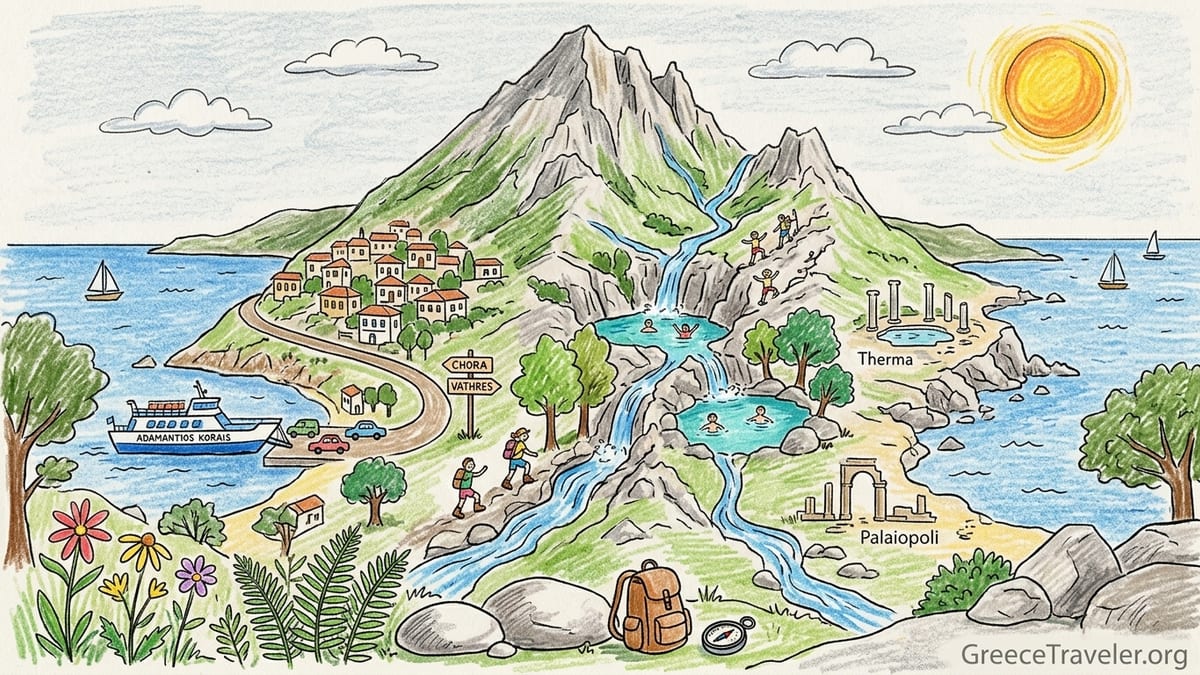
Samothrace sits alone in the northern Aegean, roughly a two-hour ferry ride south of Alexandroupoli on the Thracian mainland. Unlike beach destinations such as Naxos or Paros that offer broad sandy bays and busy resort strips, Samothrace is dominated by Mount Saos, a steep pyramidal massif. Villages and roads cling to the lower slopes and to the relatively narrow coastal strip, while the interior is a tangle of ravines, granite ridges and waterfalls. This topography shapes almost everything about travel here, from the cooler microclimate in the north to the way people move between beaches, vathres and trailheads.
Most visitors come for freshwater rather than for sea swimming alone. Streams running off Mount Saos have carved a series of natural pools, called vathres, that remain cold even in high summer. Reaching them typically means walking up rocky riverbeds under plane and chestnut trees rather than strolling along seafront promenades. Accommodation, food and nightlife are scattered rather than concentrated in a single resort zone, so choosing your base in advance has a much bigger impact on your stay than on many Greek islands.
Samothrace is also marked by an unusual mix of ancient history and modern counterculture. The Sanctuary of the Great Gods, a mystery cult centre active for nearly a millennium, once drew pilgrims from across the Mediterranean. A different kind of pilgrim arrived in recent decades: free campers and long-stay visitors who gathered in the forests near Therma. Since 2025, stricter enforcement of camping laws has changed that scene significantly, and prospective visitors now need to think more conventionally about bookings while still expecting a wilder, less serviced experience than on mainstream islands.
Landscape, Mount Saos and the Challenge of the Upper Waterfalls
Mount Saos, also written Fengari, rises to 1,611 metres almost straight from the sea, making it one of the most prominent island peaks in the Aegean. On clear days the summit offers sweeping views back to Thrace, the Dardanelles and the North Aegean islands, but getting there is physically demanding. Standard routes, such as the trail from Therma via Christos and the Karagiannis ridge, involve sustained ascents on loose rock, often with minimal shade above the tree line. Local hiking guides usually treat this as a full-day alpine-style outing rather than a casual holiday walk, and it can be dangerous in heat, wind or sudden mist.
The same caution applies to the upper waterfalls above the famous Fonias and Gria Vathra pools. Lower sections of these ravines see families in sandals and beachwear, but as you continue upstream, paths become less defined, with sections of exposed scrambling and slippery boulders. There have been rescue operations in recent summers for visitors who underestimated distances, temperatures and the technical nature of some crossings. If you plan to move beyond the first or second pools, it is wise to carry proper hiking shoes, at least 1.5 litres of water per person, and to ask locally about conditions, especially after heavy rain when rock surfaces are extremely slick.
Because trails often follow riverbeds rather than waymarked forest paths, hikers should not expect the kind of signage and infrastructure found on islands like Andros or Crete’s E4 segments. Navigation apps help, but tree cover and steep-sided canyons can interfere with GPS signal. For visitors used to conventional coastal walks, Samothrace’s combination of gradients, shade patterns and humidity can feel closer to light mountaineering. This is part of its attraction but also a reason to plan realistic hiking days and to avoid framing Saos or the upper vathres as easy family excursions.
Ferries From Alexandroupoli to Kamariotissa: Schedules, Fares and Disruptions
Samothrace has a single working port at Kamariotissa on its northwest coast. The island is currently linked to the mainland primarily by Fast Ferries, which operates the conventional vessel Adamantios Korais on the Alexandroupoli Samothraki route. In 2026 there are regular sailings all year, with increased frequency in summer. Autumn 2026 schedules, for example, list daily or near-daily crossings between Alexandroupoli and Samothrace, with morning departures on some days and afternoon services on others, usually taking around one hour forty-five minutes to just under two hours depending on conditions.
Recent price examples give a sense of budget. For 2026, agencies listing the route show one-way economy passenger tickets starting around 9 to 11 euros per adult and roughly half that for children, with infants often travelling free. Small cars are typically priced from around 40 to 50 euros one way in low and shoulder seasons, rising somewhat in peak summer, with motorbikes significantly cheaper. These figures can change with fuel prices and company policy, so it is important to check current fares when you book, but they give a realistic order of magnitude for planning.
Seasonality matters. In July and August there are usually daily services and on some days more than one departure, which provides flexibility if a sailing is cancelled for weather or operational reasons. Outside high season, especially from late October to early spring, the timetable reduces to a few weekly crossings. Wind is a recurring factor: strong northerlies in the Thracian Sea can cause delays or last-minute cancellations, and there have been years when Samothrace experienced several days of disrupted connections. Travellers with flights out of Alexandroupoli or other onward links should build in a buffer day, especially in shoulder seasons.
Tickets can be bought online through Greek ferry platforms or via local agents. In Alexandroupoli, there are ticket offices and kiosks near the port. On Samothrace, there is a clearly marked ticket office and kiosks along the Kamariotissa waterfront, which sell both passenger and vehicle tickets and can rebook you if weather forces changes. For vehicles, advance reservations are strongly advised in July, August and around major Greek holidays, as capacity is limited and locals also travel with cars for supplies and medical appointments.
Where to Stay: Kamariotissa, Chora, Therma, Palaiopoli and the South
Although Samothrace is compact, road distances and gradients mean your base will shape your experience. Kamariotissa, Chora, Therma, the Palaiopoli area and the scattered southern villages each have different strengths in terms of atmosphere, services and access to activities.
Kamariotissa surrounds the ferry port. It is the most practical base for travellers without a car who want easy access to buses, taxis, car rental offices and supermarkets. The village has several small hotels and pensions within a short walk of the harbour, plus bakeries, cafes and fish tavernas along the seafront. It feels functional rather than picturesque compared with hill villages on other islands, but staying here means your arrival and departure days are straightforward, and early morning or late evening ferry times are easy to handle.
Chora, sometimes called Samothraki town, is the traditional mountain village a short drive inland from Kamariotissa. Houses climb a steep hill beneath the castle ruins, with narrow stone lanes, small squares and views toward the sea. Accommodation here consists mostly of rooms and small guesthouses, with a few tavernas and cafes that stay lively on summer evenings. Chora suits travellers who value traditional atmosphere and cooler nights, and who are comfortable driving or using taxis down to the coast and back. Parking can be tight near the upper lanes, so confirm arrangements with your host.
Therma, on the north coast, is the main base for nature-oriented visitors. It sits in a lush area of plane trees and hot springs, close to the trailheads for Fonias Waterfalls and Gria Vathra, and within easy reach of the Varades campsite. Rooms to rent and small hotels are distributed along the coastal road and in the forested backstreets. There are simple tavernas, a small minimarket and informal beach spots on the rocky shoreline. Therma is less convenient for the ferry or for southern beaches but ideal if waterfalls and hiking are your priority.
The Palaiopoli area, east of Kamariotissa, is anchored by the Sanctuary of the Great Gods and the Archaeological Museum. Accommodation is sparser than in Therma or Kamariotissa but there are a few guesthouses and villas scattered in the countryside. Staying here appeals to travellers who want quiet rural surroundings and easy repeat access to the archaeological site, although you will need your own transport for most other activities. On the south side of the island, around Pachia Ammos and further toward Kipos, places to stay are fewer still, often in the form of isolated houses or small complexes. Choosing the south as a base suits people focused on beaches and boat trips, but you should be comfortable with longer drives to reach shops and waterfalls.
Waterfalls, Vathres and Hot Springs: Fonias, Gria Vathra and Therma
Samothrace’s inland highlights centre on its waterfalls and natural pools. Fonias, perhaps the island’s best-known river, flows through a deep gorge east of Therma. From the trailhead, a marked path follows the river upstream through forest, crossing from bank to bank on footbridges and rocks. After roughly 45 minutes to an hour of walking for an average-fit adult, you reach the first major waterfall and pool, often referred to as the first vathra. The water here is cold even in August, and cliff jumps are popular, though should be assessed cautiously for depth and current each season.
Continuing beyond this point becomes progressively more demanding, involving steeper slopes, occasional use of hands to scramble and greater exposure. Rescues in past summers underline that these upper sections are not appropriate for unsupervised young children, anyone with balance or heart issues or visitors without mountain experience. Several local guides and outdoor companies now offer organised canyoning and hiking excursions into the upper Fonias gorge, supplying helmets, wetsuits and ropes where needed. Joining one of these can be a safer way to experience higher pools.
Gria Vathra, accessible via a path starting near the road between Therma and the Fonias area, leads to a beautiful sequence of green pools and smaller cascades set in a shady ravine. The initial approach is shorter and a little easier than Fonias, which makes it popular with families and casual walkers. However, the rocks can be extremely slippery, particularly where algae grow in shallower areas, and accidents do happen. Proper footwear with grip and a willingness to get wet feet are far safer choices than flip-flops or smooth-soled trainers.
Back in Therma itself, a cluster of hot springs feeds simple bath facilities close to the village. Water temperatures are comfortably hot rather than scalding, and locals visit as much for therapeutic reasons as for relaxation. The facilities are fairly modest, closer to municipal baths than to a spa hotel, with small pools and private tubs rather than landscaped complexes. Opening periods and tariffs can change, but entry fees in recent seasons have been in the order of a few euros per person, making this an easy evening activity after hikes or swimming.
Ancient History, the Sanctuary of the Great Gods and the Nike of Samothrace
Long before tourism, Samothrace was known across the Mediterranean for the mystery cult practised at the Sanctuary of the Great Gods near modern Palaiopoli. The site lies on terraced slopes above the sea, framed by hills and shaded by trees. Walking through the complex, you pass the remains of monumental gateways, theatre-like structures and halls where initiations likely took place. Information panels help visitors imagine the rituals that once drew figures from Hellenistic royal families and the wider Greek world.
The Archaeological Museum of Samothrace stands close to the sanctuary entrance and is essential for understanding the site. It houses architectural fragments, sculptures, inscriptions and models that reconstruct how the sanctuary looked in different periods. One of the key stories told here is that of the Nike of Samothrace, the celebrated marble statue of the winged Victory that was discovered on the island in the 19th century and taken to France.
Visitors should be clear that the original Nike of Samothrace is in the Louvre Museum in Paris, not on the island. Samothrace itself has only replicas and related fragments. The museum and site use these to explain the statue’s original placement and context, but travellers hoping to see the famous original sculpture must do so in Paris. This sometimes surprises visitors who associate the statue so closely with the island’s name.
Tickets for the sanctuary and museum are typically combined, with modest entry prices compared with major mainland sites. Opening hours vary by season, with extended hours in summer and reduced schedules in winter. Shade is limited in some exposed areas of the sanctuary, so carrying water and visiting early or late in the day is advisable in July and August, especially if you plan to combine the visit with other excursions on the same day.
Coastline, Beaches and Boat Excursions: Pachia Ammos, Kipos and Beyond
Samothrace’s coastline is rugged, with many stretches of cliffs and boulder beaches. For classic sea swimming, the two most referenced spots are Pachia Ammos on the southwest coast and Kipos Beach on the remote southeast. Each offers a different take on the island’s relationship with the sea.
Pachia Ammos, reachable by paved road from Kamariotissa via the southern route, is one of the few genuinely sandy beaches on the island. It forms a small bay backed by steep hills, with clear waters and a mix of organized and free sections in summer. A beach bar and tavernas are usually open in the high season, renting sunbeds and umbrellas and serving basic food and drinks. The road down is winding but manageable in regular cars, though parking can be tight in August and on weekends when both visitors and locals arrive.
Kipos Beach lies much further east, at the end of the main southern coastal road. Here the shore is made up of pebbles and small stones rather than sand, and there are few permanent structures beyond a seasonal kiosk or simple refreshment stand. Many boat trips start or call here, using Kipos as a jumping-off point to explore the dramatic southeastern cliffs and sea caves that are inaccessible by road. Sea conditions can affect whether boats can safely approach certain coves, so itineraries often vary day by day.
Boat excursions around the island, or along its more inaccessible sides, are a highlight for many travellers. Small local operators typically run half-day or full-day trips from Kamariotissa or from small piers on the south coast, sometimes combining beach time at remote coves with simple lunches on board. Prices fluctuate according to fuel costs, boat size and inclusion of food, but recent seasons have seen per-person rates for shared trips somewhere in the range of a few dozen euros, with private charters costing more. Booking a day or two ahead in high season is wise, and always ask about sea state and cancellation policies if winds pick up.
Camping, Transport and Realistic Budgets
Samothrace long had a reputation as a haven for free campers, especially in the riverside plane-tree forest at Platia near Therma. That era has now effectively ended. Greek law prohibits wild camping on beaches, in forests, at archaeological sites and in public spaces, and since 2025 authorities on Samothrace have enforced this more strictly. The municipality has restated that camping at Platia and other informal spots is not allowed, and fines for illegal camping under recent legislation can start in the low hundreds of euros per person and rise significantly higher in aggravated cases.
For travellers who still want to camp, the main legal option on the island is the Varades municipal campsite near Therma, set in a wooded area roughly a kilometre from the Fonias trailhead. Varades is licensed and operates with basic facilities such as pitches for tents, shared toilets and showers, and a small canteen or communal area when open. Exact prices change season by season, but in recent years simple tent spots have cost a modest fee per person per night, keeping camping a budget-friendly option. Because it is the only authorised campsite, it can be busy in late July and August, so advance enquiries are prudent.
Public transport on Samothrace consists of a small network of buses that generally connect Kamariotissa with Chora and Therma, with a reduced extension toward the eastern and southern coasts in summer. Schedules often align with ferry arrivals and departures rather than running at high frequency throughout the day. For example, extra buses may run shortly after a morning ferry arrives, then again in the late afternoon. Information is usually posted at the port and bus stops, but visiting outside summer may mean very limited options, so travellers who want flexibility should not rely solely on buses.
Car and scooter rentals are available around Kamariotissa and, to a lesser degree, Therma. Daily rates for small cars in recent seasons have tended to start in the low to mid double digits in euros in shoulder season, rising higher in August. Scooters and small motorcycles are cheaper but less suitable for carrying hiking gear or for long drives on windy days. A handful of local taxis operate from the port and can be pre-booked or found at stands during busy times; they are particularly useful for one-way hikes, for example being dropped at a trailhead and walking back to your base.
Budget-wise, Samothrace can be moderate by Greek island standards. Ferry tickets for adults and a small car, a room in a guesthouse in Therma or Kamariotissa, simple meals at tavernas and a mix of self-catering and paid activities can add up, but the absence of large-scale nightlife or luxury shopping means there are fewer high-spend temptations. A realistic daily budget per person, excluding travel to Alexandroupoli and assuming two people sharing a room, might fall somewhere in the mid-range by Greek standards rather than at the very low or very high end. Hiking, swimming and exploring villages remain free, while paid extras tend to be ferries, occasional boat trips and museum tickets.
Planning Your Days: 3-, 5- and 7-Day Itineraries
With three full days on Samothrace, focus on a core sample of what makes the island distinct. On day one, settle into your base in Kamariotissa or Therma, explore the local shoreline and visit Chora in the late afternoon, staying for dinner in the village. Day two can be devoted to waterfalls: start early from Therma for the Fonias gorge, aiming for the first major waterfall and pool, and, if conditions and fitness allow, explore slightly further before returning to swim and relax at the coast or in the hot springs. Day three, weather permitting, you might head south by bus, taxi or rental car for a day at Pachia Ammos, with a simple lunch at the beach taverna and a scenic drive back via Chora or Palaiopoli.
With five days, you can add depth. After the initial waterfall and beach days, reserve a full morning or afternoon for the Sanctuary of the Great Gods and the Archaeological Museum, taking time to walk through the terraces and then cool off at a nearby beach. Another day might be used for a boat excursion along the southern or eastern coasts, visiting remote coves near Kipos that are inaccessible by road. The remaining day can be more flexible: a second visit to a vathra, a return to the hot springs on a cooler or overcast day, or a relaxed circuit of villages, stopping at small cafes and viewpoints.
A week on Samothrace opens up the possibility of attempting Mount Saos, but only if conditions and your experience align. In a seven-day stay, many visitors structure one or two days as rest or low-activity days around Kamariotissa or Therma, two days around waterfalls and vathres, one full day for the sanctuary and museum combined with coastal exploration, one day on boat trips and southern beaches and, optionally, a day dedicated to a guided ascent of Saos or to exploring more remote northern villages and viewpoints. Building rest days between strenuous hikes is wise, especially in mid-summer when heat and humidity can be draining.
Whichever timeframe you choose, it helps to keep plans flexible around wind and ferry reliability. For instance, booking boat excursions earlier in your stay allows for rescheduling if a strong northerly front passes through. Similarly, avoid planning your longest hike the day before your scheduled ferry departure, in case fatigue, minor injuries or sudden weather changes make it sensible to rest instead.
The Takeaway
Samothrace is not a conventional Greek beach island and does not try to be. Its identity lies in the convergence of mountain and sea, in cold rivers and hot springs, in scattered villages rather than continuous resort strips and in an archaeological site that once rivalled Delphi in spiritual significance. Travellers who arrive expecting kilometre-long sandy beaches and nightlife are often surprised; those who come ready to walk, adapt to the weather and embrace a certain roughness around the edges tend to find the island memorable.
Planning is more important here than on many better-known islands. You need to think ahead about ferry crossings from Alexandroupoli, understand that wind can disrupt schedules, decide deliberately where to stay and recognise that the end of informal free camping at Platia and elsewhere means booking legal accommodation or the Varades campsite. You also need to respect the difficulty of Mount Saos and the upper vathres, treating them as serious hikes rather than casual wanderings.
If that combination of preparation and unpredictability appeals to you, Samothrace offers a rare mix: wild landscapes within reach of the mainland, intense freshwater experiences in its vathres, quiet villages and a direct line back to ancient religious traditions. With realistic expectations, appropriate gear and a modest buffer of time, the island can become one of the most distinctive stops in a journey through Greece.
FAQ
Q1. How long is the ferry from Alexandroupoli to Samothrace?
The conventional ferry from Alexandroupoli to Kamariotissa on Samothrace usually takes around one hour forty-five minutes to slightly under two hours, depending on the vessel and sea conditions.
Q2. Do I need to book the ferry in advance, especially with a car?
In July and August, and around public holidays, you should book both passenger and vehicle tickets in advance, as car spaces in particular can sell out. Outside peak periods, foot passengers can often buy tickets shortly before departure, but advance booking still provides security.
Q3. Is free camping still allowed at Platia or other spots on Samothrace?
No. Free camping is prohibited across the island, including at Platia near Therma. Authorities now enforce national laws against wild camping, and fines can be substantial, so visitors should use licensed accommodation or the Varades campsite.
Q4. What is the only licensed campsite on the island?
The main licensed campsite is Varades, near Therma on the north coast. It offers basic facilities for tents in a wooded area and provides legal, low-cost camping relatively close to the Fonias trailhead and other nature attractions.
Q5. How hard is the hike up Mount Saos?
The ascent of Mount Saos is a strenuous mountain hike involving significant elevation gain, sections on loose and rocky terrain and limited shade near the top. It is suitable for fit, experienced hikers with proper footwear and gear, and is not an easy family walk.
Q6. Can children visit the waterfalls and vathres?
Many families visit the lower pools at Fonias and Gria Vathra, where paths are clearer and walking times shorter, but supervision and good footwear are essential. The upper sections of the gorges, which require scrambling and involve exposure, are not appropriate for young children or inexperienced walkers.
Q7. Where is the original Nike of Samothrace statue kept?
The original Nike of Samothrace statue is kept in the Louvre Museum in Paris. Samothrace itself displays replicas and related fragments in the Archaeological Museum and at the Sanctuary of the Great Gods.
Q8. Which area is best to stay in without a car?
Kamariotissa is usually the most convenient base without a car, as it is right at the ferry port, has bus connections, taxis, shops and several accommodation options. Therma is also manageable by bus in summer, especially for visitors focused on waterfalls and hot springs.
Q9. Are there sandy beaches on Samothrace?
Yes, Pachia Ammos on the southwest coast is the best-known sandy beach, combining a curved bay of sand with clear water and seasonal services. Most other beaches, such as Kipos, are pebbly or rocky and feel wilder.
Q10. What should I budget for a visit to Samothrace?
Budgets vary, but you should account for ferry tickets to and from Alexandroupoli, accommodation, local transport or vehicle rental, meals at tavernas and any boat trips or museum tickets. Many activities such as hiking and swimming are free, which helps keep overall daily costs moderate by Greek island standards.