


I went to Ouranoupoli expecting a simple boat ride with a few distant monasteries. What I got felt more specific than that: a tightly regulated coastal viewing route that keeps you at a fixed distance from Mount Athos, paired with a very real island break that either saves the day or steals the focus, depending on what you came for. If you are picturing “visiting Mount Athos,” this is not that. This is a sightseeing cruise along the western shoreline of the monastic peninsula, where you can look, photograph, and listen to onboard commentary, but you never set foot inside the monastic territory.
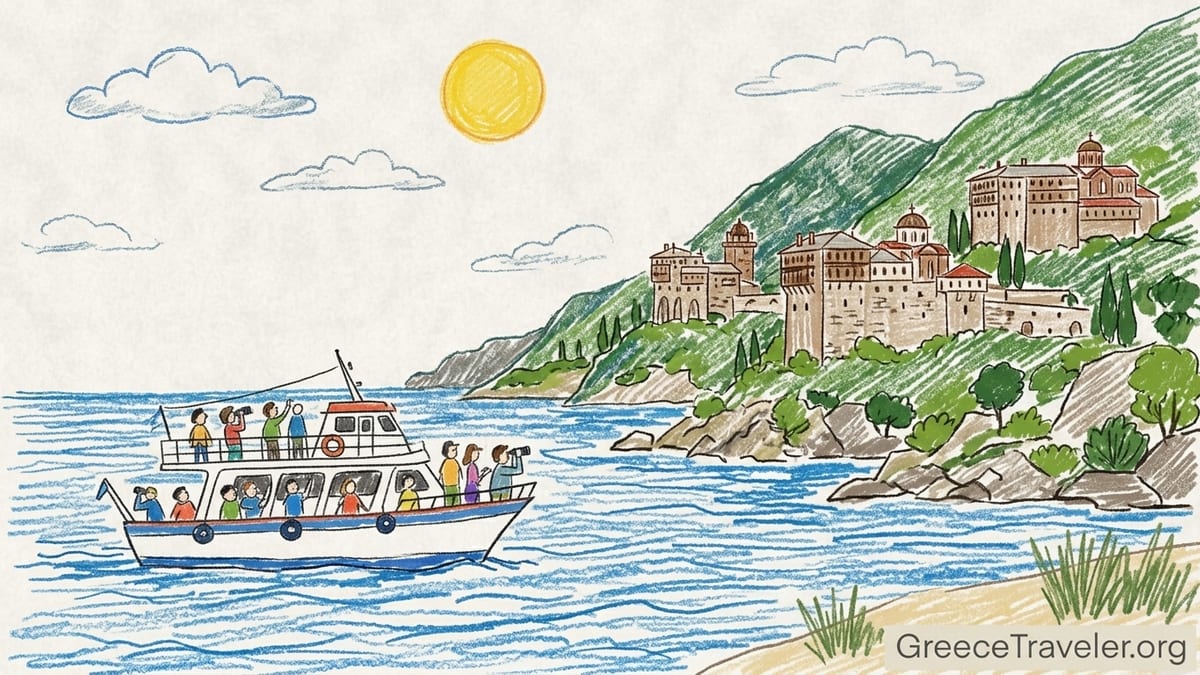
First, A Reality Check: A Coastal Cruise Is Not “Entering” Mount Athos
Let’s clear up the biggest misconception right away. A sightseeing cruise from Ouranoupoli is a legal, tourist-friendly way to view parts of Mount Athos from the water. It is not a loophole for visiting the monasteries. You do not disembark on Athos, you do not walk into courtyards, and you do not get the hushed, candlelit interior experience people associate with the Holy Mountain.
That separation is not just cultural, it is formal. Mount Athos is a self-governed monastic territory with 20 monasteries. Entry is restricted. Women are not permitted to enter the monastic territory, a rule known as the avaton, and it is enforceable by law. Eligible male visitors must secure an entry permit (the diamonitirion) through the Pilgrims’ Bureau procedures and then travel by ferry into Athos rather than on a standard tourist cruise.
Even the boat’s viewing distance is defined. Sightseeing vessels are required to keep about 500 meters off the Athos coastline, meaning your experience is shaped by distance, haze, sea conditions, and your camera gear as much as by the monasteries themselves. In other words, this is a “see it from the sea” day, not a pilgrimage.
Getting To Ouranoupoli, Parking, And Why I Arrived Early
I treated Ouranoupoli like an airport morning: arrive early, assume parking will be annoying, and plan for small delays at the harbor. That mindset paid off. Ouranoupoli is compact and busy in season, with the waterfront clustered around the harbor and the well-known Prosforion Tower nearby, which is also an easy landmark for finding the right boarding area.
I arrived about 45 minutes before departure. That was early enough to do three things without rushing: find a parking spot within a reasonable walk, confirm which boat and checkpoint I needed, and choose a seat before the best shaded sections filled up. Several operators explicitly advise arriving at least 30 minutes early, and based on what I saw at the dock, that is not a polite suggestion.
Parking felt like the main friction point. The closer you get to the harbor, the more you compete with day trippers, diners, and people doing quick drop-offs. If you are traveling with kids, carrying snorkel gear, or trying to protect camera equipment, build in extra time. Once I was walking toward the harbor, everything got easier. You can spot the boats, the ticket points, and the cluster of passengers gathering well before the final call.
Boarding, Boat Size, Seating, Shade, And What The Ride Actually Felt Like
On my day, the boat was a mid-size excursion vessel rather than a tiny speedboat. Ouranoupoli departures vary by operator, but it is common to see boats in the “tour boat” range rather than intimate yachts. For context, one of the best-known traditional sightseeing setups in the area is a 300-seat boat running scheduled departures from Ouranoupoli during the main season, which gives you an idea of how mass-market these cruises can be.
Seating and shade are not minor details here, they shape your entire trip. I found the most comfortable setup was a shaded seat with a clear line of sight to the Athos side, so I could watch monasteries slide into view without leaning into the aisle. Sun on open water is stronger than it feels on land, and while there is usually a mix of sun and shade depending on deck level and canopy design, the shade fills first.
Sea conditions matter more than many people expect. This is not an adrenaline ride, but a light chop can make standing for photos tiring, and wind noise can compete with commentary. On calm water, it feels like a floating viewpoint with a steady horizon. When the wind picks up, you start appreciating why experienced travelers bring a light layer, secure hats properly, and don’t rely on phone audio alone.
Most boats offer some kind of onboard narration, whether live or via multilingual audio. The best moments were when the commentary matched what I was seeing in real time, naming a monastery as it appeared and giving just enough background to make the silhouette meaningful. In windier stretches, I had to focus to catch every detail, which is one reason I would not skip binoculars if monasteries are your priority.
How Close You Get, What You Can Actually See, And Why Binoculars Matter
The defining feature of the Mount Athos sightseeing cruise is the distance. The boat stays about 500 meters from shore. That is close enough to see the monasteries clearly as large architectural masses, and in good light you can make out features like stacked buildings, walls, and domes. But it is far enough that you should not expect crisp detail with the naked eye the way you might at a hilltop viewpoint.
For me, binoculars and a zoom lens were the difference between “pretty coastline” and “I can actually study the monastery.” Without magnification, you still get the overall drama: stone buildings clinging to green slopes, the deep blue Aegean, and the cliffs that make Athos feel like a walled-off world. With magnification, you start noticing balconies, terraces, and the way some monasteries look like fortresses from the sea.
A practical note: phone cameras can struggle with distance, haze, and moving platforms. A smartphone zoom often turns detail into watercolor. A compact camera with optical zoom or a mirrorless camera with a longer lens gave far better results. If you are choosing between packing an extra beach outfit or packing binoculars, pack the binoculars. The Ammouliani swim is optional. Seeing Athos well from 500 meters is not.
I also found it helpful to pick a “shooting routine” that matches the boat’s motion. I sat, stabilized elbows, and waited for moments when the boat’s angle gave a clean view. Standing at the rail for long periods was doable, but tiring, and it increased the chance of shaky images, especially in wind.
Which Monasteries Were Genuinely Visible From The Water
Visibility is not just about distance, it is about angle. From the standard west-coast viewing route, several of the most photogenic monasteries are positioned to face the sea, which is why they read so well from a boat. The sensation is not of “passing one building after another” like a city waterfront, but of intermittent, very dramatic reveals separated by stretches of forested slope and rugged coastline.
On many Ouranoupoli sightseeing cruises, the named highlights along this west-coast stretch commonly include Dochiariou, Xenophontos, and Saint Panteleimon, and some itineraries also call out Zografou. These were the kinds of monasteries I could clearly identify as we approached: large, layered complexes with a strong waterfront presence that stands out even at regulated distance.
I want to be careful here because operators do not all run the exact same route, and what you “see” depends on weather clarity. But the pattern was consistent: the monasteries that sit boldly on the water-facing side of the peninsula are the ones that deliver. When the coastline bends, you sometimes get a brief window where a monastery looks almost stage-lit against the slope. Then it slips behind you, and you are back to open water and the long green shoulder of Athos.
If your operator advertises “passing six monasteries” or “seeing eight monasteries,” interpret that as “viewing from offshore,” not “visiting.” You will see them, but the experience is more like looking at world-class landmarks through a moving viewpoint than it is like an architectural tour where you can examine details at leisure.
The Ammouliani Factor: Did The Stop Improve The Day Or Dilute Mount Athos?
Many of the current best-selling products out of Ouranoupoli are combination cruises: Athos viewing plus a stop on or near Ammouliani. One very typical 2026-format example is a five-hour cruise priced at €35 for adults, departing at 11:00 on select days, advertising a pass by multiple monasteries and roughly 90 minutes of free time on Ammouliani. That is close to the exact structure I experienced, and it is a popular formula for a reason.
The Ammouliani stop changes the psychology of the trip. If you came mainly for Mount Athos, the island break can feel like an interruption, a reset that pulls you out of the monastic coastline mood just when you are settling into it. If you came with family, or if you worry you will get “monastery fatigue,” the stop can be the highlight. It gives you a tangible destination, a chance to swim, and a sense that you got more than a distant look at a restricted place.
On my cruise, that break helped in a practical way: it split the day into two clear segments, with Mount Athos viewing as the headline act and the island as a decompression zone. I used the stop to step onto stable ground, grab a cold drink, and reset my eyes after scanning the coastline through zoom. If the stop is in Ammouliani village, it feels like a quick wander and snack stop. If the stop is a beach such as Alikes, it becomes a swim-and-sand interlude, which is more fun but also more distracting.
My takeaway is simple. If you are the kind of traveler who wants the most Athos-focused experience, choose a dedicated three-hour sightseeing cruise and keep the island day separate. If you are trying to balance Athos curiosity with a classic Halkidiki summer day, the Ammouliani format makes sense, and it can turn a “nice to see” cruise into a day you actually remember.
Schedule, Route, Pricing, And Weather Cancellation: What To Check Before You Pay
Because schedules and prices can change seasonally, I checked current operator details immediately before writing this. In the Ouranoupoli market right now, you will see a few repeating patterns.
One prominent operator with a set timetable lists daily Mount Athos sightseeing departures from Ouranoupoli during the main season, with a morning cruise at 10:30 and a noon cruise at 14:00, described as running from April 1 through October 31, with the afternoon option limited to mid-May through mid-October. Their online ticket pricing currently shows €25 for the three-hour Ouranoupoli to Mount Athos cruises.
For travelers who want the Athos plus Ammouliani combination, a widely sold five-hour product currently lists adults at €35 with a departure time of 11:00 on Tuesday, Thursday, and Sunday, and it describes about 1.5 hours of free time on Ammouliani. That format matches the “see several monasteries, then island time” day that many visitors are now choosing over a shorter, Athos-only loop.
Calypso-style combo cruises also exist in this same five-hour lane, with departures at 11:00 on specific weekdays, blending Athos coastline viewing with either a swim stop near the Drenia islets or a stop connected to Ammouliani depending on the specific product and time of year. If you are booking through a reseller, confirm where the stop will be on your date, because some products shift the swim stop seasonally.
On weather and cancellations, policies vary by operator and by where you book. But there are two consistent practical truths. First, if port authorities restrict sailings due to weather, these trips do not run. Second, reputable operators clearly state that if the cruise is canceled due to weather, a refund is issued. Some operators also spell out a minimum passenger threshold, meaning a low-participation day can be canceled with a refund. If you are traveling in shoulder season, that minimum number detail is worth paying attention to.
The Takeaway: Did The Time On The Boat Justify The Price?
For me, yes, with conditions. If you go in expecting a “close-up monastery tour,” you will be disappointed by the 500-meter rule and by the reality that you are viewing a restricted place from offshore. If you go in expecting a coastal panorama with genuine historic landmarks visible from the sea, the cruise delivers.
Value depends on which format you pick. A three-hour cruise priced around €25 feels like a clean, focused purchase: you pay for the Athos coastline viewing, and that is exactly what you get. The five-hour combo at about €35 can feel like a better deal if you actually want a swim or island break, but it can also feel like diluted Athos time if your goal is purely monastery viewing.
If I were advising a friend, I would ask one question: are you bringing binoculars and actively interested in the monasteries as monasteries, or are you mostly curious about “seeing Mount Athos” while also having a pleasant half-day on the water? The first traveler should choose the shortest, most Athos-focused cruise and prioritize clear weather and good light. The second traveler should choose the combo and treat Athos as the unforgettable backdrop to a classic Halkidiki boat day.
Either way, the cruise did what I needed it to do. It gave me a real, visible sense of Athos as a place, not an idea, while staying honest about the boundary: you can look from the sea, but entering Mount Athos is a separate journey with separate rules, permits, and expectations.
FAQ
Q1. How long is a typical Mount Athos cruise from Ouranoupoli?
Most sightseeing options are either about 3 hours for an Athos-only loop, or about 5 hours for a combo cruise that adds an Ammouliani or swim stop.
Q2. How close do the boats get to Mount Athos?
Sightseeing boats generally keep about 500 meters from the coastline, which means you can see monasteries clearly but not in fine detail without magnification.
Q3. Can I enter Mount Athos on a regular sightseeing cruise?
No. A standard cruise does not allow disembarkation inside the monastic territory. Entry requires a separate permit process and travel by ferry into Athos.
Q4. Are women allowed on the Mount Athos sightseeing cruise?
Yes, women can take the sightseeing cruise because it remains offshore and does not enter the monastic territory where women are not permitted.
Q5. Do binoculars or a zoom lens really make a difference?
Yes. At the regulated viewing distance, binoculars or an optical zoom are the difference between seeing monastery silhouettes and seeing meaningful architectural detail.
Q6. Which monasteries can you see from the west-coast route?
Commonly visible highlights on many routes include Dochiariou, Xenophontos, and Saint Panteleimon, with some itineraries also referencing Zografou, depending on the operator and conditions.
Q7. Does the Ammouliani stop improve the experience?
It depends on your priorities. It improves comfort and variety for many travelers, but it can feel like lost Athos viewing time if your focus is purely on monasteries.
Q8. What does a current five-hour combo cruise cost in 2026?
A widely sold five-hour Ouranoupoli combo cruise format is currently listed at €35 for adults, typically including Athos coastline viewing and around 90 minutes of free time on Ammouliani.
Q9. What happens if the weather is bad?
If sea conditions or port authority restrictions prevent sailing, reputable operators state the cruise is canceled and refunds are issued. Some also cancel with refunds if a minimum passenger number is not reached.
Q10. How do male pilgrims enter Mount Athos legally?
Eligible men must arrange an entry permit through the Pilgrims’ Bureau procedures, then pick up the permit in Ouranoupoli and travel by ferry into Athos, following the separate pilgrimage rules.