


I set out to drive the Peloponnese with a simple rule: if the peninsula started to feel like a race, I was doing it wrong. The distances look reasonable on a map, but the Peloponnese is not a place you “cover.” It is a place you settle into, especially once you leave the motorways and start stitching together coastal lanes, mountain passes, castle towns, and archaeological sites with very real opening hours and very real midday heat.
This is the route I actually drove and the way it felt behind the wheel: Athens airport pickup, an easy first hop to Nafplio, a longer cross-peninsula day to Monemvasia, a slow, corner-heavy drift through the Mani, and then the big western swing up to Olympia. It is also, honestly, the trip I made too compressed at times. If you are trying to fit Nafplio, Monemvasia, Mani, and western extensions into seven days, you can do it, but it will be tight. Ten days is when the trip starts to breathe.
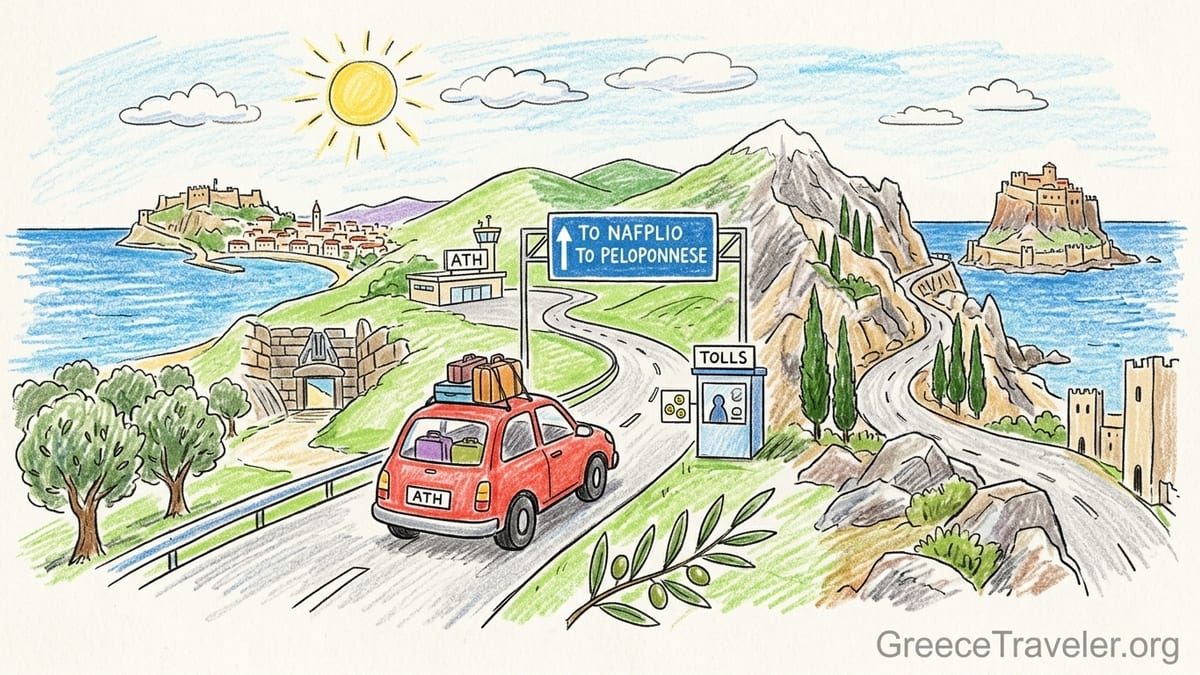
Start: Picking Up the Rental Car at Athens Airport (and Why I Did Not Start in Athens)
I collected my rental car at Athens International Airport, not in central Athens. That single choice removed the most stressful part of driving in Greece for first timers: city traffic, one-way surprises, and the feeling that you have to “win” a lane change. At the airport, the handover was straightforward: passport, driving license, a credit card for the deposit, and the usual walkaround where you photograph every existing scratch and wheel scuff before you turn the key.
If you are coming from outside the EU, bring what the rental company asks for in writing. Many rental terms in Greece specify that non-EU drivers must hold a license that is valid in Greece and the EU or have an International Driving Permit alongside their home license. Read the contract language before you fly, not at the counter when there is a line behind you. I also kept a screenshot of my booking and a printed copy of the rental terms in my carry-on, because it is easier to discuss “what was included” calmly when you can point to it.
I skipped any plan to stay in Athens first. Instead, I aimed to clear the airport, get onto the motorway network, and reach Nafplio before dark. The first hours of a Greece road trip are when you are still calibrating: roundabouts, lane discipline, Greek road signs at speed, and your own comfort with driving a car that is not yours. Nafplio is close enough to feel achievable, but far enough that you are genuinely “on the trip” by dinner.
Day 1: Athens Airport to Nafplio (Tolls, Service Stops, and an Easy First Win)
The run from the airport toward the Peloponnese is what makes this peninsula such a satisfying road trip region. You begin on big, confident roads with clear signage. The landscape changes quickly: Athens sprawl, then open highway, then the feeling of crossing a threshold toward somewhere older and slower.
This first driving day is when you meet Greece’s toll culture. It is not complicated, but it is constant. Expect multiple booths on the main corridors, and keep small bills or a card handy. On the Peloponnese trunk routes you will also see electronic tag lanes, but as a visitor in a short rental you can simply pay at the booth. The key is to treat tolls as a line item in your trip budget, not an annoyance that surprises you every time. On the Moreas motorway network, published 2026 tolls for a private car include station prices such as Spathovouni at €2.95, Nestani at €2.80, Manari at €2.30, Veligosti at €1.45, Kalamata at €2.25, and Petrina at €3.45, charged by direction of travel. If you are heading deep into the peninsula later in the week, these numbers start to matter.
Nafplio is a gentle landing. Once I arrived, the driving difficulty dropped and the walking pleasure went up. The Old Town is the point, and that creates an immediate practical issue: you may not be able to park directly outside your door. I learned quickly to pick a hotel for this trip not by “charm” alone, but by how the parking works in reality. The most relaxing arrival was the one where I could stop legally, unload luggage, and then move the car to a known lot without doing loops.
Days 2 and 3: Nafplio as a Base (Mycenae, Epidaurus, and Why I Stopped Packing Every Morning)
Nafplio is where the Peloponnese teaches you the value of staying put. The distances to the Argolid’s headline sites are short enough that you can do serious archaeology without turning the day into an endurance drive. Mycenae, in particular, is close enough that you can go early, be back for lunch, and still have an evening that feels like a holiday rather than a transit day.
Opening hours are not trivia here; they shape your entire rhythm. For Mycenae, the Greek Ministry of Culture listings for 2026 show extended summer hours, with the site running from early morning and, from May 2, 2026, staying open until 20:00. The same official listing breaks down September and October reductions in precise blocks, which is exactly the kind of detail that matters if you are driving this in shoulder season and trying to time a long lunch without accidentally arriving at 18:45 to a last entry you missed. My practical takeaway was simple: if a big site is on your list, go early, then drive later.
Epidaurus is an easy second day trip from Nafplio, and it rewards the same strategy. I arrived with water and sunscreen already in the car, because the theatre is exposed, and the climb to the upper tiers feels like a workout in summer heat. The Ministry of Culture listing for Epidaurus also indicates a summer schedule that extends to 20:00 from May 2, 2026, which gives you flexibility. You can visit late afternoon, let the light soften, and avoid the harshest midday glare on pale stone.
This was also the point in my trip where I caught myself changing hotels too often. I had originally planned to do Nafplio for just one night, but that would have meant repacking, re-parking, and reorienting for no real gain. Two nights became three, and it improved everything: calmer mornings, fewer wrong turns in new neighborhoods, and a better feel for the town after the day-trippers left.
Day 4: Nafplio to Monemvasia (A Long Cross-Peninsula Day and the First Time It Felt Like a Race)
The drive from Nafplio to Monemvasia is the day that looks fine on paper and feels bigger in the driver’s seat. You are crossing the peninsula rather than sliding along a coast. The roads shift character as you move away from the easiest corridors: fewer wide shoulders, more curves, and the sense that “three and a half hours” is a best-case promise rather than a guarantee.
This was my first truly tiring day. Not because it was dangerous, but because it demanded attention. The Peloponnese interior is beautiful in a quiet, agricultural way, and it invites stops: a quick pull-off for a mountain view, a bakery in a roadside town, an unplanned coffee because you realize your shoulders are tight. The problem is that each stop is a gift and a delay at the same time. If you are trying to reach Monemvasia before sunset, those gifts can start to feel like obstacles, and that is when the trip turns into a checklist.
Monemvasia itself forces you to slow down again. You do not drive into the medieval town. You park outside and walk in, often over cobbles and steps. That means your arrival logistics matter. I arrived wishing I had packed a smaller overnight bag rather than dragging a full suitcase like I was moving apartments. If you are doing this route, pack one “castle-town bag” you can carry easily, leave the rest in the trunk if your accommodation can arrange it, and accept that the final five minutes are on foot.
If you are compressing the Peloponnese into seven days, this Nafplio to Monemvasia leg is also where you should be honest: Monemvasia is not a quick stop. It is at its best early and late, when day visitors fade and the stone lanes feel like their own world. If you can only spare one night, keep your expectations realistic. Two nights is when Monemvasia feels like a place rather than a photo.
Days 5 and 6: The Mani Peninsula (Road Quality, Corner Fatigue, and Why One Base Is Smarter)
The Mani is where the Peloponnese stops pretending to be easy. The landscape tightens: stony hillsides, dry terraces, and villages that look built to endure rather than charm. The driving becomes more physical. Even when the road surface is decent, the curves stack up, and you start measuring time not in kilometers but in concentration.
I made a classic mistake here: I changed hotels too often. The Mani tempts you with micro-regions, each with its own mood, and it is easy to think you should sleep in all of them. In practice, every hotel change adds friction: checkout times, parking puzzles, and the mental load of learning a new approach road after dark. Next time, I would pick one Mani base and commit. A place in West Mani gives you access to beaches and tavernas with less driving stress, and you can still day-trip deeper south when you feel fresh.
Parking in the Mani is less about meters and more about confidence. Many villages were not designed for modern cars, and “parking” often means finding a sensible space without blocking a narrow lane. I drove more slowly than the locals, used pull-outs to let faster cars pass, and avoided arriving in a new village at night unless I already knew exactly where I could leave the car.
Fuel planning becomes real here too. On the main corridors you will see stations regularly, but in more remote stretches it is smart to top up when you pass a larger town rather than waiting for the fuel light to make the decision for you. The Peloponnese is not empty, but it is wide, and it is easy to underestimate how long a coastal detour can take at real-world speeds.
Day 7 and Beyond: Messinia and Olympia (When the Western Extension Stops Being Optional)
Once you commit to Olympia, you are committing to a different shape of trip. You are no longer doing a neat southeastern arc; you are swinging west and then north. That can be glorious, but it is where a seven-day Peloponnese plan usually breaks. The miles add up, and you either cut time in the Mani, cut Monemvasia, or accept that you will spend more of the week in the driver’s seat than you intended.
Olympia is one of the rare places where I planned my arrival almost entirely around opening hours. According to a detailed Olympia visitor information listing, the archaeological site runs 08:00 to 20:00 from April 1 to August 31, with last entrance at 19:30, then reduces in steps through September and October with clearly stated last-entry times. That schedule is your friend. It lets you choose whether Olympia is a morning visit before a long drive or a late-afternoon visit after one.
Ticketing details matter too, because the policy has changed over time and third-party ticket sellers can create confusion. The Olympia listing I used reflects a combined integrated ticket in the high season period priced at €12 and notes that individual tickets per area are no longer issued. That is the kind of detail that stops you from showing up expecting to “just see the stadium quickly” and then being surprised by how entry is bundled.
If you are extending into Messinia as well, be cautious about pretending it all fits comfortably. Coastal stops and castles and beach lunches sound effortless until you realize you are choosing between arriving at Olympia with enough time to enjoy it or arriving with enough time to simply enter. This is where 10 days becomes the comfortable version of the story: you get to have a long lunch and still see what you came to see.
What I Would Cut for a Seven-Day Trip (and What Makes Ten Days Feel Human)
I understand why people insist on seven days. It is a common vacation block, and the Peloponnese is close enough to Athens to feel like it should fit. But the route I drove taught me a more honest framing: seven days is a compressed Peloponnese sampler, not the relaxed “Nafplio, Monemvasia, Mani, Olympia” dream loop many itineraries imply.
If you truly have seven days and you want the trip to feel like a holiday, not a relay, I would remove the western extension to Olympia or remove Monemvasia. Keeping Nafplio and the Mani, with one strong archaeological day and one strong beach day, produces a trip with fewer long hauls. Alternatively, keep Nafplio and Monemvasia and skip the Mani, because the Mani demands time and energy for the curves, the parking, and the slow discovery.
Ten days is where everything changes. With ten, you can give Nafplio the base time it deserves, spend two nights in Monemvasia so it is not just an arrival and departure, choose one Mani base for three nights so you are not constantly packing, and still reach Olympia without turning the day into a driveathon. The peninsula stops feeling like a map problem and starts feeling like a place.
My single biggest lesson was that the Peloponnese punishes over-planning. The best moments happened in the gaps: the unplanned viewpoint stop, the bakery detour, the quiet swim when I arrived somewhere earlier than expected. Those moments only exist if you leave space for them.
The Takeaway
I drove the Peloponnese without turning it into a race, but only after I made a few classic mistakes: too many hotel changes, one cross-peninsula day that was more tiring than I expected, and a tendency to believe that “it’s only three hours” stays true once you add stops, heat, and parking. The peninsula is perfectly suited to driving, but it rewards drivers who plan less and stay longer.
If you want Nafplio, Monemvasia, Mani, and Olympia in one trip, treat seven days as compressed and ten days as comfortable. Use Nafplio as a base, let Monemvasia have at least one full evening, choose one Mani base instead of hopping around, and time Olympia around its posted seasonal hours. Do that, and the Peloponnese stops being a checklist and becomes what it should be: a slow, sunlit sequence of places that feel different from each other, connected by roads that are part of the story rather than an obstacle between scenes.
FAQ
Q1. Is seven days enough for Nafplio, Monemvasia, Mani, and Olympia?
It is possible but compressed. Seven days often forces at least one very long driving day and more hotel changes than most travelers enjoy. Around ten days is noticeably more comfortable.
Q2. Where should I pick up the rental car for a Peloponnese road trip?
Athens International Airport is the simplest pickup point for most visitors because you can avoid central Athens traffic and join the motorway network quickly.
Q3. What are the current tolls on the Moreas motorway (A7) in 2026?
Published 2026 tolls for private cars on the Moreas network include stations such as Spathovouni (€2.95), Nestani (€2.80), Manari (€2.30), Veligosti (€1.45), Kalamata (€2.25), and Petrina (€3.45), charged per direction.
Q4. Are Mycenae and Epidaurus realistic day trips from Nafplio?
Yes. They are close enough that you can visit either site and return to Nafplio for lunch or an afternoon swim without spending the whole day driving.
Q5. What are Mycenae’s opening hours in summer 2026?
Official Ministry of Culture listings show extended summer hours, including 08:00 to 20:00 from May 2, 2026, with stepped reductions through September and October.
Q6. What are Epidaurus’s opening hours in summer 2026?
Official listings indicate extended summer hours, including 08:00 to 20:00 from May 2, 2026, which makes late-afternoon visits practical in hot weather.
Q7. What are Ancient Olympia’s summer opening hours?
One detailed Olympia listing shows 08:00 to 20:00 from April 1 to August 31, then reduced hours in September and October with clearly stated last-entry times.
Q8. What should I pack differently for Monemvasia?
Bring a smaller overnight bag. You will park outside the castle town and walk in over cobbles and steps, so a heavy suitcase can turn arrival into a chore.
Q9. Do I need a special car for the Mani?
You do not need a 4x4 for the main paved routes, but you do need patience. The Mani’s roads can be narrow and curvy, and the driving can feel tiring even at low speeds.
Q10. What is the biggest planning mistake on a Peloponnese road trip?
Changing hotels too often. Every move adds time, parking stress, and mental load. Choosing fewer bases usually makes the trip feel calmer and more immersive.