


The Northern Sporades look tailor-made for a road trip: pine-covered hills, beach roads dropping into turquoise coves, and ferries shuttling between Skiathos, Skopelos and Alonissos. On the ground, though, renting a car across several islands can be more complicated than it appears in a search result. Local rules around ferries, insurance, deposits and pickup points can turn a simple booking into a tangle if you do not plan ahead. This guide walks through what to expect when hiring a vehicle in Skiathos, Skopelos, Alonissos and Skyros, with a special focus on whether you can (or should) move a rental car between islands.
Understanding the Sporades car rental landscape
The main car rental hubs in the Sporades are Skiathos Airport, Skiathos Town port, Skopelos ports (Chora and Glossa) and Patitiri on Alonissos. Skiathos, with its busy airport and compact town, often acts as the gateway, while Skopelos and Alonissos rely heavily on port-based agencies that align their opening hours and delivery services with ferry arrivals. Local firms dominate, though you will also see familiar international brands at Skiathos Airport and occasionally in Skopelos and Alonissos.
Crucially, you should not assume you can pick up one car on Skiathos and use it freely across Skopelos and Alonissos. Some local companies on Skiathos explicitly restrict where their vehicles may travel by ferry and only allow crossings under written authorisation and with extra fees and conditions. Others prohibit ferry transport altogether. On Skopelos and Alonissos, rental contracts often contain similar clauses about any ferry use, even just for hopping between neighbouring islands.
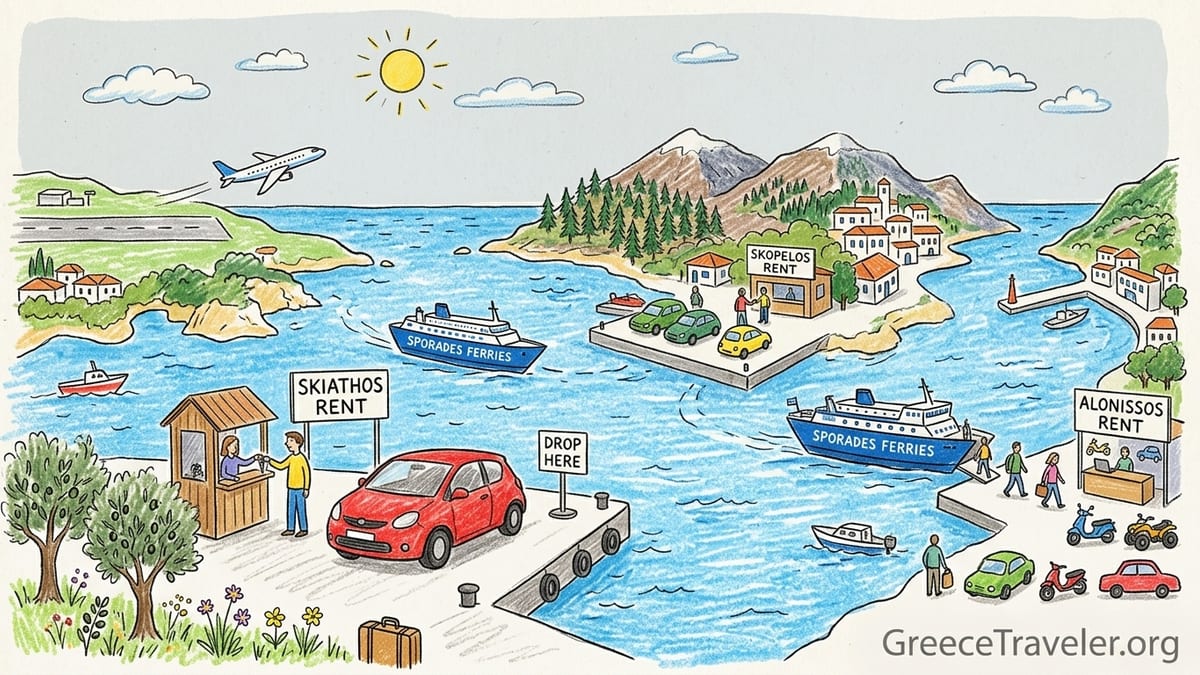
For most travellers, the simplest strategy is to treat each island as its own rental market: finish with your car on Skiathos, drop it at the airport or port, cross as a foot passenger, and collect a fresh vehicle at the next island’s dock. That may feel less “efficient” when you are booking from home, but in practice it often saves money, reduces risk and gives you access to vehicles better suited to each island’s particular roads and parking situation.
The inter-island ferries themselves are straightforward. Conventional ferries and high-speed vessels run in season between Volos or Mantoudi on the mainland and the three main islands, with stops typically arranged in the order Volos, Skiathos, Skopelos, Alonissos. You can book foot-passenger tickets easily and then align port-based car rentals with your arrival time instead of wrestling with unclear ferry rules for a single car.
Skiathos: airport pickups, town traffic and ferry fine print
Skiathos is where many visitors first encounter the Sporades car rental system. At Skiathos Airport, small local companies and a handful of international brands operate desks in or near the arrivals hall, while others run shuttle vans to off-airport yards. In peak summer, economy manual cars can sell out quickly, leaving only more expensive automatic compacts or small SUVs. Rental guides aimed at Skiathos Airport mention deposit holds in the range of roughly 1,200 to 2,500 euros for standard cars, which are reduced only if you purchase premium insurance packages.
Picking up at the airport is convenient if you plan to drive straight to your accommodation near Koukounaries, Troulos or other beach areas. If you are staying in Skiathos Town and only want a car for a few days, it can be easier to arrive by plane or ferry, settle into your hotel on foot and arrange a port or in-town rental starting the morning after you arrive. Many local offices offer hotel delivery and evening returns around the town port, which helps you avoid navigating the narrow, busy streets with luggage on your first day.
Where Skiathos becomes tricky is the combination of narrow roads, crowded parking and ferry rules. The coastal road to Koukounaries is paved and manageable, but side roads to smaller beaches often narrow into single-lane tracks with steep drop-offs and limited turning space. A small manual car is ideal for these roads and for squeezing into the informal parking areas near popular beaches. Larger SUVs are often overkill and can be stressful to park in Skiathos Town, where spaces are tight and fines for improper parking can be significant.
If you are tempted to take a Skiathos rental car by ferry to Skopelos or Alonissos, read the company’s terms very carefully and ask them in writing. Some local agencies only allow ferry crossings to those two islands, require written approval before departure, and add a per-day ferry assistance fee on top of your standard insurance. Importantly, their insurance may not cover any damage that occurs while the car is being loaded onto or carried by the ferry. Without specific authorisation, using a Skiathos car to island-hop can leave you personally liable for substantial repair or recovery costs.
Skopelos: port-based rentals, village driving and parking realities
Skopelos is larger and more mountainous than Skiathos, with steep interior roads, small villages and a long, scenic coastline. Car rental on Skopelos is concentrated around Skopelos Town port in the east and Loutraki or Glossa port in the northwest. When you step off the ferry from Skiathos, you will see small rental booths and offices within a short walk of the dock. It is common to pre-book a compact manual car and have it waiting in the port parking area, with keys handed over at a small kiosk.
Because the island’s roads involve more climbs and hairpin bends than Skiathos, many travellers prefer slightly more powerful engines, even in a compact class. A 1.2 or 1.4 litre manual hatchback handles the hills and tight corners to beaches like Panormos or Milia more comfortably than a very small city car loaded with passengers and luggage. Automatics exist but are limited; in high season they command a noticeable price premium and may be booked out weeks in advance.
Skopelos rental contracts commonly specify that taking the vehicle on any ferry requires prior written authorisation. Local companies often assume that you will remain on Skopelos for the entire duration of your rental and may not have roadside assistance arrangements on other islands. If a renter takes the car to another island without permission and suffers a breakdown, the company can bill them for towing, ferry tickets for staff, and days of lost use. For this reason alone, most visitors drop their Skiathos car before boarding the Skopelos ferry and then pick up a fresh Skopelos-based vehicle when they arrive.
Parking on Skopelos is generally easier than in Skiathos Town, but you still need to be realistic. The main waterfront in Skopelos Town has informal parking areas that fill up on summer evenings. Villages like Glossa rely on narrow, sloping lanes where small cars have a clear advantage. If you plan to drive to the chapel of Agios Ioannis (famous from the Mamma Mia film), you will encounter a steep access road and a small parking area below the rock. In practice, a compact car with good ground clearance and a confident driver is the most stress-free choice.
Alonissos and Patitiri: port collections, scooters and marine park roads
Alonissos feels quieter and more low-key than Skiathos and Skopelos, but personal transport is still very useful. The main rental companies are clustered around Patitiri, the island’s small harbour town. Some, including long-standing family-run agencies, offer cars, scooters and sometimes quad bikes from simple offices almost directly on the waterfront, with staff meeting ferries and delivering vehicles to local hotels at no extra cost.
Typical offerings in Patitiri include economy manual hatchbacks, small automatics, 125 cc scooters and basic ATVs. Prices vary considerably by season, but it is common to find entry-level car rates starting from roughly 20 euros per day in shoulder seasons, with scooters in a similar range and quads a bit higher. Many agencies highlight “full insurance” or reduced-excess options, though the detail matters: glass, tyres and underside damage may still be excluded, which is relevant on Alonissos’s occasionally rougher rural roads.
Because Alonissos is smaller, a scooter or quad can be tempting, especially for couples staying near Patitiri or in the old hilltop town. However, the roads include steep sections, sharp bends and patches of gravel, particularly as you approach more remote beaches or viewpoints in the National Marine Park area. If you are not an experienced rider, a small car is usually the safer and more comfortable choice, especially if you may return after dark when some stretches are poorly lit.
As on the other islands, do not assume that a car hired on Alonissos can be driven away to a different island at the end of your stay. Local agencies are set up for port collections and returns in Patitiri and may not agree to cross-island one-way rentals. Ferry schedules do, however, make it easy to drop your vehicle by the dock, walk onto a ferry with your luggage and arrange a new rental to meet you at the next island, which keeps your insurance straightforward and avoids haggling over where you are allowed to take the car.
Skyros: a different island and separate rental decision
Skyros, while sometimes grouped with the Sporades in travel planning, sits further south and has its own distinct transport patterns. Access is mainly via a short domestic flight from Athens or by ferry from the mainland port of Kymi. Car hire is concentrated around Skyros port and the main settlements, with small local agencies offering compact cars and a limited number of scooters. Because visitor numbers are lower than in Skiathos or Skopelos, fleets are small and high-season availability can be tight if you do not book early.
Some Skyros rental companies specify that transporting the car by ferry requires written approval. In practice, most travellers either bring their own car from the mainland on the ferry or rent directly on Skyros for the duration of their stay. If you are already on Skiathos, Skopelos or Alonissos and considering “adding on” Skyros by hopping with a rental car, it is generally simpler to return your vehicle, travel as a foot passenger through the necessary ferry or mainland connections, and then rent fresh on Skyros once you arrive.
Skyros’s roads are a mix of relatively gentle coastal runs and more rugged interior sections leading towards the less developed south and west coasts. The main village of Chora follows a traditional island pattern of narrow, stepped streets and car-free zones, so a vehicle is more about reaching beaches and rural areas rather than driving through the historic centre itself. Here again, a small car makes parking and turning much easier, particularly near popular beaches in high summer when informal parking areas fill quickly.
Because of its relative isolation, Skyros is not a destination where you should gamble with unclear rental terms. If an agency says that ferry use is only allowed with written permission, do not rely on a verbal “it should be fine.” Clarify where the car is allowed to travel, confirm whether the insurance and roadside assistance apply off Skyros, and get everything in your rental agreement before you pick up the keys.
Cars, automatics, scooters and insurance: making the right match
Across Skiathos, Skopelos, Alonissos and Skyros, the same core decisions come up repeatedly: manual versus automatic, car versus scooter or quad, and how much insurance to buy. Manual cars dominate local fleets, especially in the cheapest categories. If you absolutely need an automatic, expect to pay more and book earlier, particularly on Skiathos and Skopelos. Automatics are often grouped in higher “compact automatic” or “small SUV” categories, with higher daily rates and sometimes higher excess amounts.
On narrow and hilly roads, the size of your vehicle matters as much as the gearbox. A small hatchback is usually more useful than a large SUV, even for families, because it can tuck into tight spaces in Skiathos Town, negotiate the switchbacks above Skopelos’s beaches and navigate the compact lanes of Patitiri. Air conditioning and a sound engine are more important than a high driving position. It is worth checking the exact model or at least the class details, rather than relying on a vague “or similar” category, when you confirm your booking.
Scooters and quads are widely available, particularly in Patitiri on Alonissos and around the ports on Skiathos and Skopelos. They suit travellers who plan short, flexible trips to nearby beaches, are comfortable riding on mixed-surface roads and do not need much luggage space. However, they come with specific licence requirements and often higher risk of minor accidents. Rental contracts may exclude many types of damage from standard cover, and some travel insurers consider quad riding a higher-risk activity. If you are unsure, a small car with full or reduced-excess cover usually provides better overall protection.
Insurance and deposits are the other key variables. Even when a website advertises “full insurance,” it may still include an excess in the four-figure range and exclude damage to specific components such as tyres, wheels, glass and the underside. At Skiathos Airport, for example, it is common for standard deposits or excesses to run into the low thousands of euros, with optional extra packages that reduce, but rarely eliminate, your liability. Before confirming, ask the rental company to spell out the excess amount, the hold placed on your credit card, what exactly is covered and what happens if the vehicle is damaged while on a ferry or parked overnight at the port.
Ferry rules, one-way rentals and why separate cars are often safer
Although the ferries between Skiathos, Skopelos and Alonissos carry vehicles, most travellers do not take a rental car across all three islands. There are three main reasons. First, many local rental contracts either prohibit ferry transport outright or allow it only with written permission and extra fees. Second, even when ferry use is permitted, any damage during loading, unloading or the crossing is frequently excluded from insurance. Third, support networks and spare parts are organised island by island, so an agency on Skiathos may not be set up to recover or repair a car left stranded on Alonissos.
A common real-world pattern looks like this: you fly into Skiathos, pick up a small car at the airport for three days to explore Koukounaries and the southern beaches, then return it in Skiathos Town before boarding the ferry to Skopelos as a foot passenger. In Skopelos, you collect a locally rented compact car from a port-side office for four or five days, using it to explore beaches and villages. At the end of your stay, you drop it back at the port and ferry across to Alonissos, where a Patitiri-based agency delivers a car or scooter to the dock, ready for your final leg. Each rental is contained to one island, and your insurance and roadside assistance stay aligned with where you are driving.
Attempting to do everything with a single car, even from an international brand with offices in multiple islands, often introduces more complexity than it saves. You must confirm that one-way returns are allowed, check if cross-island drop-off fees apply, ensure the vehicle’s paperwork covers every ferry route you plan and verify that you remain covered if something happens on a smaller island with fewer services. In practice, the additional costs and stress can outweigh the perceived convenience of only handling one contract.
When planning your itinerary, factor in 30 to 60 minutes on either side of each ferry for vehicle handover. On departure days, arrange to return your car at the port half an hour before check-in closes, then board as a foot passenger. On arrival days, book your next rental to start shortly after the scheduled docking time and give yourself a small buffer for delays. Local agencies are used to ferry timings and will often adjust your pickup if they see that your boat is running late.
Deposits, documents and practical tips for stress-free rentals
Whichever Sporades island you visit, the same core paperwork and payment rules apply. You will need a valid driving licence held for at least one year, and in many cases an International Driving Permit if your licence is not from the European Union or a few other recognised countries. The principal driver must usually present a credit card in their name for the deposit hold. Debit cards are sometimes accepted for payment but not always for the security deposit, particularly at airport locations.
Deposit amounts vary by island, company and vehicle group. At busy gateways like Skiathos Airport, higher deposit holds are common, particularly on automatics and larger vehicles. Smaller local agencies in Skopelos, Alonissos and Skyros may set lower nominal excesses but still require a substantial card hold or offer an additional daily fee to reduce that hold. In all cases, it is sensible to ensure your card limit comfortably covers the hold so you do not find your holiday budget constrained for the first few days of your trip.
On collection, walk around the vehicle with a staff member and insist that every existing scratch or dent is noted on the form, including wheels and bumpers. Take time-stamped photos on your phone, especially if you are picking up at dusk or in a busy port area where inspection feels rushed. Ask directly how to handle minor scrapes or tyre issues and whether you are allowed to leave the car at the port parking lot for an early-morning ferry with keys hidden in an agreed place. This is a common local practice but should always be confirmed in your contract.
Finally, remember that narrow roads and casual parking norms do not excuse you from local traffic rules. Wear seatbelts, respect speed limits and avoid driving after drinking, even short distances back from dinner. The cost and inconvenience of dealing with an accident or fine on a small island can easily overshadow the benefit of having a car. With realistic expectations about road conditions, clear agreements on ferry use and properly selected insurance, a rental vehicle becomes a powerful tool for exploring the Sporades quietly and at your own pace.
The Takeaway
Renting a car in the Sporades is less about finding the absolute cheapest daily rate and more about matching the right vehicle to the right island under the right terms. Skiathos, Skopelos, Alonissos and Skyros each have their own road character, parking patterns and rental practices. Small, manual cars dominate fleets and perform best on narrow, steep routes, while automatics, scooters and quads are available in smaller numbers with their own price and risk profiles.
The single biggest practical lesson is not to assume that one rental car can follow you smoothly from island to island. Between ferry clauses in contracts, insurance exclusions and limited support networks, separate rentals on each island are usually safer, simpler and often no more expensive once all fees are counted. Using Skiathos Airport and the main ports as natural transition points lets you reset your contract, adjust vehicle size to local conditions and avoid uninsurable risks on ferries.
If you approach car hire in the Sporades with this island-by-island mindset, read the small print on ferry use and deposits, and book early for any must-have automatics, your reward will be straightforward driving days, easier parking and access to quieter beaches and villages that buses and taxis rarely reach. That, ultimately, is what a rental car should deliver in these pine-scented islands: not complications, but the freedom to explore.
FAQ
Q1. Can I rent one car on Skiathos and use it on Skopelos and Alonissos?
In most cases you should not plan on this. Many contracts either forbid ferry transport or allow it only with written approval, extra fees and limited insurance. It is usually safer and simpler to rent a separate car on each island.
Q2. Is it worth renting a car directly from Skiathos Airport?
Yes if you plan to drive straight to beach areas like Koukounaries and want flexibility from day one. If you are staying in Skiathos Town and only need a car for a few days, some travellers prefer to settle in first and arrange a town or port pickup later.
Q3. Do I need an automatic car for the Sporades islands?
Not necessarily. Most locals and many visitors drive manuals, and small manual cars are better value and more widely available. If you are not comfortable with a manual, book an automatic early and accept the higher price and deposit.
Q4. Are scooters and quad bikes a good idea on these islands?
Scooters and quads can be fun for short hops to nearby beaches, especially on Alonissos and Skiathos, but they require confidence on mixed roads and come with more exposure to minor accidents. For most travellers, a small car with air conditioning and decent insurance is the more comfortable and predictable choice.
Q5. How strict are rental companies about taking cars on ferries?
They are often stricter than visitors expect. Some forbid ferry use outright, others demand written permission and extra fees, and many exclude any ferry-related damage from insurance. Never assume ferry use is allowed unless your contract clearly says so.
Q6. What kind of car is best for Skopelos’s roads?
A compact hatchback with a moderately strong engine is usually ideal. The island has steep hills and tight bends, particularly on routes to beaches and villages. Large SUVs can be harder to park in small bays and village streets.
Q7. Is parking difficult on Skiathos, Skopelos and Alonissos?
Parking can be tight in Skiathos Town and busy waterfront areas on all three islands in high summer, but it is manageable with a small car and some patience. Away from the main ports, informal beach parking areas are more common, though they may be rough or uneven.
Q8. How large are the typical deposits for car rentals in the Sporades?
Deposits vary widely but can reach into the low thousands of euros at larger or airport-based agencies, especially for automatics and higher groups. Smaller local firms may set lower excesses but still place a substantial hold on your card. Always confirm the exact amount before you book.
Q9. Do I need to book car rentals in advance, or can I just walk up?
In shoulder seasons you may find cars as a walk-up at ports and in towns, but in July and August vehicles, especially automatics and quality scooters, often sell out. Pre-booking gives you a better range of options and more time to read the terms.
Q10. How should I coordinate car rentals with ferry schedules?
Plan to return your car at the port 30 to 60 minutes before your ferry departure and to start your next rental shortly after the scheduled arrival time. Inform agencies of your ferry details so they can adjust for delays and meet you with the vehicle at the dock.