


Ancient Olympia is one of those places that looks “manageable” on a map and then quietly eats your day in the best way: long sightlines across the sanctuary, slow museum rooms that deserve your attention, and a stadium walk that somehow takes longer than you think. On my visit, I set myself one rule: I would not sprint through Olympia just to tick the Temple of Zeus and the track. That meant treating the ticket like a one-day itinerary tool, not just an entry fee, and planning the order around heat, shade, and closing times.
Ticket Reality Check: One Ticket, Three Stops, And The Rules That Matter
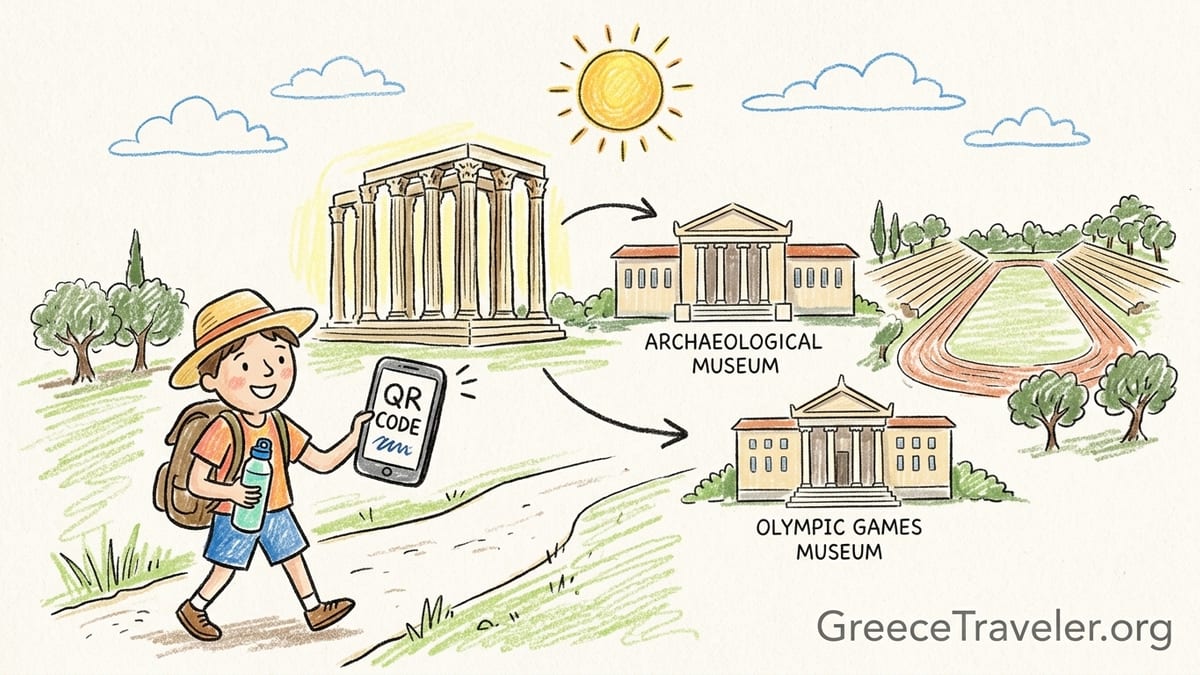
As of late September 2026, the official full integrated ticket for Ancient Olympia is €20 and it covers three places: the archaeological site of Ancient Olympia, the Archaeological Museum of Olympia, and the Museum of the History of the Olympic Games of Antiquity. That “integrated” part is what makes the day work, because you can move between the open-air site and two museums without paying again.
I bought my ticket online through the official Greek e-ticket platform (the Hellenic Organization of Cultural Resources Development system). The purchase felt like a standard government ticket checkout: pick the date, enter visitor details, and receive a QR code. The big thing to understand is that official e-tickets are generally tied to the date and, where time zones are used, to the time zone you select. In practice, that means you should choose a morning slot if you want maximum flexibility and fewer stress points later.
Two rules shaped my whole plan. First, last admission is typically allowed up to 20 minutes before closing, which is easy to underestimate when you are walking back from the stadium or still browsing the museum shop. Second, opening hours shift through the year. In the second half of September, the archaeological site runs later than in autumn, and that extra daylight is exactly what lets you do Olympia without racing.
I also looked at free-entry days before locking in my date. State-run archaeological sites and museums in Greece have specific days that are free for everyone, including March 6, April 18, May 18, the last weekend of September, and October 28, plus the first Sunday of each month from November through March (and also the third Sunday in that winter period). If you are traveling on a tight budget, aligning Olympia with one of those dates can save you the full €20, but expect larger crowds on the free days, especially if weather is pleasant.
My Arrival Plan: What Time I Came, Where I Parked, And What The Morning Felt Like
I aimed to arrive shortly before opening, because Olympia is an outdoor site first and a museum day second. Getting in early is not only about crowds; it is about temperature. Even in September, the sun can be intense once it clears the trees, and a sanctuary visit is a lot of standing still while you read signs or mentally reconstruct what used to be there.
I drove in and used the common sense approach: follow the flow of cars toward the archaeological area, park in a marked lot, and keep a small amount of cash on hand in case a private parking area is operating that day. Parking in Olympia is not the stressful “city museum” scenario you might know from Athens. What matters more is the last few minutes of walking: I wanted to be at the gate with water already opened, hat on, and ticket QR ready so I could start moving immediately.
Queues were light when I arrived. The advantage of an e-ticket is that you can skip the purchase step even if there is a line for on-site sales. The reality, though, is that your “queue time” can shift to the entry control point if a bus tour arrives at the same moment. My rule was simple: if I saw a tour group forming, I stepped aside for two minutes, let them funnel in, and then entered behind them rather than being stuck inside their stop-and-go rhythm.
One small thing I was glad I did: I screenshot my QR code and saved it offline. Mobile reception can be fine in town and then suddenly iffy when you are juggling camera, map, and ticket email. Olympia is not the place you want to be searching through a slow inbox at the turnstile.
How I Avoided The Midday Melt: Shade, Water, And A “Site First” Route
Olympia has shade in patches, but you earn it. There are tree-lined stretches, and then there are open, reflective zones where the heat bounces up from pale stone and dust. I treated the visit like a summer hike even though it was September: I brought a refillable bottle, wore breathable shoes, and assumed I would be thirsty earlier than I expected.
My order was deliberate. I started with the archaeological site while my attention was freshest and the air was coolest, then used the museums as my “midday reset” when the sun was strongest. Museums in Olympia are not just add-ons; they give context to what you just walked through, and they give your body a break. If you do museums last in summer, you risk arriving tired and skimming.
Inside the site, I kept my pace slow and did not try to force a strict loop that hits every marker. I focused on the core sanctuary areas first, then expanded outward if I still had energy. That approach reduced the feeling of constantly checking the time, which is exactly what I was trying to avoid.
If you visit in peak summer, I would push this strategy further: be at the gate at opening, do the stadium and the most open areas first, and plan to be indoors for at least an hour around midday. In shoulder season, you can be more relaxed and add longer pauses for photos and interpretation panels.
The Archaeological Site, Step By Step: What I Saw First And How Long It Really Took
Once inside, I gave myself permission to “waste” time looking. Olympia is not like a single temple platform where you get the view and move on. It is a spread-out sacred and athletic complex where the story is the layout itself. I began with the sanctuary core, moving toward the Temple of Zeus zone and nearby remains, because that is where your mental map starts to make sense.
The Temple of Zeus area was the part I expected to rush and did not. I lingered there, not because there is a fully standing temple to photograph, but because the imagination work takes time. I read the site signage, looked for vantage points that show the temple footprint clearly, and then stepped back to see how the landscape frames it. For me, the Temple of Zeus zone plus the immediate “what am I looking at?” orientation took roughly 45 minutes to an hour, depending on how much you read and how many stops you make for photos.
Then I walked toward the stadium. The stadium visit is often described as a quick detour, but in reality it is a full experience: the approach walk, the moment you step through the entrance, the scale of the track, and the way your brain automatically starts measuring distances. I spent about 30 to 40 minutes on the stadium segment, including time to sit for a few minutes, look down the length of the running track, and take in how the place still feels “athletic” rather than purely ruinous.
All in, I spent about two and a half hours in the archaeological site itself, without sprinting and without trying to see every single corner. If you read everything, pause often, and like to photograph details, you can easily stretch the site to three hours. If you are visiting in July or August and you are sensitive to heat, you might choose to do a tighter one-and-a-half to two-hour site loop and save your deeper interpretation time for the museums.
The Museums Without Rushing: What Stood Out And How I Budgeted Time
After the open-air site, I transitioned straight into the museums while I still had “attention bandwidth.” The key is to plan your museum time the way you would plan a meal reservation: not in theory, but on the clock. I budgeted about 90 minutes for the Archaeological Museum of Olympia and about 45 to 60 minutes for the Museum of the History of the Olympic Games of Antiquity. That pacing let me actually stop and look, not just walk through rooms.
In the Archaeological Museum, the headline pieces lived up to the hype. The Hermes of Praxiteles is one of those works that makes the room go quiet, and the Nike of Paionios has a sense of motion that reads clearly even when you have seen a hundred photos before. I also spent time with the sculptural decoration from the Temple of Zeus, because it connects directly back to what you saw as foundations and fragments outside. Seeing those sculptures indoors made the outdoor “stone footprint” feel suddenly three-dimensional.
The Museum of the History of the Olympic Games of Antiquity was the museum I worried would feel like a small add-on. It did not. It is focused, and that focus is what makes it effective: athletic history, origins, and the way the Olympic idea is presented through objects and explanations. I walked through at an unhurried pace and still finished within an hour, which is exactly the sweet spot after a long outdoor visit.
One practical note: I treated the museum shop and restrooms as part of the schedule, not an afterthought. If you leave them until the end, you risk colliding with last-admission timing. I built in a short buffer after each museum so that “quickly grabbing a postcard” did not turn into a closing-time sprint.
What I Would Change: Summer Versus Shoulder Season, And A Closing-Time Strategy
If I repeated my exact September plan in high summer, I would shift even earlier. In July and August, the difference between arriving at opening and arriving 90 minutes later can feel like a different climate. I would do the stadium earlier than I did, because that walk and that open track area are where the sun feels most direct. I would also plan a longer midday indoor block and accept that my outdoor pace would be slower.
In shoulder season, especially late September into October, the issue is less heat and more daylight and closing times. Hours shorten as autumn progresses, and that can quietly compress your plan. For a no-rush day, I would still enter the archaeological site first, but I would watch the clock for the museums: you do not want to be halfway through the Archaeological Museum when you realize you have 20 minutes to clear the last rooms.
My closing-time strategy was simple: I set an internal “wrap up” time that was earlier than the official closing time. With last admission generally around 20 minutes before closing, I aimed to be done with the final ticketed entry well before that. In practical terms, if the archaeological site is open until early evening in September, I still tried to be finished with my last major indoor museum room at least 45 minutes before closing so I could browse without stress, use facilities, and walk back to the car comfortably.
If you are building your day around a specific late closing, check the official hours again right before you go. Seasonal schedules can change, and even a 30-minute shift matters when you are trying to fit in three separate visits on one integrated ticket.
The Takeaway
Ancient Olympia rewards a plan that is built around comfort and context. The €20 integrated ticket is not just a price; it is an invitation to treat the sanctuary and the museums as one connected story. My best decision was doing the open-air site first, then using the museums to slow down and understand what I had just walked through, rather than trying to power through everything in the afternoon.
If you want the no-rush version of Olympia, arrive at opening, protect yourself from the heat even in September, budget real time for the Temple of Zeus zone and the stadium, and give the Archaeological Museum the attention it deserves. The day feels longer, but it also feels complete, which is exactly what you want at the birthplace of the Olympic Games.
FAQ
Q1. How much is the official Ancient Olympia ticket in 2026?
The official full integrated ticket is €20 and it covers the archaeological site plus the Archaeological Museum of Olympia and the Museum of the History of the Olympic Games of Antiquity.
Q2. Does one ticket really include both museums?
Yes. The integrated ticket covers Ancient Olympia, the Archaeological Museum of Olympia, and the Museum of the History of the Olympic Games of Antiquity.
Q3. Do I need a timed entry slot for Ancient Olympia?
If you buy through the official e-ticket system, tickets are generally issued for a specific date and, where time zones apply, the time zone selected. Choose an early slot for flexibility.
Q4. What time should I arrive to visit without rushing?
Arrive at opening if you can. It keeps you ahead of tour groups and reduces heat stress, which is the biggest pace-killer on the open-air site.
Q5. How long does the archaeological site take at a comfortable pace?
Plan about 2 to 3 hours for the archaeological site if you want time for reading signs, photos, and a slower stadium visit.
Q6. How long should I plan for the Temple of Zeus and stadium area?
A realistic, unhurried visit is about 45 to 60 minutes around the Temple of Zeus area plus about 30 to 40 minutes for the stadium segment, depending on your pace.
Q7. What museum objects are the true “don’t miss” highlights?
The Hermes of Praxiteles, the Nike of Paionios, and the sculptural decoration from the Temple of Zeus are standout highlights in the Archaeological Museum of Olympia.
Q8. What is the last-admission rule I should plan around?
As a general operating rule across many Greek state museums and sites, visitor entry is usually permitted up to 20 minutes before closing, so do not cut it close.
Q9. When are free-entry dates for Ancient Olympia?
Common nationwide free-entry dates for state sites and museums include March 6, April 18, May 18, the last weekend of September, October 28, and the first Sunday of each month from November through March (and also the third Sunday in that winter period).
Q10. What would you change for a July or August visit?
Start earlier, do the most exposed areas first (including the stadium), schedule a longer midday museum break, and carry more water than you think you need.