


I went to the Peloponnese expecting a greatest-hits loop of Mycenae, Epidaurus, Olympia, and maybe a quick photo of Monemvasia before racing back to Athens. What surprised me most was how quickly the peninsula stopped feeling like “a day trip region” and started feeling like several different countries stitched together by mountain roads, olive groves, and a coastline that refuses to behave. Argolis felt polished and easy, Laconia felt stark and medieval, the Mani felt like a beautiful dare, Messinia tasted like tomatoes and olive oil, Elis slowed me down with its rural distances, and Nemea quietly turned my ruins itinerary into a wine trip.
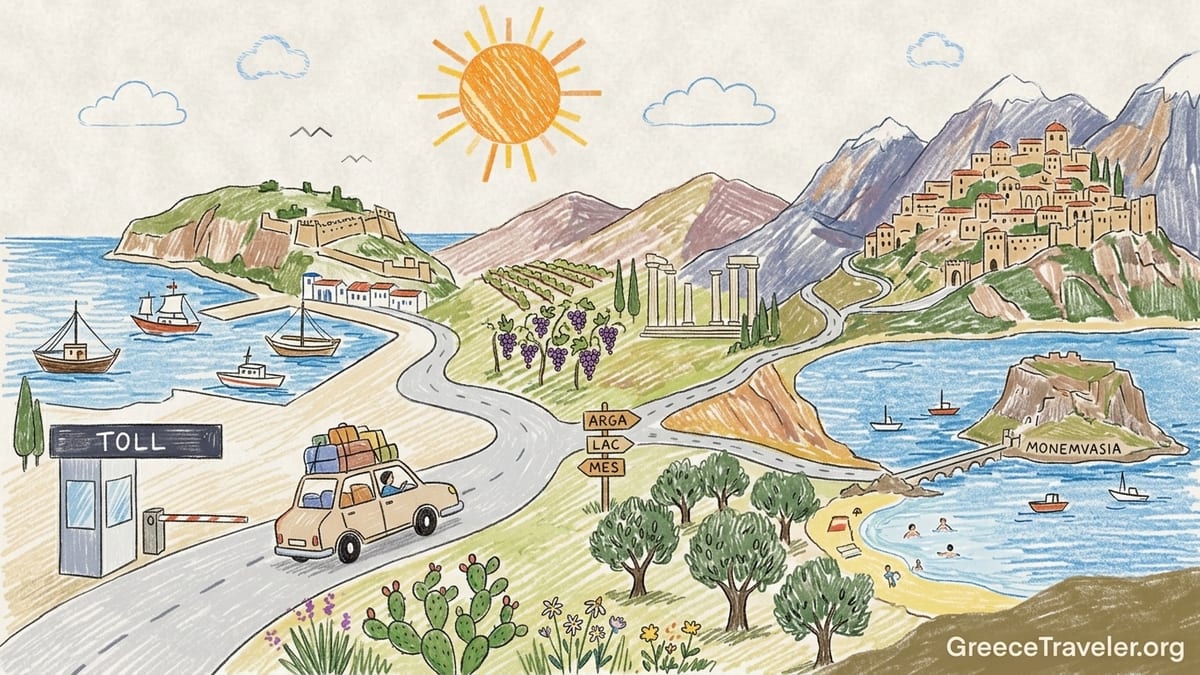
How I Actually Got Around (And Why It Changed My Whole Trip)
I did this trip with a rental car, not because I’m anti-bus, but because I wanted to watch the landscape change between regions on my own schedule. On paper, the Peloponnese looks compact. In reality, the travel time is what shapes your days. The motorways make the first part deceptively fast, and then the secondary roads remind you you’re still in Greece, with switchbacks, villages, and scenic “shortcuts” that stretch a 90-minute plan into half a day.
The easiest start was crossing the Isthmus area and heading into Argolis on good roads. The moment I committed south and east later toward Laconia and the Mani, the trip became more physical: more steering, more heat radiating off stone, more “should I pull over here or keep going?” decisions. I learned quickly that if I planned too many stops, I experienced everything with my car keys in my hand and the next parking search already in my head.
Tolls were part of the rhythm. On the main routes between Athens and the northern Peloponnese, the toll system is modern and frequent, and 2026 toll prices are published by the operators for planning and budgeting. I stopped thinking of tolls as an annoyance and more as a trade-off: pay for speed early in the trip, then spend the time you saved on slower coastal drives where the point is the scenery.
My biggest mistake was treating the peninsula like one loop that I could “just drive.” The Peloponnese rewards base towns. Every time I stayed put for two or three nights, I saw the place change. Every time I tried to push through to the next region, I lost the evening, which is when the best towns become themselves.
Argolis Beyond the Checklist: Nafplio After Dark, and the Day-Trip Trap
Nafplio was my first base, and it instantly taught me a Peloponnese lesson: the day-trippers create one version of the town, and the evening creates another. During the day, the old town felt like a carousel of gelato, souvenir shops, and tour groups drifting toward the waterfront. I enjoyed it, but it didn’t feel personal until the late afternoon, when the buses thinned and the streets started to sound like plates and conversation instead of footsteps.
That shift mattered because Nafplio is the easiest place to over-schedule. Mycenae and Epidaurus are close enough that people try to do both, plus Nafplio, plus a beach, plus a sunset viewpoint. I did a version of that and it felt rushed in the worst way: I was present for the monuments but not for the region. When I slowed down, Nafplio became a place where I could actually eat dinner without checking the time, wander the harbor, and feel the temperature drop after a hot day inland.
For Epidaurus, I worked from the official listing for the Sanctuary of Asclepius at Epidaurus, which in 2026 lists a full ticket of €20 with seasonal opening hours that generally stretch later in summer and tighten as autumn progresses. That mattered to my day because arriving late is not the same as arriving early: the light shifts, the heat shifts, and the site experience changes when you are not fighting the midday sun. The site’s published schedule also makes it clear that last admission is shortly before closing, and closures apply on specific public holidays, so I built my driving day around that reality rather than optimism.
For Mycenae, I leaned on the official Hellenic Heritage destination page for practical details rather than third-party summaries. The official listing is the one I trusted for “what time can I actually enter” and for the reminder that last admission is shortly before closing. I also built in time for the small on-site museum, which I initially considered optional. It wasn’t. Mycenae without that context felt like me staring at stones. Mycenae with the museum felt like a place with a real human scale and an actual story.
Nemea Wine Country: The Quiet Detour That Became the Point
I did not plan to care about Nemea. I thought of it as a name on a bottle and a quick archaeological stop. Then I drove through it and realized the landscape itself is the attraction: wide cultivated fields, rows of vines, and a sense of agricultural continuity that made the whole “ancient Greece” idea feel less abstract. The surprise was how restful it felt compared with the coastal bustle. It was one of the few parts of the northern Peloponnese where I didn’t feel chased by the next landmark.
I visited the Sanctuary of Zeus in Nemea as a way to anchor the wine country with something tangible. The official destination listing emphasizes the sanctuary set among the cultivated fields of the largest vine-growing zone in Greece, which matched exactly what I was seeing through the windshield as I approached. I treated it as a short stop, and that was the right pace: enough time to walk, take in the scale, and then return to the living landscape outside the gate.
If I reorganized my trip, I would put Nemea earlier and give it more breathing space. Not because you need many days for the sanctuary, but because the wine country rhythm is slower and it’s the best antidote to the “ruins sprint.” It’s also one of the easiest regions to combine with Argolis without punishing drives, which makes it ideal for a first-time itinerary that wants variety without overextending.
What I did wrong here was assume I could improvise everything. Wine country is full of places that require a reservation or at least a phone call, and I wasn’t always willing to stop and plan. Next time, I would choose one winery experience and one long lunch and commit to them, because this is the kind of region where “one good afternoon” beats three rushed stops.
Laconia’s Big Mood Shift: Mystras, Sparta, and the Pull Toward the Sea
The drive toward Laconia felt like turning the volume down. The towns became more spaced out, the mountains began to dominate the horizon, and the day started to feel structured by geography instead of my itinerary. The region also reminded me that the Peloponnese is not “just islands versus Athens.” Inland Greece can be dramatic, and Laconia’s scenery made me feel like I had crossed into a tougher, more austere version of the peninsula.
Mystras was the day that turned my legs into a factor. I’m careful about promising anyone “easy sightseeing” there because it is a real climb with uneven surfaces and lots of steps, and it’s the kind of place where heat and hydration are not optional details. The official Mystras listing highlights the seasonal free-admission days and the standard “last admission shortly before closing” rule, which reinforced my decision to go early and not gamble with a late arrival. It’s also the kind of site where you want time to stop, sit, and look out across the Eurotas valley instead of only marching upward.
From a planning perspective, Mystras belongs in the same trip as either the Mani or Monemvasia, but trying to do both on back-to-back days without a rest felt like an endurance event. I tried to stitch too much together, and I ended up with that familiar rushed feeling: arriving somewhere beautiful already tired. If I could redo it, I would choose Mystras plus one coastal destination, then build a buffer day for swimming or a slow town meal.
The other surprise in Laconia was how much I cared about the evening. Inland sites can feel like “daylight only” experiences, but the reward here was timing: finishing the site, then drifting toward the coast as the light softened, watching the mountains turn darker and more sculpted. That transition made the region feel cinematic in a way I didn’t expect from a place I initially associated with one word: Sparta.
Driving Into Monemvasia: The Moment That Felt Like Entering a Different Century
Driving toward Monemvasia is one of those Peloponnese experiences that doesn’t translate fully to photos. The road carries you closer and closer until the rock dominates your view, and then suddenly the causeway makes the approach feel deliberate, like you are being funneled into the story. For me, it wasn’t just scenic. It was a physical sensation of arriving somewhere self-contained, a place that has decided it does not need the modern world’s sprawl.
I parked outside the castle town and walked in, which was essential. You need the footstep pace to feel the transition from open road to enclosed stone streets. Inside, it’s not a museum town, it’s a living place that happens to be a fortress. The sounds bounce differently off the walls, and on a hot day the shade becomes its own kind of map. If you arrive at peak time, it can feel like a narrow corridor of people. If you arrive later, it feels like a place designed for silence.
For practical planning, I used the official listing for the Archaeological Collection of Monemvasia to understand what would actually be open on the day I arrived. In 2026, the collection is listed with a €5 full ticket, and the schedule shows a consistent closing day and standard opening hours that make it more of a daytime visit than an evening one. It’s a small detail, but it changed my timing: I did the museum-like pieces earlier and saved the atmospheric wandering for later.
My mistake here was trying to treat Monemvasia as a quick stop. It’s not. Even if you do not stay overnight, it demands a slow approach: time to park, time to walk in, time to get lost on purpose, and time to accept that the best moments are not on a checklist. If you can, stay. If you can’t, at least don’t schedule anything ambitious afterward.
The Mani: Beautiful Roads That Made Me Drive Slower Than I Planned
The Mani was where my Peloponnese confidence got checked. The roads are not “dangerous” in an alarmist sense, but they are demanding: narrow stretches, curves that keep coming, and the constant temptation to look away from the asphalt toward the sea. This was the region where distances felt longer than expected, not because the kilometers were huge, but because I drove with more caution and stopped more often just to breathe and absorb the landscape.
What surprised me most was how quickly the scenery became elemental. Stone houses, dry hills, and a coastline that looks carved rather than sandy. The Mani is not about one single “must-see.” It’s about the feeling of moving through a harshly beautiful place, where the light can be blinding at midday and golden in the late afternoon. I also felt the heat differently here: less humid, more reflective, the kind that makes you grateful for a shaded taverna even if you only stop for water.
The Mani also forced me to reconsider my itinerary style. I had planned to keep hopping bases. In the Mani, hopping felt exhausting. The right move was to choose one base and do short drives, because even short drives cost energy. This is where I started building my days around one major goal instead of three. One beach, one village, one long meal. When I tried to add more, I stopped enjoying the road and started “getting through it.”
If you are deciding how much of the peninsula to include, the Mani is the region I would not tack on as an afterthought. Give it space, or save it for a second trip. It’s too distinct, and it deserves time at its own pace.
Messinia and Elis: What I Ate, Where I Slowed Down, and Why Olympia Works Best Late in a Trip
Messinia tasted like the reason people romanticize Greek food. I ate simply and repeatedly: tomatoes that actually tasted like tomatoes, salads soaked in local olive oil, grilled fish when I was near the coast, and slow meals that turned into long conversations. It was the part of the Peloponnese where my “planning brain” finally relaxed because the pleasures were not only monumental. They were daily. Markets, bakeries, tavernas, and beaches that didn’t require a grand narrative to be worth my time.
For the big archaeological anchor in this western stretch, I planned Olympia carefully because the ticketing and opening hours matter a lot in high season and shoulder season. For 2026, official sources list an integrated ticket for Ancient Olympia at €12 in the April to October period, and there are separate official listings for the museum as well, with reminders that hours can be adjusted and that the Ministry of Culture announcements are the place where changes appear. That led me to build in flexibility: I avoided a tight afternoon arrival and instead treated Olympia as the main event of a full morning.
Elis, around Olympia, felt more rural and spread out than I expected. It’s easy to imagine Olympia sitting next to a string of other must-do stops. In my experience, the region asked for slower travel. Roads were fine, but the sensation was “longer than it looks,” and the reward was giving myself permission to not stack the day. I also appreciated that Olympia has enough on-site substance, especially if you include the museum time, that it doesn’t need to be bundled with a frantic list.
The place where my trip felt most rushed was when I tried to link too much of Messinia and Elis in one sweep. I wanted beaches and castles and ruins in a tight window. Next time, I would choose a Messinia base, do food and beach days, then move to Olympia and stay nearby overnight so Olympia gets a calm start instead of a late, tired arrival.
The Takeaway
What surprised me most beyond the famous ruins was not one hidden beach or one perfect village. It was how strongly the Peloponnese changes character region by region, and how much the driving, the heat, the road type, and the evening atmosphere shaped my experience more than any single attraction.
If you want the Peloponnese to feel enjoyable rather than like an endurance test, I would plan it as a set of realistic regional trips. Argolis plus Nemea works as a northern loop with easy logistics. Laconia plus Mystras works if you like dramatic inland scenery and serious walking. Monemvasia deserves slow time, not a drive-by. The Mani needs patience and a base. Messinia and Elis reward travelers who build days around meals, swims, and one major site rather than five.
My rule after this trip is simple: the Peloponnese isn’t small, it’s layered. Give yourself more days than you think you need, or accept that your itinerary will be a highlight reel. If I had to choose, I would rather see fewer regions and actually live in them for a couple of nights each than “collect” the whole peninsula in one rushed loop.
FAQ
Q1. How many days do I realistically need for the Peloponnese?
For a first trip with Argolis, one southern region, and one western region, I would plan about 7 to 10 days so you can base yourself and not just drive.
Q2. Which regions pair best together in one trip without exhausting drives?
Argolis pairs naturally with Nemea wine country. Laconia pairs well with Mystras and Monemvasia. Messinia pairs well with a calm Olympia day in Elis if you give yourself enough time.
Q3. Do I need a rental car, or can I rely on buses?
You can use KTEL buses for major connections, but for the Mani and for beach-hopping in Messinia and Elis, a car made my trip far more flexible and less time-limited.
Q4. What did driving into Monemvasia feel like?
For me it felt theatrical in the best way: the rock grows larger until it fills your view, then the causeway makes the approach feel like entering a self-contained world.
Q5. Is Nafplio worth sleeping in, or is it just a day trip?
Sleeping there changed it completely for me. After the day-trippers left, the old town felt calmer, more local, and much more enjoyable for dinner and evening walks.
Q6. What are the Mani roads like for a nervous driver?
They felt narrow and curvy, with constant scenery distractions. I drove slower than planned and built my days around fewer stops because the road itself demands focus.
Q7. How much time should I plan for Mystras?
I would plan a substantial half-day at minimum, and go early. It is a lot of walking with steps and uneven surfaces, and heat can make it more tiring than expected.
Q8. Are archaeological sites open late in summer?
Many major sites publish summer hours that extend into the evening, but last admission is shortly before closing and some sites have weekly closing days, so I always checked the official listing right before I went.
Q9. What is a smart way to include Olympia without rushing?
I recommend staying nearby the night before or the night after. That way you can arrive early, handle ticketing calmly, and give both the site and museum the time they deserve.
Q10. If I only pick one “beyond the ruins” region, which should it be?
If you want dramatic scenery and a distinct identity, I would choose the Mani. If you want food, beaches, and a slower pace, I would choose Messinia.