


I love the Peloponnese for the same reason it frustrates first-time visitors: the best sights are spread out, roads can be slow, and “quick” day trips have a habit of turning into long, hot logistics. On my most recent journey, I mixed guided experiences with independent exploring to find out what is actually worth paying someone else to organize. This is not a list of everything you can book. It is a field-tested decision article about when a guide genuinely upgrades the day, and when you can save the money, rent a car, and do it better on your own.
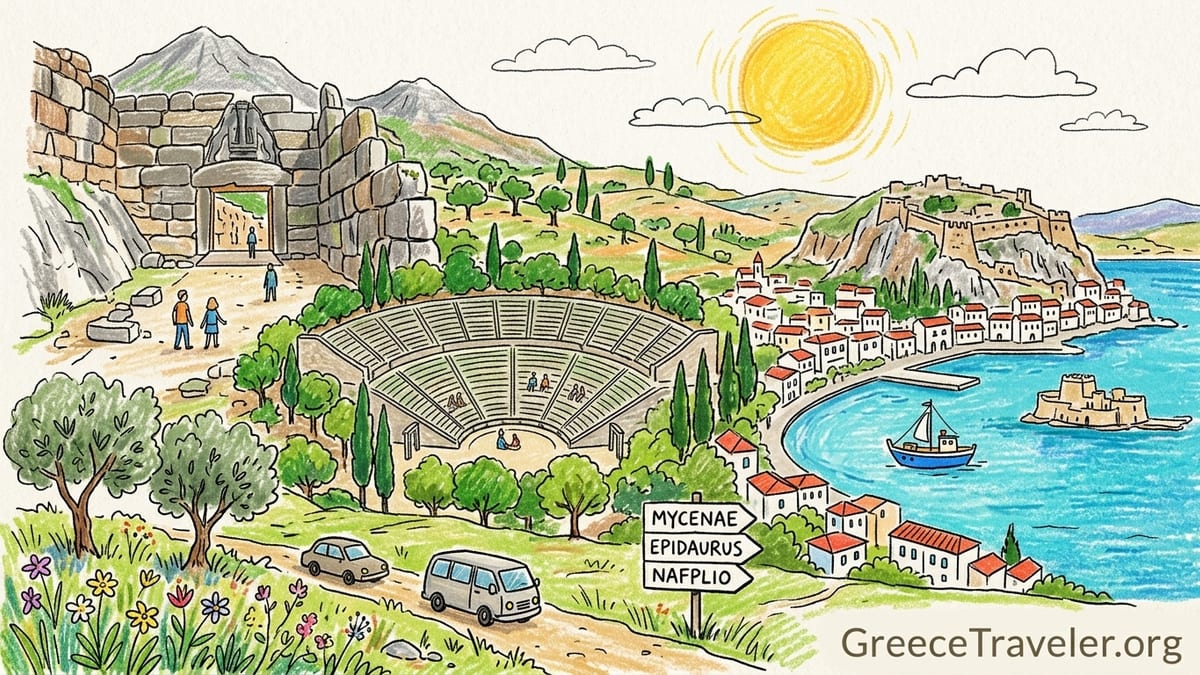
Mycenae, Epidaurus, And Nafplio From Athens: The Day Trip I’m Glad I Organized
This was the one guided day I would not attempt to replicate as a first-timer with public transport. Mycenae and Epidaurus are straightforward once you arrive, but the routing, timing, and heat management are where tours earn their fee. I personally took a small-group day trip from central Athens with hotel pickup. Pickup was early enough that we were rolling before the city fully clogged, and the big win was simply not spending mental energy on toll roads, parking, and keeping a strict clock across three headline stops.
Group size mattered. In a minivan-sized group, we moved fast without feeling herded, and we could actually ask questions during the drive. Transport quality also mattered more than I expected: cold air-conditioning and comfortable seating turned what is essentially a long driving day into something manageable. The itinerary did feel time-structured, but not chaotic. We had enough time to walk the Lion Gate at Mycenae without sprinting, enough time at Epidaurus to sit in the theater and test the acoustics, and enough time in Nafplio to get lunch and a short wander through the old town rather than only a photo stop.
Here is what the guide added that I would have missed alone. At Mycenae, the value was not “where the Lion Gate is.” It was the narrative thread: why the citadel sits where it does, how tomb architecture evolved, what features are Mycenaean versus later interpretation, and the simple practical coaching of where to stand for the best sightlines with fewer people in the frame. At Epidaurus, the guide made the sanctuary make sense. Independently, most travelers spend 90% of their time in the theater, then leave. With guidance, the Asklepieion becomes more than ruins and turns into an early medical tourism story that connects Greece’s sacred sites with later Roman practices.
Independently, I also visited Nafplio on a separate day and liked it more without a ticking clock. That independent day was better for climbing steps to Palamidi, lingering in cafés, and taking an unhurried waterfront walk. In other words: I recommend organizing the Athens-based Mycenae and Epidaurus logistics, but if Nafplio is the emotional centerpiece for you, consider spending a night there rather than treating it as the “lunch stop.”
Researched alternatives (not personally taken): a private driver-guided day can be a better fit if your priority is flexibility or accessibility, and there are also large-coach options that lower the price but usually feel more rushed at the major sites. If you want the best of both worlds, look for small-group caps around 15 people and confirm whether the guide is with you inside each site or only provides narration during transport.
Nemea Wine Experiences: The Tour I’d Pay For Even If I Had A Rental Car
I visited the Nemea wine region both ways: once independently as a self-driven half-day and once as an organized tasting experience. The independent version was easy on paper, but in practice it required a lot of pre-work: confirming which wineries accept walk-ins, aligning opening hours, and deciding who would not taste much if we were driving. The organized experience solved the two pain points that usually spoil wine days in Greece: uncertain tasting logistics and the quiet stress of drinking and driving.
On the guided wine day I took, pickup was straightforward from the Athens area, with a small group that stayed intimate enough to ask questions at each pour. The best part was not just moving between wineries. It was the structure: a deliberate pacing of tastings, water and snacks at the right times, and a food element that made the wines taste like the place rather than a checklist. A good Nemea guide also knows how to translate Greek wine labels and local grape talk into practical choices. Instead of leaving with “we tried a few reds,” I left knowing what to order later in tavernas, what styles of Agiorgitiko I actually liked, and how barrel samples differ from what I’ll find in shops.
What I would have missed alone was the behind-the-scenes context. In one stop, the guide steered us to taste with a simple prompt: try it first without food, then with a bite of something salty and local. It sounds basic, but it reframed the entire day from “tasting” to “understanding.” And because the itinerary had a defined endpoint, it avoided the common trap of overbooking wineries and ending up exhausted, slightly dehydrated, and still having to drive back to Athens.
Researched alternatives (not personally taken): some Nemea experiences build in a picnic and nature component, and others add an artisan food stop. If you are traveling as a couple or small group, confirm whether pricing is per person or per vehicle, and ask what is included in tastings versus paid on the day. The key decision lever is this: if you want to taste properly, not sip politely, pay for transport and a host. If you only want one casual tasting and a scenic drive, self-driving can work if you pre-book and limit alcohol.
Ancient Olympia: I Loved It Independently, But A Guide Made The Ruins Legible
Olympia is one of those places where you can walk for an hour and still not understand what you just saw. I did it independently first and enjoyed it, but it was a “beautiful fragments” experience: impressive, atmospheric, and slightly vague. I returned with a guided visit and that second visit is the one that stayed with me. If you only go once, a guide is the difference between “the birthplace of the Olympics” as a slogan and Olympia as a functioning sanctuary with rules, rituals, politics, and money behind it.
For planning: Olympia runs on seasonal hours, and the site is paired naturally with the Archaeological Museum. As of the latest official visitor information, Olympia uses an integrated ticket that covers the archaeological site and museums, and the opening hours stretch late in summer while tightening in winter. Even if you do not love museums, the museum is where the day makes sense. I watched other independent travelers do the site, skip the museum, and leave with a thin story. With guidance, we used the museum as a decoding key, then went back mentally through the sanctuary with a clearer map in our heads.
What the guide added that I would have missed alone was “sequence.” Olympia has a lot of pieces: temples, training areas, administrative buildings, the stadium. The guide explained what came first in a typical visit in antiquity, where athletes trained, where oaths were taken, and why some structures look more Roman than people expect. Just as importantly, the guide managed time. Instead of wandering until fatigue won, we hit the essential spine of the site and had energy left for the museum, which is where you find the objects that put muscle on the bones of the ruins.
Researched alternatives (not personally taken): Olympia is frequently visited as a shore excursion from the port of Katakolon, often bundled with a guided museum visit and lunch. Those can be efficient if you are cruise-tethered, but I would still check how much time is actually allocated inside the museum versus “free time” in the town. If you are land-based, consider staying nearby and entering early, before heat and crowds build, then doing the museum while the midday sun is at its harshest.
The Mani Peninsula And Diros Caves: Where A Local Guide Prevents A Bad Day
Mani is the Peloponnese at its most dramatic: tower-house villages, hard light, stark hills, and small roads that reward confidence. I explored Mani independently with a rental car and loved the freedom, especially for scenic pull-offs and slow lunches in places that are not designed around tour bus timing. But I also booked a guided experience for the Diros Caves portion of my Mani days, and that decision saved the day from the most common Mani mistake: underestimating queues, ticket cutoffs, and the friction of arriving at the wrong time.
Diros Caves are tightly managed by operating hours, and the ticket booth closes before the site closes. That matters because the caves are not something you can “squeeze in” at the end of a long driving day. On my guided visit, the timing was the whole point. We arrived with a plan, got tickets without the usual uncertainty, and moved through the experience smoothly. The group size was modest, which helped because the cave experience itself is intimate and can feel cramped when too many people converge at once.
What the guide added was not deep geology. It was local practicality: what time to arrive, how to handle the temperature difference, how the flow works once you are inside, and how to pair the caves with a Mani village stop that actually feels like Mani rather than a generic souvenir stretch. Independently, I visited villages and viewpoints on my own time and that was perfect. But for Diros, a guide or a well-planned, pre-timed visit is the difference between a highlight and a frustrating miss.
Researched alternatives (not personally taken): many Mani day trips combine Diros with Areopoli, Limeni, or southern villages like Vathia. Those can be excellent, but I would ask one question before booking: how long is allocated for Diros itself, including waiting and boarding, not just “visit Diros.” If the schedule stacks too many stops, the caves can become a rushed box-check, and Mani deserves better.
Messinia By Sea: The One Category I’d Book Even When I’m “Done With Tours”
Messinia is where I stopped trying to do everything with wheels. I spent time exploring independently around Pylos, Gialova, and the wider coastline and it is easy to fall into the pattern of beaches, viewpoints, and another beach. Then I booked a sailing day in the Messinian Bay area, and it instantly became one of the most “worth paying for” experiences of my entire Peloponnese journey. Boats access the coast the way it wants to be seen: cliffs, coves, water color shifts, and the sense of distance that maps flatten.
The sailing experience I took was private-style rather than a big group cruise, with a small guest capacity, a fixed departure time, and a structured but gentle pace that included multiple swim stops. Food was prepared on board and served as a real meal rather than a token snack, which mattered because a full-day sea experience can otherwise turn into a hungry day. There were no queues once we left the marina, and that is an underrated luxury in peak season Greece: you trade lines and heat for shade, water, and movement.
What the crew and host added was situational awareness. Independently, you can drive to famous beaches like Voidokilia and still not grasp the wider geography: the relationship between the bay, the islands, the protected lagoon environments, and the best coves for calm water. On the boat, we read the wind, chose sheltered water for swimming, and got a living map of the coastline. It also changed my perception of “distance” in Messinia. Places that look close on the road can take long drives, while by sea the coastline becomes a smooth, continuous experience.
Researched alternatives (not personally taken): there are also motorboat tours based around Pylos and Navarino Bay that often include Sfacteria and Voidokilia, and resort-linked half-day cruises that prioritize easy swimming and scenic anchors. Your decision point is simple. If you want a special day with a meal, multiple swims, and a sense of place, a sailing day is worth the spend. If you only want a quick transfer to a beach, do it by car and keep your money for something else.
What I Would Skip Paying For (And What I’d Pay For Again)
After mixing guided days with independent exploring, my rule is this: pay for expertise when it changes what you understand, and pay for logistics when it changes how you feel. Mycenae and Epidaurus from Athens met the logistics test. I could have driven it, but the organized day removed fatigue and kept the day coherent. Olympia met the expertise test. I could have walked it alone, but the guide turned a famous name into a vivid place. Nemea met both tests, because wine days are half knowledge and half safe transport.
What I would generally skip paying for are short, simple town visits where the value is lingering. Nafplio is the clearest example. A tour can introduce Nafplio, but it cannot give you the slow pleasure of it. I enjoyed Nafplio far more on my independent day, when I could choose my own lunch, decide whether Palamidi was a climb I wanted in that heat, and stay in the old town until the light softened. If you are trying to decide where to “save” in the Peloponnese, save on the places that reward unstructured time.
The category I would pay for again even if I had already “done” the region is the sea day in Messinia. It did not feel like someone else’s itinerary. It felt like access. In Greece, access is often what you are buying: a boat, a driver, a guide who can turn stones into stories. When a tour is just transportation to a photo, I keep my wallet closed. When it becomes access to understanding or access to a coastline, I open it.
Finally, be honest about your travel style. If you get joy from driving and discovery, build your Peloponnese trip around independent days, then spend your tour budget on a few high-impact upgrades: a small-group archaeology day, a wine day with transport, and one truly good boat day. If you dislike driving in unfamiliar places, concentrate your spending on day trips with strong logistics and small groups rather than trying to do everything cheaply on big coaches that trade price for time pressure.
The Takeaway
If you only pay for one organized experience in the Peloponnese, make it a day that either collapses difficult logistics or opens a side of Greece you cannot access on your own. For most travelers, that means: a small-group Mycenae, Epidaurus, and Nafplio day from Athens if you are Athens-based and do not want to rent a car; a Nemea wine experience if you want to taste seriously without worrying about driving; a guided Olympia visit if you care about understanding what you are looking at; and a sailing or boat day in Messinia if you want a “this could only happen here” memory.
Then do the rest independently. Use your independent days for Nafplio’s slow charm, for Mani’s scenic detours, and for the kinds of beach hours that do not improve when someone tells you when to get back on a bus. The best Peloponnese trip, in my experience, is not tour-heavy. It is tour-smart.
FAQ
Q1. Is the Mycenae, Epidaurus, and Nafplio day trip from Athens too rushed?
It can be on large-coach itineraries, but a small-group day with an early start typically feels structured rather than frantic, especially if the guide manages time at each site.
Q2. Should I stay overnight in Nafplio instead of visiting on a day tour?
If Nafplio is a priority, yes. An overnight gives you time for Palamidi, sunset walks, and unhurried meals that a day trip cannot replicate.
Q3. Are Nemea wine tours worth it if I already rented a car?
Often yes, because a good host secures appointments, structures tastings, and removes the pressure of driving after alcohol, especially if you want more than one winery.
Q4. What should I confirm before booking a Nemea wine experience?
Confirm what is included in the price (tastings, snacks or meal, transport), how many wineries you visit, and whether the day is private, semi-private, or shared.
Q5. Do I need a guide at Ancient Olympia?
You do not need one to enter, but a guide is a major upgrade if you want the sanctuary’s layout and purpose to make sense rather than feeling like disconnected ruins.
Q6. How much time should I plan for Olympia including the museum?
Plan for a half-day if you want a satisfying visit. The site plus the Archaeological Museum together are the core experience, and skipping the museum makes Olympia harder to understand.
Q7. Are Diros Caves easy to do independently?
They are doable independently, but timing is critical because operating hours and ticket cutoffs can derail a visit if you arrive late in the day or during peak periods.
Q8. What’s better in Messinia: a sailing cruise or a motorboat tour?
Sailing is ideal for a relaxed, full-day experience with swim stops and a meal on board, while motorboat tours can be better for quicker hops and specific highlights.
Q9. Is a Peloponnese tour better than renting a car?
It depends on your comfort with driving and your itinerary. Tours reduce fatigue and planning, while a car gives you freedom for slower towns and scenic detours.
Q10. What’s the single best “splurge” experience in the Peloponnese?
For me, it was a high-quality boat day in Messinia because it delivered access and scenery that are hard to replicate from land and felt genuinely special.