


I came to the Peloponnese for the famous aerial-photo beaches and stayed for the less-photogenic details: the way sand squeaks underfoot at noon, how a “tropical” cove can have nowhere to hide from the sun, and the small local choices that decide whether your swim is effortless or mildly chaotic. This coastline is long, varied, and often deceptively practical. A beach that looks like a postcard from 200 meters up might mean a hot walk without shade, a bumpy approach road, or a bay that goes from ankle-deep to suddenly deep in two steps.
What I Learned Fast: A Peloponnese Beach Can Be Perfect And Still Annoy You
The Peloponnese is not a single “best beach” destination. It is clusters: dune lagoons in Messinia, Aegean sand on Elafonisos, pebble coves in Mani, and easy town swims in Argolis. What makes it special is also what complicates it. Many of the most spectacular places sit inside protected landscapes or at the end of sandy tracks, where the rules are lighter on signage than on consequences.
Before I get specific, one honesty note: I can describe only a few beaches below in true first-person detail, as places I personally spent meaningful time swimming and lingering. Those are Kalogria Beach (Stoupa, West Mani) and Foneas Beach (between Stoupa and Kardamyli), plus Arvanitia Beach (Nafplio). The rest are researched beach clusters you should consider, with current access and logistics confirmed separately. I am distinguishing that clearly so you can trust what is lived versus what is reported.
Also, a practical truth that aerial photos hide: shade is the real luxury on the Peloponnese. On a calm July or August day, lack of natural shade can turn “I’ll stay for hours” into “I’m leaving after 45 minutes,” unless you rent an umbrella at an organized beach or bring your own. Some of the best-looking beaches are essentially full-sun arenas.
Mani, Firsthand: Kalogria Beach In Stoupa Was My “Real Swimming” Benchmark
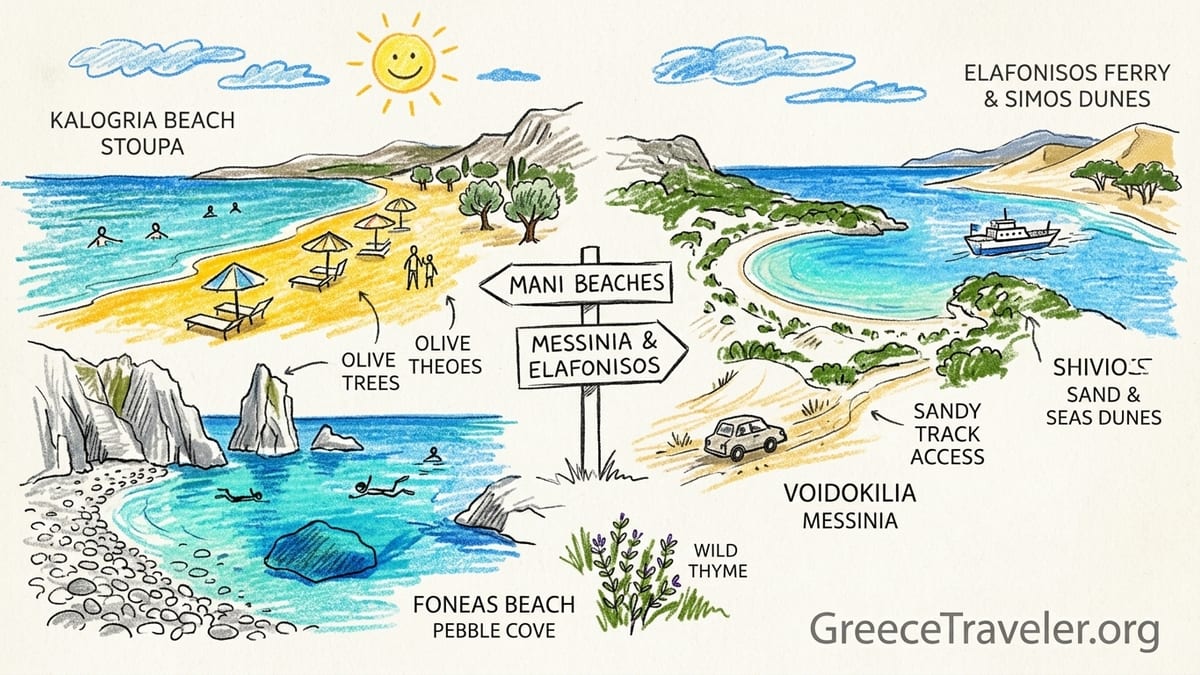
I spent the kind of time at Kalogria Beach that changes how you judge other swims: slow arrivals, multiple dips, lunch breaks, and that late-afternoon last swim when the sand has cooled. Kalogria in Stoupa is an organized, family-friendly bay, and it felt like the easiest place in Mani to simply exist all day without friction. The shore is fine golden sand, and the water stays unusually refreshing because of underwater freshwater springs that bubble out from Taygetos. That “cooler than expected” feeling is not a metaphor. It is the first thing you notice when you wade in.
Swimming here was gentle and confidence-building: shallow water for a decent distance, a smooth slope, and a bay that usually keeps the surface calm. Visibility was good enough that, on a mask-and-snorkel float, I could track the seabed texture changing from pale sand to darker patches. Near rocks, I saw small fish in the shallows, the kind you notice most when you stop kicking and just hover. It is not dramatic reef snorkeling, but it is satisfying, especially for beginners who want clear water without waves.
What made Kalogria outperform many “wilder” beaches was the practical ecosystem around it. You are not gambling your whole day on the contents of your bag. The beach is described locally and in multiple guides as well organized, with umbrellas and sunbeds, seasonal food and drink, and facilities like showers and toilets in season. I found it lively rather than loud: the soundtrack was mostly water, chatter, and beach-service orders. It can get crowded in peak summer and the free towel space can feel limited, which is the tradeoff for convenience.
Getting there is straightforward by road from Stoupa, but the last stretch can still be a small test of timing. Parking becomes the real sport in July and August. My best “real life” advice is not romantic at all: arrive earlier than you think you need to, especially if you want an easy spot and a relaxed setup. If you come late, expect a short walk from wherever you find space.
Mani, Firsthand: Foneas Beach Looked Like A Photo And Swam Like A Reality Check
Foneas Beach was the Mani contrast I needed. It is a compact cove framed by pale Mani rock, split visually by a large boulder that makes every camera feel talented. But Foneas is not a soft-sand sprawl. It is rounded white pebbles underfoot, with water that deepens quickly and can feel noticeably cooler. The first time I stepped in, I had that split-second recalibration: this is not a wading beach, it is a swimming beach.
The water clarity was striking. With a mask on, I could see down over rock edges and into the deeper blue where the seabed falls away. That depth is the thrill and the warning. People sometimes climb or jump from rocks at coves like this, but without local knowledge it is not something I treat casually. The shoreline here teaches you to be precise: where you enter matters, how you step matters, and you do not linger with your back to the swell if one is running into the cove.
Foneas also exposed the biggest aerial-photo lie: shade. The cove looks lush from certain angles because of the gorge, but on the beach itself the shade is limited and migrates quickly. In the heat of midday, you feel the lack of a real canopy. The descent from the road is short but uneven, and parking is limited along the roadside, so your arrival can feel like a small logistical negotiation rather than a glide into paradise. Some sources note a seasonal canteen, but I treat that as a bonus rather than a plan.
Still, the swim was worth it. If Kalogria is where you take children to float, Foneas is where you go when you want that clean, deep water sensation and do not mind pebbles, carrying your own water, and earning your spot.
Argolis, Firsthand: Arvanitia In Nafplio Was The Most Effortless “Town Swim” I Took
Arvanitia Beach is the Peloponnese at its most practical: a real swim inside a real town. I walked there from Nafplio’s old town, and that alone changes your relationship to the water. No car planning, no sandy track, no cooler packed like an expedition. You show up with a towel and the day becomes lighter. Multiple local sources describe it as roughly a 10-minute walk from the old town, tucked under the fortress slope, and that matches the lived feeling of it: close enough that you can swim, dry off, and still make dinner plans without “beach day” swallowing the whole schedule.
The beach itself is a mix of coarse pebbles and rocky edges, with a sandy seabed once you are in the water. It is sheltered by the Argolic Gulf, so even when wind exists elsewhere, the water can stay comparatively calm. Swimming here felt clean and contained. You are not looking at dunes or cliffs. You are looking up at stone, greenery, and the fortress presence overhead. It is one of those places where the view makes you swim slower.
Because it is a city beach, the details are organized: seasonal cafés and services are commonly mentioned, along with showers and restrooms, and there is free parking near the entrance for those arriving by car. The crowd vibe is local and mixed, not exclusively tourist. I saw people doing quick dips and leaving, and others settling into a longer beach routine. It is not a hidden beach, but it is one of the most useful beaches I visited, which is a different kind of excellence.
Messinia Research Cluster: Voidokilia And Gialova Look Like A Drone Shot For A Reason
Voidokilia, near the Gialova lagoon area in Messinia, is one of those beaches you recognize before you arrive. That near-perfect curve shows up everywhere, and it is famous precisely because it photographs like an icon. It is also part of a broader protected ecosystem around the lagoon, included in the Natura 2000 network, which is not just a label but a clue that the experience can be less “built for comfort” than newcomers expect.
Access is the detail to research before you commit a full day. Multiple sources describe reaching parking via sandy tracks, either from the Gialova lagoon side (also used by bird-watchers) or from a route that approaches from the north side. That matters because a gorgeous aerial beach is not necessarily a “pull off the road and step onto sand” beach. If you arrive at the wrong time of day, the approach heat and the lack of shade can be the real story, not the swim. Plan for a sun-first landscape: bring water, sun protection, and a realistic idea of how long your group will tolerate a walk on hot sand.
Because it sits near lagoon and dune environments, it is exactly the kind of place where environmental protections shape what you can do. The bigger lesson is not “do not go.” It is “treat it like a protected landscape first and a beach second.” If you want a beach day with services, this might not be your pick. If you want the kind of swim that feels like you stepped into a geography documentary, it belongs high on your list.
If you’re building a Messinia beach plan, think in clusters: pair Voidokilia with Gialova for a different kind of coastal day, where birdlife, lagoon edges, and sunset light can be part of the same outing. Just do not let the drone photo convince you there is shade waiting for you on arrival.
Elafonisos Research Cluster: Simos Beach, Dunes, Sea Cedars, And The Ferry Reality
Simos Beach on Elafonisos is the beach that gets described with words like “exotic,” and unusually for travel writing, the landscape description is not exaggerated. Visit Greece describes the Elafonisos coastline as a rare dune-and-sea-cedar environment with shallow turquoise water, and places Simos in the Lefki area, divided into two bays by the Sarakiniko peninsula. It is also framed as a Natura 2000 protected landscape, with endemic plants mentioned in official destination material. That combination of beauty and protection is exactly why it draws crowds in peak season and why you should treat it gently when you arrive.
The key practical point is that Elafonisos is not a drive-up mainland beach. You need the ferry connection from Pounta. Official municipality postings publish monthly ferry schedules and contact details, and a local schedule page notes the crossing time is about 8 minutes. In other words: the water may be Caribbean-colored, but your day is still governed by ferry flow, queues, and the realities of high season. If you are arriving with a vehicle, your timing matters more than your swimsuit brand.
About the swim itself, here is what is consistently reported and worth planning around: the famous Simos area includes two natural bays, and the more sheltered bay is described as shallow and protected from waves, making it feel easier and calmer for swimmers. Those are the conditions families love and photographers chase. The aerial-photo trap, however, is familiar: dunes and cedar landscapes do not automatically mean easy shade on the shoreline. Shade can exist farther back in the cedar area, but that can mean walking back and forth rather than having shade exactly where you put your towel.
If you go, treat Simos like a full-day destination with moving parts. Plan your ferry timing, think about what you are carrying, and decide in advance whether you are renting beach gear or bringing your own. And because it is a protected landscape, avoid shortcuts over dunes and respect any fencing or access guidance you find on the ground, even if others are ignoring it.
Other Peloponnese Coasts Worth Planning For: Quiet Outperformers And Seasonal Reality
Not every great swim has to be a headline beach. One of the Peloponnese’s advantages is that you can often find a “less famous but better for my day” alternative within the same region. In Argolis, for example, Nafplio’s municipality highlights multiple nearby options beyond Arvanitia, including Karathona, which is described as a larger sandy beach with shallow water that works well for families. The point is not that one is better in a universal sense, but that the coast offers different friction levels: walkable town swims, drive-and-park sands, and more remote coves.
In Mani, the pattern repeats: organized sandy bays like Kalogria can be your base, while pebble coves like Foneas become your “two-hour wow swim” when you want depth and clarity. That mix is what makes the region feel rich rather than repetitive. If you are traveling with mixed swimming confidence levels, you can keep everyone happy by alternating a shallow, sandy day with a deeper, rock-and-pebble day.
Season matters more than most visitors admit. July and August bring the highest crowds and the highest sun load. If you are traveling in shoulder season, you may find the water cooler and the beaches calmer. If you are traveling deep summer, your experience can hinge on very plain decisions: arriving earlier, choosing organized beaches when you need shade, and treating long approaches as part of the day’s energy budget.
Finally, when you see beaches tied to conservation work, treat the rules as non-negotiable. Parts of the southern Peloponnese are known turtle nesting areas, and conservation groups operate monitoring projects there. Even if you are not visiting a nesting beach, the broader lesson holds: do not bring lights to beaches at night, do not disturb marked areas, and assume that “empty at night” can mean “protected at night,” not “free for anything.”
The Takeaway
The Peloponnese gave me three different swimming lives in one trip. Kalogria in Stoupa was the all-day, low-stress sandy bay where I could actually settle in. Foneas was the photogenic Mani cove that rewarded strong swimmers and punished anyone who forgot shade, shoes, or patience. Arvanitia in Nafplio was the easiest swim of all, a city beach that proved you do not always need a remote coastline to get clear water and a satisfying dip.
The famous beaches are famous for a reason, especially around Voidokilia and Elafonisos. But the coast is at its best when you plan for reality, not for a drone shot. Assume you will need shade, assume parking is part of the story, and treat protected landscapes like the privilege they are. Do that, and the Peloponnese stops being a list of beaches and becomes a string of days you can still feel on your skin weeks later.
FAQ
Q1. What are the strongest beach “clusters” to base yourself near in the Peloponnese?
Messinia around Voidokilia and Gialova, Elafonisos for Simos and nearby bays, Mani around Stoupa and Kardamyli, and Argolis around Nafplio for walkable swims and nearby sandy options.
Q2. Is Simos Beach on Elafonisos actually protected, and does that affect your beach day?
Yes. Official destination information describes a protected dune-and-sea-cedar landscape and notes Natura 2000 protection in the area, which means you should expect limited development and follow any on-site access guidance.
Q3. How do you reach Elafonisos if you have a car?
Elafonisos requires a short ferry from Pounta. Municipal postings publish monthly schedules and contact details, and local schedule information notes the crossing is about 8 minutes, but you should confirm the exact day’s timetable before you go.
Q4. Is Voidokilia an easy “park and swim” beach?
Not always. Access is commonly described via sandy tracks from the Gialova lagoon side or from a north-side approach, so it can involve rougher driving and a more exposed walk than photos suggest.
Q5. Where did you personally spend meaningful swimming time for this article?
Kalogria Beach in Stoupa, Foneas Beach in West Mani, and Arvanitia Beach in Nafplio are described from firsthand time spent swimming and staying on the beach. Other locations are included as researched recommendations only.
Q6. Which firsthand beach had the shallowest, easiest swimming?
Kalogria Beach in Stoupa felt the most beginner-friendly, with a gentle sandy entry and a calmer bay feel, plus the practical benefit of organized services in season.
Q7. Which firsthand beach felt deepest fastest?
Foneas Beach. The pebble cove drops into deeper water quickly, which makes it thrilling for confident swimmers but less ideal for long, shallow wading.
Q8. What’s the most common “aerial photo vs reality” problem on Peloponnese beaches?
Lack of shade. Many iconic beaches sit in open, sun-heavy landscapes where the photo captures water color but not the fact that you may have no natural cover for hours.
Q9. Are there good beaches where you can swim without driving out of town?
Yes. Arvanitia Beach in Nafplio is widely described as a short walk from the old town and is a practical choice for a quick swim with seasonal services nearby.
Q10. What’s one planning habit that consistently improves a Peloponnese beach day?
Arrive earlier than you think you need to, especially in July and August. It improves parking, reduces crowd stress, and gives you more choice about where to set up for shade and wind.