

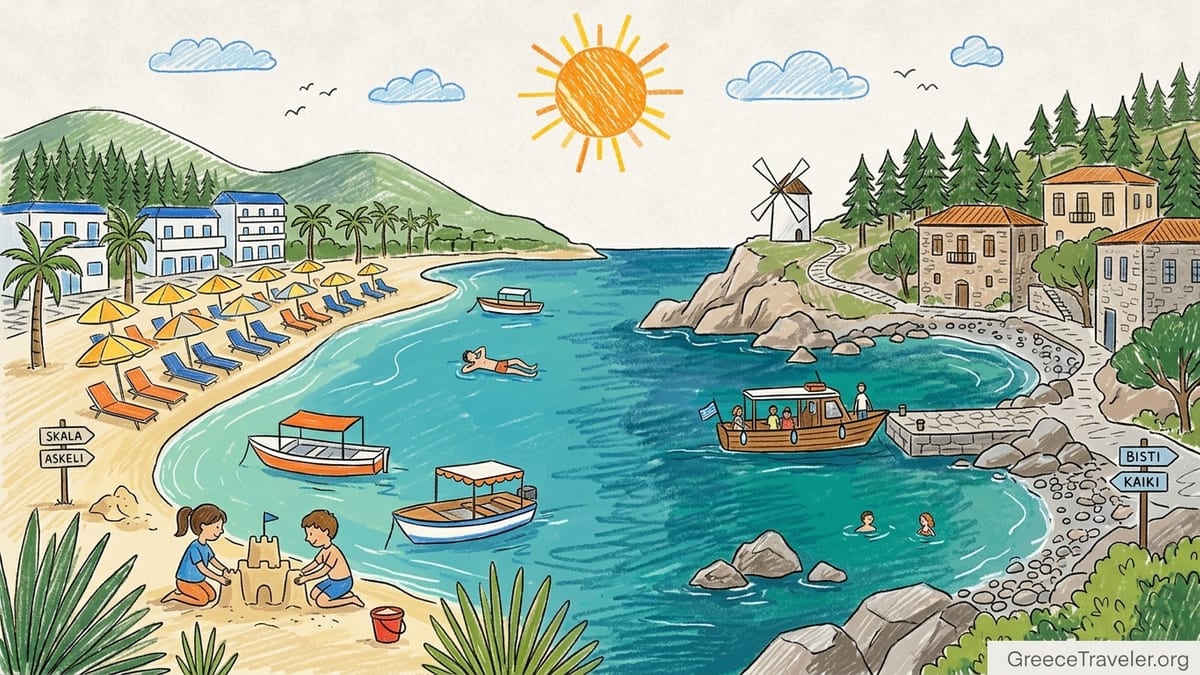
The Saronic Gulf islands are the closest escape from Athens, and for many visitors that means one thing: an easy beach day without the logistics of a long ferry. Yet the character of the beaches on Aegina, Agistri, Poros, Hydra and Spetses varies more than you might expect. Some offer soft sand and shallow water ideal for children, others rocky coves and off-the-boat snorkeling, and one island in particular, Hydra, is better for atmosphere and harbor life than for classic sandy stretches. This guide compares the main islands and their real-world beaches so you can choose the right Saronic base for the kind of seaside time you have in mind.
How the Saronic Islands Compare for Beach Time
If your priority is a simple, sandy, organized beach where you can rent sunbeds, order a coffee and watch kids paddle in waist-deep water, Agistri, Poros and parts of Aegina are the most straightforward choices. Skala on Agistri, Askeli on Poros and Agia Marina on Aegina all offer long, mostly sandy or sand-and-pebble stretches backed by tavernas and small hotels, with shallow entry and calm water in normal summer conditions.
Hydra and Spetses, by contrast, are stronger on ambiance and coves than on classic wide sandy beaches. Most of their shores are pebble or mixed sand-and-pebble, often backed by pines rather than a resort strip. On Hydra, some of the best swimming spots, such as Bisti and Agios Nikolaos, are reached by water taxi from the harbor rather than by bus or car. That makes the day feel more like a mini excursion than a roll-out-of-bed beach day.
Transport shapes the experience as much as the sand itself. Aegina has a small bus network radiating from Aegina Town to Agia Marina, Marathonas and other beaches, and it is common to buy a bus ticket for just a few euros and combine a temple visit with a swim. On Spetses, a bus and sea bus loop from the main town around to Agia Paraskevi, Agioi Anargyroi and Zogeria, while sea taxis based at the port offer private runs priced per boat, which can be good value if you are a group of four or more.
Accommodation follows this pattern. On Agistri and Aegina, many budget and midrange hotels sit directly behind sandy or mixed beaches, so you can be in the water within minutes of leaving your room. Hydra and Spetses have stricter planning and limited building along the immediate waterfront, so you are more likely to stay in town or in a village and use a boat or trail to reach your swimming spot.
Aegina: Easygoing Beaches with Island Hopping Options
Aegina, about one hour from Piraeus by conventional ferry and usually a bit less by high-speed catamaran, is often the first Saronic island people visit. Its beaches are not the most dramatic in Greece but they are practical, accessible and varied. Marathonas, on the southwest coast, is a favorite for families thanks to its shallow sandy sections, a few rows of sunbeds and easy-going tavernas directly on the shore. You can walk here from Aegina Town in around 30 to 40 minutes or take a short local bus ride.
On the eastern side, Agia Marina offers probably the most obviously “resort” style beach on Aegina, a broad arc of sand and fine pebble with organized zones of umbrellas and small hotels and rental rooms behind it. The water is generally shallow for a long way out which suits children and less confident swimmers. Regular buses connect Agia Marina with Aegina Town, so it is realistic to stay in the town for its cafés and evening promenade and day trip to the beach when the weather is best.
For clearer water and more of a cove atmosphere, travelers often head south toward Klima and Sarpa, smaller beaches closer to the fishing village of Perdika. These are more pebble than sand, with a steeper entry, so they suit confident swimmers and those who like to snorkel around rocky outcrops. In summer, basic beach amenities such as a snack bar or a few rental loungers usually appear, but you should not expect the full resort setup.
One of Aegina’s strongest assets for beach lovers is actually offshore. From Perdika, small boats run to Moni, an uninhabited islet with very clear water and a simple seasonal beach bar. The shore here is a mix of rocks and small pebbles, so many regulars bring reef shoes, but in return you get some of the clearest swimming in the Saronic Gulf and a sense of being far from the mainland, even though you are only a short hop away.
Agistri: Small Island, Big Variety of Swims
Agistri is a compact island a short ferry ride beyond Aegina, often under an hour and a half from Piraeus in total. For its size it offers a surprising range of beaches, from easy sand in Skala to wild coves like Chalikiada. Skala, where many ferries dock, is the only fully sandy stretch on the island. It is an obvious base if you are traveling with small children or prefer to step off the boat and straight onto a sunbed. Behind the sand you will find small hotels, rooms to let, bakeries and mini-markets, so self-catering stays work well here.
Walk a few minutes south from Skala and the shoreline turns to low rocks and small coves at Skliri, then eventually to the dramatic, mostly pebble Chalikiada cove reached by a footpath and short scramble. There are no organized facilities at Chalikiada, which appeals to travelers seeking a quiet, natural swim and to some wild campers in shoulder season. The entry into the water is steeper and the seabed rocky in places, so it is better for confident swimmers and for people who pack sturdy sandals.
On the west coast, Dragonera and Aponisos offer some of the clearest water on Agistri. Dragonera is a pebble beach backed by pines that come almost to the shore, with a low-key beach bar, sunbeds and simple showers in high season. The underwater visibility and rocky edges make it popular with snorkelers. Aponisos, a tiny islet tethered to Agistri by a short causeway, feels more like a private swimming platform than a typical beach. There is a small entrance fee in season to access its decked area, loungers and ladder access into the turquoise water, and many visitors wear reef shoes to protect against sharp rocks and occasional sea urchins.
Because Agistri is small, you can realistically sample several beaches in one day. Buses and small local taxis link Skala, Megalochori and the main beach areas, but many visitors rent bicycles, e-bikes or small scooters to hop between coves. This makes Agistri particularly appealing for those who do not need long featureless strips of sand but want variety and a mix of organized and low-key natural swimming spots, all within easy reach of Athens.
Poros: Classic Beach Days with Pine Forest Backdrops
Poros sits close to the Peloponnese coast and has something of a mainland feel in terms of services and infrastructure, but the beaches around its coastline remain distinctly island-like, backed in many sections by pine forest. Askeli, on the eastern side, is the largest and most developed beach, a long sweep of sand and fine pebble with organized sections offering sunbeds, showers and casual beach bars. There are small hotels and apartments behind the beach so a simple car-free holiday is realistic here.
Heading west from the main town, the coastline becomes a string of smaller coves and bays. Megalo Neorio is a sheltered bay with a sand-and-pebble shore, tavernas on the water and water sports rentals in high season. It is popular with families because of its relatively calm sea and the presence of shade from pines during the hottest hours of the day. Slightly further along lies Love Bay, a small cove almost enclosed by pine trees, which gives the bay its intense green-and-turquoise palette.
Love Bay itself is largely pebble underfoot, so water shoes can help, but the water is usually calm and clear. A modest number of loungers and umbrellas are set up here in summer, along with a small snack bar, so you can easily spend several hours without leaving. Because of its size and popularity it can feel busy in July and August, so shoulder-season visitors in May, June or late September may find it more relaxed.
For those seeking a slightly quieter swim, the area around the old Russian Dockyard, just beyond Love Bay, offers an organized sandy beach next to a historic naval complex. There is usually at least one taverna operating in season and a small cluster of sunbeds. Poros also offers easy access to beaches via local buses and taxis, and the short sea crossing to the Peloponnese means it is possible to combine a stay here with day trips to mainland towns while still enjoying classic Saronic island beach time.
Hydra: Harbors, Coves and Atmosphere over Sand
Hydra is often chosen less for its beaches and more for its distinctive car-free harbor and preserved stone mansions. The main town is built around a crescent-shaped port, with cafés, galleries and guesthouses rising steeply up the surrounding hills. There is no long sandy resort beach here. Instead, the swimming is spread across a series of small coves and pebble beaches accessible by footpath or water taxi, which is part of Hydra’s charm but worth understanding in advance.
Close to town, small rocky swimming platforms at Spilia and Hydronetta allow for quick dips with a café or bar just steps away. These are concrete terraces and ladders rather than beaches in the classic sense, and waves can slap directly against the rocks, so they are better for competent swimmers. West along the coast, the small harbor of Kamini and the pebbly beach of Vlychos can be reached on foot in under an hour from Hydra Town, with traditional tavernas and simple accommodation options nearby.
For fuller beach days, visitors often use the water taxis lining the harbor to reach Bisti, Limoniza or Agios Nikolaos on the west coast. These are pebble coves with very clear water and a more remote feel, usually with at least a seasonal beach bar and umbrellas. Boats run on a fixed-price per person or per group basis, so a family or group of friends can often make a round-trip outing for a moderate total cost, while solo travelers may prefer the slightly cheaper scheduled excursion boats that stop at several beaches on a loop.
The lack of broad sandy shores means Hydra is not the best fit if your vision of a Greek beach holiday is a child building sandcastles for hours. Instead, it suits travelers who are happy combining a late-morning swim from rocks or a pebble cove with long lunches, art galleries and harbor people-watching. If you need truly sandy shallows, it can be worth incorporating a night on Agistri or Aegina before or after Hydra to balance the experience.
Spetses: Pine-Fringed Bays and Boat-Access Beaches
Spetses, like Hydra, is known for its handsome mansions, maritime history and a port area where sea taxis line up beside horse-drawn carriages. Its beaches, though, are more numerous and often more spacious than Hydra’s, making it a strong option if you want a mix of town life and substantial swimming spots. The closest beach, Agios Mamas, sits right in town and is mainly a convenience option rather than a destination in itself, with a narrow sand-and-pebble strip beside the harbor road.
A short distance out of town, Kaiki and Agia Marina beaches offer more standard summer setups, with organized loungers, beach bars and water sports rentals. The shore here is a mix of coarse sand and pebble, and the water deepens more quickly than in shallow family beaches like Skala on Agistri, so it suits confident swimmers and teenagers rather than toddlers. Both beaches are reachable by local bus, bike or a short taxi ride from the main port.
On the outer coasts, Agioi Anargyroi and Agia Paraskevi are generally regarded as Spetses’ best main beaches. These long sand-and-pebble bays are backed by pines and low hills rather than dense development, and both usually have an organized section with a beach bar and sunbeds. Agioi Anargyroi also offers access by pedal or motor boat to the small Bekiris Cave, where a short swim into the cave mouth rewards you with filtered turquoise light. Families often appreciate that both bays offer enough shallow area close to shore for relaxed swimming, while still having deeper water for snorkeling farther out.
More secluded is Zogeria, a sheltered bay on the north side of the island with very clear, usually calm water and a narrow strip of sand and pebble backed by thick trees. A small taverna operates in season. Zogeria, Agia Paraskevi and Agioi Anargyroi can all be reached by local bus in summer, but many visitors choose the sea bus or rent a boat for the day from Dapia to circuit the island at their own pace, stopping wherever the water looks best. Compared with Hydra, Spetses gives you more options for full beach days while still retaining a sense of old-world atmosphere in its town.
Sand vs Pebble, Shade, Snorkeling and Beach Bars
Across the Saronic islands, pure soft sand is relatively limited. Agistri’s Skala and Aegina’s Agia Marina offer the most straightforward sandy entries, while parts of Marathonas and some sections of Askeli on Poros are sandy or sand-and-fine-pebble mixes. These are the best options if you will be barefoot most of the day or have children who want to play on the shore rather than in deeper water.
Pebble and rock dominate many of the more scenic coves. Love Bay on Poros, Dragonera and Aponisos on Agistri, much of Spetses outside the town beaches, and almost all of Hydra’s swimming spots are pebble-based. The trade-off is usually clearer water and better snorkeling around rocks, but you will be happier with water shoes in your bag. Snorkelers tend to favor places like Dragonera, Aponisos, Zogeria and the rocky points near Bisti or Agios Nikolaos, where fish cluster around submerged stones.
Natural shade comes mainly from pine trees, which lean down to the shore at beaches such as Dragonera and some of the Poros coves, as well as Zogeria and Agia Paraskevi on Spetses. On more open, sandy beaches like Skala and Agia Marina you rely on umbrellas and built shade from beach bars and cafés. If you are traveling in July or August with children, consider beaches where at least part of the shore has afternoon tree shade to avoid relying entirely on rented umbrellas.
Beach bars range from simple kiosks selling iced coffee, water and packaged snacks to full-service venues with cocktails, club music and meals. On Agistri, Dragonera and Aponisos each have simple but atmospheric spots where you can expect a cold drink, salads and grilled dishes. Agia Marina on Aegina and Askeli on Poros lean toward a more conventional resort-bar feel, with multiple venues along the seafront. Hydra’s Bisti and Limoniza typically have small seasonal bars or canteens, but you should not assume full facilities; bringing extra water is wise, especially in shoulder months when operations may be scaled back.
Getting Around: Water Taxis, Buses and Walking
One of the pleasures of the Saronic islands is that even the more remote beaches rarely require long journeys. Aegina, Agistri and Poros each have small bus networks that connect the main town to popular beaches in summer. Tickets are usually inexpensive, often just a few euros one way, and timetables are posted at bus stops and in cafés. On Agistri, a combination of buses and taxis connects Skala with Dragonera and Aponisos, though in high season many travelers opt for rented scooters or bicycles to keep schedules flexible.
Hydra and Spetses rely more heavily on sea transport. On Hydra, traditional water taxis line the harbor wall, each with a price list for different beaches. Prices may be per boat, so a shared ride with other travelers can keep costs down. In addition to these taxis proper, there are boat excursions that make loops to Bisti, Agios Nikolaos and other coves on a semi-regular schedule. Walking is realistic to closer spots like Kamini and Vlychos, but in the midday heat the path can feel long, so carry water and a hat.
Spetses combines land and sea options. A local bus and in-season sea buses run from the main port to Agia Paraskevi, Agioi Anargyroi and Zogeria. Sea taxis offer direct runs at any time of day, again priced by route. Travelers with teenagers or confident drivers often rent quad bikes or scooters to do a circuit of the island, stopping at several beaches for quick swims. Since private cars are restricted on parts of Spetses and completely absent from Hydra, expect short walks from the drop-off point to the exact swimming spot, which adds to the sense of being on a slower-paced island.
In all cases, check the last return times, especially in shoulder seasons outside July and August when evening services can be limited. Weather can also affect boat schedules; in windier conditions, smaller water taxis may not run to more exposed coves, so have a backup plan such as a closer, more sheltered beach or a swim near town.
The Takeaway
Choosing the best beaches in the Saronic Islands is less about finding a single perfect stretch of sand and more about matching an island’s character to the kind of beach time you enjoy. If your priority is easy, sandy, family-friendly swimming with plenty of accommodation and tavernas within a few minutes’ walk, then Agistri’s Skala, Aegina’s Agia Marina and Poros’s Askeli are natural candidates.
If you like the idea of hopping between pebbly coves by boat, lingering in pine-shaded bays and combining swims with atmospheric evenings in historic ports, Spetses and Hydra come into their own. Hydra in particular is stronger for harbor life, car-free lanes and rocky swimming spots than for classic wide beaches, while Spetses adds more full-scale bays such as Agioi Anargyroi and Agia Paraskevi.
For many travelers from Athens, the ideal Saronic escape is a combination. A couple of nights on Agistri or Aegina provide conventional sandy beach days, perhaps with a boat trip to Moni or Aponisos, followed by a stay on Hydra or Spetses for their architecture, dining and cove swimming. With short ferry rides and relatively compact coastlines, these islands let you sample several distinct beach styles in a single trip, without long journeys or complicated planning.
FAQ
Q1. Which Saronic island has the best classic sandy beaches for families?
Agistri, Poros and Aegina offer the easiest sandy or sand-and-pebble beaches for families, particularly Skala on Agistri, Askeli on Poros and Agia Marina on Aegina.
Q2. Is Hydra a good choice if I want long sandy beaches?
No, Hydra is better known for its harbor atmosphere, stone architecture and small pebble coves reachable by water taxi. It is not ideal if you want wide sandy shores.
Q3. Do I need water shoes for the beaches in these islands?
Water shoes are highly recommended for pebble and rocky beaches such as Dragonera and Aponisos on Agistri, Love Bay on Poros, and most coves on Hydra and Spetses.
Q4. Can I visit multiple Saronic islands and beaches in one trip from Athens?
Yes. Many travelers combine Aegina and Agistri or Poros and Spetses in a single week, using ferries from Piraeus and local boats between nearby islands.
Q5. Are there good snorkeling spots in the Saronic Islands?
Yes. Rocky coves and clear water at places like Dragonera and Aponisos on Agistri, Zogeria on Spetses and the coves near Bisti on Hydra are particularly good for casual snorkeling.
Q6. How easy is it to reach the beaches without renting a car?
On Aegina, Agistri and Poros, local buses and taxis reach the main beaches. Hydra and Spetses rely more on water taxis, walking and limited bus services, but a car is not necessary.
Q7. Which island is best for a short beach-focused day trip from Athens?
Aegina and Agistri are the most practical for day trips, as ferries run frequently and you can be on beaches like Marathonas or Skala within a few hours of leaving Piraeus.
Q8. Are there shaded beaches suitable for the hottest summer days?
Beaches backed by pines, such as Dragonera on Agistri, Love Bay on Poros and Zogeria and Agia Paraskevi on Spetses, offer natural shade in addition to umbrellas.
Q9. Are beach bars and facilities available in May and September?
Many organized beaches operate from around May to late September, but in early or late season some bars and sunbed rentals may have limited hours or be closed, so bring water and snacks.
Q10. Which island balances atmosphere with good beach options?
Spetses is a strong compromise, with an attractive town, historic feel and several substantial beaches like Agioi Anargyroi, Agia Paraskevi and Zogeria reachable by bus or boat.