


The Saronic islands are Athens’s backyard: close enough for a long weekend, relaxed enough to feel like a proper island holiday. For families, they offer sheltered swimming, villages you can actually walk around with a stroller, and journey times that work even with nap schedules. But they are not all equally practical when you are travelling with children. Poros, Aegina and Agistri feel built around family days, while Hydra and Spetses add a more atmospheric, car-light twist. This guide compares them through a family lens so you can pick the island that fits your kids, budget and energy levels.
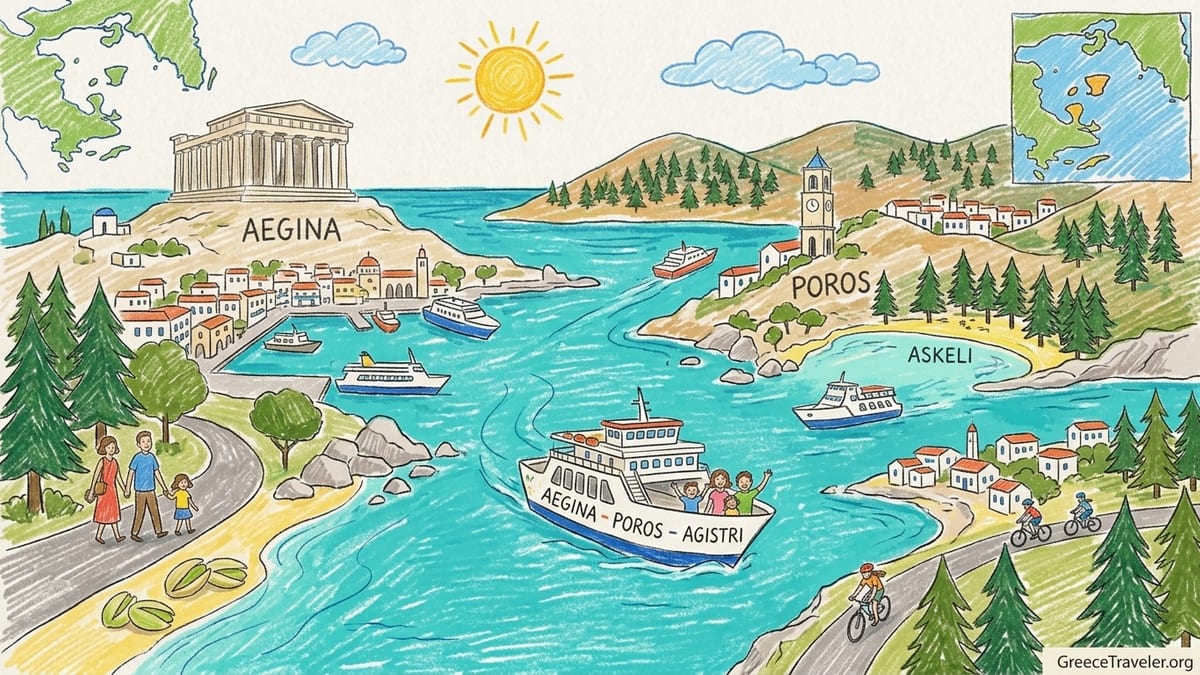
How quickly can you get from Athens to each island?
When you are travelling with children, the first big factor is journey time. All five islands sit in the Saronic Gulf, so you are looking at hours rather than half-day voyages, but there are meaningful differences. From Piraeus, high-speed ferries typically reach Aegina in about 40 minutes and conventional ferries in around 1 hour and 15 minutes, making it the quickest and most flexible option, with multiple departures daily in summer. Families often time an early morning sailing, have kids eating a bakery breakfast on deck, and still be in the sea at Marathonas Beach before lunch.
Agistri and Poros are the next easiest. Many high-speed services run Piraeus–Aegina–Agistri, reaching Skala or Megalochori on Agistri in roughly 1 hour to 1 hour 30 minutes, depending on stops. Poros usually sits on a Peloponnese route, with high-speed boats doing Piraeus to Poros in about 1 hour, and slower ferries in roughly 2 hours. In practice, that means you can leave Piraeus after the commuter rush and be checking into a family apartment near Askeli Beach early afternoon.
Hydra and Spetses are further out and feel more like “proper” trips than day escapes. High-speed ferries from Piraeus to Hydra generally take around 1 hour 45 minutes to 2 hours; Spetses can run to 2 hours 15 minutes or more, depending on intermediate stops. Families who choose these usually build in a snack-heavy crossing and accept that arrival will be closer to mid-afternoon. The reward is fewer day-trippers and a stronger sense of escape, especially outside peak August weekends.
One practical detail for all islands is that summer sailings sell out on Fridays and Sundays. For a smoother family experience, many parents opt for midweek departures, booking seats in advance and aiming for morning boats when children are fresher and seas are typically calmer.
Beaches and swimming: where the water feels made for kids
Poros, Aegina and Agistri all win points for accessible, family-friendly beaches, but in different ways. On Poros, Askeli Beach is the main family magnet: a long arc of sand-and-fine-pebble shore with shallow entry and a mix of free sections and organised parts with loungers, umbrellas, showers and a couple of low-key beach bars. A short taxi or bus ride away, Love Bay is a tiny, pine-fringed cove with calm, sheltered water that often feels like a natural swimming pool for confident younger swimmers.
Aegina offers more choice spread around the island. Marathonas Beach, about 10 minutes by bus or taxi from Aegina Town, is sandy with gradual depth and a row of tavernas where kids can eat grilled chicken or fries in their swimsuits between swims. On the opposite side of the island, Agia Marina is the largest resort beach, a long stretch of sand with sunbeds, water-sport kiosks in high season and a shallow shoreline suitable for splashy toddlers. Families who prefer quieter surroundings often base themselves near the smaller cove at Aeginitissa, where eucalyptus and other trees offer pockets of natural shade right behind the sand.
Agistri, though smaller, is almost purpose-built for simple beach days. Skala, where many ferries dock, has a wide, shallow beach with sandy sections and a promenade of tavernas and cafés directly behind it. The seabed stays shallow for several metres, so many parents let older children bob around on inflatables while they sit in the shallows. Just across the island, Dragonera and Aponisos are pine-backed coves reached by local bus, taxi or hired bicycles, where the water is clearer and slightly deeper but still calm, with basic sunbeds and snack shacks in summer.
Hydra and Spetses have more mixed beach situations. Hydra Town itself has rocky swimming spots and concrete platforms where older kids jump straight into deep water; proper beaches such as Vlychos, Kaminia and Bisti usually require a short boat ride or coastal walk. The water is clear, but access often involves pebbles or ladders rather than a classic sandy shelf. Spetses has more formal beaches near town, like Agios Mamas, Kaiki and Agia Marina, which offer a combination of sand and pebbles, sunbeds and often water-sports. These work well for reasonably confident swimmers and teens, though the seabed can slope more quickly than at Skala or Marathonas.
Poros vs Aegina vs Agistri: which layout works best with children?
Poros’s layout is a big reason it is frequently described as particularly family-friendly. The main town curls around a horseshoe harbour on one side of the channel, and many family apartments sit either in the town streets or along the coastal road towards Askeli. Distances are short, and the terrain around the town and main beaches is mostly flat or gently sloping. Parents often comment that they can push a stroller from their apartment to a bakery, pick up cheese pies, and continue to the beach in 10 minutes without needing a car.
Aegina has a larger footprint and more variety, which can be both a strength and a small complication. Aegina Town itself is relatively flat and easy to navigate with a stroller, but the best family beaches are spread out: Marathonas and Aeginitissa to the south, Agia Marina to the east, Vagia and Souvala to the north. This separation means you either choose a beach village as a base or factor in short bus or taxi rides into your daily rhythm. For some families, that is a positive, giving each day a small sense of adventure as you decide whether to head to a sandy cove or a pier with deeper water for older children.
Agistri is tiny, and that compactness is its charm. The two main villages, Skala and Megalochori, are linked by a coastal road that many visitors walk or cycle in the cool parts of the day. Skala in particular is almost a one-street town along the shore, with mini-markets, tavernas, rooms-to-let and the beach all within a few minutes’ walk. For families used to city traffic, it can feel liberating to let children walk ahead to the bakery or playground while parents follow. The trade-off is that in high summer, the narrow lanes and limited beachfront can feel busy.
If your priority is a gentle layout with minimal logistics, Poros and Agistri come out strongest, with Aegina slightly more spread but still manageable. In Poros, staying around Askeli or in the town lets you live largely car-free while still having variety; on Agistri, a base in Skala removes almost all daily complications, especially for shorter trips.
Getting around: buses, boats and car-light islands
On Poros, a small local bus and taxis link the town with Askeli, Neorio and the main beaches. Some families choose to rent a small car for a day to explore further-flung spots like Russian Bay and Vayionia, but many never do, relying instead on the bus, taxis and the occasional boat trip. The narrow channel between Poros and the mainland town of Galatas is crossed by frequent small ferries, making day outings for a supermarket run or a short drive into the Peloponnese straightforward if you really need a larger store or a clinic.
Aegina has the most developed public bus network of the five islands, with routes from Aegina Town to Marathonas and Perdika, and separate services to Agia Marina, Souvala and other villages in summer. Tickets are inexpensive, bought either at kiosks or directly from the driver, and buses are usually modern coaches with air conditioning. For families, this means teenagers can in time take the bus independently to meet friends at the beach, while younger children often enjoy the novelty of the short ride itself.
Agistri keeps things simpler: there is a small local bus connecting Skala, Megalochori and the more remote beaches in high season, but many visitors get around mostly on foot or by renting bicycles or e-bikes. Taxis fill in the gaps for evening restaurant trips or returning from Dragonera with sandy, sleepy children in tow. Boat taxis can sometimes be arranged informally between Agistri and Aegina for day excursions, although these are weather-dependent and usually organised locally.
Hydra and Spetses are the two notably car-restricted islands in this group. Hydra is fully car-free, with transport in the form of boats, water taxis and, for luggage, donkeys or small handcarts. That gives the harbour town a distinctive calm, but it also means a lot of walking and steps, which can be tiring for younger children or difficult with strollers. Spetses allows only limited local vehicles; for most visitors, movement is on foot, by bicycle, occasionally by horse-drawn carriage along the waterfront, or via water taxi and small buses to the more distant beaches. Families who value a quieter soundscape and are happy to walk usually find the trade-off worthwhile, especially in the evening when the promenades become relaxed, traffic-free strolling routes.
Family apartments, food and practical daily costs
All five islands have a healthy supply of simple family apartments and mid-range small hotels rather than large all-inclusive resorts. On Poros, the concentration of accommodation around Askeli and the town means plenty of self-catering studios with kitchenettes, small pools and sea views. A family might, for example, rent a two-room apartment a few minutes uphill from Askeli Beach, use the kitchenette for breakfasts and simple pasta dinners, and rely on the handful of nearby tavernas for relaxed evenings where children can play on the sand while adults finish their meal.
Aegina’s size translates into a wider range of options, from basic rooms in Aegina Town to family-run pensions at Marathonas, Agia Marina and Perdika. Prices in recent years have sat in the mid-range by Greek island standards, with simple family studios often more affordable in May, June and September than in peak August. Because the island has a local year-round population, you also find everyday services that keep costs reasonable: supermarkets with familiar brands, bakeries on many corners, and casual gyros shops where a family of four can still eat for less than a sit-down taverna meal.
Agistri’s accommodation stock is more compact and skewed towards small hotels and studios in Skala and Megalochori. Many are run by families themselves, so it is common to find owners who happily arrange baby cots, lend beach toys or recommend quieter coves for a windy day. You will not find major international brands here; instead, think two-star and three-star local hotels with balconies, simple furnishings and walking-distance access to both beach and tavernas.
On all three main islands, food is usually a highlight for parents and children alike. Waterfront tavernas typically serve fresh grilled fish, simple pasta, souvlaki, local cheeses and salads. Children quickly gravitate to grilled chicken skewers, fries, saganaki cheese and the occasional plate of meatballs in tomato sauce. In Aegina, pistachios are a local specialty, appearing in ice cream, pastries and as roasted snacks sold by the kilo near the port. Hydra and Spetses tend toward slightly higher prices overall, thanks in part to their more boutique profile, but you can still manage costs by alternating taverna dinners with supermarket picnics eaten on your balcony or the beach.
Beyond the beach: what can families actually do?
Poros offers an easy mix of simple excursions without long transfers. A popular low-effort outing is a small boat trip around the island’s coastline: children watch for fish in the clear water while parents enjoy the forested slopes and coves. On land, the clock tower above town is a short, manageable climb rewarded with views over the channel and the Peloponnese. Slightly older children might enjoy renting bicycles or e-bikes with parents to explore the coastal road towards Neorio and Russian Bay, stopping for swims along the way.
Aegina adds more overtly “cultural” options that can still work with children. The Temple of Aphaia above Agia Marina, set among pine trees with sea views, turns into a manageable myth-and-history outing if framed as a search for ancient carvings and “secret” corners rather than a formal tour. From Perdika, small boats run to the uninhabited islet of Moni in season, where older kids can snorkel in turquoise water and watch semi-wild deer and peacocks that wander the pine forest. Back in Aegina Town, a slow evening promenade along the harbour with pistachio ice creams in hand can be as memorable as any big-ticket activity.
Agistri’s appeal lies in simple, repeatable days. Families rent pedal boats in Skala, take gentle coastal walks between coves, or hire bicycles to ride the pine-shaded road to Dragonera for a swim and a lemonade at the beach cantina. There are no large museums or elaborate attractions; instead, the rhythm becomes beach, siesta, early evening play in the village square and taverna dinners where children inevitably make friends with local cats.
Hydra and Spetses excel at low-key exploration rather than structured attractions. On Hydra, older children often love the freedom of walking car-free lanes, climbing steps between stone houses and jumping from rocks into the deep blue water at organised swimming spots. There are small museums and historic mansions to visit, but the main experience is the harbour and its amphitheatre of houses. Spetses offers a longer coastal path and a more resort-like set of beaches; families might rent bicycles or, for those comfortable on two wheels, scooters or quads to complete a loop of the island, stopping at Agia Paraskevi or Zogeria for swims. Teens in particular tend to appreciate the combination of independence, beach clubs and relaxed nightlife that Spetses provides.
Where Hydra and Spetses fit in a family-focused Saronic trip
Hydra and Spetses are often mentioned in the same breath as Aegina, Poros and Agistri because they share the same gulf and are reachable from Athens without flights. For families, they make the most sense either as a second stop after a more straightforward base or for trips with older children and teens. Hydra’s complete absence of cars creates a magical first impression, but the many steps and rocky swimming access can be tiring for toddlers and anyone needing wheels. Families who do come with small children often book accommodation close to the harbour to reduce climbing, accept that strollers may be of limited use, and lean into slow days of café stops and boat trips to nearby beaches.
Spetses, while still largely car-free, has a slightly more resort-like infrastructure and is better suited to multi-generational groups or families with varied interests. Grandparents might take a horse-drawn carriage ride along the waterfront to a café at Kaiki Beach, while parents and teens rent bicycles or quads to explore more distant coves. Agia Marina becomes a default beach for days when you want full facilities and water-sports on tap. Because journey times from Athens are longer than for Aegina, Poros or Agistri, most families choose to stay at least three or four nights to make the trip worthwhile.
In a family-specific comparison, Poros, Aegina and Agistri still emerge as the “easy wins” for first-time Saronic trips, with Poros particularly applauded for sheltered swimming and a layout that keeps almost everything within stroller range. Hydra and Spetses layer on atmosphere, architecture and car-light charm that can be especially appealing on a repeat visit or with older children who appreciate wandering, photography and staying out a bit later in the evenings.
The Takeaway
If your priority is the most straightforward, child-friendly setup, Poros edges ahead. Its combination of sheltered beaches like Askeli and Love Bay, compact town, manageable gradients and reliable local transport makes everyday life with kids unusually easy. You can walk from apartment to bakery to beach without traffic stress, and sheltered swimming means more time in the water and less time worrying about waves.
Aegina is the all-rounder: the quickest hop from Piraeus, multiple sandy and shallow beaches such as Marathonas and Agia Marina, real local life and cultural trips to places like the Temple of Aphaia. It suits families who like a little daily variety and don’t mind short bus rides. Agistri is the small-scale option, ideal if you want a village-and-beach rhythm with almost no logistics, especially around Skala’s shallow shore.
Hydra and Spetses round out the picture as more atmospheric, occasionally pricier choices that shine for older children and teens. Hydra’s steps and rocky waterfront favour confident walkers and swimmers; Spetses’s spread-out beaches and loops by bike or scooter reward active families. For many travellers, a smart strategy is to start with a few easy days on Poros or Aegina, then add a shorter stay on Hydra or Spetses for a taste of car-free island life.
Whichever island you choose, the overall advantage of the Saronic Gulf is how forgiving it is for families: short sailings, predictable seas in summer, and a style of tourism still centred on simple pleasures. Shallow morning swims, bakery lunches under an umbrella, and evenings strolling along a harbourfront are the common thread. The main decision is how much you want to move around and how self-contained you want your base to be.
FAQ
Q1. Which Saronic island is best for a first family trip from Athens? Poros is often the easiest starting point thanks to its sheltered beaches, compact layout and straightforward 1 to 2 hour ferry journey from Piraeus.
Q2. Is Aegina suitable for families without a car? Yes. Aegina has one of the better bus networks in the Saronic Gulf, connecting Aegina Town with beaches like Marathonas, Perdika and Agia Marina, so you can rely on buses and taxis.
Q3. Is Agistri too small to keep children entertained for a week? For many families, a week on Agistri works well if you enjoy simple routines: beach time in Skala, bike rides to Dragonera or Aponisos, and relaxed evenings in the villages.
Q4. Are there sandy beaches or just pebbles on these islands? All three main family islands have sandy or sand-and-pebble options, including Askeli on Poros, Marathonas and Agia Marina on Aegina, and Skala on Agistri.
Q5. Which island is best if we are travelling with a stroller? Poros and Agistri are the most stroller-friendly because their main areas are largely flat and distances between accommodation, shops and beaches are short.
Q6. Are Hydra and Spetses a good idea with toddlers? They can be, but expect more walking, steps and rockier swimming. Many parents find them easier with school-age children or teens rather than toddlers in strollers.
Q7. How expensive are restaurants on these islands for a family? Casual tavernas remain good value: a family of four can usually share salads, grilled meats, a simple pasta and soft drinks for a moderate bill, especially outside peak August.
Q8. Can we combine more than one Saronic island in a single trip? Yes. Common combinations include Aegina with Agistri or Poros, or a week split between an “easy” base like Poros and a shorter stay on Hydra or Spetses.
Q9. Are there medical facilities if a child gets sick? Aegina, Poros and Spetses each have basic medical services or clinics, with more comprehensive hospitals available back in Athens, which is only a short ferry ride away.
Q10. When is the best time to visit the Saronic islands with kids? Late May, June and September are ideal, with warm seas and fewer crowds than August. July and August are livelier and hotter, with busier beaches and ferries.