


The Saronic Islands are Athens’ closest island escape: a string of green, low-key islands scattered across the Saronic Gulf, less than two hours from the capital. For first-time visitors to Greece, they offer an easy taste of island life without the long ferry rides of the Cyclades. This guide explains what makes the Saronic group different, how to get there from Piraeus, what to expect on each major island, and how to choose between a quick day trip, a single-island stay or a longer island-hopping holiday.
Saronic Islands vs Cyclades: What Makes Them Different
The Saronic Islands sit in the Saronic Gulf, the sheltered stretch of sea just south and southwest of Athens. Unlike the Cyclades, which are scattered further out in the central Aegean, the Saronics are much closer to the mainland. That proximity shapes everything: ferry journeys are shorter, seas are usually calmer, and many Athenians keep weekend houses here. As a visitor, you feel less cut off from the mainland and more like you have slipped into Athens’ maritime backyard.
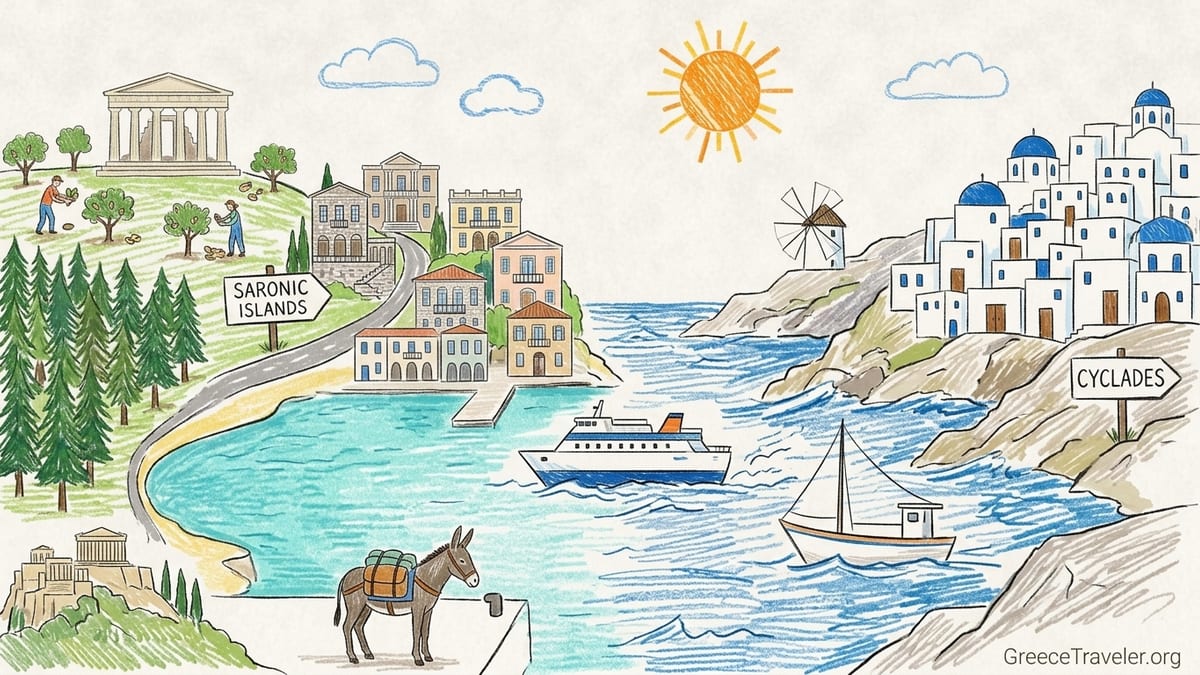
Visually, the Saronic Islands are softer than the stark Cyclades. Instead of bright white cubic houses on bare, windswept hillsides, you find neoclassical mansions in stone and pastel colors, pine forests running down to the water, and gently rolling hills rather than dramatic cliffs. Aegina town’s long waterfront of 19th-century facades and Hydra’s stone captains’ houses climbing amphitheatrically above the harbor feel a world away from the minimalist, sun-bleached look of islands like Mykonos or Ios.
The climate and sea conditions also contribute to a more relaxed experience. Summer winds in the Cyclades, known as the Meltemi, can whip up choppy seas and delay ferries. The Saronic Gulf is more protected, so sailings are generally smoother and more frequent in high season. This reliability matters if you are building tight connections around an international flight or have only a few days to spare.
Culturally, the Saronics feel lived-in year-round. Aegina, in particular, is a full-time commuter island for people working in Athens, with supermarkets, schools and local cafés that stay open in winter. That means slightly lower prices in many places than in the most famous Cycladic hotspots, and a dining scene that still caters to local tastes. You might still pay a premium for a seafront table in Hydra or Spetses in August, but you are less likely to encounter the party-first, ultra-luxury atmosphere that defines parts of the Cyclades.
How Close They Are to Athens and Understanding Ferry Access
All five islands in this guide, plus smaller Agistri, are linked to Athens by regular ferries from the port of Piraeus. For visitors staying in central Athens, Piraeus is about 25 to 40 minutes away by taxi depending on traffic, or around 30 minutes on the metro. Most Saronic ferries depart from Gate E8, which is clearly signposted within the port. In summer, there can be dozens of daily departures spread across the different islands.
Travel times vary depending on whether you choose high-speed catamarans or slower conventional ferries. As a broad guideline, high-speed crossings from Piraeus to Aegina can be as quick as around 40 minutes, and to Agistri roughly 55 to 70 minutes. Poros is often reached in about 1 hour 15 minutes on a fast boat, Hydra in roughly 1 hour 45 minutes to 2 hours, and Spetses in about 2 hours 15 minutes to 3 hours, often via intermediate stops such as Poros and Hydra. Slower ferries take longer but are usually cheaper and offer open decks for sea views.
Ticket prices fluctuate with season and operator, but as a rough reference point in recent seasons, a one-way high-speed ticket from Piraeus to Aegina has often fallen somewhere in the 20 to 30 euro range, while slower ferries can be noticeably less. Routes further along the chain, like Piraeus to Hydra or Spetses, are generally more expensive than the short hop to Aegina. It is prudent to book high-speed ferries in advance for July and August, especially on weekends, while for slower boats outside peak season you can often buy tickets on the day at the port.
Several companies operate on these routes, with day-cruise vessels and scheduled ferries sometimes sharing similar timetables. A common pattern is the line that runs Piraeus to Poros to Hydra to Spetses, which lets you use the same boat to connect between islands as well as to the mainland. When planning, it helps to build in a cushion of at least a couple of hours between your ferry arrival back in Piraeus and any same-day flight from Athens, to allow for minor delays and the transfer to the airport.
Island Personalities at a Glance: Aegina, Agistri, Poros, Hydra, Spetses
Each Saronic island has a distinct character. Aegina feels like a bustling, everyday Greek island town with serious heritage and a reputation for pistachios. Agistri is compact and relaxed, with a strong focus on swimming, camping and simple holidays. Poros is green and gentle, its waterfront lined with cafés that look across to the Peloponnese coast only a few hundred meters away.
Hydra is the star for many first-timers, a dramatic amphitheater harbor crowned with stone mansions and completely free of cars and motorbikes. Everything here moves either on foot, by donkey or by water taxi. Spetses, at the far end of the chain, is elegant and slightly more upscale, with horse-drawn carriages on the seafront, grand 19th-century mansions and wooded bays ideal for exploring by bicycle or small boat.
Because all five are relatively close together, it is tempting to try to see everything in one trip. For a very short visit, however, it often makes more sense to choose one island that matches your interests rather than rush through three in two days. If you imagine your ideal island memory, whether that is a sunset at a hilltop temple, an afternoon on a pine-fringed beach, or strolling past art galleries and yacht masts, that picture will guide your choice.
In practice, many visitors start with Aegina or Hydra for a first taste of the Saronics, then come back in a future trip for a fuller multi-island holiday. Others use Poros or Agistri as a quiet base for swimming and day trips, with one longer excursion to Hydra or Spetses factored in. The key advantage of this region is flexibility: you can adjust your plans even a day or two in advance, since ferries between the islands are frequent in summer and travel times are short.
Aegina: Easy Classic With History and Pistachios
Aegina is the closest and most practical island for an Athens side trip. On arrival in Aegina town after roughly a 40 to 70 minute crossing, you step straight into a working harbor lined with fishing boats, fruit stalls and pistachio vendors. The island is famous throughout Greece for its pistachios, which you will find sold in paper cones along the quay and in forms ranging from salted nuts to pistachio ice cream and local sweets in bakeries.
Beyond the harbor, Aegina’s main historical sight is the Temple of Aphaia, perched on a hill in the northeast of the island and often described as forming a triangle with the Acropolis and the Temple of Poseidon at Cape Sounion. Taxi drivers in Aegina town offer fixed-rate excursions that combine the temple with the 19th-century monastery complex at Agios Nektarios, one of the largest churches in Greece. Joining such a tour or arranging a local taxi is an efficient way for first-timers to see the highlights in a single day.
For beaches, Marathonas and Agia Marina are the most popular. Marathonas, a short taxi or bus ride from Aegina town, has several beachside tavernas where grilled fish and simple Greek salads are served at shaded tables only meters from the sand. Agia Marina, further east, has a long sandy beach backed by small hotels and rooms to let. Prices for a basic double room in shoulder season are often more modest here than on Hydra or Spetses, which makes Aegina attractive for budget-conscious travelers.
Aegina works very well as a day trip, a quick one-night escape from Athens or as the first stop on a longer Saronic itinerary. If your priority is to minimize travel time and costs, or you are traveling with children and want an easy journey with plenty of facilities, Aegina is usually the most straightforward choice.
Agistri and Poros: Green, Relaxed and Ideal for Swimming
Agistri is a small, pine-covered island a short hop beyond Aegina. Many ferries from Piraeus call at both, so you can reach Agistri either directly by high-speed or by taking a slower boat and changing in Aegina. The main settlements, Skala and Megalochori, are connected by a coastal road that can be walked or cycled comfortably. The mood is simple and low-key, with small family-run hotels, beach bars and one main supermarket supplying most needs.
The island’s star attraction is its clear, shallow water and beaches. Aponisos, on the southwest coast, is a rocky islet connected by a short causeway where a small beach club runs a paid swimming area. It is not a luxury operation, but it does offer sunbeds, umbrellas and basic food and drink, with vivid turquoise water that many visitors compare favorably with more famous Greek islands. Dragonera and Chalikiada are other popular swimming spots; the latter attracts campers and is reached by a short path down from the road through pine trees.
Poros, slightly further along the Saronic chain, actually consists of a narrow strait separating the island of Sferia from the Peloponnese. Poros town climbs amphitheatrically from the harbor, watched over by a white clock tower. Its seafront is lined with cafés where locals sip coffee while looking across to the small town of Galatas on the mainland, reached in a couple of minutes by local ferry.
Poros’ beaches are scattered along the north coast, with Askeli and Love Bay among the best known. Askeli has a long stretch of sand and shingle backed by hotels and simple beach clubs renting sunbeds. Love Bay is smaller and framed by pines, popular in summer for its calmer waters and slightly more secluded feel. Boat and kayak rentals are widely available for exploring the coastline, and prices are often marginally lower than on Hydra and Spetses because Poros caters to a mix of Greek and international visitors with varying budgets.
Hydra and Spetses: Car-Free Charm and Elegant Escapes
Hydra is one of Greece’s most distinctive islands, largely because it has banned private cars and motorbikes from its main settlement. The harbor is a tight horseshoe lined with stone mansions, art galleries and cafés, with donkeys and mules waiting near the quay to carry luggage up the steep lanes. Water taxis line the inner harbor, ready to shuttle visitors to small coves and beaches along the coast such as Vlychos, Plakes and Bisti.
Hydra does not have wide sandy beaches, but it excels in atmosphere. Swimming platforms carved into the rocks at Hydra town itself allow you to walk straight from stone steps into deep, clear water, while pebbly coves at Vlychos or Kaminia are reached by walking paths or water taxi within 20 to 40 minutes. The island has long attracted artists and writers, and in recent years boutique hotels and stylish guesthouses have filled restored mansions. Room prices in high season reflect demand, particularly for harbor-view accommodation, so booking early can make a clear difference.
Spetses, at the southern end of the Saronic group, is also largely free of private cars in its main town, with restrictions applying in the central area. Instead you see bicycles, scooters, small public buses and traditional horse-drawn carriages trundling along the waterfront promenade. The old harbor area, with its stone shipyards and archways, is especially atmospheric at night when tavernas and bars spill out onto the quay.
Spetses is bigger than Hydra and has more beaches, many backed by pine forest. Kaiki Beach and Agia Marina are among the closest to town, while Zogeria and Vrellos are popular for clearer water and more natural surroundings, reached by boat or road train in summer. Accommodation leans towards the mid to upper range, with a handful of historic hotels near the port and many elegant villas on the slopes above the town. Spetses is a good fit if you want a slightly refined atmosphere with more beach variety than Hydra, yet still prefer a car-light environment.
Beaches, History and Sailing: What To Do Across the Saronics
The main shared pleasure of the Saronic Islands is simple: swimming in relatively calm, clear water. Because the gulf is sheltered, water temperatures from late May to early October are usually comfortable, and many beaches are protected from stronger winds. Families often favor Aegina’s Marathonas or Agia Marina, Agistri’s Aponisos, Poros’ Askeli, Hydra’s family-friendly Vlychos, and Spetses’ Kaiki and Agia Marina. You will find a mix of organized beaches with sunbeds and umbrellas available for a daily fee and unorganized coves where you simply lay your towel on the sand or rocks.
Historically minded visitors have plenty to explore as well. Aegina’s Temple of Aphaia is the stand-out ancient site in the Saronic group, often visited in combination with Agios Nektarios monastery on a half-day circuit by taxi or rental car. Hydra’s history is visible in its maritime museums and preserved captains’ mansions around the harbor, some open to the public at set hours. Spetses has its own maritime heritage, commemorated in museum houses that tell the story of the island’s role in the Greek War of Independence.
Sailing is a natural fit for the region. The cluster of islands within relatively short distances makes the Saronic Gulf a popular training ground for yacht flotillas and crewed charters. It is common to see small fleets of sailboats moored overnight in protected bays on Poros or tucked into tiny harbors on Hydra and Spetses. For first-time visitors who do not sail, day cruises from Piraeus that call at three islands in one day, such as a classic route combining Poros, Hydra and Aegina, offer a simple way to sample the area on a fixed timetable that includes lunch on board.
Independent travelers can also hop between islands using regular ferries. For example, you might spend two nights in Poros, then take a morning ferry to Hydra for another two nights, followed by a final stop in Spetses before returning to Piraeus via a direct high-speed boat. Because all of these ferries use the same basic coastal route, you can often buy each leg separately rather than committing to a package. That flexibility allows you to adjust for weather or simply stay longer on an island that you especially enjoy.
Choosing Between a Day Trip, One-Island Stay or Multi-Island Holiday
If you have only one free day in Athens and want a straightforward taste of island life, Aegina is usually the most practical choice. An early morning ferry from Piraeus allows you to be strolling along Aegina’s harbor by mid-morning, with time to visit the Temple of Aphaia, swim at a nearby beach, have a seafood lunch by the water and still be back in Athens by evening. Organized day cruises that visit multiple islands are a good fit if you prefer a fully planned schedule where transport and meals are bundled into one price.
Hydra can be done as a long day trip, especially on a high-speed boat, but it is often more rewarding as an overnight or two-night stay. Waking up on the island, wandering the cobbled lanes before the day-tripper crowds arrive, or watching the sunset from the rocky swimming platforms at Kaminia are experiences that feel more special when you are not rushing to catch the last ferry. Similarly, Spetses deserves at least one or two nights to justify the longer travel time and to explore the ring road by bicycle, scooter or public bus.
A one-island stay makes sense if you have three to five nights and want to unpack once. Aegina is best if you want an affordable base with good connections, supermarkets and easy access back to Athens. Agistri suits travelers who prioritize beaches and do not mind a limited nightlife scene. Poros is ideal if you like greenery, a traditional harbor town and the option to pop over to the Peloponnese. Hydra works for those drawn to art, architecture and a pedestrian environment, while Spetses is great for couples or families seeking an elegant but relaxed holiday with several different beaches to rotate between.
For a full week or more, a multi-island holiday is very achievable. A classic combination is Aegina or Agistri for swimming and a slower pace, followed by Poros and Hydra for atmosphere, and ending in Spetses for beaches and a touch of refinement. You could, for example, spend two nights in Aegina, two in Poros, two in Hydra and two in Spetses, using high-speed ferries between each leg. This pattern spreads your travel time and lets you experience how the mood changes as you move further down the gulf.
Practical Tips for First-Time Visitors
First, pay attention to your arrival time in Athens when planning a same-day ferry. If your flight lands late afternoon or evening, it is usually wiser to spend the night in Athens and travel to the islands the next morning, rather than risk missing the last boat. Piraeus is a busy working port, so plan at least 30 minutes to find your gate, buy or collect tickets and board. In summer, ferries can be crowded on Fridays and Sundays as Athenians head to and from their weekend houses.
Luggage is handled relatively informally. On most ferries, you either carry your bag to a luggage rack near the entrance or keep it with you if it is small. On high-speed catamarans, staff may direct you to a designated luggage area by the boarding door. It is sensible to keep valuables and travel documents in a smaller day bag that stays with you at your seat. On car-free or car-light islands such as Hydra and central Spetses, porters with handcarts, donkeys or small hotel vehicles often meet boats to help with luggage for a fee or as part of hotel service.
Costs vary across the islands but some patterns are clear. A simple lunch of grilled fish or meat, a salad and a soft drink near the water on Aegina or Poros might come to a moderate sum for two people, while a similar meal in a prime harbor-view spot on Hydra or Spetses can be noticeably higher, especially in August. Coffee prices also rise with the view; you will often pay less a couple of streets back from the waterfront. Small grocery shops sell basics like water, fruit and snacks at near-mainland prices, which can help manage your budget on longer stays.
Finally, consider seasonality. The main season runs from late May to late September, when ferries are most frequent, sea temperatures are warmest and most businesses operate full hours. April, early May and October can be wonderful for walking and sightseeing, with milder temperatures and fewer crowds, but sea swimming may feel cool to some visitors and fewer high-speed departures may run each day. In winter, some smaller hotels and tavernas close, but Aegina in particular remains lively as a commuter island.
FAQ
Q1. Are the Saronic Islands suitable for a first trip to Greece? Yes. Their proximity to Athens, shorter ferry trips and relatively calm seas make them ideal for first-time visitors who want an easy taste of Greek island life without complex logistics.
Q2. Which Saronic island is best for a single day trip from Athens? Aegina is usually the best choice for a day trip because it is the closest, has frequent ferries, offers both beaches and major sights like the Temple of Aphaia, and has plenty of cafés and tavernas near the port.
Q3. Can I visit more than one Saronic island in a day? Organized day cruises commonly combine three islands such as Poros, Hydra and Aegina in one long day, and scheduled ferries can also allow a Hydra plus Aegina or Aegina plus Agistri pairing, but you will only have limited time on each stop.
Q4. Are Hydra and Spetses really car-free? Hydra is effectively car-free in its main settlement, with transport by foot, donkey and water taxi. Spetses limits cars in the central areas, so most visitors get around on foot, by bicycle, scooter, bus or horse-drawn carriage along the seafront.
Q5. How far in advance should I book ferries and accommodation? For July and August, booking ferries and accommodation at least a few weeks ahead is sensible, especially for Hydra and Spetses. In shoulder seasons like May, June and September, you often have more flexibility, though weekend ferries can still fill.
Q6. Is it easy to island hop between Aegina, Agistri, Poros, Hydra and Spetses? Yes, during the main season regular ferries run a coastal route that links Piraeus, Aegina, Agistri, Poros, Hydra and Spetses, making it straightforward to combine two or more islands in one holiday with relatively short travel times.
Q7. Do I need a car on the Saronic Islands? In most cases you do not. Aegina and Poros have buses and taxis that cover main beaches and sights, while Agistri is compact enough for walking and cycling. Hydra and central Spetses restrict cars, so walking, water taxis and bicycles are the norm.
Q8. What should I budget for a simple meal on the islands? Prices vary, but a modest taverna meal of a main dish, shared salad and a drink on Aegina, Agistri or Poros is typically moderate. Expect higher prices in prime harbor-front spots on Hydra and Spetses, especially in peak season.
Q9. When is the best time to visit the Saronic Islands? Late May to late September offers warm seas and frequent ferries. June and September often provide a balance of good weather and fewer crowds, while July and August are busiest and warmest with the most boat options.
Q10. Can I combine a Saronic Islands trip with a longer mainland itinerary? Yes. Many travelers spend a few days in Athens, then add two to six nights on the Saronic Islands, or pass through Piraeus on the way to or from the Peloponnese. The short ferry times make it easy to fit the islands into a wider Greek journey.