


Close enough to Athens for easy access but far enough to feel like a true escape, the Saronic Islands are where many Greeks themselves slip away for long weekends. With around 1,500 properties listed across Aegina, Agistri, Poros, Hydra and Spetses, choosing the right base can be more confusing than booking the ferry. This guide focuses on where to stay, comparing the main islands and then the key areas within each so you can match your base to your style of trip, whether that means simple beach days, family-friendly value, romantic evenings on car-free harbors or a more polished island holiday.
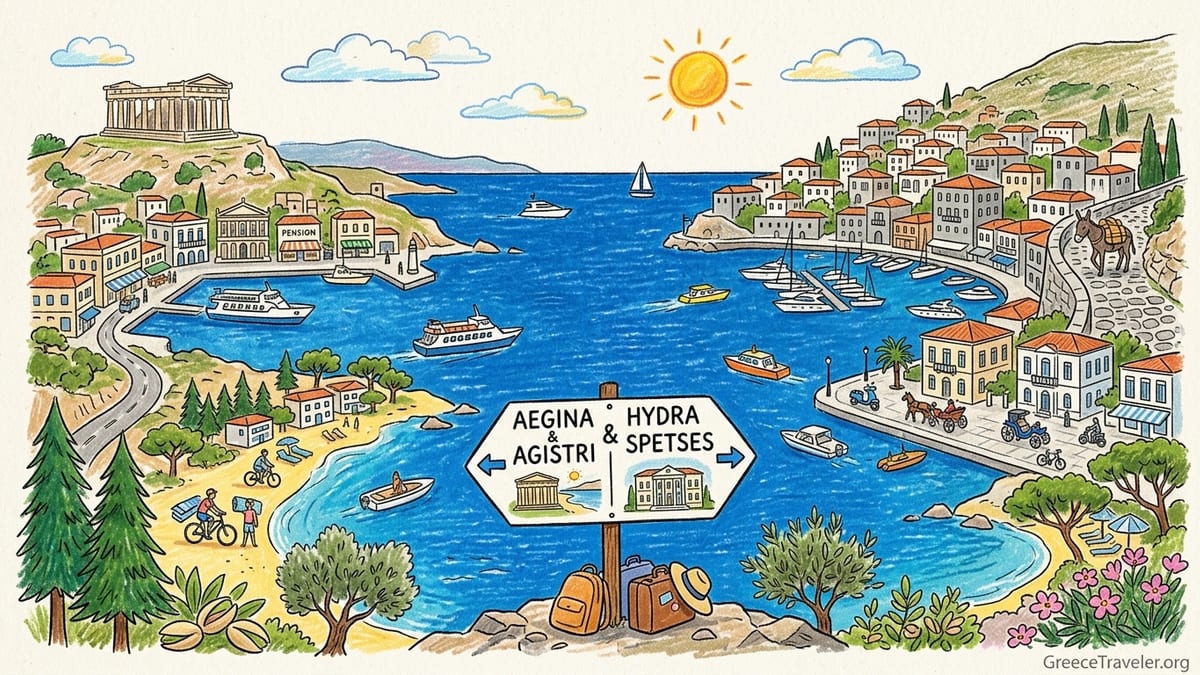
How to Choose Between the Saronic Islands as a Base
All five main Saronic Islands are within roughly 1 to 3 hours by ferry from Piraeus, which makes them ideal for short breaks and first-time trips to Greece. Aegina tends to be the default choice for its frequent ferries, year-round life and wide variety of areas, from the busy main town to the more low-key resort of Agia Marina. Agistri is smaller and quieter, essentially a simple beach island where you can walk between most places and fall asleep to the sound of cicadas. Poros combines a lively waterfront town with wide, pine-framed beaches that work especially well for families and for travelers looking for good value.
Hydra and Spetses feel more like classic “holiday islands,” which is why they attract more international visitors and higher prices. Hydra is entirely car-free, with donkeys, handcarts and water taxis taking the place of cars and buses, and its main harbor fills with yachts, day-trippers and couples looking for romantic evenings on the quay. Spetses allows limited vehicles, but most visitors still move around by foot, bicycle or scooter, and the tone is more sophisticated: neoclassical mansions, boutique hotels and stylish beach clubs frequented by Athenians on summer weekends.
When deciding on a base, think first about convenience and travel time, then about atmosphere. If you want to step off the ferry and be in the middle of shops, tavernas and onward buses, Aegina Town, Poros Town and Hydra harbor are strong contenders. For a softer, more relaxing stay where the center of life is the beach, Agistri’s Skala, Aegina’s Agia Marina, Poros’s Askeli and several beaches on Spetses are better fits. Because the islands are small, you can explore widely from any base, but your choice of village will shape the mood of your trip.
Prices vary by island and by season, but as a rule of thumb Aegina, Agistri and Poros are usually more affordable than Hydra and Spetses. In July and August, a simple double room on Aegina or Agistri might start from the lower mid-range per night, while a similar room with a harbor view on Hydra or Spetses may easily be significantly higher. If your dates are flexible, June and September bring softer light, warm seas and noticeably better value.
Aegina: Convenience and Variety
Aegina is the workhorse of the Saronic Islands, busy with commuters and weekenders from Athens, day-trippers, and longer-stay visitors. Frequent ferries and high-speed boats connect Piraeus to Aegina Town in around 40 to 75 minutes, and some services continue to Agia Marina on the east coast. This connectivity, plus a wide mix of accommodation and the presence of supermarkets, ATMs and year-round tavernas, makes Aegina an easy first island in Greece.
Aegina Town is the island’s main harbor and most practical base if you want a bit of everything without relying heavily on taxis. Along the waterfront you will find simple pensions above cafes, mid-range hotels and a few more polished boutique options tucked into side streets. Staying here puts you within walking distance of the daily fish and vegetable market, bakeries, and the evening stroll along the harbor, where caiques bob in front of pastel neoclassical facades. From town, buses run to Agia Marina, Perdika and other villages, and it is easy to join boat trips to nearby Moni islet for a day of swimming with deer wandering in the pine forest behind the beach.
Agia Marina, on the east coast around 15 to 20 minutes by bus or taxi from Aegina Town, is the island’s main beach resort. The sandy bay is lined with family-run hotels, rental studios and casual tavernas, and in summer the shallow water is busy with inflatable toys and children learning to swim. This is a good choice if you want to step out of your room and be on the beach in under a minute, and if you prefer to spend most of your holiday between sunbed, taverna and an evening drink on a balcony rather than exploring every corner of the island. Agia Marina also sits close to the Temple of Aphaia, one of Greece’s most impressive ancient sites outside the mainland’s big names, which makes it easy to combine culture and sea without a long journey.
Beyond these two hubs, smaller places like Perdika on the southwest offer a quieter village feel and easy boat access to Moni, while inland hamlets provide traditional stone houses, pistachio orchards and views across the Saronic Gulf. These are best suited to repeat visitors or those renting a car, since bus services may be infrequent. For most first-time visitors, the choice on Aegina comes down to the urban, year-round life of Aegina Town versus the beach focus of Agia Marina.
Agistri: Simple Beach Stays and Walkable Villages
Just across the water from Aegina, Agistri is a compact green island, roughly 13 square kilometers in size, that feels markedly more relaxed. Ferries usually dock either in Skala, on the northeast coast, or at Megalochori (often called Mylos) just to the west, and the two settlements are only about 2 kilometers apart, linked by a coastal road and a level seafront walk that takes around 20 to 25 minutes. Many visitors explore Agistri by rented bicycle, e-bike or scooter, and it is common to see people in swimsuits pedaling between beaches with a towel over their shoulder.
Skala is the practical and family-friendly choice. The main sandy beach stretches out along the waterfront, backed by small hotels, rooms-for-rent, cafes and ice cream shops, and the shallow water stays calm in most weather. For a typical stay, you might check into a mid-range hotel directly on the sand, have breakfast on a terrace overlooking the bay, spend the morning swimming or renting a paddleboard, and then walk to a nearby taverna for grilled fish. In the evening, Skala has enough tavernas and low-key bars to feel lively but rarely overwhelming.
Megalochori, by contrast, is the island’s official capital and a quieter port village with narrow lanes and more local life. Some travelers prefer to stay here for a less touristy atmosphere, waking up to the sound of church bells and roosters rather than beach bars. Small guesthouses and apartments sit a few minutes’ walk back from the sea, and the coastline between Megalochori and Skala is a long fringe of pebbly and sandy patches where you can slip into the water away from the main beach crowds. This base suits couples and solo travelers who prioritize calm and do not mind walking or cycling to Skala for a more developed beach or evening options.
From either Skala or Megalochori, it is straightforward to reach other swimming spots such as Skliri and the more rugged cove at Chalikiada, as well as the west-coast beaches of Dragonera and Aponisos, where pine trees reach almost to the water. Because distances are short and there is essentially one main road, you can comfortably explore the whole island without a car. For most visitors, the key decision is whether to be directly in Skala’s beach-and-taverna bubble or in the quieter village streets of Megalochori.
Poros: Families, Beaches and Good Value
Poros sits closer to the Peloponnese mainland than to the other Saronic islands, separated from the town of Galatas by a narrow, photogenic channel. The ferry from Piraeus typically takes between 1 and 2.5 hours depending on the route, and small local boats shuttle constantly across to the mainland. The inhabited part of Poros effectively has two sides: the compact, amphitheater-shaped Poros Town on the islet of Sferia, and the larger pine-covered Kalavria across the canal, where many of the beaches and resort-style accommodations are found.
Poros Town itself is a classic harbor settlement, its hillside layered with white and pastel houses topped by a prominent clocktower. Staying here places you in the middle of waterfront life, with cafes, bakeries and tavernas at street level and pensions and small hotels above. Rooms with balconies overlooking the channel see a constant parade of fishing boats, sailing yachts and ferries sliding silently past, and at night the lights of Galatas twinkle across the water. This is an excellent base if you enjoy strolling the quay, browsing small shops and catching buses or taxis to beaches during the day.
Askeli, on the Kalavria side a short bus, taxi or even long walk from Poros Town, is the island’s main organized beach area. The sandy arc of Askeli beach offers sunbeds, water sports, beach bars and a deeper stretch of sea that suits confident swimmers and families with older children. Many mid-range hotels and apartment complexes sit just across the quiet road from the water, which means a typical stay here can be very simple: breakfast on a balcony, a few steps to the sand, a break for lunch at a taverna under the pines, then back to the sea. Prices on Poros are generally competitive compared with more famous Greek islands, which makes Askeli appealing for families seeking space and amenities without a luxury price tag.
Further along the coast from Askeli, beaches like Neorio and Love Bay offer shaded sand and pebbles under thick pine trees. Accommodation here is more scattered, often in small hotels or rental houses with sea views. These areas suit guests who prioritize tranquility and greenery over walking distance to town. From any of these bases, taxis and local buses still make it easy to nip into Poros Town for evening meals or a change of scene, so the choice is largely about how close you want to be to the main harbor versus the beaches.
Hydra: Romance and a Car-Free Harbor
Hydra is the most distinctive of the Saronic Islands because it is entirely car-free. The main port is a perfect stone amphitheater of gray mansions and terracotta roofs around a horseshoe-shaped harbor, with donkeys and mules waiting on the quay to carry luggage and supplies up the steep lanes behind. High-speed ferries from Piraeus typically take around 1.5 to 2 hours, and when you step off the boat you are immediately in the heart of the action: cafes, galleries, boutique hotels and yacht moorings are all within a few minutes’ walk.
Most visitors stay around Hydra harbor itself, where accommodation ranges from simple guesthouses tucked into back alleys to high-end restored mansions with shaded courtyards and stone pools. This is the place for those classic Hydra experiences: taking a morning coffee while watching water taxis come and go, strolling the circular coastal path to the tiny settlement of Kamini, and returning in the evening to candlelit dinners along the waterfront. Couples in particular appreciate being able to walk everywhere, from sunset viewpoints to small galleries and jewelry shops, without ever needing a vehicle.
Because space around the harbor is limited, rooms with a direct harbor or partial sea view command a significant premium, especially in July and August and on long weekends in May and June. Budget-conscious travelers can find better value by staying slightly uphill or a few minutes’ walk back from the sea, where traditional stone houses have been divided into apartments and small hotels. The walk back may involve steps and cobbles, so this option suits reasonably fit guests, but the reward is quieter nights and often broader views over the rooftops and bay.
Beyond the main harbor, a handful of accommodations sit in smaller coastal hamlets like Kamini and Vlychos, reached on foot along the coastal path or by water taxi. These spots are good for repeat visitors or those who want to be right above a small swimming platform or pebbly cove rather than in the center of town. For most first-time visitors, however, staying in or very near the harbor keeps logistics simple and maximizes time spent soaking up Hydra’s unique car-free atmosphere.
Spetses: A More Sophisticated Island Holiday
Spetses, at the southern edge of the Saronic Gulf, has a long history as a naval island and a present as one of the preferred escapes for affluent Athenians. The main town curls around Dapia port and continues along the waterfront to the Old Harbor, lined with neoclassical mansions, palm trees and polished stone promenades. While cars are restricted in the central areas, you will see horse-drawn carriages, scooters, bicycles and a limited number of taxis. High-speed ferries from Piraeus usually take just over 2 hours.
Staying near Dapia places you at the everyday heart of the island: ferries, sea taxis, bakeries, supermarkets, banks and many casual cafes. Here you will find smaller hotels and guesthouses on side streets, with some rooms overlooking the port and others facing courtyards. A typical day might involve breakfast on a terrace, then a walk to the bus or boat stop to reach one of the beaches farther along the coast, returning in the evening to join the promenade along the harbor and perhaps a drink at a bar where locals and visitors mingle.
The Old Harbor area, a 10 to 20 minute walk or short carriage ride from Dapia, feels more atmospheric and is home to several of the island’s most characterful boutique hotels and fine-dining restaurants. At night, lights from yachts moored in the natural bay reflect off the water, and the stone quayside becomes a long open-air dining room. This area suits travelers wanting a more polished holiday, with cocktail bars, artful cuisine and late-night energy that still feels more stylish than raucous.
Several of Spetses’s best-known beaches lie farther from town, including organized stretches with sunbeds and beach clubs as well as quieter coves backed by pines. Many visitors choose to rent a bicycle, e-bike or scooter for a day or two to circle the island, stopping to swim at remote spots where the water turns deep turquoise. Some higher-end resorts and villas are set near these beaches, often with shuttle services or their own small piers. If you stay here, you trade some immediate access to town for a more resort-like, self-contained experience, which can be ideal for longer stays or for visitors who plan to spend most days by the sea.
Comparing Key Areas: Town vs Beach, Harbor vs Hillside
Across the Saronic Islands, a common question is whether to stay in the main town or closer to a beach. On Aegina, this is most often a choice between Aegina Town and Agia Marina. Aegina Town gives you multiple ferry options, evening life, access to buses around the island and a more “local” feel, with year-round residents and businesses. It is the better base if you plan to explore widely, visit archaeological sites, and enjoy different tavernas each night. Agia Marina, in contrast, is for travelers who want nearly everything within a short walk: sandy beach, beachfront hotels, casual restaurants and simple nightlife centered around a single promenade.
On Agistri, the decision is Skala versus Megalochori. Skala is the obvious first choice for families and anyone who wants to step off the ferry and straight onto a sandy beach lined with tavernas and rental shops. The atmosphere is holiday-oriented and sociable. Megalochori, a short walk or bus ride away, offers a more low-key vibe, with traditional houses, a small harbor and a coastline that feels less built up. You may trade immediate beach access for quieter evenings and a bit more authenticity, while still being close enough to enjoy Skala’s facilities when you wish.
Poros presents a similar split between Poros Town and Askeli. Staying in Poros Town brings you charming backstreets, a range of dining options and easy transfers, with beaches reached by short bus or taxi rides. Askeli places you right by the sand, with several mid-range hotels and apartments popular with families who value being able to pop back to their room from the beach in minutes. Because Poros is compact, you can comfortably shuttle between the two; it is common for guests staying at Askeli to head into town most evenings for dinner or a stroll by the harbor.
Hydra’s main contrast is between staying immediately around the harbor versus a short walk uphill or along the coast. Harborfront rooms are about as central and romantic as it gets, but usually come with higher prices and more noise from cafes and boats, especially in high season. Rooms a few streets back or higher up offer better value and quieter nights, at the cost of a short walk on stepped lanes. On Spetses, the practical choice is between being in or near Dapia for convenience, closer to the Old Harbor for atmosphere and nightlife, or near one of the beaches for a more resort-style holiday. All are connected by coastal roads and paths, so you can combine experiences even if you commit to one base.
The Takeaway
Selecting the right base in the Saronic Islands is less about finding a single “best” place and more about matching an island and neighborhood to the way you like to spend your days. Aegina works well if you prioritize convenience, short ferry rides and a mix of town life, beaches and historical sites. Agistri is ideal for simple, car-free beach stays where you can walk or cycle almost everywhere. Poros offers an appealing blend of value, family-friendly beaches and a characterful harbor town. Hydra is for romance and atmosphere, where stone mansions rise steeply above a car-free harbor and evenings linger over candlelit dinners. Spetses provides a more sophisticated holiday setting, with stylish hotels, polished promenades and easy access to pine-fringed coves.
Once you have chosen your island, think carefully about which village or neighborhood suits your priorities: town or beach, harborfront or hillside, central buzz or quiet evenings under pine trees. With Booking and similar platforms listing roughly 1,500 properties across the Saronic Islands at any given time, availability is usually good outside peak dates, but the most atmospheric guesthouses and best-value beachfront rooms on Hydra and Spetses in particular can book up months in advance. Plan ahead for July and August, consider shoulder-season travel for softer prices and lighter crowds, and remember that even a simple room a short stroll from the sea can feel luxurious when the Aegean is on your doorstep.
FAQ
Q1. Which Saronic island is best for a first-time visitor without a car?
Aegina is usually the easiest choice for first-time visitors without a car because it has frequent ferries, a proper town with services, and reliable buses to beaches like Agia Marina and villages such as Perdika. Poros Town is a close second thanks to its walkable harbor and short transfers to nearby beaches.
Q2. Is Agistri too small for a week-long holiday?
Agistri is compact, so a week will feel very slow-paced unless you enjoy repeating the same beaches and walks. Many travelers find 2 to 4 nights ideal, combining Agistri with time on Aegina, Poros or in Athens. A longer stay can work if your priority is pure relaxation and swimming.
Q3. Where should families with young children stay in the Saronic Islands?
For families with younger children, Skala on Agistri, Askeli on Poros and Agia Marina on Aegina all work well. These areas offer shallow or gently shelving beaches, accommodation close to the sea, and plenty of casual tavernas where children are welcome and mealtimes can be flexible.
Q4. Which island is most romantic for couples?
Hydra is often considered the most romantic, with its car-free harbor, stone mansions and candlelit waterfront dinners. Spetses also appeals to couples looking for a slightly more upscale feel, especially around the Old Harbor area with its neoclassical buildings and stylish bars.
Q5. Are Hydra and Spetses much more expensive than Aegina, Agistri and Poros?
In general, accommodation and dining on Hydra and Spetses are more expensive, especially for harborfront or sea-view rooms and higher-end restaurants. However, those on a moderate budget can still find simpler guesthouses slightly back from the water, particularly outside peak summer months.
Q6. Is it better to stay in Aegina Town or Agia Marina?
Aegina Town is better if you want easy access to ferries, a wider choice of tavernas and shops, and buses around the island. Agia Marina is preferable if your focus is on a sandy beach, staying close to the water and having most things within a short walk, with quick access to the Temple of Aphaia.
Q7. How many nights should I spend on Poros?
Poros works well for anything from a quick 2-night stay to a full week. Short stays suit visitors combining Poros with other islands, while longer visits are attractive for families who appreciate Askeli’s beach and the island’s good value, using Poros Town as a base for relaxed days by the sea.
Q8. Can I visit multiple Saronic Islands on one trip?
Yes, it is quite practical to combine islands such as Aegina and Agistri, or Poros with Hydra and Spetses, using ferries that link Piraeus and the Saronic Gulf. Just be mindful that ferry timetables may be more limited outside peak season, so check schedules and plan at least one or two nights on each island rather than relying on day trips alone.
Q9. Do I need to book accommodation far in advance?
For July, August and Greek holiday weekends, it is wise to book popular areas like Hydra harbor, Spetses Old Harbor, Askeli beach and central Aegina Town several months ahead. In June, September and shoulder seasons, you will usually find more options closer to your travel dates, though especially charming small hotels can still fill quickly.
Q10. Which Saronic island is best value for money?
Poros, Aegina and Agistri generally offer the best value, with a wide range of mid-range and budget-friendly rooms and many reasonably priced tavernas. Hydra and Spetses provide a more polished atmosphere but at higher average prices, so they suit travelers willing to spend more for setting and style.