


Athens makes it remarkably easy to add a taste of island life to your city break. The classic Saronic Islands day cruise to Hydra, Poros and Aegina packs three very different islands into one long day at sea, with hotel transfers, lunch and entertainment bundled into a single ticket. At the same time, frequent ferries from Piraeus allow independent travelers to design slower, more flexible day trips to just one island, often for less. This guide compares both approaches in practical detail so you can decide whether to book a three-island cruise or hop a regular ferry to one Saronic island instead.
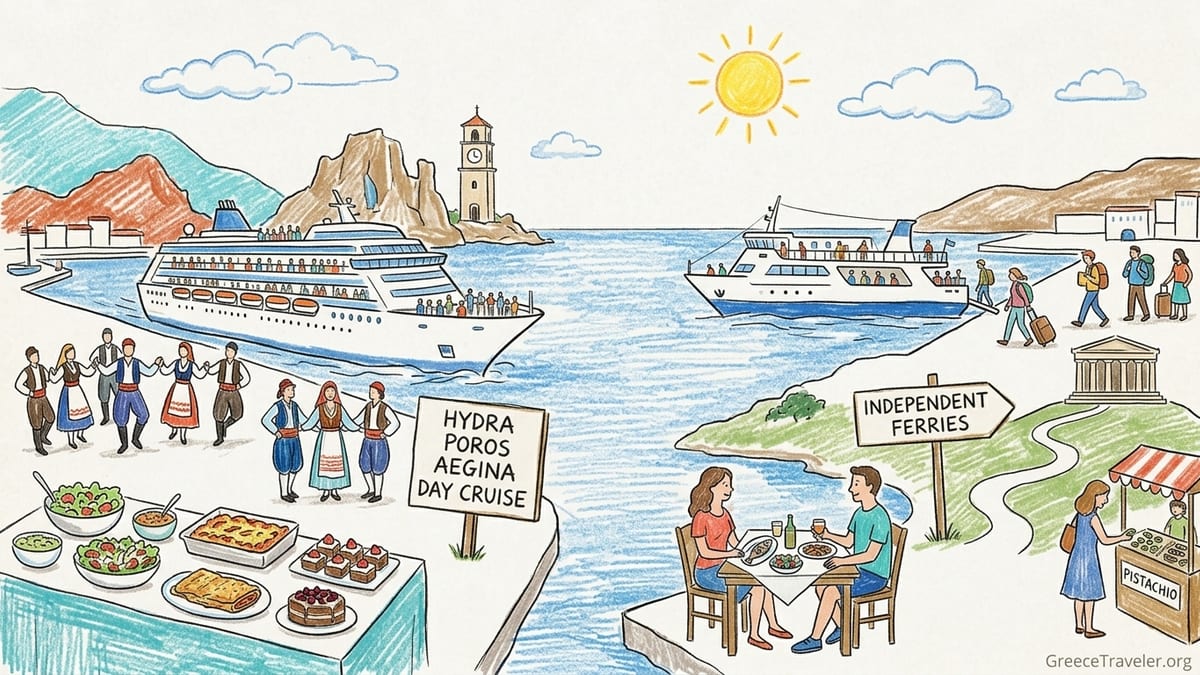
What the Hydra–Poros–Aegina Day Cruise Actually Looks Like
Several operators in Athens sell almost identical one-day cruises that visit Hydra, Poros and Aegina. A typical day starts with an early pick up in central Athens between about 6:30 and 7:30 in the morning, followed by a coach transfer to a port east or south of the city or to Piraeus itself. You then board a large multi-deck cruise vessel designed specifically for this route, often carrying several hundred passengers, with lounges, bars and open decks for sea views.
The sailing pattern is broadly similar across companies. Most ships head first to Hydra, the most distant and romantic of the three, then continue to Poros for a short stop, and finish in Aegina before returning to Athens in the early evening. The whole trip lasts roughly 11 to 12 hours door to door, with the ship usually back at port between 7:30 and 8:00 in the evening and coaches returning guests to their hotels soon after.
One widely advertised operator, marketed under the Athens Day Cruise brand, currently lists standard adult tickets for this three-island itinerary from about 99 euros and VIP tickets from about 235 euros, depending on seasonal promotions. These headline prices typically include the cruise itself and a buffet-style lunch served on board. Optional extras such as walking tours on Hydra or excursions to the Temple of Aphaia on Aegina can be added at booking or on the day.
The atmosphere on board is somewhere between a relaxed ferry and an organized excursion. During sailing legs there may be live music, folkloric dance shows and announcements about the islands, as well as bars serving drinks and snacks. It is sociable and fairly structured, which many visitors appreciate, especially if they want to see a lot with minimal planning.
How Much Time You Really Get on Each Island
One of the most important questions for travelers is how much time they will actually spend ashore. Schedules vary slightly by company and by season, but in practice the pattern is consistent. Hydra usually receives the largest share of time, often around 1 hour 45 minutes to 2 hours. This gives you enough space to stroll around the horseshoe-shaped harbor, explore a few back lanes lined with stone mansions, maybe visit a small museum, and sit for a quick coffee or pastry at one of the waterfront cafes.
Poros tends to be the briefest stop, frequently around 50 to 60 minutes. Ships dock directly opposite the pastel harborfront, so you can walk off, climb the steps up to the clock tower for a panoramic view over the Saronic Gulf if you move briskly, and then wander back via narrow alleyways and small churches. There is rarely time for a proper swim on Poros during standard itineraries unless you sacrifice sightseeing and head straight to a nearby swimming spot.
Aegina, being closest to Athens, is often scheduled for about 1 hour 15 minutes to 2 hours. If you stay in the main port town, you can browse pistachio stalls along the promenade, step into the whitewashed church near the harbor, and sip a drink with a view of fishing boats. If you book an optional coach excursion, for example to the hilltop Temple of Aphaia or to the seaside village of Agia Marina, your available free time in the port itself will be shorter but you will see more of the island’s interior.
The net result is that, on a standard Hydra–Poros–Aegina cruise, you will likely enjoy roughly four to five hours on land, spread across three islands, and six to seven hours at sea and in port transfers. For travelers who enjoy the journey and the changing views as much as the destinations, that can feel rewarding. For those who want slow, deep exploration of one island, it can feel rushed.
What Standard Tickets Include vs VIP Experiences
Standard tickets on the main three-island cruises are designed to be all-in-one and good value. A typical standard fare of around 99 euros per adult currently includes the full-day cruise to Hydra, Poros and Aegina, a buffet lunch served on board, and in many cases a basic live entertainment program with music and dance during at least one of the sailing segments. Some operators also include shared hotel transfers from central Athens or offer them at a modest surcharge.
In description, standard class usually gives access to all general decks and lounges. You find self-service or buffet counters where you can fill a plate once the lunch seating opens, with Greek and international dishes such as salads, baked pasta, stewed meats, vegetables and desserts. Drinks, including coffee, soft drinks, beer and wine, are often extra for standard guests, purchased from onboard bars. Seating is open, so you choose space in interior lounges or on open decks on a first come, first served basis.
VIP tickets, typically from around 235 euros per adult with some seasonal variation, add a different experience. On Athens Day Cruise, for example, VIP guests have access to a separate VIP lounge with more spacious seating, a higher-end buffet or plated dishes, complimentary soft drinks throughout the day, and Greek specialties such as ouzo and meze. VIP packages often bundle hotel pick up and drop off from a wider radius in Athens, priority check-in at the port, and at least one guided walking tour, commonly on Hydra. Some VIP programs also provide reserved tables, welcome drinks and discounts at the onboard boutique.
The practical difference on the day is comfort and convenience rather than a change in the core itinerary. Whether you hold a standard or VIP ticket, the ship visits the same three islands for similar durations. VIP perks matter most if you value having guaranteed seating in a quieter area, faster boarding, included drinks and a more curated onboard dining experience. If your main goal is simply to reach the islands and you do not mind queuing at the buffet or buying your own drinks, standard class is usually sufficient.
Hotel Transfers, Onboard Meals and Entertainment
For many visitors staying in central Athens without a rental car, the simplicity of door to door transfers is a key selling point of the organized cruises. Most major operators either include shared coach transfers from central hotels and common meeting points or sell them as an easily added extra. A typical routine sees a guide or driver meeting you in the hotel lobby or at a nearby pick up point around 6:30 to 7:00, driving 20 to 40 minutes to the embarkation port, and then meeting you again at the end of the day to return you to the same point.
If you book independently on a walk up ferry from Piraeus, you will organize your own transfer to the port. That usually means a 25 to 30 minute taxi or ride-hail from central Athens, or a 25 minute metro ride on Line 1 plus a short walk to the docks. The cost is often lower than cruise transfers if you are traveling solo or as a couple, but you are responsible for timing connections so that you do not miss your ferry. For families or larger groups, the bundled transfer in cruise packages can compare well with ordering two taxis or a private van.
Meals are another key difference. On the three-island cruises, lunch is almost always included and served as a buffet on board. You might, for example, fill a plate with Greek salad, rice pilaf, roasted chicken or beef stew, vegetables and dessert. Vegetarian options are usually available but can be repetitive, so guests with specific dietary needs are wise to confirm in advance. Standard class might have a single buffet seating, while VIP lounges can offers upgraded menus and fewer queues.
On independent ferry trips, food is do-it-yourself. Ferries to Aegina, Hydra and other Saronic islands often have small snack bars serving coffee, bottled drinks, packaged sandwiches and pastries, but many travelers prefer to grab a bakery breakfast in Athens and then eat their main meal at a taverna on the island itself. For example, an independent day tripper to Aegina might have grilled fish and a salad at a harborfront taverna, then stop for pistachio gelato before boarding the return ferry, tailoring both timing and budget to their own pace.
Independent Ferries to One Island: Aegina, Hydra or Poros
If your priority is to explore one island in depth rather than seeing three in a single day, regular ferries from Piraeus offer an appealing alternative. Aegina is the easiest option for a relaxed day trip. High-speed vessels can reach the island in around 40 minutes while conventional ferries take about an hour, and services run frequently during most of the year. That gives you the flexibility to leave Athens mid-morning and still enjoy several hours of swimming, temple visits and seaside meals before returning in the early evening.
Hydra, further out in the Saronic Gulf, is also well connected to Piraeus by hydrofoils and high-speed catamarans. Journey times are typically around 90 minutes to 2 hours one way, depending on the route and stops. Many independent travelers book a morning departure around 8:00 or 9:00, spend a long, lazy day wandering Hydra’s car-free lanes, perhaps taking a coastal walk toward Kaminia or Vlichos for a swim, and then catch an early evening boat back. Because Hydra is more expensive for accommodation and meals than Aegina, a day trip by ferry can be a cost-conscious way to experience its charm.
Poros, closer to the Peloponnese mainland, is sometimes overshadowed by its more famous neighbors but can make a pleasant, quieter day trip. Ferries from Piraeus often take around 1 hour to 1 hour 15 minutes by high-speed boat. With an early start, you can climb to the hilltop clock tower, rent a bicycle to explore beaches on the opposite shore, or sit in cafes watching sailboats and local life with a less hurried feel than on the three-island cruise’s short stop.
Independent ferry travel also opens up other Saronic options such as Agistri, which is popular with Athenians for its clear water and beaches, and which can be combined with Aegina in a DIY island hop using local boats. However, arranging such combinations requires checking current schedules, buying separate tickets and building in buffer time in case of delays, which not every visitor wants to manage on a short city break.
Comparing Costs and Convenience: Cruise vs DIY
From a budgeting perspective, the three-island cruises sit in the middle ground between bare-bones transport and fully private charters. A current headline price of about 99 euros for a standard adult ticket including lunch, and around 235 euros for a VIP experience with transfers and extras, reflects the scale and inclusions of these big-boat operations. For a couple, a standard cruise might therefore run close to 200 euros plus any drinks and optional tours. For a family of four with older children at or near adult pricing, the bill can easily climb beyond 350 to 400 euros once extras are included.
By contrast, a DIY day trip to Aegina using regular ferries might cost roughly 20 to 40 euros per person for return tickets, depending on whether you choose a slow boat or a high-speed option and how early you book. Add a metro ride or taxi to and from Piraeus, perhaps 5 to 15 euros each way depending on group size and mode, and a sit-down lunch on the island, and a couple can still enjoy a full day out for less than the cost of two standard cruise tickets. Even a more distant island like Hydra can often be visited for under the cost of a single VIP cruise ticket if you plan ahead.
However, those lower transport costs come with trade-offs. DIY travelers must research ferry companies, departure times and return options, especially outside summer when frequency drops. They also assume the risk of missed connections if they misjudge traffic or public transport delays in Athens. Organized cruises, by comparison, bundle logistics, food and basic entertainment into one purchase and provide a clear structure to the day. For many visitors on a once-in-a-lifetime trip or with limited time in Greece, that reduction in planning stress is worth the premium.
In short, cruises offer maximum convenience and a sampler of three islands for a single fixed price, while independent ferries deliver better value and deeper immersion on one island but require more preparation and responsibility. Your choice may come down to whether you value ease and variety more than flexibility and detail.
Who Benefits Most from the Three-Island Cruise
The Hydra–Poros–Aegina cruise is especially well suited to first-time visitors to Greece who want a snapshot of island life without reorganizing their entire itinerary around island stays. If you have only two or three full days in Athens and are unlikely to return soon, seeing three distinct islands in one long but efficient day can feel like good use of your time. It is also a strong option for multigenerational families, where older relatives may appreciate smooth transfers, reserved seating and not having to change boats or navigate full ferry terminals.
Travelers who enjoy a cruise-style environment often favor this option as well. There is usually live music, a sense of festive group energy, and the pleasure of watching the coastline slide by from open decks. If you like meeting other travelers, having staff available to answer questions, and being guided toward highlight photo spots on each island, the structured stops can work in your favor. VIP upgrades suit guests who value added comfort, quiet space and included extras rather than simply the destination itself.
On the other hand, independent-minded travelers who dislike crowds and regimented schedules may quickly grow frustrated by the three-island format. The short stop in Poros rarely allows more than a quick walk and a coffee, and some guests feel they barely scratch the surface of Hydra and Aegina before being called back to the ship. For photographers chasing golden-hour light, or swimmers wanting a long afternoon in the sea, a DIY ferry day to one island often provides a more satisfying rhythm.
Ultimately, the organized cruise makes the most sense if your main objectives are convenience, variety and a scenic day on the water. If your priorities are slow exploration, quiet corners and spontaneous choices, you are more likely to enjoy booking a direct ferry to Aegina, Hydra or another Saronic island and building your own day around the local landscape.
How to Decide: Key Questions Before You Book
Before committing to either an organized Hydra–Poros–Aegina cruise or an independent ferry, it helps to ask a few practical questions about your own preferences and circumstances. Start with your time budget. If you only have one free day in Athens and you are keen to see as much variety as possible, the three-island cruise gives you a curated overview with minimal planning. If you have several free days, dedicating one day to a single island such as Aegina or Hydra may offer more depth without sacrificing the chance to see others on separate outings.
Next consider your energy levels and tolerance for crowds. The day cruise is long and fairly packed, with early departures, short bursts of island exploration, and periods of busy buffets and organized entertainment on board. It can be a delight if you thrive in lively environments and enjoy full days. For those who tire easily or prefer quieter settings, a slower ferry ride followed by a relaxed day in one island town, with time to linger in a cafe or on a beach, might feel more restorative.
Your appetite for planning is another factor. If you like researching ferry schedules, identifying tavernas and reading up on small beaches or hikes, the DIY route rewards that effort with flexibility and local flavor. If you would rather outsource those decisions and simply show up at your hotel lobby at the appointed hour, letting the cruise staff handle the rest, then the packaged day trip will likely leave you more satisfied. Neither approach is inherently better; they simply serve different travel styles.
Finally, think about the balance between cost and perceived value. If a price of about 99 euros for a standard cruise or 235 euros for a VIP experience fits comfortably within your budget and you place a high premium on convenience, transfers and onboard meals, the cruise is easy to justify. If you are traveling for several weeks on a tighter budget, saving by using regular ferries and eating in local tavernas may free funds for other experiences in Greece.
The Takeaway
Choosing between a Saronic Islands day cruise and an independent ferry trip is ultimately about matching the style of the experience to the kind of traveler you are. The Hydra–Poros–Aegina cruise is a polished, high-convenience product that delivers hotel transfers, three islands, lunch and a festive onboard atmosphere in a single, neatly packaged day. Standard tickets currently start around 99 euros, with VIP experiences from about 235 euros adding comfort, dedicated lounges, extra inclusions and guided elements without changing the underlying itinerary.
Independent ferry trips from Piraeus to Aegina, Hydra, Poros or other nearby islands can be significantly cheaper and allow a slower, more personalized day. You trade the security of a single ticket and escort for the freedom to choose your departure times, dining spots and how long you spend in each cove or cafe. For many travelers, especially those with several days in Athens or who plan to return to Greece, that flexibility and sense of discovery outweigh the convenience of an organized cruise.
Whichever option you choose, the key is to set realistic expectations. The three-island cruise offers a broad, enjoyable glimpse of the Saronic Gulf rather than a deep exploration of any one island, while a DIY day trip trades range for intimacy. Align your decision with your priorities, book with a reputable operator or ferry line, and you will almost certainly step off the boat at the end of the day having added a memorable sea-scented chapter to your time in Athens.
FAQ
Q1. How long does the Hydra–Poros–Aegina day cruise from Athens last?
The cruise is usually a full-day experience of about 11 to 12 hours door to door, including hotel transfers, with early morning pick up and evening return.
Q2. How much time will I actually have on each island during the cruise?
Typical itineraries allow around 1 hour 45 minutes to 2 hours on Hydra, about 50 to 60 minutes on Poros, and roughly 1 hour 15 minutes to 2 hours on Aegina, depending on the operator and season.
Q3. What is included in a standard ticket for the three-island cruise?
Standard tickets usually include the full-day cruise, a buffet lunch on board, access to general lounges and decks, and basic onboard entertainment. Hotel transfers and guided island tours may be included or offered as paid extras depending on the provider.
Q4. What do VIP tickets offer that standard tickets do not?
VIP options, currently from about 235 euros, typically add access to a private lounge, upgraded meals, complimentary soft drinks, some alcoholic beverages, priority check-in, often hotel transfers, and at least one guided tour, while following the same island route.
Q5. Are meals and drinks included on the cruise?
A buffet-style lunch is almost always included in both standard and VIP tickets. Standard passengers usually pay separately for most drinks, while VIP guests often receive complimentary soft drinks and some alcoholic options.
Q6. Is it cheaper to visit the Saronic Islands independently by ferry?
In many cases, yes. A DIY day trip to Aegina or another nearby island using regular ferries and arranging your own meals can cost significantly less per person than an organized three-island cruise, though you will handle all logistics yourself.
Q7. Which island is best for an independent day trip from Athens?
Aegina is often the easiest and most flexible choice, with frequent ferries, a journey of about 40 to 60 minutes one way, good swimming spots and simple access to the Temple of Aphaia. Hydra and Poros are also popular but require longer travel times.
Q8. Do I need to book the Hydra–Poros–Aegina cruise or ferries in advance?
For the three-island cruise, advance booking is strongly recommended, especially in high season. For regular ferries, booking ahead is wise on busy summer weekends or holidays, while off-season travelers sometimes find tickets on the day.
Q9. Is the three-island cruise suitable for families with children?
Yes, many families find the organized structure, included meals and onboard entertainment convenient. However, it is a long day, so parents should consider their children’s energy levels and bring snacks, sun protection and activities for the sailing time.
Q10. How should I choose between a three-island cruise and a DIY ferry trip?
Choose the cruise if you value convenience, seeing three islands in one day and having logistics and meals handled for you. Opt for a DIY ferry trip if you prefer lower costs, smaller crowds, and more time to explore a single island at your own pace.