


The Saronic Islands are the easiest Greek islands to reach from Athens, and in 2026 they are better connected than ever. But “easy” does not mean “simple”: ferry routes differ widely between Aegina, Agistri, Poros, Hydra and Spetses, and not every island links directly to every other one. This guide focuses on real routes and 2026 operators so you can plan island hopping with your eyes open, not based on idealised lines on a map.
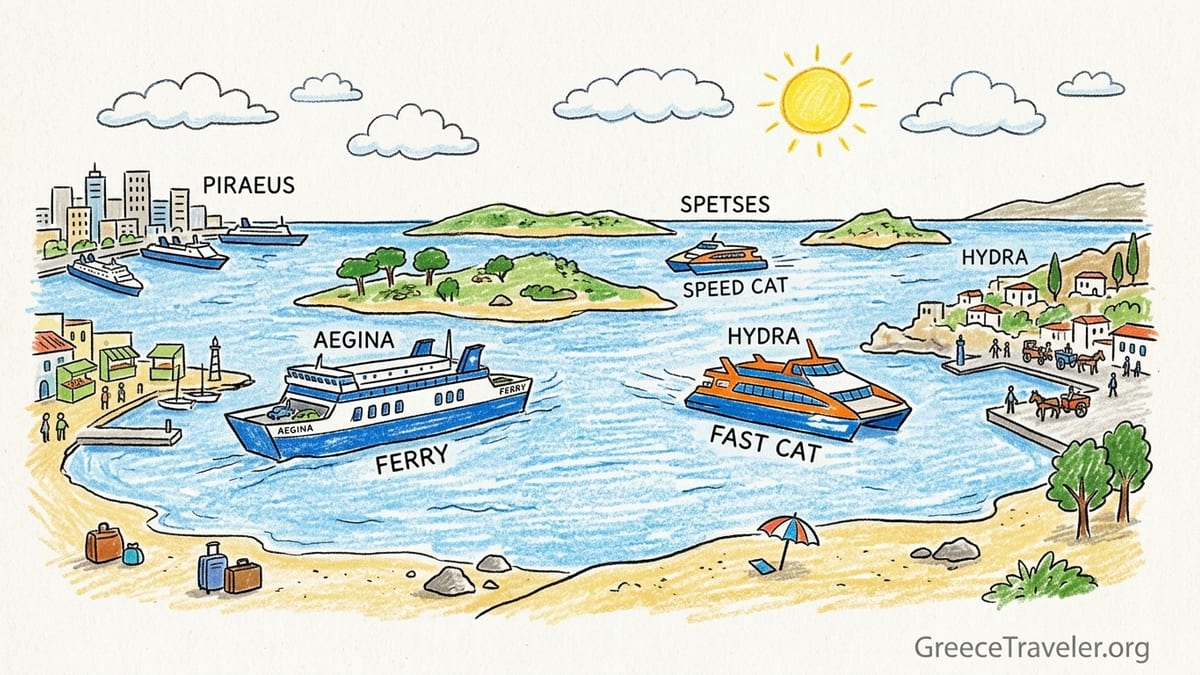
How Saronic Island Hopping Really Works in 2026
If you look at a map, the Saronic Islands seem to form a ring around the entrance to the Gulf, tempting you to connect them in any order. In practice, ferry routes in 2026 are built around Piraeus, with two main “branches” for travellers: an Aegina and Agistri axis, and a Poros, Hydra and Spetses axis. You can combine the two, but you will almost always pass back through Piraeus or the Peloponnese mainland rather than sail directly between every island.
The first branch, serving Aegina and Agistri, is dominated by Saronic Ferries with conventional car ferries and by smaller high-speed vessels from various operators. Saronic Ferries runs year-round links from Piraeus to Aegina and Agistri, typically stopping at both islands on the same sailing, which makes them the backbone of short Athens getaways. In summer, departures are frequent enough that many Athenians treat Aegina almost like a suburb.
The second branch links Piraeus with Poros, Hydra and Spetses using fast catamarans operated mainly by Hellenic Seaways (part of the Attica group) and Alpha Lines, often in the classic chain Piraeus – Poros – Hydra – Spetses and back. Timetables for 2026 published by Alpha Lines for its Speed Cat I show exactly this pattern, with morning departures from Piraeus that reach Hydra in a bit over an hour and Spetses roughly 2 hours 15 minutes after leaving Athens in peak season.
Understanding these two branches is the key to realistic planning. A week-long trip might sensibly combine Athens with Aegina and Agistri, or Athens with Poros, Hydra and Spetses. Trying to stitch all five islands into a single loop is possible but usually means backtracking via Piraeus or using buses and taxis through the Peloponnese, which adds time and complexity.
Key Ferry Operators, Vessels and 2026 Schedules
On the Aegina and Agistri side, the workhorse company is Saronic Ferries, running large conventional vessels such as the F/B Achaeos between Piraeus, Aegina and Agistri. The company’s 2026 timetable lists multiple daily sailings, with at least a morning and afternoon departure year-round and denser schedules from late spring to early autumn. These conventional ferries are slower but spacious, comfortable and forgiving about luggage, making them ideal for travellers with suitcases or families with pushchairs.
High-speed passenger-only boats also run on these routes, cutting travel times significantly and adding frequency in peak months. These are typically small catamarans or hydrofoils used heavily by commuters and weekenders. They get you from Piraeus to Aegina in around 40 minutes instead of about 1 hour 15 minutes by conventional ship, at a modest premium, and are a good choice for day-trippers trying to maximise beach time.
On the Poros, Hydra and Spetses side, two brands dominate 2026 schedules. Hellenic Seaways operates high-speed catamarans such as the Aero Highspeed and Flyingcat vessels, following routes like Piraeus – Poros – Hydra – Spetses – Porto Heli in high season. These services run year-round, though with fewer departures in winter. In parallel, Alpha Lines deploys its Speed Cat I on a very similar chain. Its 2026 itineraries show daily morning departures from Piraeus at 09:45, calling at Hydra around 11:00 and reaching Spetses shortly after, with afternoon returns from Spetses to Hydra and then Piraeus.
For planning purposes, assume that in July and August there will be at least two or three high-speed departures most days between Piraeus and each of Poros, Hydra and Spetses in each direction. In shoulder seasons such as late April or October, you may see one morning and one afternoon departure, and outside those months some days may have just a single sailing. Schedules are usually published early in the calendar year and are often tweaked in spring, so for travel in May or later you should check again a few weeks before your trip for any timing changes.
Fast Ferry vs Conventional Ship: Which Should You Choose?
For the Saronic Islands, the choice between fast ferry and conventional ship is about more than just speed. Fast ferries, including the Aero Highspeed, Flyingcat series and Alpha Lines’ Speed Cat I, are passenger-only catamarans designed to maximise quick point-to-point travel. They typically shave 30 to 45 minutes off a crossing to islands like Hydra or Spetses compared with an older, slower vessel, and they offer airline-style numbered seating in air-conditioned cabins. On a mid-morning Piraeus to Spetses sailing in August, this can be the difference between arriving in time for lunch or for a late afternoon swim.
Conventional ferries on the Aegina and Agistri routes are more like small cruise ships: they carry vehicles, have open decks, cafes and plenty of outdoor seating. Travel times are longer, but on a sunny early summer day many travellers prefer to sit on deck with a coffee rather than inside a sealed catamaran cabin. These ships are also less sensitive to sea conditions, so on choppy days in spring or autumn they can be more comfortable, and they are usually a little cheaper per ticket.
Prices in 2026 vary depending on the route and vessel. A typical one-way high-speed ticket from Piraeus to Spetses on Alpha Lines costs around 50 euros for a standard seat, while Piraeus to Hydra is lower because of the shorter distance. Shorter hops, such as Poros to Hydra or Hydra to Spetses, are usually in the 15 to 25 euro range on high-speed boats. Conventional ferries from Piraeus to Aegina have lower fares, often in the low teens for foot passengers, making frequent weekend trips more affordable for Athenians.
For most visitors, the rule of thumb is simple. If you value time and plan to island hop between Poros, Hydra and Spetses in a short window, the fast ferries are the logical choice. If you are only going from Piraeus to Aegina or Agistri, or you have luggage and want outdoor space and a slower pace, choosing at least one leg on a conventional ship can be part of the holiday experience rather than a sacrifice.
Ports, Terminals and What to Expect with Luggage
Almost all Saronic ferry routes start from Piraeus, the main port of Athens. Services to the Saronic Islands usually depart from the inner central gates, commonly E8 for high-speed services to Poros, Hydra and Spetses and nearby gates for Aegina and Agistri. Across 2026, port authorities continue to group Saronic departures in a compact area, but you should still allow a comfortable margin of time, as traffic around the port can be heavy and the walk between metro, taxi and gate can be 10 to 20 minutes depending on your arrival point.
On Aegina, ferries arrive at the main Aegina Town port, a lively waterfront lined with cafes and pistachio stands. The island also has smaller harbours at Souvala and Agia Marina, used by some seasonal or local services, but most visitors arrive and depart through Aegina Town. Agistri is served primarily by the ports of Skala and Myli; conventional Saronic Ferries ships tend to use one, while high-speed passenger boats may call at the other. The sailing time between Aegina and Agistri is short, often under 30 minutes, which makes it easy to combine both islands in a single trip.
On the Poros, Hydra and Spetses branch, ferries call at the main harbours right in each town. Poros ferries arrive at the long quayside that stretches along the waterfront of Poros Town. Hydra and Spetses are famously car-free, so the ferry piers sit at the heart of their main settlements, with luggage transfers handled by handcarts, small electric vehicles or horse-drawn carriages in Hydra’s case. This means that as soon as you step off the boat you are effectively in town, but it also makes timing ferries important: a late-night arrival with several suitcases will involve hauling them along cobbled waterfronts rather than into a waiting taxi.
For luggage, conventional ferries have designated luggage rooms or shelves on the car deck, where you leave larger bags on boarding and collect them on arrival, while carrying any essentials with you upstairs. High-speed catamarans usually have luggage racks at the ends of the passenger cabin. In both cases staff are accustomed to backpackers and families and rarely weigh standard suitcases for foot passengers, but you will be responsible for moving your own bags and ensuring you board in time. Arriving at the port at least 30 to 40 minutes before departure is a sensible buffer during busy summer weekends.
Booking Ferry Tickets and Using 2026 Schedules
For 2026, all major Saronic ferry operators support online booking and digital tickets, and this is increasingly the default. Companies such as Saronic Ferries, Hellenic Seaways and Alpha Lines publish their timetables on their own websites and through Greek ferry aggregators. Many travellers now research schedules on comparison platforms, then book either directly with the operator or through the same aggregator, storing QR code tickets on their phone.
On popular high-season routes like Piraeus to Hydra or Piraeus to Spetses on a Friday afternoon in late July, advance booking is strongly recommended. Sailings can sell out days in advance, especially around Greek public holidays and August weekends. By contrast, conventional ferries to Aegina outside peak holiday periods remain relatively easy to board even when booking just a day or two ahead. A common pattern for Athenians is to buy outbound and return tickets online for a chosen weekend, then make changes at the port ticket office if plans shift, subject to each company’s change rules.
Schedules in the Saronic Gulf follow a rough seasonal pattern. Limited winter timetables, with one or two sailings per day on most routes, gradually expand in late spring, typically from around late April or May, with additional sailings layered on Friday evenings and Sunday afternoons to serve weekenders. Peak season, from roughly late June to early September, sees the highest frequency, with early morning, midday and late afternoon sailings on the busiest days. In September and October, most operators begin to scale back again, cutting some midday sailings while retaining morning and evening connections.
When interpreting 2026 schedules, note that some Alpha Lines and Hellenic Seaways sailings function as through services. For example, a morning Piraeus – Poros – Hydra – Spetses sailing might show separate timings and fares for each segment, but in practice it is the same catamaran continuing down the chain. This makes island hopping straightforward: you can board in Poros and stay aboard until Hydra, or embark in Hydra and ride on to Spetses, without changing vessels. Just be aware that intermediate stops may be brief, often 5 to 10 minutes, so you should be ready to disembark promptly when your island is called.
Realistic Island-Hopping Routes and Whether to Return via Piraeus
With the 2026 route pattern, a realistic short trip from Athens might look like this: start with two nights in Aegina, continue to Agistri for a night or two, then return to Piraeus. Saronic Ferries and other operators provide frequent links between Piraeus, Aegina and Agistri, and there are usually several daily crossings between Aegina and Agistri themselves in high season. This means you can wake up in Agistri, catch a mid-morning boat back to Aegina for lunch and a last stroll, then board an afternoon ferry to Piraeus and still be back in the city by early evening.
For a slightly longer trip focused on the eastern branch, a common route is Piraeus – Poros – Hydra – Spetses – Piraeus. In summer 2026, combined services from operators like Hellenic Seaways and Alpha Lines let you travel from Poros to Hydra in as little as about 30 minutes and from Hydra to Spetses in around 1 hour. A practical itinerary would be one or two nights on Poros, two nights on Hydra and three nights on Spetses, using mid-morning or early afternoon catamarans to move between islands and a final afternoon return from Spetses to Piraeus.
What is notably less realistic is attempting a seamless loop that links all the Saronic Islands without repeating any legs. There are no regular direct ferries between Aegina or Agistri and Hydra or Spetses in 2026. To move from the Aegina branch to the Hydra and Spetses branch, you almost always have to return to Piraeus and then continue, or travel by bus or car to a Peloponnese port such as Methana, Galatas, Ermioni or Porto Heli and then take a local boat to Poros, Hydra or Spetses. This mainland “bridge” can be interesting for slow travellers but usually adds a full day of transit compared with a simple return to Piraeus and onward sailing.
As for whether to finish by returning to Piraeus or by continuing onward between islands, the decision depends on your onward plans. If you are flying out of Athens or continuing to another island group, returning to Piraeus from your final Saronic island is almost always the simplest solution, giving you access to the metro and the long-distance ferry network. If you plan to rent a car and explore the Peloponnese after Hydra or Spetses, it can make sense to depart from Ermioni or Porto Heli on the mainland side instead. Fast boats and local water taxis connect Hydra and Spetses to these ports, where buses and taxis link onward to Nafplio and other Peloponnese destinations.
Seasonality, Weather and How It Affects Your Crossing
Ferry travel in the Saronic Gulf is less exposed to extreme weather than in open Aegean island groups, which is one of the reasons these islands are popular for short breaks almost year-round. That said, weather and season still shape the ferry experience in 2026. In July and August, the main concern is heat and crowding, not storms. Midday departures can be very hot on exposed decks of conventional ferries, so travellers often choose early morning or late afternoon sailings for comfort, especially when travelling with children.
In spring and autumn, by contrast, you may encounter windier days when fast ferries experience some motion and passengers prone to seasickness are more comfortable on the larger conventional vessels to Aegina and Agistri. While cancellations in the Saronic routes are less common than on longer Cycladic crossings, they do occur during strong winds, especially for smaller high-speed vessels. Keeping a half-day buffer in your schedule if you have a flight to catch after your island hop is a sensible precaution.
Off-season, from November to March, the picture changes again. Schedules thin out, particularly on the Poros, Hydra and Spetses axis, which may see just one or two daily sailings on some days. Departures are also more heavily concentrated in the morning. For example, it is common to have an early Piraeus to Hydra and Spetses sailing and an afternoon or early evening return, but nothing late at night. If you are visiting in winter, it is important to organise accommodation and ferry tickets together so that you are not relying on connections that only run on certain days of the week.
On balance, the sweet spot for combining easy ferry planning with pleasant weather is late May to late June and September. During these periods you benefit from near-peak schedules on both Saronic branches without the highest summer crowds, and you have more flexibility to choose between fast ferries and conventional ships, morning and afternoon crossings, and direct and stopping services.
The Takeaway
Island hopping in the Saronic Gulf in 2026 is all about working with how the ferries actually run rather than how a stylised map might suggest. The network divides naturally into two arms: Piraeus to Aegina and Agistri on one side, and Piraeus to Poros, Hydra and Spetses on the other. Within each arm, frequent services and through-sailings make it straightforward to string two or three islands together over a week, especially in peak season when timetables are thickest.
Fast catamarans from operators such as Hellenic Seaways and Alpha Lines deliver speed and convenience on the Poros, Hydra and Spetses chain, at a higher price and with less outdoor space, while conventional ferries operated by Saronic Ferries offer a slower but more spacious and often cheaper ride to Aegina and Agistri. Booking online, travelling light and allowing a little slack for summer crowds or occasional weather disruptions will make almost any itinerary workable.
Most travellers will be happiest choosing either an Aegina and Agistri combination or a Poros, Hydra and Spetses route, using Piraeus as a reliable hub at the beginning and end of the trip. Trying to force every island into a single loop without repeating legs usually adds more logistics than enjoyment. With realistic expectations and an eye on 2026 schedules, the ferries of the Saronic Gulf can feel less like a puzzle and more like part of the pleasure of exploring a compact, varied corner of the Greek islands.
FAQ
Q1. Can I visit all the main Saronic Islands in one week?
It is technically possible to visit Aegina, Agistri, Poros, Hydra and Spetses in a single week, but you will spend a lot of time in transit and may need to route back through Piraeus or via Peloponnese ports to connect the two main branches. Most travellers are happier focusing on either Aegina and Agistri or on Poros, Hydra and Spetses in one trip.
Q2. How far in advance should I book Saronic ferry tickets in 2026?
For July and August departures, especially Friday and Sunday sailings to Hydra and Spetses, it is wise to book at least several days in advance and earlier around public holidays. For Aegina and Agistri outside peak weekends, booking a day or two before you travel is usually enough, though buying online in advance still gives you peace of mind.
Q3. Are there direct ferries from Aegina or Agistri to Hydra or Spetses?
There are no regular direct services from Aegina or Agistri to Hydra or Spetses in the 2026 schedules. To move between these islands, you will generally return to Piraeus and then continue on a different route or travel via Peloponnese ports such as Methana, Ermioni or Porto Heli using local boats and buses.
Q4. Which is better for day trips from Athens, Aegina or Hydra?
Aegina is the easier and more flexible day trip, with frequent conventional ferries and high-speed boats that take around 40 minutes to 1 hour 15 minutes each way. Hydra is further and served mainly by high-speed catamarans, so you have fewer departure times and higher fares, though the island’s car-free harbour and stone mansions make it a memorable excursion if your budget and schedule allow.
Q5. Can I rely on digital tickets, or do I need to print them?
Most major operators in the Saronic Gulf, including Saronic Ferries, Hellenic Seaways and Alpha Lines, now accept digital tickets shown on a smartphone. Some still offer the option to pick up a printed boarding card at the port ticket office. Unless your specific booking confirmation says otherwise, carrying a digital ticket is normally sufficient.
Q6. How early should I arrive at Piraeus before my ferry?
In summer, arriving 45 to 60 minutes before departure is a comfortable margin, especially if you are unfamiliar with the port or travelling with luggage. For early morning or off-season crossings when the port is quieter, 30 to 40 minutes is generally enough, but it is always better to be early in case of traffic or queues at the gate.
Q7. Are there luggage limits on Saronic ferries?
Foot passengers on Saronic ferries rarely encounter strict luggage limits, and it is normal to travel with a suitcase and hand baggage. Large or unusual items may require special handling, and on fast ferries overhead space is limited, so heavy bags go on designated racks. You remain responsible for lifting and watching your belongings during boarding and disembarkation.
Q8. Do ferries between Poros, Hydra and Spetses run year-round?
Yes, but with reduced frequency in winter. In the high season there are multiple daily high-speed catamarans linking Piraeus, Poros, Hydra and Spetses. In the low season the route often shrinks to one or two departures per day on some days of the week, so winter travellers should plan more carefully and check 2026 timetables close to their travel dates.
Q9. Is it worth paying extra for a fast ferry?
On longer legs such as Piraeus to Hydra or Piraeus to Spetses, the time saving and extra daily frequency offered by fast ferries usually justify the higher fare, especially if your trip is short. On shorter crossings like Piraeus to Aegina, whether it is worth paying more is a personal choice; many travellers enjoy the slower, open-deck experience of a conventional vessel.
Q10. Can I continue from the Saronic Islands to other Greek island groups?
There are no regular direct ferries from the Saronic Islands to the Cyclades or other distant island groups. The practical way is to return to Piraeus and connect there to longer-distance ferries, or to travel overland through the Peloponnese to ports that serve other regions. If you plan to combine the Saronic Gulf with the Cyclades, building in a night in Athens between ferry legs is usually the most stress-free option.