


The Saronic Islands are where many sailors fall in love with Greece for the first time. Just a few hours from central Athens, they offer short, sheltered hops between pine-clad bays, car-free harbours and low-key resort towns. For first-time skippers, families and anyone who wants more swimming and taverna time than heavy-weather sailing, a Saronic itinerary from Athens is one of the most forgiving and rewarding yacht holiday options in the Mediterranean.
Why Choose the Saronic Islands for Your First Athens Charter
The Saronic Gulf lies between the Attica peninsula and the Peloponnese, with Athens on its northern shore. This geography creates a natural barrier that keeps the worst of the Meltemi winds out of the area, so conditions are generally calmer than in the Cyclades further east. Recent route planners for the Saronic describe typical summer winds at Force 3 to 4 in the afternoons, with most one-week circuits from Athens totaling around 100 to 120 nautical miles and individual legs of 10 to 25 nautical miles. That translates into three to five hours of sailing per day rather than dawn-to-dusk passages.
This matters for holidaymakers who want a gentle introduction to yachting. Instead of punching into steep seas, you are more likely to be close-hauled or on a reach in relatively flat water, with enough breeze to sail but not so much that families or nervous crew are uncomfortable. Operators that specialise in the Saronic, such as those based at Alimos Marina and Lavrion, actively market the area as Greece’s most beginner-friendly sailing ground, precisely because you can have a full cruising experience with comparatively low stress.
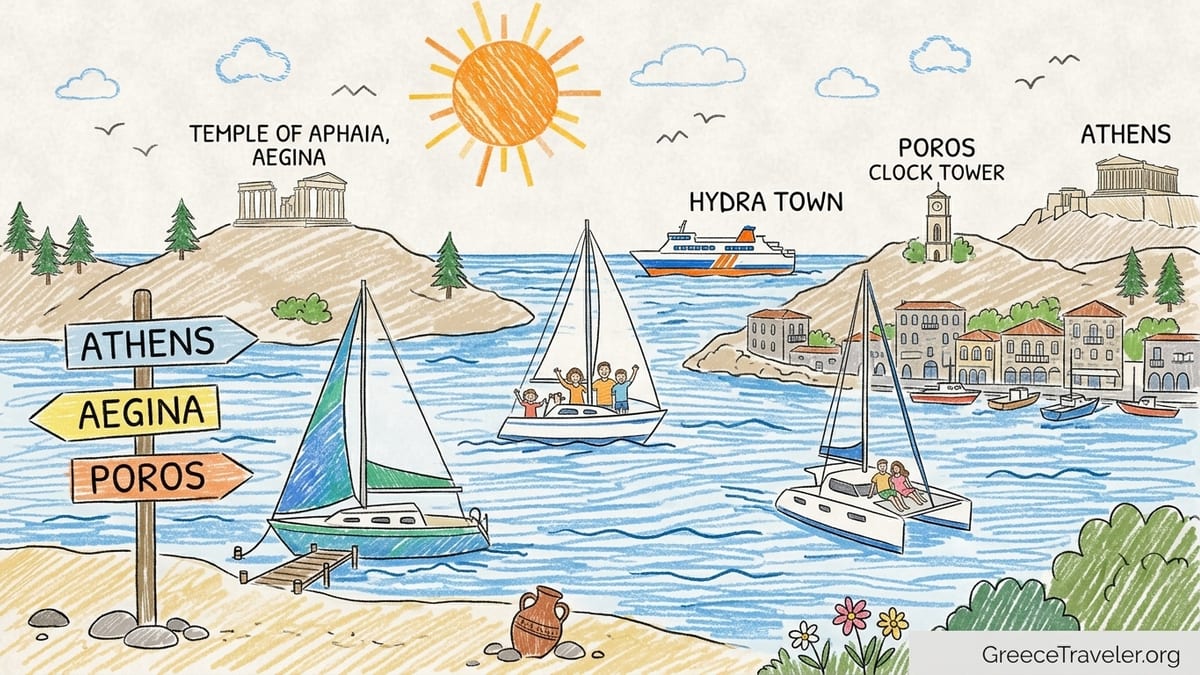
There is also a cultural advantage. A one-week Saronic circuit can include classical sites like the Temple of Aphaia on Aegina, the amphitheatre at Epidaurus via the Peloponnesian coast, and the preserved mansions of Hydra town, alongside low-key beaches on Agistri or pine-scented anchorages around Poros. Ferry schedules from Piraeus connect all the main islands year-round, which means that even if weather or a technical issue interrupts your sailing plan, you can usually reposition crew or meet a cabin charter by public ferry without losing the trip.
Understanding Your Charter Options from Athens
Athens is Greece’s primary charter gateway. The largest fleets for the Saronic Gulf operate from Alimos Marina on the so-called Athens Riviera, a short taxi ride south of the city centre and roughly 45 to 60 minutes from Athens International Airport depending on traffic. Charter companies also base Saronic-oriented yachts at nearby marinas such as Flisvos and, further away, Lavrion on the tip of the Attica peninsula. Fleet operators like Istion Yachting, Kavas and other Greek brands advertise Alimos as their main Athens base with dozens of monohulls and catamarans between roughly 34 and 50 feet available for weekly rentals.
For bareboat charters, a 38 to 40 foot cruising monohull suitable for four to six people typically starts somewhere in the region of 1,800 to 3,500 euros per week in the Saronic, depending on season, age of vessel and booking lead time. Modern cruising catamarans from around 40 to 45 feet often command double or more, particularly in high season between late June and early September when demand from European and North American travellers peaks. These figures normally exclude extras such as end cleaning, outboard engines for the dinghy, and fuel, but marina fees within the Saronic are usually modest by Mediterranean standards.
If you lack the qualifications or confidence to skipper your own boat, skippered and fully crewed options are widely available. Many Athens-based companies will provide an English-speaking skipper for a daily fee on top of the bareboat price, usually plus meals and a dedicated cabin. At the higher end, fully crewed yachts and luxury catamarans package the vessel, captain, chef and sometimes a hostess, with weekly rates that run into several thousand euros per person in high season. Cabin-charter products also exist specifically on Saronic Gulf routes, where you book an individual cabin rather than the whole yacht, making a week-long circuit of Aegina, Hydra, Poros and Agistri accessible to couples or solo travellers who prefer to share.
Bareboat, Skippered, Catamaran or Cabin Charter: Which Is Right for You?
Bareboat charters from Athens suit experienced sailors who possess the correct paperwork and are comfortable handling a yacht in close quarters. Greek regulations normally require at least one qualified skipper on board with a recognised certificate plus a second crew member able to assist. In practice, most operators will ask to see proof of competence, often in the form of an International Certificate of Competence or equivalent, and may quiz you about recent experience. The Saronic’s short distances and plenty of sheltered harbours make it a favourite choice for these independent crews, especially for those moving up from coastal cruising at home.
Skippered charters make sense for less confident sailors, mixed-experience groups, or anyone who simply wants to treat the yacht as a mobile villa. Adding a professional skipper can transform the experience: they can judge weather windows, adjust the itinerary on the fly, and handle tight manoeuvres in busy harbours like Poros and Hydra. Families often find that having a skipper on board lets parents step back from boat handling and focus on children, swimming stops and shore excursions. There is a cost, but split between six or eight guests it can be reasonable, especially outside peak weeks in July and August.
Catamarans are increasingly popular in the Saronic Gulf, particularly for groups and family charters. Their twin hulls provide more deck and living space, separate cabins and shallower drafts that help with anchoring in tighter coves around Agistri or the back of Aegina. The trade-off is higher charter cost and different handling characteristics, especially in crosswinds when berthing stern-to. Many first-time catamaran charterers choose a skippered option in their first year, then step up to bareboat cats once they feel comfortable with the size and windage.
Cabin charters using 45 to 50 foot monohulls or catamarans are a strong option for solo travellers and couples who like the idea of a social boat without the cost of a private charter. In 2026, several specialist outfits sell set-date, week-long Saronic itineraries that depart from Athens and follow a fairly standard loop through Aegina, Hydra, Poros and Agistri, with scheduled swim stops and shore dinners. These trips tend to include a skipper and often a hostess, breakfast and some lunches, while dinners are ashore in tavernas. You sacrifice itinerary control but gain simplicity and the chance to meet like-minded travellers.
Classic One-Week Routes: Aegina, Poros, Hydra and Spetses
Most Saronic itineraries from Athens start with a short hop to Aegina or Agistri. From Alimos Marina the distance to Aegina town is around 17 to 20 nautical miles, usually three to four hours under sail in typical summer breezes. Some skippers prefer the small port of Perdika on Aegina’s southwest coast for a quieter first night, while others aim for Agia Marina on the northeast for proximity to the Temple of Aphaia. An alternative is Agistri, a compact island just west of Aegina with turquoise shallows at Aponisos and quieter anchorages around the south coast.
The next leg commonly leads to Poros, an island actually separated from the Peloponnese by a narrow channel. Sailing distances from Aegina to Poros typically fall in the 15 to 20 nautical mile range depending on your exact departure port and route. Approaching from the north, the amphitheatre-like town with its clock tower rising above the harbour is one of the postcard views of the Saronic Gulf. Many charters spend at least one night stern-to along the waterfront, benefiting from easy access to provisioning, fuel trucks and a wide choice of restaurants clustered around the quay.
From Poros, holiday routes diverge. One popular pattern heads south to Hydra for a taste of a car-free island where donkeys and handcarts still handle most logistics. The leg is roughly 15 to 20 nautical miles via the sheltered coasts of the Peloponnese, and the sight of Hydra town’s stone mansions piled around its natural amphitheatre is another of the Saronic’s signature arrivals. Berths on the main quay are highly sought after in high season, so many skippers aim to arrive by early afternoon or accept that they may have to raft alongside other yachts. An alternative overnight is the uninhabited islet of Dokos, where boats anchor in clear water and spend the night under the stars.
Further south lies Spetses at the mouth of the Argolic Gulf, sometimes considered part of the wider Argo-Saronic group. Not all one-week routes include it because of time constraints, but several sample itineraries from Athens do add Spetses on a seven-night cruise, typically with a 20 to 25 nautical mile leg from Hydra. The island has an upmarket feel, elegant neoclassical buildings and horse-drawn carriages in place of cars within the main town limits. Including Spetses works best for crews comfortable with slightly longer days under sail or for those booking ten-night charters who can afford the extra miles without rushing. On the return, many skippers stop again in Poros or in a quiet anchorage on the Peloponnese coast before closing the loop back to Aegina and Athens.
Marinas, Anchorages and Nightlife: Where to Moor in the Saronic
A Saronic itinerary naturally alternates between marina or harbour nights and quieter anchorages. Athens itself is marina-based: Alimos and neighbouring bases provide shore power, water and check-in formalities, and many operators include the first and last night’s berthing fees in the charter price. Once you clear the city, Aegina town offers a busy harbour with stern-to mooring and the convenience of large supermarkets nearby for provisioning. Perdika and Agia Marina on Aegina provide more low-key options, generally with fewer facilities but a more village-like feel.
Poros is one of the best all-round bases in the middle of the Saronic. The waterfront quay wraps around the town, accommodating a large number of visiting yachts, and fuel trucks regularly circulate, which is useful mid-week. There is a good range of bakeries and grocery stores within a short walk, plus chandlers for basic boat parts. In high season, berthing fills quickly, so arrival by mid-afternoon is wise. Even then, poring over the depth sounder and watching for laid mooring chains in the harbour is important, and first-timers often appreciate guidance from a skipper or neighbouring crews.
Hydra’s harbour is the Saronic’s most notorious pinch point. The inner ring of berths can double or triple raft in July and August, and once filled, the port police will often direct newcomers to anchor off and stern-line back to the rocks either side of the harbour entrance. This is where a skippered or crewed charter really shows its value, as many bareboat skippers find Hydra stressful during peak weeks. Those willing to anchor overnight in coves like Mandraki or nearby Dokos can enjoy swimming and quiet evenings before riding the dinghy ashore for dinner, swapping the harbour’s buzz for a more secluded experience.
Agistri and various spots along the Peloponnese, such as the bay at Epidaurus or small harbours like Ermioni, offer more anchorage-oriented nights. Here, you might drop the hook in 5 to 10 metres over sand and spend the evening onboard, perhaps with a dinghy ride to a taverna jetty. Families often enjoy these anchorages as they offer safe swimming around the boat and star-filled skies at night. Balancing marina comforts every couple of days with anchorage nights in between is a good rhythm, keeping everyone showered, provisioned and recharged without losing the magic of being at sea.
Sailing Experience, Weather and Family Suitability
The Saronic Gulf’s reputation for sheltered waters and short hops makes it an attractive choice for crews with limited sea time or with younger children. Compared to the Cyclades, where strong Meltemi winds can reach gale force in summer, the Saronic and neighbouring Argolic Gulfs sit behind the protective landmass of Attica and the eastern Peloponnese. This does not remove weather risk entirely, but it does reduce exposure to extended beats into steep seas. Most weeks between May and October see a pattern of light morning airs building to moderate afternoon breezes that are sufficient for enjoyable sailing yet usually manageable for reasonably competent skippers.
For families, this translates into flexible days. You can motor or sail for two or three hours in the morning, anchor for a long lunch and swim in a bay such as Russian Bay near Poros or Aponisos on Agistri, then potter on to a harbour in the late afternoon. Children get a mix of sailing, swimming and shore time rather than long passages, and if a particular day looks windy or unsettled, you can often stay put and explore ashore. Greek island towns like Hydra and Poros remain lively in the evenings but are generally relaxed by big-resort standards, with dining focused on harbourside tavernas rather than nightclubs.
That said, some experience still helps. Even in the Saronic, afternoon gusts can funnel between islands, and crowded harbours demand confident boat handling in tight spaces, especially when crosswinds and prop wash complicate stern-to manoeuvres. Less experienced skippers might time arrivals earlier in the day and avoid the busiest weeks of late July and early August. For new sailors or multi-generational groups, booking a skipper or even opting for a cabin charter can significantly reduce stress while giving everyone a comfortable introduction to life at sea.
Charter-Base Logistics: Getting From Athens Airport to Your Yacht
Most Saronic charters begin and end at Athens-area marinas, with Alimos (sometimes called Kalamaki) the largest hub. After landing at Athens International Airport, you can expect a transfer of roughly 45 minutes to an hour by taxi or pre-booked shuttle to reach the marina, depending on traffic. Many fleets suggest guests aim to arrive at the base by mid-afternoon on the first day, as formal check-in, inventory inspections and safety briefings can take a couple of hours before you are cleared to leave. Some crews choose to sleep aboard at the dock and depart early the next morning, while others head directly to Aegina or Agistri if winds and daylight permit.
Provisioning is straightforward. Large supermarkets a short taxi or ride-share journey from Alimos stock everything from fresh fruit and vegetables to Greek wines and long-life supplies, and some offer online ordering with delivery to the quay. Within the islands, Aegina, Poros and Hydra all have well-stocked mini-markets, bakeries and butchers, so you do not need to purchase a full week’s worth of food in Athens unless you prefer to. Fuel is generally taken at the end of the charter from a bunkering quay or via a fuel truck that visits your berth, with total consumption depending heavily on how much you motor compared with sailing.
When planning flights, remember that most charters require the yacht to be back at base by late Friday afternoon even if the official handover is on Saturday morning. This allows the company to perform checks and cleaning before the next guests arrive. If you have an evening or extra day in Athens at the end of your charter, many travellers choose to stay in the city centre for easy access to the Acropolis and the Plaka district, or along the Athens Riviera for a final swim. With ferry connections from Piraeus to all the main Saronic islands, it is also possible to have part of the group arrive by sea to meet the boat or depart by ferry if schedules differ.
The Takeaway
The Saronic Islands offer one of the most accessible and forgiving sailing holidays in Greece. Short distances between Aegina, Agistri, Poros, Hydra and, for longer routes, Spetses, combine with sheltered waters to create an itinerary that suits first-time charterers, returning sailors and multi-generational families alike. Athens-based charter bases provide a wide range of monohulls and catamarans, with options from bareboat to skippered and cabin charter products that loop through the main islands on fixed dates in 2026 and beyond.
Success in the Saronic largely comes down to matching your charter style and route to your experience and expectations. Confident sailors may relish a slightly longer loop that includes Spetses and quiet anchorages on the Peloponnese coast, balancing lively harbour nights in Poros and Hydra with serene bays under the pines. Those newer to sailing, or travelling with young children, might opt for a simpler circuit focused on Aegina, Agistri and Poros, using a skipper to take the strain of boat handling while the group enjoys swims, shore walks and late dinners on the waterfront.
With its combination of manageable sailing, culturally rich stops and straightforward logistics from Athens International Airport, the Saronic Gulf remains a compelling choice for anyone considering a yacht holiday in Greece. Whether you book a cabin on a shared yacht, charter your own catamaran with friends or hire a skipper to guide a family adventure, this compact group of islands offers plenty of scope for a week on the water that feels both relaxed and genuinely adventurous.
FAQ
Q1. Do I need a sailing licence to charter a yacht in the Saronic Islands?
Most bareboat charters from Athens require at least one qualified skipper with a recognised certificate and a second competent crew member. If you do not have the necessary licence or experience, you can add a professional skipper to your booking or choose a cabin charter where all sailing is handled for you.
Q2. How long does it take to sail from Athens to Aegina or Poros?
From Alimos Marina to Aegina town usually takes around three to four hours under typical summer conditions. From Aegina to Poros you should allow another three to four hours, depending on wind strength and your exact route.
Q3. Is the Saronic Gulf suitable for families with young children?
Yes, the short distances, relatively sheltered waters and frequent swim stops make the Saronic one of Greece’s most family-friendly sailing areas. Many families also hire a skipper so parents can focus on the holiday rather than boat handling.
Q4. What is the best time of year to sail the Saronic Islands?
The main season runs from May to October. June, early July and September often provide a good balance of warm weather, reliable winds and fewer crowds than the peak weeks of late July and August.
Q5. Should I choose a monohull or a catamaran for a Saronic charter?
Monohulls are generally more affordable and rewarding for keen sailors, while catamarans offer more living space, privacy and stability at anchor. In the Saronic’s relatively calm conditions, both work well, so the choice often comes down to budget and comfort priorities.
Q6. How many nights should I plan in marinas versus anchorages?
A common pattern is to spend roughly half your nights in harbours such as Aegina, Poros or Hydra for easy shore access and half at anchorages near quieter bays. This gives a mix of comfort, facilities and peaceful nights under the stars.
Q7. Can I visit Spetses on a one-week Saronic itinerary from Athens?
Yes, but including Spetses usually requires slightly longer daily passages and efficient time management. It works best for crews comfortable with full sailing days or for charters of ten nights where you have more flexibility.
Q8. How do cabin-charter Saronic cruises work?
Cabin charters sell individual cabins on a shared yacht following a fixed one-week route, typically from Athens through Aegina, Hydra, Poros and Agistri. A professional skipper, and often a hostess, handle navigation and meals, while guests share common areas onboard.
Q9. What additional costs should I budget for beyond the charter fee?
On top of the base charter price you should allow for fuel, end cleaning, mooring fees outside your home marina, provisioning, skipper fees if applicable, and meals ashore. In the Saronic, these extras are usually moderate compared to other Mediterranean regions but can add a noticeable percentage to the total.
Q10. How do I get from Athens airport to the charter marina?
Most travellers take a taxi, ride-share or pre-booked transfer from Athens International Airport to marinas like Alimos or Flisvos. The journey typically takes 45 to 60 minutes depending on traffic, so it is wise to factor this into your arrival and departure plans.