


Planning a Greek island escape from Athens often comes down to one big decision: stay close with the Saronic Islands or go further into the Aegean to the Cyclades. Both offer memorable beaches, whitewashed towns and long, lazy dinners by the water, but they suit very different kinds of trips. The smartest choice usually depends less on which is objectively “better” and more on how much time you have, how confident you feel with ferries, and what kind of Greece you want to experience first.
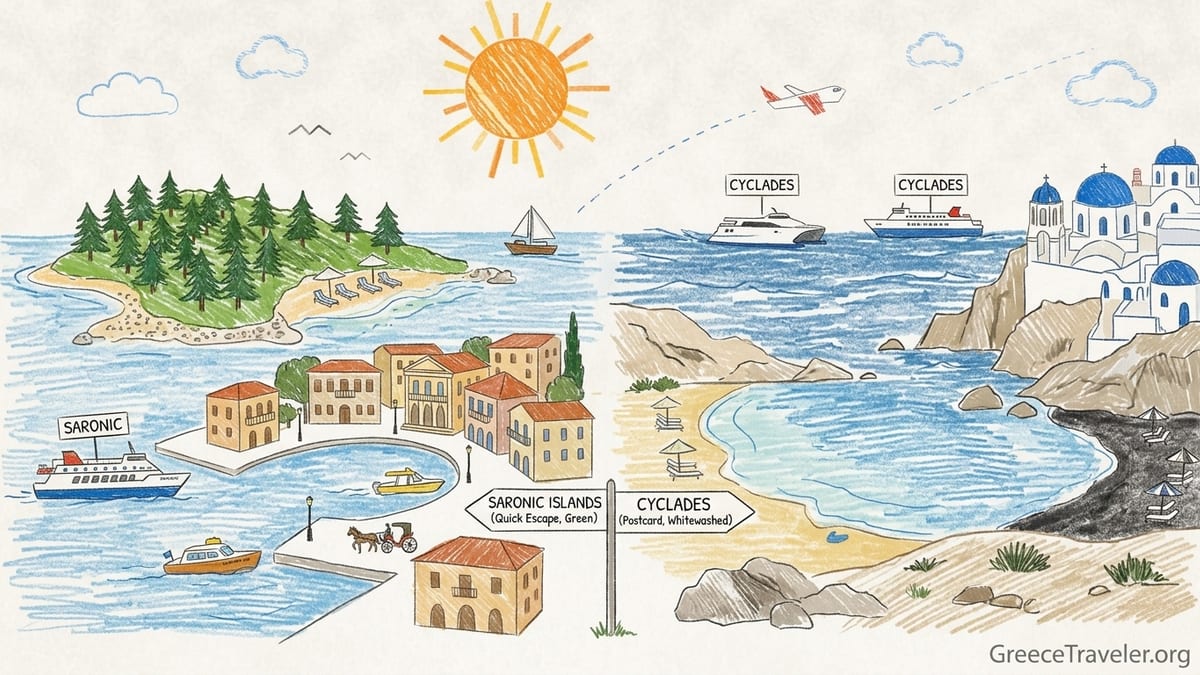
Overview: Two Very Different Greek Island Gateways
The Saronic Islands (Aegina, Agistri, Hydra, Poros and Spetses, plus smaller Salamina) sit in the Saronic Gulf just off Athens. They are the classic quick escape for Athenians: greener hills, pine forests down to the water, relaxed harbors and elegant historic towns like Hydra and Spetses, where cars are restricted and you get around on foot, by water taxi or horse-drawn carriage. You can realistically leave central Athens after breakfast and be swimming before lunch.
The Cyclades lie further out in the Aegean and include famous names such as Santorini, Mykonos, Naxos, Paros, Milos, Syros and dozens more. This is the postcard Greece of whitewashed cube houses, blue-domed churches and stark, sun-bleached landscapes. Moving between islands takes longer but you have a far bigger menu of destinations, from party-heavy Mykonos to family-friendly Naxos or low-key Serifos.
In practice, the Saronic Islands work best if you have 2 to 5 days to add to an Athens city stay, or if you dislike complicated travel days. The Cyclades come into their own on trips of at least a week, ideally longer, when the extra ferry time makes sense and you can settle into a slower island rhythm.
Getting There from Athens and Ferry Times
For sheer convenience, the Saronic Islands win. Ferries leave all day from the Athens port of Piraeus. High-speed boats reach Aegina in about 40 minutes and most regular ferries take around 1 hour to 1 hour 15 minutes. Services run several times daily year-round, with extra departures in summer, and walk-up tickets are usually available outside the very busiest weekends.
Hydra and Spetses are slightly further but still very manageable. Hydrofoils and high-speed catamarans connect Piraeus to Hydra in roughly 1 hour 10 minutes to 2 hours depending on the vessel and stops, with some summer timetables showing a mid-morning Piraeus departure reaching Hydra by late morning. Spetses adds another 30 to 60 minutes beyond Hydra, meaning a total journey of around 2.5 to 3 hours in normal summer conditions.
By contrast, reaching the Cyclades usually means a longer crossing or an internal flight. Ferries from Piraeus to Mykonos typically take about 3 to 4 hours on high-speed services, and around 5 hours or more on slower conventional ferries. Santorini, one of the most popular Cycladic destinations, is roughly 4.5 to 6 hours by fast ferry in 2026, and about 7 to 8 hours on standard boats depending on the route and stops. Several operators now run near-daily summer high-speed crossings, but sailings are more vulnerable to delays or cancellations in strong Meltemi winds.
Domestic flights can cut this time dramatically for some Cycladic islands. There are short daily flights from Athens to Santorini, Mykonos, Naxos and Paros in season, often taking 35 to 50 minutes in the air. However, prices climb quickly in July and August and luggage allowances can be tight. If you are planning a very short break, the travel time and extra cost of flights often make the Saronic Islands more appealing.
Beaches, Landscapes and Architecture
The Saronic Islands tend to be greener and softer. On Aegina you will find pebble and sand coves backed by olive groves and low hills, and a mix of simple beach tavernas and organized sunbed rentals. Agistri is heavily forested in places, with clear water and rocky swimming spots like Dragonera and Aponisos where pine trees come right down to the sea. Hydra and Spetses have a more rugged coastline, with small pebbly beaches, rocky platforms and turquoise coves accessible by boat taxi or coastal walking paths.
The architecture in the Saronics reflects their role as 19th century merchant and naval hubs. Hydra Town is all stone mansions, terracotta roofs and amphitheater-style streets rising from a horseshoe harbor. Spetses has grand neoclassical villas and the landmark Poseidonion Grand Hotel facing the waterfront promenade. These islands feel historic and atmospheric, more like living open-air museums than modern resorts.
The Cyclades, by contrast, are where you find the “classic” Aegean imagery. Towns like Oia and Fira on Santorini perch dramatically on caldera cliffs, with white cube houses, narrow alleys and blue church domes stacked above the sea. Naxos and Paros offer softer, more spacious versions of the same look, with whitewashed villages like Apeiranthos or Lefkes surrounded by terraced hills and dry stone walls. The landscapes are generally drier and more open than in the Saronics, with low shrubs, bare rocks and intense light.
In terms of beaches, the Cyclades have the broader variety and generally more dramatic settings. Naxos is known for long sandy stretches like Agios Prokopios and Plaka, with shallow, family-friendly water. Paros has Golden Beach and Santa Maria for windsurfing and kitesurfing, as well as small protected coves. Milos offers striking volcanic scenery and unusual beaches like Sarakiniko with its moon-like white rock formations. Santorini has black and red volcanic sand beaches at Perissa, Kamari and Red Beach. If beaches are your top priority, the Cyclades will likely satisfy more deeply, while the Saronics offer pleasant but usually more modest options.
Nightlife, Atmosphere and Crowds
Atmosphere on the Saronic Islands tends to be relaxed and lived-in. Aegina and Salamina are commuter or weekend islands for Athenians, so you will find year-round life rather than purely seasonal resorts. Even in August, Aegina Town feels like a busy small port rather than a party destination. Hydra and Spetses get lively on summer weekends, with stylish Athenians and yacht crews filling waterfront bars, but midweek evenings still feel more like an elegant promenade than an all-night club scene.
The Cyclades host some of the most intense nightlife in Greece. Mykonos is globally known for its beach clubs, sunset cocktails in Little Venice and late-night bars in Mykonos Town. Entry to big-name venues and sunbed packages can reach premium prices in peak season, and international DJs appear regularly. Paros has transformed in recent years into a younger, trendier hotspot, with Naoussa’s harbor lined with sophisticated cocktail bars and late-night spots. Santorini has plenty of bars in Fira and Oia, but the focus there is more on sunset views and fine dining than on all-night dancing.
Crowds are also very different. The Saronic Islands definitely get busy in July and August, especially on Greek holiday weekends, but the scale is smaller. Hydra’s harbor can feel crowded when several yachts are in, and Aegina’s main beaches can be packed on a Sunday, yet you can usually escape with a short walk or a short water taxi ride. In shoulder seasons like May, June, September and early October, you may find quiet villages and empty hiking trails, especially on Agistri and Poros.
In the Cyclades, overtourism is a real factor on certain islands in high summer. Narrow lanes in Oia can become congested at sunset, with organized tour groups and cruise passengers lining up for photos. Ferries arriving into Mykonos or Santorini in August can deliver hundreds of passengers at once, which strains taxi capacity and pushes prices up. However, less-famous Cycladic islands such as Serifos, Sifnos, Folegandros or Tinos still offer a calmer, more traditional atmosphere even in peak months, as long as you book accommodation early.
Wind, Weather and When to Go
One of the biggest practical differences between the Saronic Islands and the Cyclades is wind. The Cyclades sit squarely in the path of the Meltemi, a seasonal north wind that blows mainly in July and August and can reach strong force for several days in a row. On windy days, ferries may be delayed or rerouted, seas can be rough and some beaches on the north coasts of islands become choppy and less pleasant for swimming.
These winds help keep Cycladic summers dry and relatively cool at night, but they can disrupt travel plans. If your itinerary relies on same-day connections or tight flight-ferry combinations, the risk of schedule changes is worth considering, especially in late July and August.
The Saronic Gulf is more sheltered, which usually means calmer seas and more predictable ferry operations. Strong winds can still occur, but outright cancellations are less frequent on the main Saronic routes than on exposed Cycladic crossings. Temperatures in both regions are similar, with hot, dry summers from June through early September and mild shoulder seasons in May and October. For hiking on Hydra’s trails or exploring Santorini’s caldera paths, April, May, late September and October are particularly pleasant, with fewer crowds and moderate heat.
If you are sensitive to motion sickness or anxious about potential disruptions, the Saronic Islands are the safer bet in terms of wind and ferry reliability. If you love windsurfing or kitesurfing, the breezier Cyclades, particularly Paros and Naxos, offer world-class conditions in mid-summer.
Costs, Logistics and Island Hopping
On pure transport cost and simplicity, the Saronic Islands tend to be more budget friendly. A one-way high-speed ticket from Piraeus to Aegina or Hydra often costs less than a fast ferry to Mykonos or Santorini, and the shorter distance keeps fuel surcharges down. Accommodation on Aegina, Agistri and Poros can be good value compared with headline Cycladic islands, with simple rooms and studios often available at moderate prices outside the absolute peak weeks.
Hydra and Spetses are exceptions and are priced more in line with upscale Cycladic destinations due to their car-free status and limited development. Historic boutique hotels and restored mansions on Hydra, in particular, can command premium nightly rates in July and August. Eating out in both island groups ranges widely, from simple souvlaki places to high-end seafood restaurants, but the most famous Cycladic hotspots around the caldera in Santorini or in Mykonos Town generally belong to the upper end of the scale.
For island hopping, the Cyclades offer a far richer network. You can easily connect routes such as Mykonos–Paros–Naxos, or Naxos–Ios–Santorini, and smaller islands like Koufonisia, Amorgos or Folegandros fit neatly into many itineraries. Several ferry companies operate on overlapping routes, creating options for morning or afternoon crossings during the main season. That said, piecing together multi-island trips requires paying attention to timetables, as some links operate only a few times per week.
Island hopping in the Saronics is possible but more limited. A typical short route might combine Aegina and Agistri (connected by a local boat taking around 10 to 20 minutes) or pair Hydra and Spetses via Poros with careful planning. However, sailings between Hydra and Spetses can be less frequent than the main Piraeus routes, so many travelers base themselves on one island and use day trips by ferry or water taxi instead of constantly changing hotels.
Trip Length: Matching Each Island Group to Your Time
The clearest way to decide between the Saronic Islands and the Cyclades is to start with your available time and work backwards. If you have just 2 or 3 extra days after visiting Athens, the Saronic Islands almost always make more sense. For example, you could spend one night on Aegina, visit the Temple of Aphaia and nearby beaches, then hop to Agistri for one more night of swimming and cycling among pine forests before returning to Piraeus in about an hour.
With 3 to 5 days, a focused stay on Hydra or Spetses works particularly well. You can catch a mid-morning hydrofoil from Piraeus, have lunch harbor-side on Hydra, hike to monasteries in the hills and use water taxis to reach pebble coves like Vlychos or Bisti. Spetses offers relaxed bike rides around the island, coves such as Agia Marina and Anargyri, and an attractive waterfront lined with cafes and bars. Because travel times are modest, you will not lose a full day in transit.
Once you reach about 7 days in Greece, the Cyclades become attractive. A common first-timer itinerary is 3 nights in Naxos and 3 in Paros, or 3 nights in Santorini followed by 3 in Naxos. That gives time for at least two or three beach days, a boat trip or wine tasting, and an inland village exploration on each island. With 10 to 14 days, you can add a third island such as Mykonos for nightlife, Milos for its coves and boat tours, or a quieter place like Folegandros.
Very short trips to marquee Cycladic islands are technically possible but not ideal. A 2-night Santorini getaway from Athens might involve a 45-minute flight each way, plus check-in and transfers to and from the caldera. Realistically, you could lose much of your first and last days traveling. This may be worthwhile for a honeymoon treat or a bucket-list photo, but for a relaxed holiday feel, the Saronic Islands are usually better suited to brief Athens extensions.
Who Should Choose the Saronic Islands vs the Cyclades
The Saronic Islands are especially strong for travelers who value ease and spontaneity. If this is your first time in Greece, you are traveling with young children, or you feel nervous about long boat rides, the short, sheltered crossings to Aegina, Agistri, Poros, Hydra and Spetses will be reassuring. The islands’ greener landscapes and historic harbor towns also suit visitors who imagine leisurely waterfront strolls more than dramatic sunset viewpoints.
Hydra and Spetses, in particular, appeal to design-minded travelers and history lovers. Waking up in a 19th century mansion on Hydra, drinking coffee under bougainvillea and listening to donkeys clip-clop through the alleys offers a deeply Greek atmosphere without needing to chase specific photo spots. Weekend getaways from Athens, off-season escapes in April or October, and trips where work and leisure need to blend (thanks to good ferry frequency back to the mainland) all play to the strengths of the Saronic group.
The Cyclades are the better choice if you have more time and a stronger sense of what you want. If your dream is the classic Aegean aesthetic, you will not regret putting in the extra travel to reach Santorini, Mykonos, Naxos or Paros. Photographers, food lovers and people who want variety on a single trip will appreciate how quickly the vibe changes from island to island: cosmopolitan Mykonos, laid-back Naxos, romantic Santorini, bohemian Anafi or artistic Tinos each offer a distinct personality.
Active travelers will also find more specialized options in the Cyclades. Naxos and Paros are hubs for wind sports, several islands offer well-marked hiking trails between villages, and there are good diving and sailing opportunities throughout the archipelago. For families with 10 to 14 days, combining a few Cycladic islands can give both adults and children a sense of discovery and adventure that is harder to replicate on a very short Saronic trip.
The Takeaway
There is no single “best” Greek island group, only the one that fits your trip. The Saronic Islands excel as extensions of an Athens city break or as low-stress escapes where ferries are short, logistics are straightforward and historic towns like Hydra and Spetses provide charm in an easily digestible package. They are close enough that you can make last-minute decisions based on weather, energy levels or what caught your eye that morning.
The Cyclades, meanwhile, deliver the full Aegean dream: iconic whitewashed villages, sweeping beaches and a huge choice of islands with very different moods. They ask more of you in travel time and planning, but they also reward longer stays and slower exploration. If your schedule and budget give you a week or more on the islands, the extra effort usually feels worthwhile.
As a rule of thumb, think of up to 5 days as Saronic territory and anything from a week upwards as Cycladic territory. Use the Saronics when you want a graceful, easy island interlude around an Athens-focused trip, and choose the Cyclades when you are ready to commit more days to Greece’s islands as the heart of your journey rather than just the encore.
FAQ
Q1. Are the Saronic Islands or the Cyclades better for a 3-day trip from Athens?
For a 3-day trip, the Saronic Islands are usually better because ferry rides are short and simple, so you spend more time on the beach and in town and less time in transit.
Q2. Can I visit Santorini as a day trip from Athens?
In practical terms, no. Even the fastest ferries from Piraeus to Santorini take several hours each way and flights involve airport transfers and check-in time, so a day trip would feel rushed and tiring.
Q3. Which islands are easiest to reach from Athens without flying?
Aegina, Agistri, Poros, Hydra and Spetses in the Saronic Gulf are among the easiest, with frequent ferries from Piraeus and travel times typically between 40 minutes and about 3 hours.
Q4. Where will I find the classic whitewashed houses and blue-domed churches?
That iconic look is most common in the Cyclades, especially on islands such as Santorini, Mykonos, Paros and Naxos, where villages are built in the traditional Cycladic cube style.
Q5. Which islands are better for budget-conscious travelers?
Less-famous Saronic islands like Aegina, Agistri and Poros, and quieter Cycladic islands like Serifos or Tinos, often offer better value than headline destinations such as Santorini, Mykonos, Hydra or Spetses.
Q6. How much does a typical ferry ticket cost from Athens to these islands?
Prices vary by operator and season, but expect to pay roughly the cost of a casual dinner out for a high-speed trip to Aegina or Hydra, and somewhat more for longer routes to Mykonos, Naxos or Santorini, with slower ferries usually cheaper.
Q7. Is island hopping easier in the Saronics or the Cyclades?
Island hopping is more extensive in the Cyclades, where you can link multiple islands on one trip, while the Saronics are better for choosing one or two bases and making day trips.
Q8. Which islands are better for nightlife?
For high-energy nightlife and beach clubs, the Cyclades win, especially Mykonos and, to a lesser extent, Paros and Ios. The Saronics lean more toward relaxed waterfront bars and low-key evenings.
Q9. Are the Saronic Islands really less windy than the Cyclades?
Generally yes. The Saronic Gulf is more sheltered, while the Cyclades are exposed to the seasonal Meltemi winds, which can be strong in July and August and sometimes disrupt ferry schedules.
Q10. If I have 10 days, should I choose the Saronic Islands or the Cyclades?
With 10 days, the Cyclades usually make more sense because you have enough time to justify longer crossings and to enjoy two or three different islands without rushing.