


Pelion is the rare Greek destination where your hotel choice is not just about “nice rooms” but about physics: altitude, shade, wind, road curvature, and how long it takes to turn a breakfast decision into a swim. I planned my stays thinking Pelion would feel like one compact peninsula. In practice, it behaves like two different holidays stitched together: the mountain villages above Volos and the west coast on the calm Pagasetic Gulf, versus the east coast where the Aegean shows up louder, bluer, and more exposed. To make this guide useful, I am separating places I personally stayed from properties I researched for 2026 and would book next, and I am making geography the main character in every recommendation.
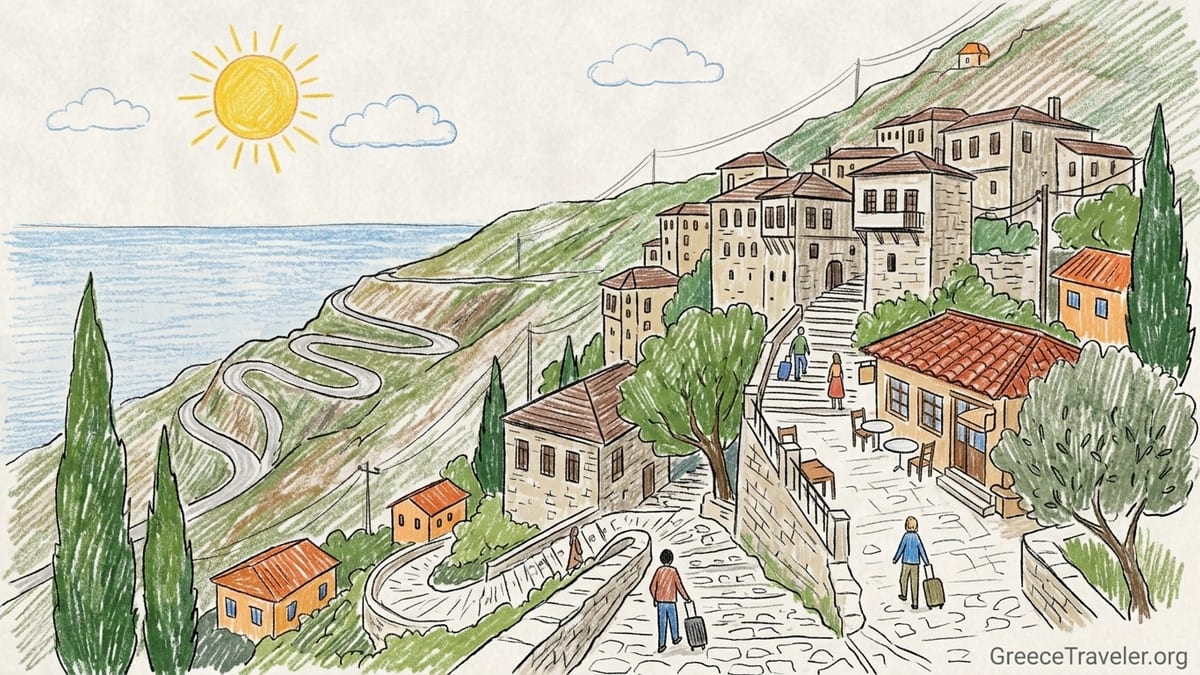
Portaria: A Mountain Base That Feels Close Until It Doesn’t (Stayed)
I used Portaria as my first base because on a map it looks brilliantly central: perched above Volos, near the junction that points you either deeper into the mountain villages or out toward the coasts. What booking photos did not prepare me for was how “vertical” daily life feels here. Even when a property advertises parking, you still tend to walk up or down sloped lanes, often on stone paving that can get slick after evening humidity.
My room in Portaria was the first reminder that Pelion is a mountain, not a beach resort with a view. At night the temperature dropped enough that I was glad the room had proper heat control rather than just a thin blanket. Stone architecture looks romantic in pictures, but thick masonry changes the indoor feel: it can stay cool in the afternoon and then feel suddenly chilly after sunset if the heat is not consistent. The bed was firm and supportive, the kind you notice more after driving Pelion’s tight roads, and I slept deeper than I expected.
Breakfast was the Portaria payoff. In mountain villages, mornings come with quieter terraces, strong coffee, and the sense that you are staying in a lived-in neighborhood rather than a hotel strip. From my door it was a short walk to tavernas in the village center, which meant I could eat without driving at all. That was the real luxury here: not a spa, but the ability to leave the car parked for a day.
The trade-off became obvious the moment I tried to “pop to the beach.” Driving times were not hard in pure distance, but they were tiring in tempo: hairpins, narrow lanes, and the kind of concentration that makes you arrive at the seaside feeling like you have already done an activity. If your Pelion dream is two swims a day plus sunset drinks, Portaria can quietly force too much driving.
Makrinitsa: Stone Mansions, Stairs, And The Reality Of Car-Free Lanes (Stayed)
Makrinitsa is the Pelion village that most resembles an architectural photo essay: stone mansions, cobbled lanes, and a balcony feeling over Volos and the Pagasetic Gulf. It is also where the “last 150 meters” rule becomes your lifestyle. Several Makrinitsa mansions openly note that cars are not allowed deeper into the village and that you arrive via the main parking area, then walk in on foot along cobblestones, sometimes around 140 to 150 meters depending on the property and spot you find.
That short distance sounds trivial until you do it with rolling luggage, a tote bag of snacks, and a jacket because mountain evenings cool fast. Booking photos rarely show the approach: the small ramp here, the uneven stone step there, the angle of the lane, and the fact that your check-in might involve a gentle but real climb. If you have mobility concerns, Makrinitsa needs extra thought, and choosing a place close to the main path and parking matters more than room décor.
Inside, Makrinitsa is where Pelion’s stone architecture makes the strongest impression. Many restored mansions lean into thick walls and wood ceilings, and you feel it in sound and temperature. My room stayed naturally cool during the day, which was a relief after sunny village walks, but it also meant I cared a lot about the bedding at night. The best sleep I had in Makrinitsa came down to practical details: a duvet with substance, a bed that did not sag in the middle, and windows that shut tightly against the occasional gust.
Wi-Fi was the one modern detail that felt less predictable in the mountains. The connection worked, but it was not the “take video calls on the balcony all day” experience that some booking pages imply. I treated the village like a place to log off. For meals, I could reach the central square and tavernas on foot, but the return walk was a stair workout. I loved the romance of Makrinitsa, but if your Pelion plan includes daily beach hops, this base can make you feel like you are commuting between two different trips.
Tsagarada: Lush East Pelion, Where The Forest Controls Your Day (Researched For 2026)
Tsagarada sits on the east side of Pelion, and the mood shift is immediate: thicker greenery, deeper shade, and a sense that the forest is closer than the sea even when you are driving toward beaches. For a 2026-style stay that reads as polished rather than rustic, one of the best-known options is 12 Months Resort and Spa, which positions itself as a luxury base in the Tsagarada area. If you want the “hotel facilities” feeling without giving up the village atmosphere entirely, it is a logical shortlist contender.
If you prefer something that feels more like a guesthouse than a resort, Iris Tsagarada describes itself as a newer luxury guesthouse with junior suites. What stood out in 2026 research was not just the rooms but the signal that this is a place that thinks about food as part of the stay, with its own shop-style items and house products mentioned on its site. That matters in Tsagarada because driving out for a late snack is not as casual as it sounds on a map.
There is also a practical geography advantage to Tsagarada: you are close to some of Pelion’s most famous east coast beaches, but you sleep higher, where evenings can be cooler. That can be a gift in July and August, especially if your beachfront room would otherwise feel warm at night unless the air conditioning is excellent. In Tsagarada, you are more likely to need a light layer after dinner, and room temperature tends to be about how well a property manages humidity and airflow, not just heat.
The warning label is road energy. East Pelion drives can be slower than visitors expect, and the last approach into some guesthouses can involve narrow lanes. When a listing looks like it is “only” a few kilometers from a beach, remember that those kilometers are not flat. Book Tsagarada when you want village evenings, forest walks, and one main beach per day, not when you want to bounce between coves like you are island-hopping.
Agios Ioannis: Beachfront Convenience, But Choose Your Room Like A Local (Stayed And Researched)
Agios Ioannis is the east coast answer for travelers who want the sea to be the default, not the reward after a drive. I stayed beachfront here to reset my Pelion rhythm: morning swim, breakfast, shade, repeat. The big difference from the mountains was how I used time. In Portaria and Makrinitsa, days started with planning. In Agios Ioannis, days started with stepping outside.
Room temperature at the beach was a different kind of challenge. The sea brings humidity, and a ground-floor or shaded room can feel cooler but slightly damp if ventilation is weak. Booking photos rarely show where the sun actually hits the balcony at 4 p.m. or how close your room is to the evening promenade noise. I learned to treat “sea view” as only one checkbox. The other checkboxes are airflow, sound insulation, and whether your room is one of the ones that catches the breeze.
For 2026 research, Agios Ioannis has a clear trend: newer or newly renovated boutique-style hotels pushing a clean, modern look right on the beach. Aetherion Hotel presents itself as a newly renovated beachfront hotel in the heart of Agios Ioannis. Kelly Beach Hotel positions itself as a brand-new boutique beachfront retreat in Agios Ioannis. These are the kinds of places I would choose for a short stay when I want effortless swimming and the ability to walk to dinner without thinking about parking.
Walking access is the Agios Ioannis superpower. Restaurants are typically close, and you can plan your day around being on foot. The hidden cost is that you might stop exploring the rest of Pelion because it becomes easy to stay put. If your goal is to see stone villages, waterfalls, and multiple coastlines, do not make Agios Ioannis your only base. Use it as the “sea chapter” of a split-stay itinerary.
Afissos And Kala Nera: The Pagasetic Gulf Side For Calm Water And Easier Logistics (Stayed And Researched)
The west side of Pelion, on the Pagasetic Gulf, feels designed for travelers who want easier days and gentler water. Afissos, in particular, worked for me when I wanted swimming without the Aegean drama. The sea here tends to feel calmer, and the overall vibe is more “evening stroll” than “windy cliff cove.” It is also where driving felt less like an obstacle course and more like normal holiday logistics.
In Afissos, I liked being able to finish breakfast, walk to a nearby restaurant later without a major climb, and still have the option to drive to another bay without it becoming a full-day commitment. As a base, it is forgiving. If you are traveling with someone who gets car-sick on mountain hairpins, the Pagasetic Gulf side can be the difference between loving Pelion and enduring it.
For researched 2026 options, Afissos Blu is a traditional-style hotel positioned in the heart of Afissos, with rooms described around views and the Pagasetic Gulf setting. For a more apartment-style stay that suits longer trips, Agnanti Hotel Apartments appears in 2026 booking research as an aparthotel-style option with room types that can include kitchenette features, which is useful if you want to shop locally and eat on your balcony rather than doing restaurant meals every night.
Kala Nera is a practical choice if you want a straightforward beach village where services are easy to find. Hotel Pegasus in Kala Nera markets itself as open year-round, and local Kala Nera tourism listings continue to highlight it among the village’s hotels. The key advantage in Kala Nera is the “no surprises” factor: flatter walking, simpler parking, and beaches that are quick to reach once you arrive. The trade-off is that you are not waking up inside a stone-mansion fairytale. You are choosing convenience over drama, and for many travelers, that is the smarter Pelion move.
Milies And Southern Pelion: When You Want Old Stone, Quieter Nights, And A Slower Clock (Stayed And Researched)
Milies feels like the hinge between Pelion’s mountain identity and its gulf-side ease. It has the old-village atmosphere and stone houses, but it also feels more connected to day trips toward the Pagasetic Gulf coast. When I stayed in this zone, my days became less about chasing the best beach and more about enjoying where I was: a slower breakfast, a walk through lanes that smelled like damp stone and greenery, and afternoons that did not require heroic driving.
For a researched 2026 stay in Milies itself, Archontiko Filippidi appears in current listings as a traditional-style property close to key village points, including the folklore museum area and the Milies train station. If you want a place that reads as historic and central, Milies Historic Chalet also presents itself as a heritage-style option, originally built in the 18th century, which is the sort of stay you choose when the building is part of your itinerary.
Southern Pelion is where I would send travelers who want to feel like they have escaped the “top ten villages” circuit. The coastline and small settlements down south can be gorgeous, but they punish over-ambitious daily plans. This is the zone where your base can absolutely force too much driving if you keep trying to do both coasts. My best days in southern Pelion were the ones where I committed to one side, picked one beach, and let the rest of the day unfold.
One honest detail: in quieter villages, Wi-Fi and phone signal can be more variable, and some stays feel like they were designed for reading, not remote work. If you need guaranteed video-call reliability, check this before you arrive and be ready to work from a café or adjust expectations. The reward for accepting the slower clock is that you experience Pelion as a mountain peninsula, not a checklist.
The Takeaway
Pelion’s best hotels are not “best” in isolation. They are best because they fit the geography you actually want to live inside. Portaria and Makrinitsa excel when you want stone architecture, village dinners, and cool nights, but they can turn beach days into a driving assignment. Tsagarada is the east-side compromise: forest-village atmosphere with access to iconic beaches, as long as you accept slower roads. Agios Ioannis is for travelers who want the sea to be immediate and restaurants to be walkable, but it can quietly limit exploration because it is so easy. Afissos and Kala Nera are the smooth-logistics choices on the Pagasetic Gulf, ideal for calm swims and lower-stress days. Milies and southern Pelion reward travelers who stop chasing distance and start choosing one coastline at a time.
If I were planning Pelion again, I would split the trip: a mountain mansion base for atmosphere, then a beachfront base for rest. That one decision fixes most first-timer mistakes, because it keeps the magic of Pelion’s stone villages without turning every swim into a commute.
FAQ
Q1. Is it better to stay in Portaria or Makrinitsa?
Portaria is generally easier for road access and quick services. Makrinitsa is more dramatic and atmospheric, but expect more walking from the public parking area.
Q2. Do Makrinitsa hotels usually have parking at the door?
No. Many stays rely on the main village parking, and you often walk the last stretch on cobblestone lanes. Some properties arrange help with luggage.
Q3. Which area is best if I want to swim every day without driving far?
Agios Ioannis is the simplest “step out and swim” base on the east coast. Kala Nera and Afissos are good west-coast alternatives with calmer gulf water.
Q4. Will a mountain mansion room feel cold at night?
It can. Thick stone walls hold cool temperatures, especially in shoulder seasons and at night. Confirm heating and ask how rooms are kept warm in cooler months.
Q5. What do booking photos of Pelion mansions usually not show?
They often underplay stairs, steep lanes, and the walk from parking. They can also miss how shaded a room is and how that affects warmth and light indoors.
Q6. Where should I stay if I want a luxury, facilities-style hotel experience?
Look at higher-end options around Tsagarada, including resort-style properties, if you want more services on-site while still being in east Pelion.
Q7. Is the Pagasetic Gulf side good for families?
Often yes, because the water can be calmer and logistics tend to be easier. Afissos and Kala Nera are common bases for low-stress beach days.
Q8. Can I do Pelion without a car if I pick the right hotel?
You can reduce driving by staying beachfront in Agios Ioannis or in a flat beach village like Kala Nera, but exploring multiple villages and coves is much harder without a car.
Q9. If I stay in a beachfront hotel, will I still see the “classic Pelion” villages?
Yes, but plan them as dedicated day trips. The drive can be slow, so it works best when you choose one mountain village per day rather than trying to combine many stops.
Q10. How many bases do you actually need in Pelion?
Two bases is the sweet spot for most first trips: one mountain village for architecture and cool nights, and one coastal village for easy swims and evening walks.