


I need to be transparent up front: I did not personally complete an Athens to Meteora day trip. For this piece, I rebuilt the day from current 2026 operator materials and traveler reports, focusing on what you can realistically expect in a 13 to 14-hour itinerary, including today’s departure setup at Athens Larissis Station, current monastery entrance fees, and what most tours actually include.
Why I Researched This Day Trip Like I Was Taking It
Meteora has the kind of reputation that makes smart travelers do risky math. It is roughly half a day away from Athens, yet it is also one of the most photogenic, spiritually charged landscapes in Greece: giant stone pillars and working Orthodox monasteries perched on top like they were placed there by a patient, stubborn hand. The question I hear most is not “Is Meteora worth it?” It is “Is Meteora worth it as a single-day tour from Athens?”
To answer that honestly, I treated this as an assignment to reconstruct a real day. I pulled the latest 2026 tour descriptions, checked current monastery fee rules, and compared the promised timelines to what travelers say the day feels like when you are living it. The result is less dreamy than Instagram, but more useful: a realistic, minute-by-minute sense of what happens from your alarm clock in Athens to the moment you stumble back into the city late at night.
If you are shopping day tours, you will notice the same backbone in most of them: departure around 8:00 AM from near Larissis Station, about 4 to 5 hours of highway driving each way with one or two stops, then around 4 to 4.5 hours in Meteora itself with a local escort or guide and a smaller vehicle for the monastery loop. Most 2026 itineraries also cap monastery interiors at two or three, because that is the realistic maximum once you factor in stairs, dress code checks, ticket lines, traffic, and viewpoint stops.
The Night Before: What I’d Prep If I Had to Do This Tomorrow
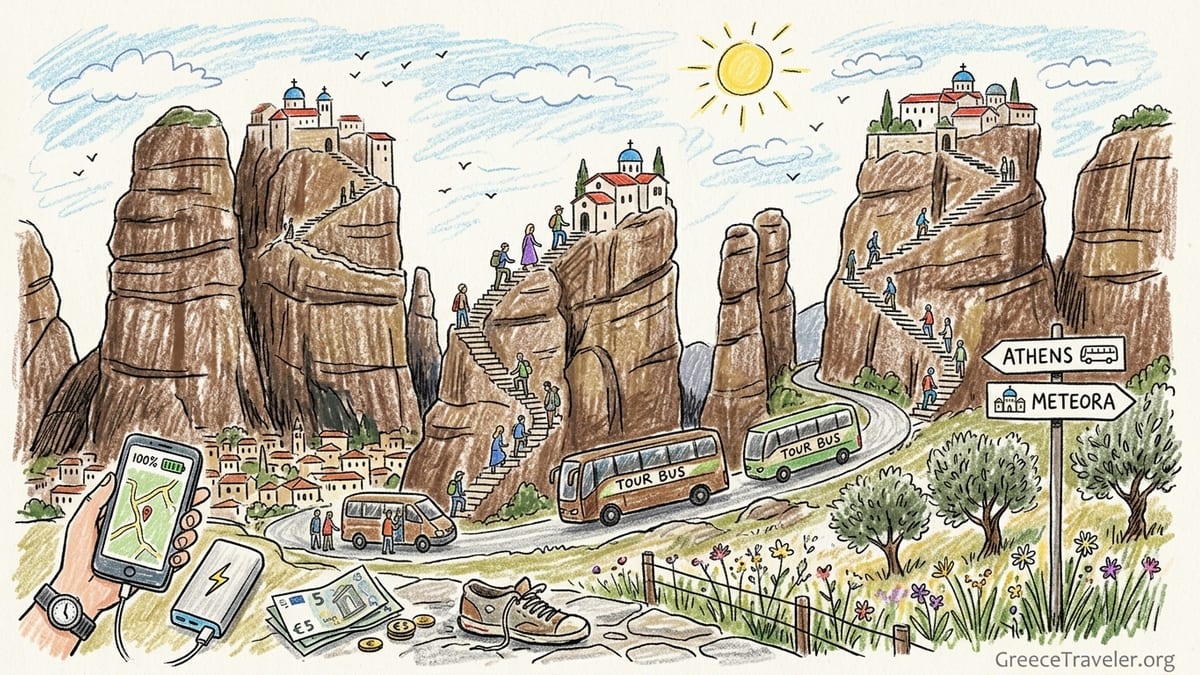
The first truth about an Athens to Meteora day trip is that the day actually starts the night before. Not because you have to pack much, but because forgetting one small detail can ruin your “meaningful time” on the rocks. The big one is cash. In 2026, the monasteries generally charge a per-monastery entrance fee, typically €5 per adult, paid at each gate, and it is widely described as cash-only. If you enter three monasteries, plan for about €15 per adult just for admissions, plus a little extra for small purchases like water or a quick coffee.
The second prep item is clothing, and it is not optional. These are active religious sites. In plain terms: if you show up in shorts, a tank top, or a too-short skirt, you can be turned away at the entrance. Many monasteries keep wrap skirts or shawls for visitors, but relying on that adds friction and time. For a day trip where minutes matter, I would wear lightweight long pants and a breathable top that covers shoulders, then bring a thin layer for air-conditioned coaches and windy viewpoints.
The third prep item is phone logistics. A lot of 2026 tours lean on audio guides or app-based ordering for optional meals at stops. Even if you are not planning to use those features, the day is long and the moment you reach Meteora, you start taking photos continuously. I would leave Athens with my phone at 100%, a power bank, and offline maps downloaded for Kalambaka and Kastraki so I can orient myself during any free time.
Finally, I would plan for a “good enough” night of sleep, not a perfect one. When a tour expects you at the meeting point shortly before 8:00 AM, you are waking up early even if you are staying in central Athens and even if you are used to jet lag. This is a day where fatigue compounds. The earlier you start the smoother you move on those monastery stairs.
Wake-Up, Metro, And The Real Departure Point At Larissis
Most Athens to Meteora day tours in 2026 anchor their departure around Athens Railway Station, commonly called Larissis Station. Several operators describe the meeting point as across from the station on Deligianni Street, near a recognizable coffee chain storefront, with instructions to look for branding on the bus window or door. The practical takeaway: do not assume “Larissis Station” is enough information. You should read your voucher like a boarding pass and confirm the exact side of the road and the landmark described by your operator.
If I were taking this tomorrow, I would set my alarm for 6:15 AM. That gives enough time for a quick breakfast, one last cash check, and a buffer for Athens transit. Even if you are staying somewhere walkable to Syntagma, Monastiraki, or Omonia, the city can surprise you with small delays. Larissis is also served by the metro, which makes it straightforward, but “straightforward” is not the same as “stress-free” when you are trying to spot a specific coach among other buses and morning traffic.
Boarding tends to be simple. Many tours do not assign seats and do not require a printed ticket; they ask you to confirm your name with the driver or escort. That means the best seats are a first-come, first-served situation. If you care about legroom or motion sickness, arriving early is not just responsible, it is strategic.
Expect a coach-style bus with air-conditioning. Some 2026 listings specifically mention amenities like Wi-Fi and USB charging. In real life, I would treat Wi-Fi as a bonus and USB charging as a gamble: bring your own cable, and still assume you will use your power bank later. The comfort level is usually better than a city bus but not luxury sleeper-class. This is a long sit, and seat comfort becomes a major part of your memory of Meteora.
On The Road: Seat Comfort, Stops, And The Long Highway Middle
Once you clear Athens, the day becomes a rhythm of highway miles, landscape changes, and the quiet social choreography of a tour group. The coach settles into an intercity tempo: some people nap immediately, some start editing photos they haven’t taken yet, and some stare out the window to watch Attica give way to central Greece. If you are tall, the difference between an aisle seat and a window seat is not just preference, it is survival. I would choose aisle for easier stretching on a 4 to 5-hour ride.
Most 2026 itineraries build in at least one stop each way. A common pattern described by operators is a coastal or seaside restaurant stop rather than a generic highway rest area. In practical terms, that means you can expect a real bathroom, the option to buy coffee, and a slightly nicer break than a gas station. It also means prices may feel “tourist stop” high: the kind of place where a cappuccino and a pastry can cost more than you’d pay at a corner bakery in Athens.
After the stop, you are back on the bus for the longest uninterrupted stretch of the day. This is where the day trip’s biggest trade-off becomes obvious: Meteora is not a quick hop from Athens. Even optimistic itineraries put the one-way travel time in the several-hour range, and the total day runs around 14 hours. If you are sensitive to long rides, this is the point where it is worth asking yourself whether you are doing this to “see Meteora” or to “collect Meteora.” The day trip can deliver the first, but it often feels like the second.
One important 2026 planning note: Greece’s transport network can experience disruptions, and some rail routes in central Greece have had closures and changes in recent years. That is one reason many operators emphasize coach transport as the simplest option: fewer transfers, fewer moving parts. Still, before publication, I would re-check the operator’s latest messages for any roadworks, strike advisories, or route updates that could shift the timeline later into the night.
Arrival In Kalambaka: Switching Vehicles And Meeting The Local Guide
Most day tours aim to reach Kalambaka around midday, commonly somewhere in the 12:00 to 12:30 window depending on traffic and the length of the morning stop. Kalambaka is the gateway town that sits right under the rocks. If you have only ever seen Meteora in photos, this is the moment the place surprises you: the rock pillars do not rise gently. They loom. They appear suddenly, like a stage set that someone forgot to tell you was real.
A common operational detail in 2026 is a vehicle switch. Several tours describe arriving in Kalambaka and then transferring from the long-distance coach to a smaller local minibus for the monastery loop. That switch matters because Meteora’s roads are winding, parking is tight, and a big coach can be clumsy up there. The minibus also changes the vibe. You go from anonymous coach energy to something more like a small group excursion, where you can actually hear your guide and ask questions without shouting over headrests.
This is usually where you meet the local escort or guide who will narrate the monastery circuit. Some tours include a licensed guide for the broader story but do not necessarily guide you inside monastery buildings, where tours may rely on posted signage, your own pace, and basic visitor etiquette. In many cases, your “meaningful Meteora time” is highly dependent on the guide’s ability to keep the group moving without making you feel rushed. It is a hard balancing act.
Kalambaka itself often gets only a sliver of attention on the day trip. Some itineraries mention free time in town late afternoon, but the truth is that your visit is monastery-first. If you want to shop, linger at a cafe, or do the town slow, that is one of the biggest arguments for staying overnight.
Up On The Rocks: How Many Monasteries You Actually Enter In One Day
Meteora has six active monasteries open to visitors on a rotating schedule. On paper, “seeing Meteora” can sound like you will cover all of them thoroughly. In reality, on a day trip from Athens, entering two or three monastery interiors is the realistic ceiling for most people. Even tours that advertise stopping at all six often mean photo stops or exterior viewpoints at some, and only entering a subset.
What does “entering” mean? It means climbing up from the road, buying a ticket at the entrance booth, passing a dress-code check, then moving through a mix of courtyards, chapels, museum rooms, terraces, and narrow stairways. Add in time for rest, water, and simply looking out over the valley, and each monastery can easily take longer than you expect, especially when crowds bottleneck at doorways or viewpoint terraces.
Stairs are the physical tax of Meteora. Some monasteries feel relatively accessible, while others demand sustained climbing. Many visitors cite the Holy Trinity monastery, in particular, as one of the more demanding approaches. Even if your tour is carefully planned, you are still doing repeated bursts of uphill walking in sun-exposed stone corridors. In high summer, heat is not a side note, it is a governing force. Your tour might run on a timetable, but your body runs on hydration and shade.
Budget-wise, the per-monastery fee adds up quickly. If your tour enters three monasteries and you are paying €5 each, that is about €15 per adult, not usually included in the base tour cost. If you are traveling as a couple, plan for €30 just in admissions. The good news is that the math is simple. The less good news is that the payment is typically separate at each gate, and you need that money ready.
Lunch, Photo Stops, Hermit Caves, And The Parts That Feel Like “Meteora”
Most Athens day trips try to deliver Meteora as a highlight reel: a few monasteries inside, several viewpoint pull-offs, and at least one stop that feels different from “monastery tourism.” In 2026, a common example is a short visit to hermit caves, often described as the Badovas area, where early monks lived in rock hollows. This is one of the most vivid moments because it connects the landscape to the human scale. A monastery on a pillar is astonishing, but a small cave carved into a cliff is intimate and unsettling in a way photos do not fully capture.
Lunch is usually either an optional add-on or a stop where you can buy your own meal. Many operators frame it as a meal in Kastraki, a small village just below the rocks, known for tavernas with terrace views. In practical terms, lunch on a day trip is not leisurely. It is a refuel. If you have an included lunch, expect something recognizable and filling rather than experimental: Greek salad, grilled chicken or pork, fries or potatoes, bread, and a soft drink or water depending on the package. If lunch is not included, you may be choosing from a set menu designed for speed.
Photo stops are not filler at Meteora, they are essential. The landscape changes every few minutes as you loop the road. A good guide will time the stops for classic angles: the wide valley views, the monastery silhouettes, and the dramatic vertical faces of the rocks. The downside is that each stop is also a time leak. Ten minutes becomes fifteen when people queue for the same overlook. Multiply that by several viewpoints, and you can see why entering more than three monasteries in one afternoon is tough.
This is also where footwear matters. Smooth sneakers can be fine, but I would not want slick soles on worn stone steps, especially if there is dust or afternoon humidity. I would pack light, but I would take footwear seriously. On a day trip you do not have time for a blister.
The Clock Reality: How Much Of The 13 To 14 Hours Is Travel Versus Meteora Time
When you do the honest accounting, the Athens to Meteora day trip is a travel day with a spectacular intermission. Typical 2026 operator timelines point to roughly 4 to 4.5 hours of travel each way, not counting stop time. Add a morning stop and an evening stop, plus boarding time, plus the Kalambaka vehicle switch, and you are often looking at 9 to 10 hours of the day devoted to transport and logistics.
That leaves roughly 4 to 4.5 hours for what you came for: monastery visits, viewpoints, and the hermit caves. Four hours can be meaningful, but it is not expansive. It is enough time to be awed, not enough time to be absorbed. It is enough time to enter a few monasteries and understand the basic story, not enough time to feel you have lived with the place.
The late return is part of the deal. Many itineraries place arrival back in Athens somewhere around 10:30 PM to 11:00 PM, depending on departure time, traffic, and the length of the final stop. That means you are not doing a relaxed dinner in Athens afterward. You are doing “grab something close to the hotel” and falling asleep. If you have an early flight the next day, this is a risky choice.
Would I do it as a day trip? If my Athens schedule was tight and Meteora was a lifelong must, yes, with eyes open. But if I had even one spare day, I would strongly consider an overnight. Staying in Kalambaka or Kastraki gives you something the day trip almost never delivers: the softer light of sunset and early morning, less rushed monastery time, and the ability to experience Meteora without constantly glancing at the bus clock.
The Takeaway
An Athens to Meteora day tour in 2026 is doable, organized, and often genuinely impressive. It is also long in a way that changes the experience. You will likely wake up early, meet across from Larissis Station, ride a coach for hours, stop once or twice for coffee and bathrooms, switch to a smaller vehicle in Kalambaka, and realistically enter two or three monastery interiors with several photo stops. You will climb stairs, feel the heat if you are there in summer, pay per-monastery entrance fees in cash, and get back to Athens late enough that the city feels like a different planet from the rocks you left behind.
The day trip is best for travelers who want the Meteora highlights without committing to a night outside Athens. It is not ideal for travelers who want to linger, hike between viewpoints, visit more monasteries at a calm pace, or photograph Meteora in golden-hour light. Those travelers should plan an overnight and treat Meteora as the destination it is, not a day-trip checkbox.
If you do take the long day, the smartest strategy is simple: confirm the exact meeting point in Athens the day before, carry enough cash for admissions, dress conservatively, bring water and a power bank, and accept that your “Meteora time” is precious and limited. In exchange, you get one of Greece’s most surreal landscapes, delivered in a single day, with just enough time on the rocks to understand why so many people rearrange their itineraries to come back and do it properly.
FAQ
Q1. Where do most Meteora day tours from Athens depart from in 2026?
Most depart from the Larissis area, with meeting points described as across from Athens Larissis Train Station on Deligianni Street near recognizable storefronts.
Q2. What time should I arrive at the meeting point?
Plan to arrive at least 15 minutes early. For an 8:00 AM departure, being there around 7:45 AM reduces stress and improves seat choice.
Q3. How long is the full Athens to Meteora day trip?
Most itineraries run about 13 to 14 hours total, including road time, stops, and the Meteora touring window.
Q4. How much of that day is just travel?
Expect roughly 8 to 9 hours of driving time round-trip, plus stop time. Meaningful Meteora touring time is often around 4 to 4.5 hours.
Q5. How many monasteries can you realistically enter on a day trip?
Two or three monastery interiors is the realistic maximum for most day trips, even if you stop for photos at more locations.
Q6. How much are Meteora monastery entrance fees in 2026?
A common current rule is about €5 per adult per monastery, paid separately at each entrance. Children under 12 are often free.
Q7. Are monastery entrance fees usually included in the tour price?
Often they are not included, even on well-reviewed tours. Many packages explicitly list monastery tickets as excluded.
Q8. Is there a dress code for Meteora monasteries?
Yes. Modest clothing is required. Shorts and sleeveless tops can result in denied entry, and women may need skirts that cover the knees and covered shoulders.
Q9. Is lunch included on Meteora day trips from Athens?
It depends on the package. Some offer an optional prepaid lunch, while others stop at a taverna where you purchase your own meal.
Q10. Would you recommend staying overnight instead of doing a day trip?
If you can spare the time, yes. An overnight usually gives you sunset or early morning light, a calmer pace, and more than three interiors without rushing.