


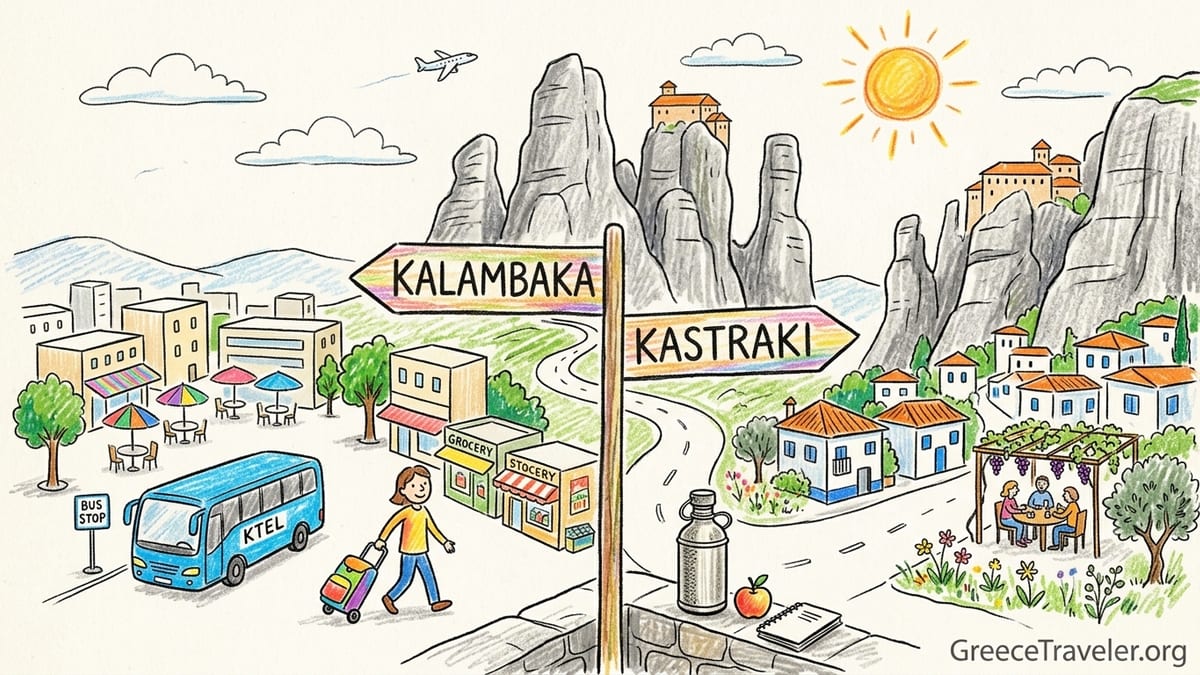
I came to Meteora thinking the only decision that mattered was which monasteries to prioritize. Instead, the biggest difference in my trip started earlier and ended later: where I slept below the rocks. I split my stay between Kalambaka and Kastraki, hauling the same luggage, chasing the same sunrise light, and dealing with the same practical frictions like cash for monastery tickets, dinner timing, and where to park without stress. What surprised me was how much Kalambaka’s everyday convenience shaped my energy and schedule, and how Kastraki’s proximity to the cliffs quietly changed the feel of every morning and the way I photographed the rocks. If you are choosing between the two in 2026, this is the on-the-ground comparison I wish I had before booking.
Arrival Day Reality Check: Luggage, Check-In, And That First Impression
When I arrived with a roller bag and a daypack, Kalambaka felt like a town that expects travelers. The practical landmarks are clustered: the intercity coach stop area, the main streets with hotels, and the places you immediately need like an ATM, a minimarket, and somewhere to sit with a coffee while you wait for check-in. That mattered more than I expected, because Meteora trips tend to start and end with some kind of transit puzzle, and Kalambaka is simply set up for it.
Kastraki, by contrast, felt like arriving “already at Meteora.” The rocks fill your windshield or your field of view sooner, and the village reads more like a basecamp than a transport hub. The trade-off is that arrivals can be slightly more manual: the last stretch up the road from Kalambaka is short, but with luggage it is the kind of short that still changes how you plan. The first time I checked into Kastraki, I was glad I had already stocked water and snacks before heading up, because options are more limited late in the day.
One small but telling detail: if you land late and are hungry, Kalambaka gives you more second chances. In Kastraki, I felt more pressure to line up dinner with restaurant hours and my arrival time, because the village is quieter and closes down faster. That quiet is part of its appeal, but it is also a real factor if your bus runs late or you have an exhausted travel day.
Transport Convenience In 2026: Why Kalambaka’s Hub Status Changes The Whole Trip
In 2026, Kalambaka stays the obvious transport base. Bus information in Thessaly is easy to find and, importantly, updated: for example, KTEL Trikala’s Trikala to Kalambaka route information is shown as verified as recently as September 25, 2026. Kalambaka also appears as the central station reference point for Meteora by bus planning. In practical terms, that means if you are coming from Athens or Thessaloniki via bus connections through Trikala, you naturally end up in Kalambaka and can start your trip without adding an extra transfer.
The other 2026 transport reality is that rail in Greece can involve substitutions and changes due to works. Hellenic Train’s own network information has noted bus substitutions on parts of the Central Greece network, including sections connected with the Palaiopharsalos to Kalambaka axis. Even if your specific travel day runs smoothly, the point is that flexibility matters, and Kalambaka is the place where that flexibility exists: ticket offices, more taxis circulating, and more accommodation used to travelers arriving at odd hours.
What this changed for me was pacing. In Kalambaka, I could comfortably plan one long day up at the monasteries and still keep my evenings low-effort because dinner and supplies were right there. In Kastraki, I felt more committed to the “Meteora schedule” itself. When I stayed in Kastraki, my day tended to start earlier and end earlier, not because anyone told me to, but because the village atmosphere nudged me that way.
If you are visiting without a car, this section is not just background. It is the booking decision. Kalambaka is where you can recover from travel friction and still have a good Meteora day. Kastraki is where you minimize distance to the rocks, but you accept that anything involving bus or rail logistics tends to start by getting yourself down to Kalambaka first.
Hotels And What “Good Location” Means In Each Base
In Kalambaka, a “good location” usually means walking access to food and the practical errands that turn into hidden time sinks: buying cash, topping up groceries, picking up sunscreen, or grabbing something quick if you return hungry after sunset. Kalambaka has bigger accommodation variety, and it shows in the feel of the streets: more signage, more people arriving with backpacks, and more places that look designed for the quick check-in, quick shower, quick dinner rhythm.
In Kastraki, “good location” is not about proximity to services. It is about your first glance from the balcony, or stepping outside before breakfast and seeing the rock faces catching early light. I remember one Kastraki morning when I opened the window and the cliffs were already glowing softly, while the village below was still quiet enough that I could hear birds and the occasional distant car. That is a different kind of value than being close to a supermarket.
There is also an expectation gap: in Kalambaka, I felt comfortable arriving with nothing planned because the town would absorb me. In Kastraki, I booked with a more intentional mindset: I knew I wanted to photograph at sunrise, I wanted short mornings with minimal commuting, and I wanted an evening that felt calm. If you are the kind of traveler who values “I can always figure it out when I get there,” Kalambaka supports that personality better.
One caution I would offer: do not overpay for a Kastraki room with a “Meteora view” unless you are sure what that means. In Kastraki, rock views are often excellent, but the exact angle matters for sunrise color and for whether you see cliffs, monasteries, or mostly village rooftops. If your trip is photography-focused, you will feel the difference between “a view” and “the view” every single morning.
Food, Groceries, And The Little Errands That Decide Your Evenings
Kalambaka’s advantage is not just that it has more restaurants. It is that the density of options lets you eat well without planning your day around dinner. That affected my trip in a concrete way: after a long afternoon of monastery stairs and viewpoints, I could return, shower, and choose food based on what I actually wanted, not based on what was still open. It also made it easy to find something light if I was saving energy for a sunrise start.
Kastraki’s dining scene, on the nights I stayed there, felt more like a small set of reliable places where you settle in. The pace is calmer, and if you like a “same taverna two nights in a row” vibe, it works beautifully. But if you are picky, traveling with someone who is, or arriving late, Kalambaka gives you more resilience.
Groceries are where Kalambaka quietly pulls ahead for most travelers in 2026. A simple example: Lidl has a listed store at Trikalon 156 in Kalambaka, which is the kind of practical anchor that matters if you are buying picnic food, hiking snacks, or bottled water in bulk. If you want to stock up on recognizable basics like yogurt, fruit, bakery items, sunscreen, and pain relief for sore legs, it is easier in Kalambaka. In Kastraki, I could cover essentials, but I did not feel the same comfort of “I can get anything I need tonight.”
The other thing food affects is your sunrise routine. In Kastraki, I found it easier to do the quiet, early coffee and snack rhythm without feeling like I was missing out on town life. In Kalambaka, because there is more going on, I was more tempted to stay out later. That can be a pro or a con depending on whether you came for golden-hour photography or for relaxed evenings and social buzz.
Noise, Parking, And Walking: The Day-to-Day Friction You’ll Actually Feel
Kalambaka is a real working town, and it sounds like one. Depending on where your hotel is, you may hear more traffic, deliveries, and late-night movement. I did not find it unbearable, but it was noticeable, especially on nights when I wanted to sleep early for sunrise. The upside is that the same town energy makes it feel safer and more active when you are walking back from dinner.
Kastraki’s evenings were notably quieter. The silence is not absolute, but it is the kind of quiet that makes Meteora feel closer, even though you are still in a settlement with roads and cars. I remember coming back from sunset and realizing I had not checked my phone in an hour because the atmosphere did not demand it. For me, that was the difference between a “tour” and a “stay.”
Parking is its own category at Meteora because the road into the rocks has hairpins and viewpoints where people stop impulsively. If you have a car, the best habit is to plan your parking stops rather than improvising. Travel guidance reviewed in 2026 repeatedly warns against roadside parking and points out that fines for unsafe roadside stops can be significant, with reported ranges that can hit roughly €40 to €80 plus administrative costs. Even if you never see enforcement, the bigger issue is safety and flow: the road has tour coaches, confident local drivers, and visitors who stop suddenly to take photos.
Walking between Kalambaka and Kastraki is doable. The distance is not huge, and you can treat it like an evening stroll if the weather is pleasant. But “doable” and “pleasant with a backpack or after a full day of steps” are different. For me, staying in Kalambaka meant more walking for views, while staying in Kastraki meant more walking that felt like it belonged to the landscape rather than to the commute.
Sunrise, Sunset, And Rock Views: How Kastraki Changes Mornings For Photographers
Photography is where Kastraki’s location stops being romantic language and becomes measurable time. When I stayed in Kastraki, I could be outside with a camera in minutes, catching the first shift in color on the cliffs without needing to navigate town streets or coordinate transport. Those minutes matter because Meteora light changes quickly: you can go from soft pink to bright contrast in what feels like one long breath.
Sunset is a similar story, but with a twist. Multiple updated Meteora guides in 2026 recommend Kastraki as the better base if sunset is the point of the trip, because you are closer to the western-facing terraces and classic viewpoints. What I felt on the ground was that sunsets became less of an “event” I had to schedule and more of a default evening option. I could decide late, walk out, and still be in the right place at the right time.
In Kalambaka, the rock views are still impressive, but they are more “across town” than “above your shoulder.” Kalambaka gives you wide views toward the plain, and for some travelers that panorama is part of Meteora’s scale. But if your goal is that intimate sense of sleeping under cliffs and watching them change mood, Kastraki delivers it more effortlessly.
One practical detail that affects sunrise and sunset photography is access to water and supplies. In Kalambaka, I felt comfortable returning late from sunset, grabbing something from a supermarket, and resetting for morning. In Kastraki, I wanted to already have what I needed for the morning in my room because the village is quieter and I preferred not to hunt for anything at dawn. That small planning shift is exactly what makes Kastraki feel like a basecamp.
Getting To The Monasteries: Bus, Car, Tours, And The Cash-Only Surprise
Most independent visitors will touch Kalambaka’s transport network at some point. Several 2026 bus-focused guides describe a municipal or local shuttle-style route that starts from Kalambaka’s KTEL area and loops up toward the monasteries, with stops including Kastraki and the major monasteries. In practical terms, even if you sleep in Kastraki, you may find yourself stepping down to Kalambaka to align with a bus departure, a tour pickup, or a ticketing question.
If you are using public transport, check the current seasonal timetable when you arrive. Timetables can shift, and some third-party pages disagree on exact departure times. What I treated as reliable was what was posted through current KTEL-related pages that flag verification dates in 2026, and what local staff at my accommodation confirmed once I was on site. When I did not have that confirmation, I built slack into the day and avoided tight connections.
By car, the monasteries are straightforward but not stress-free. You are dealing with narrow sections, tour buses, and limited parking at monastery lots, especially midday. My own best day was the day I treated Meteora like an early-morning activity: I drove or rode up early, visited one or two monasteries before the crowds, and then returned to rest, rather than trying to force all six into the peak 11 a.m. to 2 p.m. window.
The most important monastery logistics detail in 2026 is money. Multiple current Meteora travel operators and guides state that admission is typically €3 per adult per monastery and that cash is effectively required because card payments are not reliably accepted at the ticket booths. That changes your base choice more than you would think. In Kalambaka, grabbing cash late is easier. In Kastraki, if you forget, you may lose time backtracking before you ever climb a single step.
Opening hours and closure days also vary by monastery and season, and different sources sometimes publish different tables. Rather than pretend one schedule is universal, my practical takeaway is this: plan around flexibility. Pick your priority monasteries, ask your hotel what is open tomorrow morning, and do not assume you can enter the one you want at the exact time you want without checking. That advice becomes more important if you are car-free, because missed timing can cascade into a long wait for the next bus or a more expensive taxi ride.
The Takeaway
Kalambaka is the better base when convenience is the backbone of your trip. If you are arriving by coach, juggling rail substitutions, traveling without a car, or simply want more choice for restaurants and groceries, Kalambaka keeps Meteora easy. It is also the smarter pick if you expect to arrive late, because the town gives you more backup options for food, errands, and last-minute problem solving.
Kastraki is the better base when atmosphere and proximity are the point. If you want to feel the rocks immediately, walk out for sunrise with almost no friction, and end your day in quiet rather than in town energy, Kastraki delivers. For photographers, hikers, and couples looking for a calmer evening mood, the village’s location makes Meteora feel less like a day trip and more like a place you are genuinely staying.
If you are torn, here is the most honest way I can frame it: Kalambaka gave me a smoother trip; Kastraki gave me a deeper one. In 2026, accommodation research and traveler planning still tends to land in the same place: Kalambaka leads on transport and services, Kastraki leads on quiet atmosphere and immediate rock views. The right choice depends on whether you want your base to reduce friction, or increase immersion.
FAQ
Q1. Is it better to stay in Kalambaka or Kastraki for Meteora in 2026?
Kalambaka is better for transport, services, and restaurant variety, while Kastraki is better for quiet nights and being closer to the rocks for sunrise and sunset.
Q2. Which base is best if I do not have a car?
Kalambaka is usually easier without a car because intercity buses and local transport options center there, and you have more backups if a timetable does not line up.
Q3. Can I walk between Kalambaka and Kastraki?
Yes, many travelers walk between them, but it feels very different with luggage or after a full day of monastery stairs, so plan accordingly.
Q4. Which base is better for sunrise photography?
Kastraki often wins for sunrise because you can be under the cliffs within minutes, which helps you catch fast-changing light without commuting first.
Q5. Which base is better for sunset?
Kastraki is commonly preferred for sunset access and atmosphere because it sits closer to classic viewpoints and the western-facing rock terraces.
Q6. Are Meteora monastery tickets cash-only in 2026?
Many current guides and operators advise that you should expect to pay cash at the monasteries because card payments are not reliably accepted at ticket booths.
Q7. How much should I budget for monastery entry?
A commonly published 2026 figure is about €3 per adult per monastery, so your total depends on how many of the six active monasteries you enter.
Q8. Which base is better for families?
Kalambaka often suits families for easier dining and shopping, while Kastraki can be great for families who prioritize quiet nights and quick access to views.
Q9. Which base is better if I arrive late at night?
Kalambaka is usually safer for late arrivals because it has more open services, more transport connections, and more dining options at flexible hours.
Q10. If I am staying two nights, should I split nights between both?
If your schedule allows, splitting can work well: use Kalambaka for an easy arrival and logistics, then move to Kastraki for quieter mornings under the rocks.