


I rode the historic Pelion train, nicknamed the “Moutzouris,” on a clear weekend morning with one goal: find out what the trip is actually like, beyond the romantic photos of stone bridges and red carriages. This is a concrete, travel-author account of the day from the moment I aimed for Ano Lechonia station, through ticket logistics and the slow climb to Milies, to the long midday pause in the village before the 15:00 return.
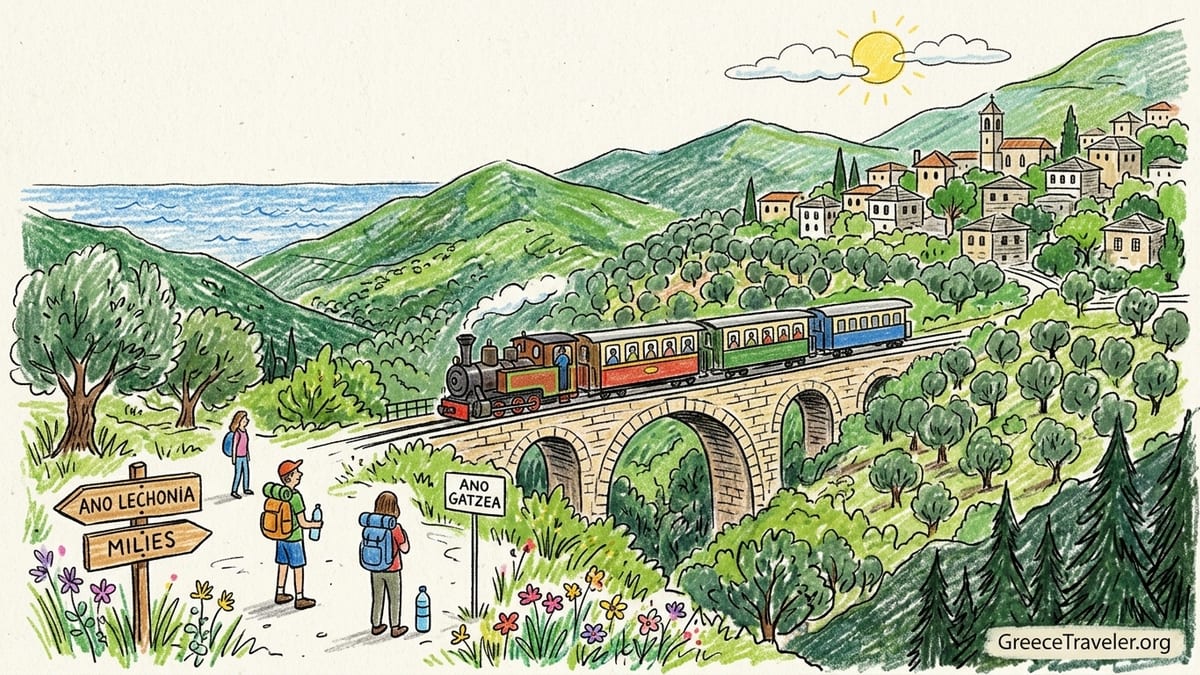
Before You Go: The Schedule, Journey Time, And What’s Officially Running Now
If you plan around just one fact, make it this: the Pelion train’s main tourist service operates as a day trip with a morning departure and an afternoon return. As of September 2026, Hellenic Train lists the Ano Lechonia to Milies departure at 10:00 (train 3800) and the return from Milies at 15:00 (train 3801). The published running time is about 90 minutes each way over roughly 15 kilometers, with a scheduled stop at Ano Gatzea that’s long enough to step off for air and photos.
On paper, it’s simple: board at Ano Lechonia, watch Pelion unfold at low speed, reach Milies just before midday, then you have several hours in the village before the 15:00 return. In reality, the “simple” part becomes much easier when you treat it like a timed excursion: arrive early, assume a crowd on weekends, and pack what you want for the layover because Milies is charming but not built around rushed train crowds.
Hellenic Train also announces selected extra Friday services in September 2026, specifically on September 4, September 18, and September 25. That matters if you’re traveling midweek and hoping to squeeze the train ride into a road trip, or if you want a slightly less compressed feel than a peak Saturday.
One important expectation-setting note: this is not a commuter train. It is a historic, scenic experience on a heritage narrow-gauge line. The “purpose” is the ride itself, so the practical question isn’t “Is it fast?” but “Does slow feel relaxing or frustrating for you?” I’ll answer that honestly later.
Getting To Ano Lechonia: How I Arrived, Where I Parked, And What The Station Area Feels Like
I based myself in Volos, treated the day as a dedicated excursion, and aimed to arrive at Ano Lechonia with time to spare. Ano Lechonia is close enough to Volos that you do not need an overnight stay in Milies to make the train work, but you do need a plan for the final stretch to the station.
On this trip, I drove and parked near the station, choosing the least stressful option: arrive early enough that I could circle once, park calmly, and walk to the platform without feeling late. In practice, that meant targeting a station arrival roughly 30 to 45 minutes before the 10:00 departure. The earlier you show up, the more “excursion” the day feels and the less it feels like you’re sprinting toward a one-shot departure.
If you don’t have a car, a taxi from Volos is the cleanest solution. In the Pelion area, taxi logistics are usually straightforward for an outbound ride, but what catches travelers is the return: you are getting back to Ano Lechonia in the late afternoon, and that’s when you want to already know whether you’re calling a taxi, meeting a driver, or walking to a nearby pickup point. My practical tip is to decide that plan before you board in the morning, not after you arrive back tired and sun-warmed at 16:30.
The station environment felt like a small event. Families, couples, and groups arrived steadily, and you could tell who had done this before: they were the ones holding water bottles, wearing comfortable shoes, and lining up with the calm confidence of people who know the train will be full but the day will be fine.
Ticket Logistics: Booking Procedure, What To Have Ready, And What I Did In Real Life
For ticket logistics, I followed the same rule I use for any tourist train with limited capacity: treat it like a reservation-required experience even if someone tells you “You can always buy on the day.” Hellenic Train’s own guidance emphasizes planning ahead and buying early for high-demand services, and the Pelion train is exactly the kind of ride where demand concentrates on weekends and holidays.
At the time of my trip, the most dependable approach was to use Hellenic Train’s official booking flow (the company directs passengers to book tickets via its online ticketing and app channels) and keep proof of purchase accessible on my phone. I took screenshots as well, because rural reception can be inconsistent and I didn’t want my boarding moment to depend on a loading screen.
In addition to online channels, Hellenic Train also notes that ticket issuance can be done at station ticket offices and, where applicable, onboard. The key phrase is “where applicable.” For a heritage run with a crowd, you don’t want to gamble your morning on onboard issuance or last-minute availability. I planned as if the train could sell out and as if the line at the station could be slow.
Because fares can change and because discounts and exclusions vary by service type, I am deliberately not printing a specific euro amount here unless it is directly confirmed on Hellenic Train’s Pelion train materials at the time you publish. The most reliable pre-trip routine is: open Hellenic Train’s Pelion train page for the timetable, then proceed to the official booking path for the exact fare on your date, for your passenger types, and for any return selection. That two-step check avoids the common mistake of relying on third-party tourism sites that can lag behind real pricing.
Boarding And The Carriages: What The Train Felt Like Inside
The “Moutzouris” nickname is famous, and the train leans into that heritage identity. What surprised me is how quickly the vibe shifts from “tourist attraction” to “shared ritual.” People greet each other, parents negotiate window seats, and everyone collectively agrees that we are now on Pelion time.
The consist I rode had classic-looking passenger coaches that felt purpose-built for slow sightseeing: windows that matter, seats arranged for pairs and small groups, and enough movement in the car that you are constantly reminded you are on an old, narrow-gauge line climbing a living landscape. This is not a silent, smooth, modern ride. It has character, creaks, and the gentle side-to-side motion that makes you look up from your phone and out at the greenery.
Crowd level on my day was high but manageable. The practical consequence was simple: if you care about your seat choice, board early and pick your spot without drama. I watched later arrivals take whatever was left, and they still looked happy, but the best windows were clearly claimed first. For couples, I’d aim for two seats together on the outward leg. For groups, expect to split across adjacent bays unless you show up early enough to coordinate.
The atmosphere was friendly and lightly festive. You could hear several languages, plenty of Greek families, and more than a few travelers who clearly timed their Pelion weekend around this ride. Nobody seemed dressed up; everyone seemed dressed correctly.
Departure, Speed, And Scenery: Why 90 Minutes Can Feel Like Either A Dream Or A Test
We rolled out of Ano Lechonia at the published morning departure time, and within minutes the day changed pace. The train’s slow speed is not a bug; it’s the feature. Hellenic Train’s own descriptions highlight that the ride is intentionally slow and that it takes about 90 minutes to cover a short distance. That’s not because the route is inefficient, but because the line is narrow, historic, and engineered to hug the terrain.
Did the 90 minutes feel relaxing or slow? For me, it was relaxing in a way that modern travel rarely is. I wasn’t thinking about arrival time; I was thinking about textures: stone retaining walls, dense greens, sudden openings where you glimpse the gulf, and the rhythmic pause before each small curve. If you are the kind of traveler who gets restless when you can’t “make progress,” it may feel slow. But if you’ve come to Pelion to exhale, the train is basically a moving meditation with better views.
The ride is scenic almost immediately, but it becomes especially memorable when you begin to notice the craftsmanship: old masonry, careful grading, and the way the line threads through vegetation. Hellenic Train highlights stone structures, arched bridges, and other engineering details built into the terrain, and that’s exactly what you feel from the window: the route doesn’t conquer the mountain; it negotiates with it.
I brought simple provisions: a full bottle of water, a second smaller bottle as backup, and a snack I wouldn’t regret if it got warm in my bag. I also packed something I always recommend for slow scenic transport: a light layer. Even on warm days, the combination of shade, motion, and sitting still can make you surprisingly cool, especially if you grab a seat near a window that catches the breeze.
The Ano Gatzea Stop, Bridges, And The “This Is Why We Came” Moments
The scheduled stop at Ano Gatzea is one of the day’s anchors. It breaks up the ride, it gives kids and restless adults a reset, and it provides a natural photo moment that doesn’t feel like you’re constantly hopping up and down in the aisle. On my trip, most passengers stepped off, stretched, and immediately pointed their phones at the train itself.
From a traveler’s perspective, the stop also changes how the rest of the ride feels. Before Ano Gatzea, you’re settling into the rhythm and still learning what kind of slow this is. After Ano Gatzea, you’re invested. You’ve already watched the landscape evolve, and now you’re waiting for the signature structures: the bridges and the more dramatic approach toward Milies.
Hellenic Train calls out specific highlights along the way, including the stone bridge of Kalorema and the metal Taxiarchis bridge near Milies, also known as the De Chirico bridge. Even if you don’t know the names while you’re rolling over them, you feel the change when the train enters those moments: passengers lean toward the windows at once, and the carriage becomes quiet for a beat, the way a room does when everyone is looking at the same painting.
This part of the journey also clarified why driving to Milies doesn’t replace the train. Yes, you can reach Milies by road, and you should, at least once, because Pelion villages are made for slow drives and stops. But the train gives you a stitched-together view of terrain and engineering that you simply don’t get behind a steering wheel.
Arriving In Milies: How I Spent The Layover, What I Ate, And Whether This Works As A Day Trip
We arrived in Milies close to the late-morning arrival time listed by Hellenic Train, and the platform energy flipped from “ride” to “village day.” Milies feels like it’s waiting for you, but not performing for you. It’s a real place with its own pace, and you immediately sense you have enough time to do more than snap a photo and run back to the station.
I treated the layover like a slow block of hours rather than a checklist. I walked from the station into the village along the traditional paths, then settled in for a proper sit-down break. The best use of those hours, in my experience, is to do three things: wander without rushing, commit to a long lunch, and leave yourself buffer time to drift back toward the station without stress. The return departure is fixed, and you do not want to be the person sprinting uphill because you lost track of time in a beautiful place.
Food and water strategy matters here. I carried water and snacks on the train so I wouldn’t be dependent on timing, but I still planned to eat in Milies. If you’re traveling with kids, picky eaters, or anyone who gets hangry, the smartest move is to bring a snack that functions as an emergency lunch. That way you can choose a cafe because it looks good, not because it’s the only thing that can feed you fast enough.
Does the day work better as a train excursion or part of a Pelion stay? If you’re short on time, it works beautifully as a stand-alone excursion from Volos: drive or taxi to Ano Lechonia, ride up, spend the midday in Milies, ride back, and still have your evening free in the city for dinner along the waterfront. But it works even better as part of a Pelion stay if you can give it breathing room: spend a night in a nearby village, wake up without an alarm, and treat the train as the centerpiece of a slow weekend rather than one more “must-do” between beaches and viewpoints.
The Takeaway
The Pelion “Moutzouris” is not a ride you do for efficiency. You do it for a very specific kind of pleasure: old engineering, green slopes, stonework and bridges, and the rare travel feeling that you are moving slowly enough to actually see. The 90 minutes can feel dreamy if you’re ready to lean into the pace, and it can feel long if you arrive expecting a quick hop to Milies.
Logistically, the day is easiest when you treat it like a timed event. Get to Ano Lechonia early, have your ticket plan settled in advance through Hellenic Train’s official channels, and pack water and a snack so the morning feels relaxed even if the train is full. Once you arrive in Milies, do less than you think you should. The best souvenir is not a photo of the carriage; it’s the feeling of having spent an unhurried afternoon in a Pelion village because a little train forced you to slow down.
If you’re trying to decide whether it belongs in your itinerary, my honest answer is this: it’s at its best when you let it be the day’s main event. Pair it with a Pelion stay if you can, but don’t hesitate to do it as a Volos-based excursion if that’s what your schedule allows. Either way, you’ll understand why this short, slow line has become one of Greece’s most enduring rail experiences.
FAQ
Q1. What time does the Pelion train depart from Ano Lechonia and return from Milies?
As of September 2026, Hellenic Train lists departure from Ano Lechonia at 10:00 and the return departure from Milies at 15:00 on regular weekend operation.
Q2. How long is the Pelion “Moutzouris” journey?
Hellenic Train describes the route as roughly 15 kilometers and about 90 minutes each way, with a scheduled stop at Ano Gatzea.
Q3. Does the train run only on weekends?
Regular operation is listed for Saturday and Sunday, and Hellenic Train also announces selected extra Friday services in September 2026 on specific dates.
Q4. Are there extra Friday services in September 2026?
Yes. Hellenic Train announced additional Friday itineraries for September 2026 on September 4, September 18, and September 25.
Q5. Where do I buy Pelion train tickets?
Hellenic Train directs passengers to book via its official booking channels, and it also notes tickets may be issued at station ticket offices and, where applicable, onboard. For busy dates, booking ahead through official channels is the safest approach.
Q6. Do I need to print my ticket?
In practice, most travelers use a mobile ticket on their phone. It’s still smart to keep a screenshot available in case reception is weak near the station or en route.
Q7. Is the ride comfortable for children?
It is generally family-friendly, but it is slow and can feel long for very young kids. The Ano Gatzea stop helps, and bringing water and snacks makes the outward leg easier.
Q8. Does the train feel relaxing or too slow?
If you enjoy scenic travel and slow pacing, it feels relaxing and immersive. If you prefer fast transport and constant activity, it can feel long. Treating it as the main event of the day helps it feel rewarding.
Q9. What should I bring on the train?
Bring water, a snack, sun protection for time outside at stops, and a light layer. Even on warm days, sitting still by an open window can feel cool.
Q10. Should I do the Pelion train as a day trip from Volos or as part of a Pelion stay?
It works well as a day trip from Volos because the timetable is built around a midday layover in Milies. It can feel even better as part of a Pelion stay, where you can avoid rushing and build a slower weekend around the ride.