


Thessaly looks compact on a map. In practice, it is a region of time traps: hairpin climbs, villages that are “nearby” only as the crow flies, and day trips that quietly turn into two-hour round trips each way. After several overnight stays stitched together across the plain, the biggest lesson was this: base selection is the trip. Hotels matter, but the town or village you sleep in determines parking stress, whether you can eat after dark without driving, how early-tour pickups work, and how many times you will repeat the same winding road just to get back to your room.
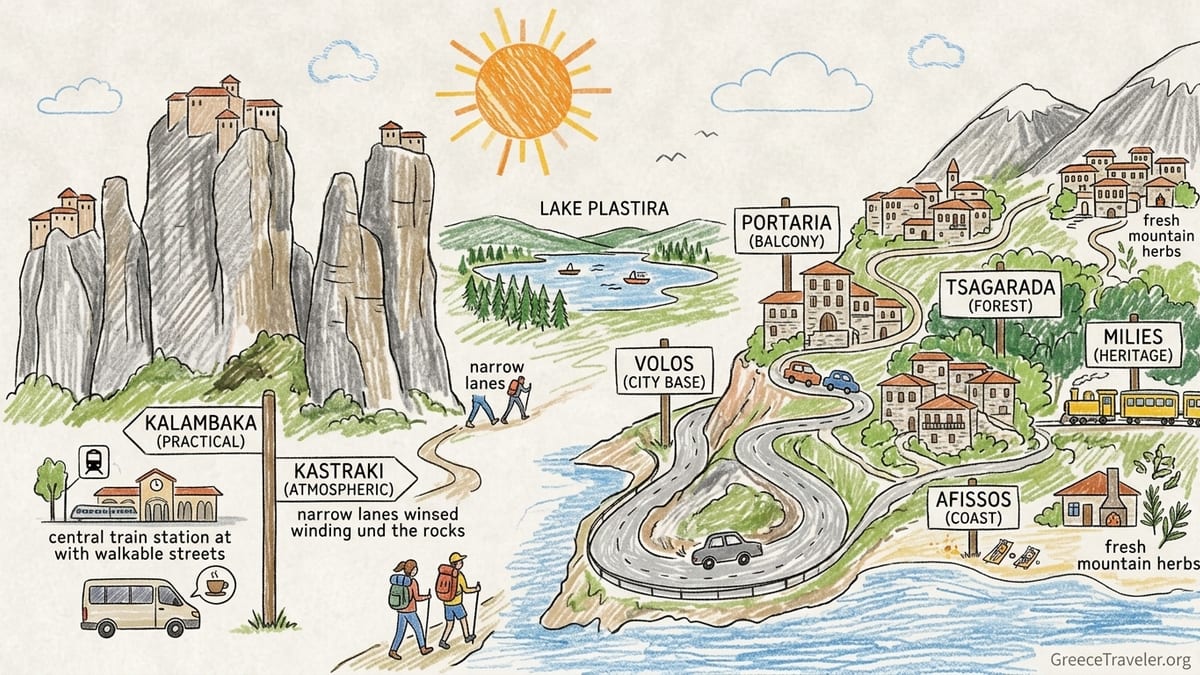
Start With The Only Question That Matters: What Do You Want To Minimize?
When travelers ask “Where should I stay in Thessaly?” they usually mean “Which hotel is best?” The more useful question is: what do you want to minimize, every single day? In Thessaly, you are always paying in one of four currencies: drive time, parking friction, food logistics after dark, or atmosphere. The right base is the one that keeps your chosen currency from being drained.
If you are self-driving, parking and road geometry become real constraints. A beautiful stone guesthouse can be perfect until you arrive at 10:30 p.m. and discover your “nearby parking” is a steep lane, an unlit shoulder, or a public square already packed. If you are using tours, pickup points matter: some Meteora tours start very early and commonly collect guests from central points such as the Kalambaka rail station area, while also offering hotel pickups by request. That is convenient in theory, but it plays differently depending on whether your accommodation is on a drivable street or up a stair-stepped old quarter.
If you are traveling without a car, transport realities force your hand. Public transport in Thessaly is usable, but it is not designed as a tourist loop. Buses and replacement rail segments change, and links between “headline” places often require a change in a hub city. That means a base with a real intercity terminal, supermarkets, and evening dining within walking distance can be more valuable than the prettiest view.
My biggest regrets came from choosing convenience over atmosphere on nights that were supposed to be slow and romantic, and choosing atmosphere over convenience on nights when I needed a clean, fast morning exit. Thessaly rewards honesty: pick the base that matches how you actually travel, not how you imagine you will travel.
Meteora: Kalambaka Versus Kastraki (And Why The Wrong Choice Feels Like A Daily Penalty)
Meteora is the one Thessaly stop where the “right” base is narrow and forgiving at the same time. Narrow, because you want to be close enough for sunrise and early monastery visits; forgiving, because both Kalambaka and Kastraki can work. The deciding factor is what you plan to do after the monasteries close and the tour buses leave: do you want a proper town with services, or do you want to fall asleep under the rocks?
Kalambaka is the practical choice if you value walkability, bigger grocery options, and the simplest “I’m arriving late” logistics. It is also the easier option if you are connecting by rail or intercity bus and want to avoid the last-mile friction. Several operators run early morning Meteora tours that begin around 8:20 a.m., using pickup points such as the Kalambaka train station and, by request, hotel-area pickups in Kalambaka. That kind of timing is painless when your room is on a normal street and you can be outside in two minutes with a coffee.
Kastraki is the atmospheric choice, and the one I most enjoyed on a “Meteora is the main event” itinerary. You trade some convenience for proximity to the rockscape and a village feel. The penalty shows up at night and in errands: if you need a proper supermarket run, a pharmacy, or a broader selection of late-evening food, you are more likely to drift back toward Kalambaka. The good news is the distance is small enough that this does not become a daily hour-long backtrack, it is more like an extra step that you notice when you are tired.
Parking is the wildcard in both places, and it becomes a real issue at peak arrival times. Meteora day-trip operators themselves warn that the midday window is when crowds swell and parking becomes a problem. That tracks with what I experienced: the monasteries have signed parking areas, but they are not limitless, and when coaches are stacked you may end up parking down the road and walking uphill. Staying in Kastraki can reduce the feeling of “we drove all this way just to circle for a space,” but it does not eliminate the reality that monastery parking can still be tight.
How Your Meteora Base Changes The “Early Start” Math
Meteora punishes late starts. The monasteries have rotating closure days, and whichever ones are open will collect the crowds. The best antidote is not a magic ticket or a secret viewpoint. It is being on the road early, with minimal morning friction.
In Kalambaka, the early start is easier to execute without thinking. If you are driving, you can be out with a takeaway coffee and a full tank, and you can swing by a bakery or mini market without detouring. If you are joining a morning minibus tour, the logistics are straightforward because many pickups cluster around the town center or the rail station area, and operators also accommodate “near your hotel” collection when requested. The difference between being two minutes from the pickup point and fifteen minutes away can mean breakfast or no breakfast.
In Kastraki, the early start is emotionally better. You wake up already “in” Meteora. It is the difference between seeing the rocks as a destination and living beside them. The downside is that some accommodations sit on narrow lanes where a minibus pickup is possible but slightly fussy, and if you are self-driving you may spend an extra few minutes negotiating tight turns or finding your parked car if you arrived late the night before.
My personal regret here was choosing a very convenient Kalambaka stay on a night when I wanted to linger in the rockscape after sunset. I gained supermarket access and easy parking, but I lost that last, quiet look up at the pillars when the village lights come on. If Meteora is your headline, Kastraki’s atmosphere is real value. If Meteora is a single stop in a multi-base road trip, Kalambaka’s practicality keeps everything smoother.
Pelion Is Location-Sensitive: Volos Versus Portaria, Tsagarada, Afissos, Kala Nera, And Milies
Pelion is where Thessaly’s base decision becomes brutally important. 2026 transport and route research makes the key point clear: Pelion villages that look close can be separated by slow, winding roads. The peninsula is not a “pick any village and day-trip the rest” destination unless you love driving at 30 to 50 km/h on hairpins and returning after dark on narrow, unlit bends.
Volos is the functional base. It has the intercity bus terminal, a long waterfront full of evening dining, and the kind of supermarket access that makes multi-day travel easy. It is also the right base if you are mixing Pelion with other Thessaly moves, because you can connect outward without having to descend from the mountain every time. The tradeoff is obvious: you are not sleeping in Pelion. Every day begins with a climb or a coastal drive, and you will repeat it. If your plan is “a different beach every day on the east coast,” Volos can create a lot of backtracking.
Portaria is the classic compromise base, and the one that felt the most “effortless” for mixed Pelion itineraries. It is close to Volos, with a short bus ride that is explicitly published in current schedules: about 30 minutes, roughly 13 km, and a low fare. That matters if you have one driver and want the option of leaving the car parked some days, or if you are traveling without a car but still want a Pelion village atmosphere. The big upside is that Portaria sits on the western “balcony” above Volos, so you can do quick sunrise looks, easy evening returns, and still drop into the city if you want a long late dinner.
Tsagarada is a different trip entirely. It is on the east side, closer to beaches and the feel of “real Pelion nature,” but it is not quick to reach. One published driving description puts Volos to Tsagarada at around 47 km and roughly an hour on the coastal approach, and also notes seasonal complications such as a winter closure possibility on a mountain route near the ski area that can force a longer detour. Staying in Tsagarada is how you avoid long daily drives to east-coast beaches and trailheads. The penalty is evening logistics: dining choices can be more limited, and a late supermarket run is not something you casually do without planning.
Afissos and Kala Nera change the rhythm again. They sit in the “southern and middle” Pelion coastal zone where you can mix beach time with mountain villages without committing to the far east. My atmosphere-versus-convenience regret happened here: I chose a super-convenient coast base for a few nights, and it was perfect for morning swims. But when I wanted the stone-village evenings and the quiet squares of the mountain interior, I realized I had engineered a nightly climb and descent that I did not actually enjoy. In Pelion, you should pick the coast only if you want the coast every day.
Milies is the heritage-and-hills base. It is famous as the terminus area for the historic Pelion Railway, and it sits in that central-southern mountain zone where you can reach viewpoints and traditional villages without always being committed to the far east. It is also the kind of base where you need to think about parking: many stone villages have tight cores, and your “five-minute walk” can include stairs and cobbles. The reward is atmosphere that does not feel imported.
Lake Plastira: Neochori Versus Kalivia Pezoulas (And What “Easy Nights” Actually Mean)
Lake Plastira is the Thessaly detour that often becomes the quiet highlight. The base decision here is less about sightseeing density and more about how you want your evenings to work: do you want a village with enough going on after dark, and do you want to avoid long drives on lakeside roads at night?
Neochori is one of the strongest all-around bases because it concentrates what you need within a short radius: tavernas, cafes, and small shops. The local municipality’s own listings show Neochori has multiple dining options and even grocery and gift shop type services, which matches the “you can arrive and still find something open” feeling. I liked Neochori most for two practical reasons: after-dark food did not require a long drive, and there were enough choices that a single closed taverna did not sink the evening.
Kalivia Pezoulas can be even more convenient for lakeside access, depending on where your activities are, and it is clearly set up for visitors with multiple listed restaurants and cafes. It also felt slightly more “spread out,” which can be a plus if you have a car and want easy pull-up parking, and a minus if you are hoping to walk between everything in a tight village core. If your trip involves water-side activities or you want to keep mornings very simple, Kalivia Pezoulas is a logical base.
Road conditions matter here more than travelers expect. Lake Plastira is not a flat lakeside loop: the area is high enough that winter conditions like snow and freezing weather are a real consideration, and even in shoulder seasons you should treat it as mountain driving. The “simple” decision becomes: do you want to do your driving in daylight, and do you want dinner within a short, familiar route? My own regret was staying in a more scenic, slightly isolated spot one night and realizing that “just pop out for dinner” turned into a careful, slower night drive on unfamiliar bends.
Transfer time is also a real planning variable. By car, Trikala to the Lake Plastira area is often around three quarters of an hour in typical routing. By bus, it can become a chain via Karditsa and onward, with transfer time swelling the journey to around two hours in common planning tools. That difference changes what a “day trip” feels like. If Lake Plastira is more than a photo stop for you, base there rather than commuting.
Trikala Or Larissa: When A City Base Makes Genuine Logistical Sense
Sometimes the best Thessaly base is not a mountain village at all. It is a city that saves you from repeating the same intercity move, especially if you are stitching together Meteora, Pelion, and Lake Plastira in one trip.
Trikala is the most useful “connector” base when Meteora and Lake Plastira are both on your list. It is close enough to Meteora for a day run, and it sits on practical routes toward Karditsa and the lake. There are current published schedules that show direct bus departures from Trikala to Meteora, including routes that continue through Kalambaka and Kastraki and up to the monasteries, which is the kind of detail that turns a theoretical plan into an actionable one. If you like returning to a city with more evening life and shopping, then heading out again, Trikala can be a strong choice.
Larissa makes sense when you care about regional rail and bus connections and want a larger hub to anchor multiple directions, including the coast and Pelion access through Volos. It is not a romantic base, but it is a friction-reducer. It is also a realistic base if your trip is partially constrained by transport disruptions: Thessaly has seen rail suspensions and replacement services in recent years, and travelers who rely on public transport often find that being in a hub city makes changes easier to absorb.
The honest drawback to both cities is that they can dilute the “this is why I came to Thessaly” feeling. If you pick Trikala or Larissa for the wrong nights, you will regret it. I did, once: I chose a city base on a night when I wanted silence, a view, and a slow dinner by a fireplace. Instead I got convenience and a perfectly fine evening, but it felt like I had postponed the actual experience to the next day.
The right way to use Trikala or Larissa is as a deliberate buffer night: the night before an early departure, the night you need laundry and shopping, or the night you want to break up longer transfers. They are not substitutes for Meteora’s rocks, Pelion’s stone villages, or Lake Plastira’s calm shorelines. They are the grease that makes the rest of Thessaly run smoothly.
The Takeaway
Thessaly rewards travelers who choose bases like a logistics planner, not like a romantic novelist. For Meteora, you can choose Kalambaka for services and easy early starts, or Kastraki for maximum atmosphere under the rocks, knowing that monastery-area parking can still be tight and midday crowds amplify it. For Pelion, the base decision is the entire trip: Portaria behaves like an easy compromise with simple access to Volos, Tsagarada is an east-coast commitment that cuts beach and trail commute time, Afissos and Kala Nera shift you into a coastal rhythm, and Milies tilts toward heritage and mountain evenings. For Lake Plastira, Neochori and Kalivia Pezoulas both work, but your happiness will come down to after-dark food, how much you want to walk versus drive, and whether you are comfortable with mountain-lake roads at night and in colder seasons.
If you take one rule into Thessaly, make it this: spend your “effort budget” where it creates memories, not where it just gets you back to your room. Sleep close to your highest-priority landscape, and use city bases only when they clearly reduce transfer stress. In a region where a short-looking hop can become a slow, winding drive, choosing the right base is the difference between exploring Thessaly and simply commuting through it.
FAQ
Q1. Is Kalambaka or Kastraki better for staying near Meteora?
Kalambaka is better for services, supermarkets, and easy logistics. Kastraki is better for atmosphere and feeling closer to the rocks, with slightly more limited errands after dark.
Q2. Do Meteora tours pick up from hotels, or only from the train station?
Many morning tours use central pickup points such as the Kalambaka train station area, and some operators also offer pickup near your hotel by request, depending on access.
Q3. How hard is parking at the Meteora monasteries?
Each monastery has a signed parking area, but it can fill quickly in peak hours. At busy times you may need to park farther away and walk uphill.
Q4. Can I base in Volos and day-trip Pelion easily?
Yes, Volos is practical and has the main bus terminal and easy shopping. The downside is daily backtracking and slower drives on Pelion’s winding roads, especially if you want the east coast.
Q5. Why do drives between Pelion villages take longer than they look on the map?
The roads are narrow and winding with hairpins, steep sections, and slower average speeds. Even short distances can take a surprisingly long time, especially after dark.
Q6. Is Portaria a good Pelion base without a car?
Portaria can work well because it has a short, frequent bus connection to Volos, letting you combine village atmosphere with access to a major transport hub.
Q7. Should I stay in Tsagarada if I want east-coast beaches?
Tsagarada is a strong choice if east-coast beaches and trails are your priority, because it reduces daily commuting from Volos or the west side of Pelion.
Q8. What is the best base at Lake Plastira for evenings and food?
Neochori is often the easiest for evenings because it clusters multiple tavernas, cafes, and small-shop options, reducing the need for night driving.
Q9. Does Lake Plastira make sense as a day trip from Trikala?
By car it can, since the drive is often under an hour. By bus, connections via Karditsa can stretch the trip and make timing tighter, so an overnight by the lake is often more relaxing.
Q10. When does it make sense to stay in Trikala or Larissa instead of a village base?
It makes sense for buffer nights that reduce transfers, enable early departures, or simplify shopping and logistics, especially when you are connecting Meteora, Pelion, and Lake Plastira in one itinerary.