

I used to treat Thessaly like a “pin it on the map and go” region: Meteora for the monasteries, Pelion for villages and beaches, Lake Plastira for a nature reset. Then I started returning in different seasons, and the place stopped behaving like a single destination. Thessaly is a whole weather system. The timing that makes Meteora feel effortless can make Pelion feel moody and slick. The month that delivers warm Aegean swims can turn the monastery steps into a furnace. And the season that empties out the roads can also shrink monastery visiting windows enough to force hard choices.
Thessaly Is Not One Climate: What Changes When You Move From Plain To Peaks
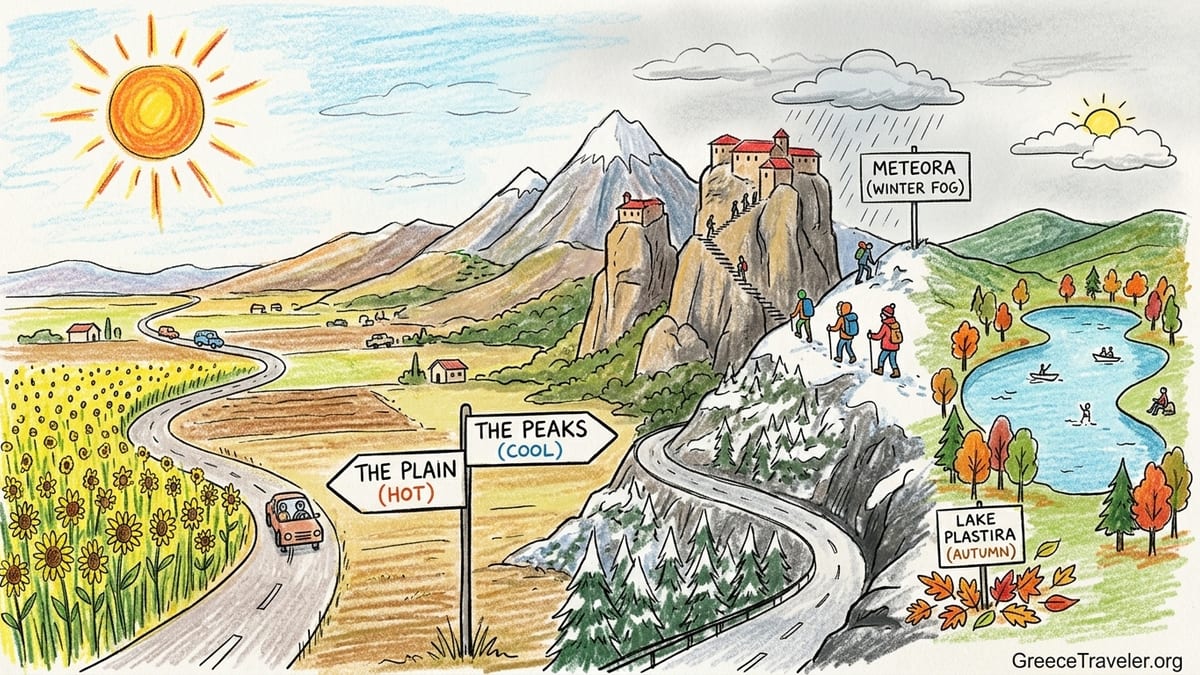
Thessaly’s biggest planning trap is assuming the whole region “does summer” the same way. The inland plain around Larissa runs hotter and drier in summer than many visitors expect, while the Pelion peninsula can flip from bright to foggy with very little warning, and Lake Plastira sits high enough that evenings can feel surprisingly crisp even when the coast still looks like beach weather. In other words, a Thessaly trip is often a mini road trip through different microclimates.
On my warm-season visit, the inland heat was the first thing I underestimated. In July and August, Larissa’s long-term normals put average highs in the low-to-mid 30s Celsius, and heat spikes are not unusual. That inland warmth matters because it is the connective tissue of many itineraries: you might be driving between Trikala and Meteora, or crossing through the plain toward Karditsa for Lake Plastira. Even if your end point is cooler, the transit day can be punishing if you plan it like a casual hop.
Winter and shoulder seasons reshape the region differently. Cold and damp do not land evenly. Meteora can be grey and atmospheric with low cloud clinging to the rock towers, while the Pelion road up toward villages like Tsagarada can add fog and wet switchbacks that slow you down far more than the map suggests. On the flip side, the same seasonal softness can create the Thessaly I fell for most: fewer tour buses at viewpoints, the sense that villages belong to locals again, and dinners that do not need a reservation days in advance.
Meteora In Summer Versus Winter: Timetables That Change Your Day, Not Just The Mood
Meteora is where seasonality becomes truly practical rather than cosmetic. The monasteries operate on different visitor timetables from April to October versus November to March, and the winter schedule does not simply “close a little earlier.” It can change which monasteries are realistically doable in one day.
In the April 1 to October 31 season, monasteries typically keep longer hours, with many opening around mid-morning and closing mid-afternoon to late afternoon depending on the house. From November 1 to March 31, visiting hours shorten and some monasteries add extra closed days. For example, Great Meteoron is open fewer days in winter than in summer, which can take it off the table if you only have a single day in Meteora and you land on the wrong weekday. That is the kind of seasonal detail that matters more than whether you prefer a sweater or a T-shirt.
Admission is straightforward but adds up quickly: it is commonly €5 per monastery, paid at the gate, and visitors should not count on card payment. The practical implication is that season can affect not only what you see, but also what you pay. In summer, longer hours tempt you into “one more monastery.” In winter, you may do fewer entries simply because the day gets compressed.
My biggest lesson: I would now plan Meteora around opening hours first, then build my road loop second. In summer, I would schedule my first monastery right at opening and keep the hardest climbs early. In winter, I would plan for fewer interiors and more viewpoints, and I would choose which monastery matters most to me before I arrive, because the shorter season can make “we’ll decide later” a losing strategy.
Heat On Monastery Steps, And What I Packed Wrong
I learned Thessaly’s summer truth on Meteora’s stone steps. In the heat, the climb is not just “a bit of exercise,” it is an exposure event. The staircases bake, shade comes and goes, and the combination of sun and reflective stone can make the last section feel far steeper than it looks in photos. I have felt that specific kind of slow, dry fatigue that arrives when you have underestimated both the temperature and the fact that you cannot really stop without blocking a narrow flow of other visitors.
I packed badly the first time: not enough water, and the wrong kind of shirt. If I were scheduling differently now, I would visit the monasteries that require more climbing earlier, then keep the easier-access sites for later. I would also bring a refillable bottle and plan to refill when I can rather than trusting myself to find a shop at the right moment. Cash also matters more than people assume, because you do not want to be the person at the gate trying to make a payment problem everyone else has to wait behind.
The dress code is another summer-versus-winter packing trap. In warm weather, you are tempted to dress for the heat, but monasteries require modest clothing. I now treat this as a packing system: lightweight trousers or a long skirt option that breathes, a shirt that covers shoulders, and something that can handle sweat without feeling like wet paper. The aim is to be compliant without turning the visit into an uncomfortable costume change.
What I would do differently: if I had only one midsummer day, I would begin earlier than I think I need to, build in a long shaded lunch break in Kalambaka or Kastraki, then return for late-day viewpoints rather than attempting a full “six monasteries sprint.” In peak warmth, the best Meteora moments are often the ones where you are not forcing the itinerary to prove a point.
Hiking In Meteora: Shoulder Season Light, Winter Atmosphere, And Summer Reality
Season changes not only the monastery interiors, but also what hiking feels like. On a clear shoulder-season day, the trails around the rock pillars can feel like a different destination: bright light, crisp air, and enough breathing room to hear your own footsteps instead of tour commentary. That is the Meteora I would recommend to hikers who want the landscape as much as the architecture.
Summer hiking is doable, but you need a different mindset. Exposure is higher, shade can be limited on some paths, and the experience becomes more about managing heat than enjoying terrain. In my case, it changed how I chose my timing: I would rather hike early morning or toward golden hour and accept that midday is for museums, a long lunch, or simply sitting still.
Winter adds a different set of constraints: shorter daylight, the possibility of wet rock and reduced visibility, and the need to assume your pace will be slower. Even if you are not in deep snow conditions, the combination of damp and cold can sap energy in a way visitors do not anticipate when they picture Greece. My planning layer now is simple: in winter, I keep hikes shorter, I do not stack multiple ambitious trail goals into one day, and I treat viewpoints as valid “wins” rather than a consolation prize.
If you are mixing monasteries and hiking, season dictates which one should lead. In summer, lead with the most exposed effort first thing. In winter, lead with the monastery schedule, because the timetable is the immovable object. Hiking can flex. Opening hours cannot.
Pelion’s Mountain Villages And Aegean Beaches: Foggy Roads, Festival Nights, And Swimming Timing
Pelion is where Thessaly’s seasonal mood swings feel most personal. The mountain villages are intimate, stone-and-chestnut places where a little rain turns cobbles glossy and a little fog makes you drive as if you are reading the road letter by letter. I have been on mountain roads here in low cloud where the scenery disappears, and the experience becomes less “Greek postcard” and more “slow, careful, don’t miss the turn.” That is not a complaint. It is a reminder that Pelion rewards time buffers.
In high summer, Pelion’s Aegean-facing beaches pull focus. The practical question becomes swimming comfort. Around the Sporades and nearby Aegean coast, sea temperatures typically rise into genuinely comfortable swimming in summer and often remain inviting into September, but a May or early June swim can still feel bracing depending on the week. I have learned to plan “beach days” with flexibility early in the season, and to treat late summer and early autumn as the more reliable window for long water time.
Season also shapes what is open. Many seaside services ramp up for peak season and then begin tapering as autumn progresses. If your Pelion plan depends on a specific beach bar, sunbed service, or boat excursion, the shoulder seasons can be hit or miss, and you should confirm what is running rather than assuming summer convenience.
One seasonal anchor I would happily plan around is the PelionFestival, which schedules concerts and events in villages like Zagora and Tsagarada in mid-to-late July. I attended a festival evening once as a counterweight to hot-day beach time, and it changed the texture of the trip. Instead of collapsing after swimming, I had a reason to be showered, fed, and sitting in a village courtyard at night with music in the air. Pelion in summer can be more than beaches if you choose dates that bring culture into the itinerary.
Lake Plastira By Season: Outdoor Activities That Actually Have Prices, And A Different Kind Of Summer
Lake Plastira is my favorite Thessaly reset button because it changes the definition of “summer.” Even when the region is warm, the lake’s setting in the hills makes the experience feel cooler and more spacious. Timing still matters, but here it is less about museum timetables and more about what you want to do outside.
Unlike many destinations where outdoor activities are vaguely described, Lake Plastira has providers that publish concrete offerings and pricing. At Tavropos Activities, for example, hydrobike rentals are listed at about €10 per person for 30 minutes and €15 per person for one hour. Having an actual number changes how you plan: you can build a lake day that includes a defined activity cost rather than treating it as a mystery add-on you decide on impulse.
I have also learned to respect the lake’s weather safety reality. Providers explicitly warn about mist and storms, and that is not theoretical. If fog builds, the lake can feel disorienting quickly because shorelines look similar and distances are hard to judge. When I return, I would schedule water activities earlier in the day when conditions are often more stable, then keep hiking, cycling, or a long lunch for later.
Seasonally, Lake Plastira works beyond peak summer. In warm months, it is a softer alternative to the coast when you want nature without sunburn. In autumn, it becomes about color and crisp air. In winter, the region leans quieter, and the lake’s appeal shifts toward calm walks, fireplaces in guesthouses, and short, bright-day outings rather than long aquatic sessions. The key is to match the activity to the season rather than forcing a July template onto January.
Winter Versus Summer Across Thessaly: Driving, Crowds, And What I Would Schedule Differently Next Time
Summer in Thessaly is a game of stamina and timing. Winter is a game of daylight and openings. The crowd story is real in both directions: in summer, the pressure points are predictable, and the most famous viewpoints and monasteries collect people fast. In winter, the crowds thin, but you can lose time to closed doors and shorter hours if you arrive with a summer mindset.
Driving is the season-specific factor I respect most now. In summer, the challenge is heat and the temptation to overpack days because roads feel easy and daylight is long. In winter and the wet edges of shoulder season, fog and rain can make Pelion’s mountain roads slow and tiring. I have arrived in villages more drained from concentration than from distance, and that changes what you realistically want to do once you get there.
If I were scheduling Thessaly again as a multi-stop trip, I would group the most timing-sensitive pieces first: Meteora on the days that align with the monastery timetable, then Pelion with a buffer day that can flex between village exploring and beach time depending on weather, then Lake Plastira as either a mid-trip decompression or a final nature coda. I would also plan for the cash reality at Meteora and for fewer “just in case” wardrobe mistakes by packing one dedicated monastery outfit that is breathable and respectful.
The biggest shift in my planning style is that I no longer ask “What is the best month?” I ask “What do I want Thessaly to feel like?” If I want long, easy monastery hours without the peak heat, I look to the April to October timetable but aim for the earlier and later parts of that window. If I want moody rock formations, empty viewpoints, and a quieter rhythm, I accept the November to March constraints and plan my monastery choices like appointments, not options.
The Takeaway
Thessaly does not reward a single “best time” answer because each marquee experience behaves differently as the seasons change. Meteora is the most schedule-sensitive, with a clear split between April to October and November to March hours that can make or break a day. Pelion is the most weather-sensitive, especially on mountain roads where fog and rain can turn a short distance into a slow journey, while the Aegean side shifts from bracing spring swims to late-summer comfort. Lake Plastira is the most activity-flexible, with outdoor providers offering concrete options and pricing that let you design a real day rather than a vague nature stop.
If you plan Thessaly like a sequence of weather-aware choices rather than a checklist, the region stops feeling like three separate destinations and starts feeling like a single story told in different seasons. My best trips here have been the ones where I scheduled around what the season makes easy and saved the “prove I can do it all” energy for somewhere less shaped by timetables, fog, and sun on stone steps.
FAQ
Q1. Is there a single best month to visit Thessaly?
No. Thessaly changes dramatically by place and season, so the best timing depends on whether you prioritize Meteora interiors, hiking, Pelion beaches, or Lake Plastira outdoors.
Q2. What is the practical difference between Meteora’s April–October and November–March seasons?
Monastery visiting hours are longer from April to October and shorter from November to March, and some monasteries add extra closed days in winter, which can change what you can see in one day.
Q3. How much should I budget for Meteora monastery entry fees?
Plan on about €5 per monastery, paid at the gate, and bring cash so you are not stuck at the entrance without a way to pay.
Q4. When should I visit Meteora to avoid the worst heat on the steps?
If you are visiting in summer, start at opening and do the most physically demanding monasteries first. Shoulder months within the April to October timetable can feel easier on the stairs.
Q5. Is Pelion a good beach destination in shoulder season?
It can be, but swimming comfort is more reliable in high summer and often into September. In May and early June the sea can still feel cool, and some seasonal services may not be fully running.
Q6. What weather issue most affects Pelion travel planning?
Fog and rain on mountain roads. Even short drives can take longer, so build buffers into village-to-beach and village-to-Volos routes.
Q7. What is a real example of an activity cost at Lake Plastira?
Hydrobike rentals at Tavropos Activities are listed at about €10 per person for 30 minutes and €15 per person for one hour, which helps you plan a realistic day budget.
Q8. Can Lake Plastira work as a winter destination?
Yes, but the focus shifts from water time to walks, viewpoints, and cozy stays. Treat winter as a quiet nature trip rather than a lake-sports trip.
Q9. What is one summer event worth timing a Pelion trip around?
The PelionFestival runs in mid-to-late July with concerts and events in villages like Zagora and Tsagarada, adding a cultural night option beyond beach plans.
Q10. What did you pack wrong for Thessaly, and what would you change?
I underestimated sun exposure at Meteora and packed poorly for monastery dress requirements. Next time I would bring a breathable, modest outfit, carry more water, and keep cash ready for entry fees.